Are Your Study Methods Truly Effective for the IB?
Many IB students inadvertently sabotage their learning by relying on passive study techniques like elaborate, aesthetic note-taking. While visually appealing, these methods create an illusion of mastery. True understanding and retention, crucial for IB success, stem from active recall and strategically timed reviews, forcing your brain to retrieve information rather than merely recognize it.
The Illusion of Productivity: Why Your Pretty Notes Aren't Working
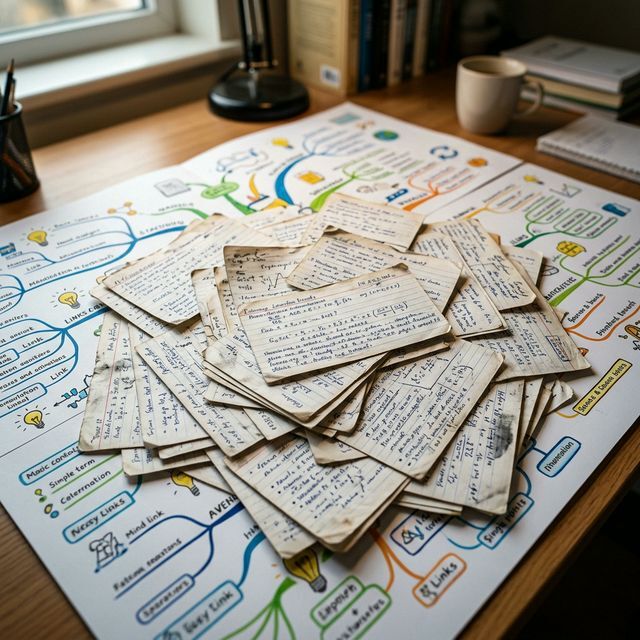
As an IB student, you're constantly bombarded with information. It's natural to want to organize it beautifully, to create those Instagram-worthy notes with perfect highlights and intricate mind maps. But here's a tough truth: while they might look impressive, these aesthetic notes are often a significant time sink that yields minimal returns for your actual learning and exam performance.
The Trap of Complexity Bias
Our brains have a curious tendency called "Complexity Bias." We're often drawn to elaborate, intricate systems, believing they must be more effective simply because they look more sophisticated. Think of it this way: are you spending hours sharpening your axe, or are you actually chopping wood? Many students spend disproportionate time "polishing the axe" – meticulously formatting notes, choosing the perfect color scheme, drawing elaborate diagrams – rather than engaging in the effortful "wood chopping" (actual learning and retrieval practice).
Tutor Tip: Don't mistake the physical act of creating notes for the cognitive act of learning. If it feels too easy, you're likely not pushing your brain hard enough.
The Fluency Illusion: Familiarity Isn't Mastery
When you re-read your beautifully crafted notes or textbook chapters, your brain processes the information. You see the words, the concepts, and they feel familiar. This feeling of familiarity is what psychologists call the "fluency illusion." You trick yourself into believing you've mastered the material simply because you recognize it. But recognition is a vastly different beast from recall. Under exam pressure, when you need to produce an answer without any prompts, that familiarity often evaporates, leaving you blank.
This is akin to recognizing a famous actor's face (familiarity) versus being able to recite their entire filmography (recall). For the IB, you need to be able to recite that filmography, not just nod knowingly when you see their face.
Passive vs. Active Engagement: A Fundamental Divide
The core issue is the difference between passive and active engagement:
- Passive Methods: Re-reading, highlighting, summarizing, watching lectures without active processing, creating aesthetic notes. These involve consuming information.
- Active Methods: Flashcards, blurting, practice questions, teaching someone else, self-testing. These involve retrieving or producing information.
Passive methods might feel productive because they involve time spent with the material, but they don't force your brain to build the strong neural connections needed for long-term retention and application. They keep the information in your short-term working memory, which is fragile and easily forgotten.
Unleashing True Memory: The Power of Active Recall
So, if passive methods are a trap, what's the antidote? Enter active recall – the single most powerful study technique you can employ. Active recall is precisely what it sounds like: actively retrieving information from your memory. Every time you try to remember something without looking at your notes, you're practicing active recall.
The Neuroscience Behind Retrieval Practice
Think of your memory like a vast library. When you read a book (passive learning), you're just putting it on a shelf. When you actively recall information, you're not just retrieving the book; you're also creating a clearer, wider path to that book's location. Each time you access it, that path becomes stronger and easier to navigate.
Neuroscience supports this: effortful retrieval practice strengthens the neural pathways associated with that memory. It's like a mental workout for your brain. The more effort it takes to pull out a piece of information, the stronger the connection becomes once you successfully retrieve it. This process solidifies knowledge far more effectively than simply re-exposing yourself to the information.
Why Flashcards are Your Secret Weapon
This is where flashcards shine. Forget the perfect handwriting and artistic designs. Your flashcards should be rapid, messy, and functional. They are a tool for immediate, brutal self-testing.
A good flashcard poses a question on one side and the answer on the other. This simple format forces you into active recall. You see the question, you must try to retrieve the answer from your memory before flipping the card. The immediate feedback (correct or incorrect) helps you identify exactly what you know and, more importantly, what you don't know.
This isn't about rote memorization alone; it's about building a robust network of understanding. If you can explain a concept from a single prompt on a flashcard, you're on your way to mastery.
Mastering the Forgetting Curve: Spaced Repetition Explained
Active recall is powerful, but it becomes unstoppable when combined with its best friend: spaced repetition. This strategy leverages a fundamental truth about human memory to optimize your review schedule.
The Ebbinghaus Forgetting Curve: A Mathematical Reality
In the late 19th century, psychologist Hermann Ebbinghaus conducted groundbreaking research on memory. He discovered that without review, information is forgotten at an exponential rate. This is graphically represented by the "forgetting curve." Immediately after learning something, you remember 100%, but within hours or days, that retention plummets dramatically.
Imagine you learn a new IB Physics formula. If you don't review it, your memory of it might drop to 50% within a day, and even lower a week later. The curve shows that the steepest drops occur shortly after initial learning.
The mathematical representation of this decay can be approximated by a function like R(t) = R_0 * e^(-t/k), where R(t) is retention at time t, R_0 is initial retention, e is Euler's number, and k is a constant related to the strength of the memory trace. The key takeaway is that time works against your memory, and reviews are essential to counteract this.
The Algorithm of Optimal Review Intervals
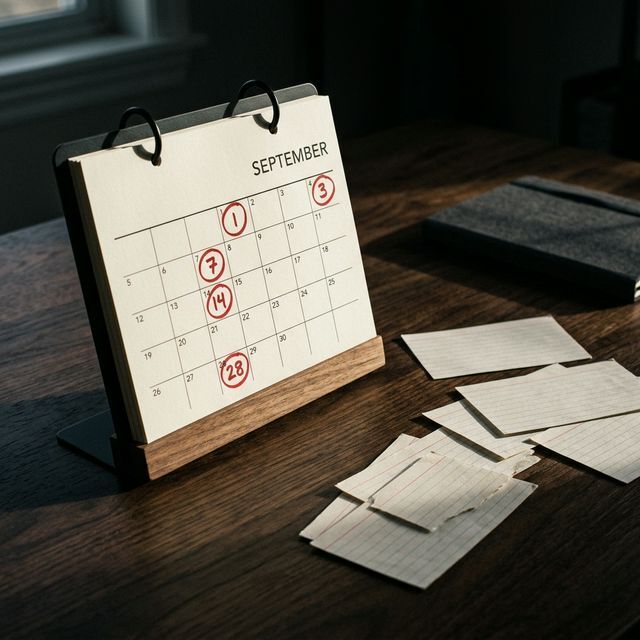
Spaced repetition directly combats the forgetting curve by scheduling reviews at strategically increasing intervals. Instead of reviewing everything every day, you review items just as you're about to forget them. This "effortful retrieval" moment is precisely when your brain strengthens the memory most effectively.
A typical spaced repetition schedule might look something like this:
- First Review: 1 day after initial learning.
- Second Review: 3 days after the first review.
- Third Review: 7 days (1 week) after the second review.
- Fourth Review: 30 days (1 month) after the third review.
- Subsequent Reviews: Intervals continue to expand (e.g., 3 months, 6 months, etc.).
Each successful recall "resets" the forgetting curve, but at a higher baseline, meaning the next review interval can be longer. This optimizes your study time, ensuring you're not over-reviewing what you already know well, and focusing your precious mental energy on what needs the most reinforcement.
Tools for Automated Spacing (e.g., Anki)
While you can certainly manage spaced repetition with physical flashcards and a calendar, digital tools like Anki have sophisticated algorithms built-in. They track your performance on each flashcard and automatically adjust the next review date, taking the guesswork out of scheduling. This allows you to focus purely on the act of recall, knowing the system is optimizing your learning behind the scenes.
Common Pitfalls That Derail IB Students (and How to Dodge Them)
Even with the best intentions, students often fall into traps that undermine their study efforts. Recognizing these pitfalls is the first step to avoiding them.
The "Pretty Notes" Obsession
As discussed, spending hours on aesthetic perfection is a common mistake. It feels productive, but it's a form of procrastination in disguise. The goal of studying is to learn, not to create a work of art.
Tutor Tip: Allocate a strict, minimal time limit for note-taking. Focus on capturing information efficiently in a way that facilitates flashcard creation, not on making it look good.
Avoiding Mental Friction: The Path of Least Resistance
Our brains are wired to conserve energy. Active recall is mentally demanding; it creates "mental friction." Re-reading is easy. Because active recall requires more effort, many students unconsciously avoid it, defaulting to passive methods. This avoidance, however, prevents the deep processing necessary for true understanding and long-term retention.
Embrace the struggle! If recalling a fact feels difficult, that's a sign your brain is working hard, and that's precisely when the most robust learning occurs. The discomfort means growth.
The Cramming Cycle and Cognitive Overload
Without a structured, systematic review process like spaced repetition, students inevitably try to absorb vast amounts of complex information under severe time constraints before exams. This leads to:
- Cognitive Overload: Your working memory gets flooded, making it impossible to process new information effectively.
- Poor Retention: Information learned under stress and time pressure is quickly forgotten after the exam.
- Increased Stress and Burnout: The cycle of cramming is exhausting and unsustainable.
Spaced repetition, by contrast, distributes learning over time, making each study session more manageable and effective, preventing the need for last-minute panic.
Your Elite IB Study Framework: Actionable Steps to Dominance
Ready to transform your IB study habits? Here's a powerful, actionable framework to implement active recall and spaced repetition effectively.
Step 1: Rapid Flashcard Creation – Quality Over Quantity (of aesthetics)
- Break Down the Syllabus: Go through your subject syllabus or textbook chapter by chapter. Identify key facts, definitions, formulas, concepts, and relationships.
- Convert to Questions: For every piece of information, create a flashcard. The front should be a question, the back the answer.
- Example (History): Front: "What were the main causes of WWI?" Back: "Militarism, Alliances, Imperialism, Nationalism (MAIN)."
- Example (Math): Front: "State the derivative of sin(x)." Back: "cos(x)."
- Example (Biology): Front: "What is the function of mitochondria?" Back: "Cellular respiration, ATP production."
- Keep it Atomic: Each flashcard should ideally test one single piece of information or concept. Don't try to cram an entire paragraph onto one card.
- Prioritize Speed: Don't get bogged down in making them pretty. Focus on clarity and functionality.
Tutor Tip: Aim to create flashcards as you learn new material, not as a separate, time-consuming activity later. This integrates active processing from the start.
Step 2: Embrace the Blurting Method – Uncover Your Gaps
The blurting method is a fantastic way to test your true understanding and identify knowledge gaps. It's simple, but brutally effective:
- Choose a Topic: Select a specific topic from your syllabus (e.g., "Photosynthesis," "Demand-Side Policies," "The Cold War").
- Grab a Blank Sheet: Without looking at *any* notes or textbooks, write down absolutely everything you can remember about that topic. Diagrams, definitions, equations, examples – everything.
- Time Yourself: Give yourself a set amount of time, say 5-10 minutes, to "blurt" out as much as possible.
- Check and Correct: Once time is up, compare what you wrote with your comprehensive notes or textbook. Use a different colored pen to add missing information and correct errors.
- Analyze Gaps: The areas where you struggled or missed information are your weak spots. Convert these into new flashcards for targeted active recall.
Tutor Tip: Blurting simulates exam conditions. The mental strain is precisely what builds the recall muscles you need to perform under pressure. Don't shy away from the struggle!
Step 3: Optimize Focus with the Pomodoro Technique
To sustain high-intensity active recall sessions and prevent burnout, integrate the Pomodoro Technique:
- Set a Timer: Work intensely on active recall (doing flashcards, blurting, practice questions) for 25 minutes. No distractions.
- Take a Short Break: After 25 minutes, take a mandatory 5-minute break. Stand up, stretch, get a drink of water – anything to disengage your brain briefly.
- Repeat: After four "Pomodoros" (25-minute work sessions), take a longer break of 15-30 minutes.
This structured approach enhances focus, prevents mental fatigue, and makes consistent, rigorous study more manageable. You'll find you get more done in less time, and your brain remains fresh.
Final Thoughts: Transform Your IB Journey
The IB Diploma is a marathon, not a sprint. Success isn't about how many hours you spend passively reading or how beautiful your notes are. It's about the quality and efficiency of your cognitive engagement. By embracing active recall and spaced repetition, you're not just studying harder; you're studying smarter, aligning your efforts with how your brain actually learns and remembers.
Ditch the illusion of productivity, embrace the effortful struggle of true learning, and watch your understanding, retention, and ultimately, your IB scores soar. Your future self will thank you for prioritizing functional, effective study over aesthetic appeal.