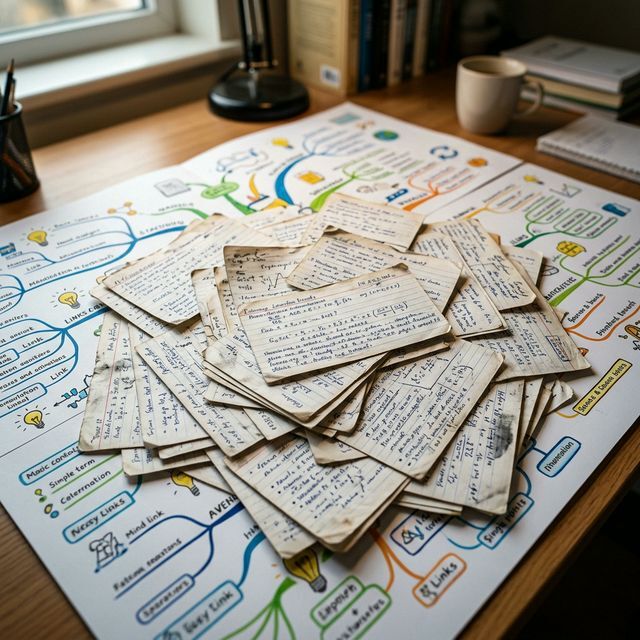
The Silent Saboteur: Why Passive Studying Fails You
You've probably spent countless hours re-reading your notes, highlighting textbooks, and watching explanation videos. It feels productive, doesn't it? Like you're absorbing everything. But what if I told you that this comfort is often an illusion, a silent saboteur of your true potential? This is the 'fluency illusion,' where familiarity with material is mistaken for genuine understanding and the ability to apply it under pressure. Pre-emptive testing is the ultimate IB strategy to overcome this, where by actively recalling information *before* you feel ready, you strengthen neural pathways, expose knowledge gaps early, and drastically improve long-term retention for exam success.
Unmasking the "Fluency Illusion": The Core Problem
What is the Fluency Illusion?
Imagine you're reading a chapter, and as you go over the same sentences multiple times, they start to look familiar. You think, "Ah, I know this!" But knowing something on a surface level is very different from being able to recall it from scratch, explain it, or apply it to a complex problem. The fluency illusion is precisely this: mistaking the ease of processing information (because you've seen it before) for actual mastery of that information. It's a psychological trap that makes passive study methods feel effective, even when they're not.
The Deceptive Comfort of Passive Review
Why do we fall for it? Because passive studying – like re-reading or highlighting – is easy. It doesn't demand much cognitive effort. Your brain isn't really working hard to retrieve information; it's just recognizing it. This comfort creates a false sense of competence, convincing you that you've learned something when, in reality, you've only built a superficial acquaintance with it. When the pressure of an exam hits, and you need to recall without cues, that's when the illusion shatters, often too late.
Tutor Tip: Feeling like studying is "easy" can be a red flag. True learning often involves a bit of a struggle, a push against cognitive resistance. Embrace that struggle – it means your brain is actively building stronger connections!
The Science of Smarter Learning: How Pre-emptive Testing Works
To truly conquer the IB, we need to leverage the very mechanics of how your brain learns and remembers. This isn't just about studying harder; it's about studying smarter, using scientifically proven methods to embed knowledge deeply.
Retrieval Effort: Forging Stronger Neural Connections
Think of your brain like a vast forest, and each piece of information is a destination. When you passively re-read, you're like flying over the forest in a helicopter – you see the path, but you don't actually walk it. When you engage in active recall, you're forcing yourself to navigate that path on foot, clearing branches and building a clear, well-trodden trail. This cognitive strain, the effort it takes to pull information from memory without immediate prompts, fundamentally strengthens the neural pathways associated with that concept. The more effortful the retrieval, the stronger and more durable the memory becomes. It's like building muscle: you don't get stronger by just looking at weights; you get stronger by lifting them.
The Forgetting Curve & Spaced Repetition: Timing is Everything
Our brains are designed to forget. Hermann Ebbinghaus famously charted the "forgetting curve," showing how quickly we lose newly acquired information if we don't actively try to retain it. This isn't a flaw; it's a feature, allowing us to prioritize what's important. However, for the IB, everything is important!
This is where Spaced Repetition comes in – it's the mathematical optimisation of memory. Instead of cramming, which leads to rapid forgetting, spaced repetition strategically schedules your self-testing sessions at increasing intervals. By revisiting material just as you're about to forget it, you force your brain to work harder to retrieve it, further strengthening the memory. The optimal intervals vary, but a common pattern looks like this:
- Initial Exposure: Learn the concept.
- 1st Review: 1 day later.
- 2nd Review: 3 days later.
- 3rd Review: 1 week later.
- 4th Review: 1 month later.
- Subsequent Reviews: At increasingly longer intervals (e.g., 3 months, 6 months).
Each successful retrieval at these spaced intervals tells your brain, "This information is important; keep it!" This systematic approach combats the forgetting curve directly, ensuring long-term retention without overwhelming your brain.
Tutor Tip: Don't wait until you've forgotten everything to re-test. The sweet spot for spaced repetition is just before complete forgetting, when retrieval is effortful but still possible. This maximizes memory consolidation.
The Pareto Principle (80/20 Rule): Maximizing Your Effort
The Pareto Principle, or the 80/20 rule, states that roughly 80% of effects come from 20% of causes. Applied to your IB studies, this means that 80% of your academic success will likely come from 20% of your most focused, high-leverage activities. Passive studying? That's typically in the 80% of low-efficiency activities that yield only 20% of the results. Active, pre-emptive testing, on the other hand, is firmly in that critical 20% of high-impact efforts.
By prioritizing active testing, you ensure that the majority of your valuable study time is spent on methods that genuinely improve long-term retention and application skills, rather than on high-volume, low-efficiency labour that just makes you feel busy.
Your Action Plan: Implementing Pre-emptive Testing in the IB
Now that you understand the 'why,' let's get into the 'how.' These are concrete, actionable steps you can start implementing today to transform your IB preparation.
Step 1: Embrace Past Papers & Worksheets (Memory-First!)
This is your primary weapon. Don't wait until you feel ready; start attempting questions from past test papers, worksheets, or custom flashcards entirely from memory. Resist the urge to consult your notes immediately. The goal here isn't to get the right answer first time, but to identify what you *don't* know.
- Untimed Practice: The Learning Phase: Initially, don't worry about the clock. Focus on understanding the question structure, the type of knowledge required, and how to formulate an answer. If you get stuck, make a note, move on, and only consult your resources *after* you've given it your best shot. This helps you learn *how* to approach questions.
- Timed Mock Exams: The Performance Phase: As you become more familiar, progressively transition to strictly timed mock exams. This builds crucial mental stamina, teaches you time management under pressure, and replicates the high-stress conditions of actual IB exams. Treat these as real exams – no notes, no distractions.
For IB students, this means tackling Paper 1, Paper 2, and Paper 3 questions (where applicable) for each subject. Don't just do the questions; actively try to predict the mark scheme and internalize the examiner's expectations.
Step 2: Master with the Feynman Technique
Nobel laureate Richard Feynman's technique is a phenomenal way to expose the cracks in your understanding. It forces you to simplify complex topics, which is the ultimate test of true comprehension.
- Choose a Concept: Pick a topic you're studying for the IB.
- Explain it to a Child: Write or say aloud everything you know about it, as if you're teaching it to someone with no prior knowledge (e.g., a 10-year-old). Use simple language, analogies, and concrete examples.
- Identify Gaps: When you get stuck, or when your explanation becomes convoluted, you've found a gap in your understanding. Go back to your notes, textbooks, or online resources to clarify these specific points.
- Simplify and Organize: Once you've filled the gaps, rewrite or re-explain the concept, making it even simpler and more concise. Use your own words, not jargon.
Tutor Tip: If you can't explain something simply, you don't understand it well enough. The Feynman Technique is your diagnostic tool for true mastery.
Step 3: The Power of the Error Log: Your Personal Growth Tracker
Completing practice tests is only half the battle. The real learning happens in the review. A detailed error log is your secret weapon for targeted improvement. After every self-test, don't just look at the correct answers; dissect your mistakes.
How to Create an Effective Error Log:
You can use a simple notebook or a spreadsheet with the following columns:
| Date | Subject/Topic | Question Number/Type | Your Answer | Correct Answer/Concept | Error Category | Why I Made the Error | Action Plan |
|---|---|---|---|---|---|---|---|
| 15/03 | Physics/Mechanics | Paper 1, Q12 (MCQ) | B | C | Conceptual | Confused momentum with kinetic energy in elastic collisions. | Review elastic/inelastic collision theory. Practice more MCQs on collision types. |
| 17/03 | Math AA HL | Paper 2, Q5 (Calculus) | Incorrect derivative | Chain rule applied | Procedural | Forgot to apply the chain rule for composite functions. | Drill chain rule problems. Create a cheat sheet for derivative rules. |
| 19/03 | History/Cold War | Paper 1, Q3 (Source Analysis) | Missed context | Lack of specific dates/figures | Factual | Didn't recall key dates/events for Cuban Missile Crisis. | Review Cold War timeline & key actors. Make flashcards for dates. |
Error Categories:
- Factual Lapses: You simply didn't know a specific definition, date, formula, or name. (e.g., forgetting the formula for centripetal force).
- Procedural Lapses: You knew the facts but made a mistake in the steps or application of a method. (e.g., misapplying a mathematical algorithm, incorrect experimental procedure).
- Conceptual Lapses: You fundamentally misunderstood a core idea or principle. (e.g., confusing correlation with causation in statistics, not grasping the concept of opportunity cost in economics).
Categorizing your errors helps you identify patterns. Are you consistently making factual errors in a particular topic? Do you struggle with procedural steps in math? Are there core concepts in history that you just haven't grasped? This insight allows you to create a highly targeted "Action Plan" for future study, turning every mistake into a powerful learning opportunity.
Common Pitfalls to Avoid: Don't Sabotage Your Success
Even with the best intentions, students often fall into traps that undermine the effectiveness of pre-emptive testing. Be aware of these to stay on track.
The "I'll Test When I'm Ready" Trap
This is the most prevalent error. Students endlessly re-read notes, watch videos, and highlight, waiting for that elusive feeling of "readiness" before attempting practice questions. This is a self-defeating cycle! You'll never feel 100% ready, and by delaying active retrieval, you're reinforcing the fluency illusion. The whole point of pre-emptive testing is to test *before* you feel ready, to expose your gaps early, and to make the learning process effortful. Don't wait; dive in!
Obsessing Over Scores, Ignoring Analytics
It's natural to care about your score on a practice test. However, if your sole focus is the number at the top of the page, you're missing the point. A low score on a practice test isn't a failure; it's a diagnostic tool. Without tracking deeper performance analytics – like your recurring patterns in accuracy, timing, or strategic weaknesses (which your error log helps with!) – you'll keep repeating the same errors. Focus on the *why* behind your mistakes, not just the *what*.
The Cramming Catastrophe
Cramming – trying to force a huge amount of information into your brain at the last minute – is the antithesis of effective learning. It triggers cognitive overload, leads to poor retention (especially long-term), and significantly heightens anxiety. While it might give you a temporary boost for a short-term memory task, it completely negates the benefits of spaced retrieval and deep understanding required for the IB. Prioritize consistent, spaced practice over frantic last-minute efforts.
The Sunk Cost Fallacy in Exams
During an actual exam, you might encounter a difficult question that you've already spent five precious minutes on. The "sunk cost fallacy" is the cognitive bias that makes you stubbornly stick with that question, thinking, "I've already invested so much time; I can't give up now!" This leads to wasting even more time, potentially missing out on easier marks elsewhere. In a timed exam, be strategic: if you're stuck, move on. Secure the marks you can, and if time permits, come back to the harder questions. Your goal is to maximize your overall score, not to conquer every single question.
Your Path to IB Mastery
The IB Diploma is a marathon, not a sprint. True success comes not from innate intelligence alone, but from intelligent, disciplined effort. By understanding and actively combating the fluency illusion through consistent, pre-emptive self-testing, you're not just studying; you're fundamentally rewiring your brain for deep understanding and long-term retention. Embrace the struggle, track your progress, and trust in the power of active recall. You have the tools; now go out there and master your IB journey!