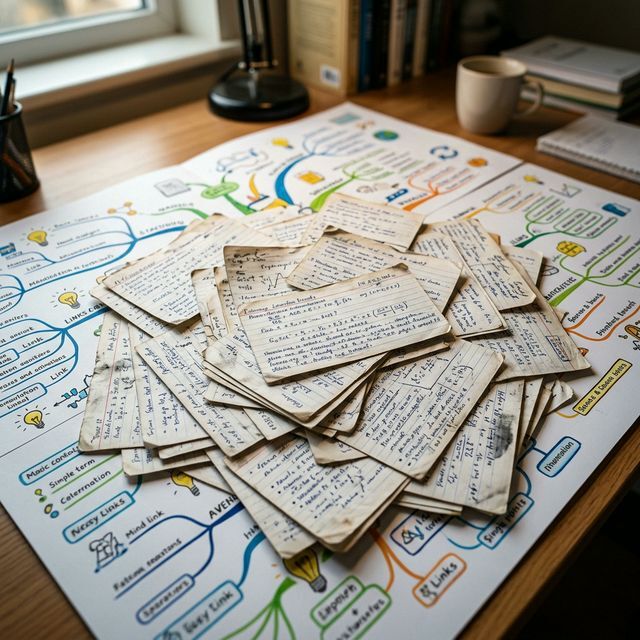
The Science of Memory: Why Spaced Repetition Works
Spaced repetition is a powerful study technique that strategically spaces out your review sessions to optimize long-term memory. By revisiting material at increasing intervals, you combat the natural forgetting curve, forcing active recall and strengthening neural pathways. This method ensures core concepts are deeply ingrained, making retrieval effortless during high-stakes IB exams.
Hey there, future IB conqueror! You're probably juggling a mountain of content across six subjects, and it can feel like you're constantly forgetting things you just learned. Sound familiar? That's not a sign you're not smart enough; it's just how our brains are wired. The good news? There's a scientifically proven strategy to beat the forgetting curve and lock information into your long-term memory: Spaced Repetition. Think of me as your personal tutor, guiding you through the mechanics of making this incredibly powerful tool work for you.
Understanding the Forgetting Curve and the Spacing Effect
Let's start with the enemy: the Forgetting Curve, first described by Hermann Ebbinghaus. Imagine you learn something new today. Without any review, the amount of information you retain drops off dramatically over time. Within a day, you might have forgotten a significant chunk! This isn't laziness; it's your brain's natural way of clearing out what it perceives as 'unimportant' data.
Now, for the hero: the Spacing Effect. This is the phenomenon where learning is more effective when study sessions are spaced out over time, rather than crammed into a single session. Why? Because each time you revisit material after a gap, your brain has to work harder to retrieve it. This "effortful retrieval" isn't a bad thing; it's like a workout for your memory, strengthening the neural connections associated with that information. Each successful retrieval makes the next one easier and slows down the rate at which you forget.
The Power of Active Recall
Hand-in-hand with spaced repetition is Active Recall. This means actively trying to retrieve information from your memory rather than passively re-reading notes or highlighting. When you're using spaced repetition, every review session must involve active recall. Don't just look at the answer; try to generate it yourself first. If you can't, that's okay! The struggle itself is part of the learning process, identifying gaps and making the subsequent learning stick even more firmly.
Tutor Tip: Think of your memory as a muscle. Passive re-reading is like gently massaging it; active recall is like lifting weights. Which one builds strength faster? Exactly!
The Spaced Repetition Sweet Spot: Your Optimal Review Intervals
This is where the magic happens and where we get mathematically rigorous. To truly embed a concept into your long-term memory, we need to time your reviews precisely when your brain is just about to forget the information. This creates a powerful 're-learning' moment that significantly boosts retention.
The Baseline Schedule: 1-3-7-30 Days
The most widely accepted and effective baseline schedule involves reviewing material at these specific intervals after your initial learning:
- Day 1 (24 hours after initial learning): This first review is crucial. It catches the information before the steepest part of the forgetting curve takes hold, consolidating your initial understanding.
- Day 3 (Three days after the first review): By now, the memory has weakened slightly. Retrieving it here forces a stronger re-encoding.
- Day 7 (One week after the second review): A longer gap. This is where you really start to feel the effort of retrieval, but the success is incredibly rewarding for your memory.
- Day 30 (One month after the third review): This final major interval aims to solidify the information, moving it into a highly stable long-term memory store. After this, you might only need annual or semi-annual refreshers for truly core concepts.
Each time you hit one of these review points, you're not just re-learning; you're essentially 'resetting' your forgetting curve, but with each reset, the curve becomes shallower, meaning you forget slower and retain longer. It’s like building a stronger and stronger dam against the river of forgetting.
A Condensed Variation: 1-3-7-14 Days
For subjects or topics where you might have a shorter timeline before an exam, or for slightly less complex information, a slightly condensed schedule can also be highly effective:
- Day 1
- Day 3
- Day 7
- Day 14 (Two weeks after the third review)
This variation still leverages the spacing effect but accelerates the final consolidation. Choose the schedule that best fits the density of the material and your exam timeline. For core, foundational IB concepts, the 1-3-7-30 model is often superior.
Turning Theory into Practice: Actionable Strategies for IB Students
Knowing the theory is one thing; implementing it is another. Here’s how you can weave spaced repetition seamlessly into your IB study routine.
1. Integrate into Your Master Revision Timetable
This isn't an optional extra; it's a fundamental shift in how you schedule your revision. Instead of blocking out 'Chemistry' for 3 hours, break it down: 'New Chemistry Topic X', then 'Review Chemistry Topic Y (Day 1)', 'Review Chemistry Topic Z (Day 3)'.
- Daily Micro-Sessions: Rather than marathon weekend cramming, aim for shorter, focused daily review sessions. Even 20-30 minutes dedicated to active recall using spaced repetition can be far more effective than hours of passive study. This builds stronger neural pathways and reduces stress.
- Forward Planning: When you learn a new concept, immediately schedule its first review for the next day, its second for three days later, and so on. Use a digital calendar or a physical planner to keep track.
2. Leverage Digital Flashcard Tools
While physical flashcards are great, digital tools can automate the scheduling of spaced repetition, making it incredibly efficient.
- Active Recall Focused: These tools typically show you a question or prompt, and you try to recall the answer before revealing it. This forces active retrieval.
- Self-Assessment: After revealing the answer, you rate how well you knew it (e.g., "again," "hard," "good," "easy"). The algorithm then adjusts the next review interval based on your response, perfectly aligning with the spaced repetition principle.
- Beyond Definitions: Don't just use flashcards for definitions. Create cards for problem steps, diagram labels, concept comparisons, and even mini-essay outlines.
Tutor Tip: When making flashcards, keep them atomic – one question, one answer. Break down complex ideas into smaller, digestible chunks. This makes recall easier and more precise.
3. The Power of the Error Log: Your Secret Weapon
This is arguably one of the most powerful, yet underutilized, strategies. Every mistake is a learning opportunity, but only if you actively engage with it. The "3-step fix" is your protocol:
- Identify the Mistake: Don't just mark it wrong. Pinpoint exactly what went wrong. Was it a conceptual misunderstanding? A procedural error? A careless slip?
- Write a Reflection: In your error log (a dedicated notebook or digital document), document the original question, your incorrect answer, the correct answer, and then a detailed reflection on why you made the mistake. What was your thought process? What concept did you misapply? How will you approach it differently next time?
- Force a Complete Redo: This is CRITICAL. Don't just read the correct solution. Schedule a complete re-attempt of that exact problem (or a very similar one) from memory. Apply the 1-day, 3-day, 1-week interval rule to your errors.
Example Error Log Entry:
| Date | Subject/Topic | Question/Problem ID | Type of Error | Why I Made the Mistake | Correct Approach Summary | Scheduled Re-tests | Outcome (Date/Score) |
|---|---|---|---|---|---|---|---|
| 2024-03-10 | Physics/Mechanics | Q3, P1 (Nov 2023) | Conceptual Error (Newton's 2nd Law) | Confused acceleration with velocity when setting up force equations. Didn't correctly identify net force. | F_net = ma. Ensure all forces are identified and components resolved correctly. Pay attention to direction of acceleration. | 2024-03-11 (D1), 2024-03-14 (D3), 2024-03-21 (W1) | D1: 2024-03-11 (Correct) |
| 2024-03-12 | Math AA HL/Calculus | Integration by Parts (Practice Set) | Procedural Error (sign error) | Forgot to apply negative sign correctly when integrating by parts formula. Rushed the calculation. | Remember formula ∫u dv = uv - ∫v du. Double-check all signs, especially when v or du is negative. | 2024-03-13 (D1), 2024-03-16 (D3), 2024-03-23 (W1) | D1: 2024-03-13 (Correct) |
This systematic approach ensures that your mistakes become powerful learning tools, not just sources of frustration.
Common Pitfalls and How to Avoid Them
Spaced repetition is incredibly effective, but only if you use it correctly. Many students inadvertently undermine its power by falling into common traps.
1. The Fluency Illusion
This is perhaps the biggest saboteur. The fluency illusion makes you feel like you understand something simply because it looks familiar. If you just re-read your notes, highlight passages, or passively watch a video, the material feels familiar. Your brain says, "Oh, I know this!" But when it comes to actively recalling or applying that knowledge in an exam, you draw a blank. This is because familiarity is not the same as mastery.
- How to Avoid: ALWAYS prioritize active recall. Close your notes. Ask yourself questions. Teach the concept to an imaginary student. Do practice problems from scratch. If you can't explain it or do it, you don't know it well enough yet.
2. The Trap of Last-Minute Cramming
We've all been there. The exam is tomorrow, and you're trying to shove a semester's worth of information into your brain in one night. Cramming might give you a short-term boost (enough to pass an easy quiz), but it's terrible for long-term retention. It overloads your cognitive capacity, leads to high stress, and the information is quickly forgotten after the exam. It completely bypasses the neural consolidation that spaced repetition aims for.
- How to Avoid: Start early. Plan your revision using spaced repetition from the very beginning of the course. Small, consistent efforts over time yield vastly superior results to frantic, last-minute binges.
3. Passive Review of Mistakes
Getting a question wrong stings. The natural inclination is to quickly glance at the correct answer or the mark scheme and think, "Oh, I get it now." This is another form of passive review and a major pitfall. You might understand the solution, but can you reproduce it under pressure? Probably not.
- How to Avoid: Implement your error log religiously. Force yourself to redo the problem from scratch. If it's a conceptual error, revisit the underlying theory and then re-attempt a similar problem. The act of struggling and then successfully solving it cements the learning.
4. Inconsistency and Abandoning the Schedule
Spaced repetition is a system, and like any system, its effectiveness relies on consistency. Missing review days or arbitrarily changing intervals can weaken its impact. Life happens, but try to stick to your schedule as much as possible. If you miss a review, don't just skip it; reschedule it as soon as you can, perhaps shortening the next interval slightly to compensate.
- How to Avoid: Make your schedule realistic. Don't overcommit. Use reminders and integrate it into your daily routine. Treat your review sessions as non-negotiable appointments with your long-term memory.
Conclusion: Your Path to IB Mastery
Spaced repetition isn't just another study hack; it's a fundamental principle of how our brains learn and retain information. By understanding the forgetting curve, embracing active recall, and diligently applying the optimal review intervals, you can transform your study habits and achieve truly robust, long-lasting knowledge. This isn't about working harder; it's about working smarter. Integrate these strategies into your IB journey, and you'll not only ace your exams but also build a deeper, more profound understanding of your subjects. Now go forth and conquer that IB Diploma!