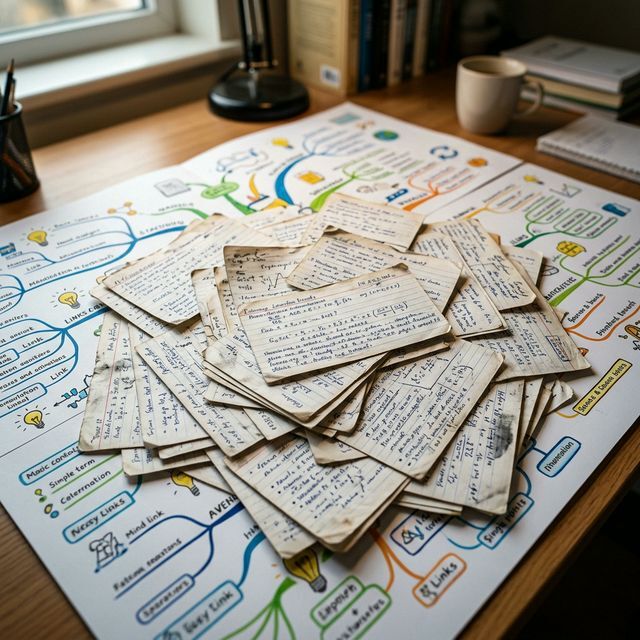
Introduction: The Hidden Trap of Traditional Study Methods
Hey there, future IB high-achiever! Let's be honest, you've probably spent countless hours re-reading your notes, highlighting textbooks until they glow, and passively watching educational videos. It feels productive, right? You nod along, the information seems familiar, and you think, "I've got this." But then comes the exam, and suddenly, that familiar material feels distant, the answers elusive. This isn't your fault; you've fallen into a common cognitive trap known as the "fluency illusion."
This comprehensive guide is designed to pull you out of that trap. We're going to fundamentally transform how you approach studying for the IB Diploma. Forget passive absorption; we're diving deep into the powerful, scientifically-backed strategies of active recall and spaced repetition. These aren't just "tips"; they're the foundational pillars upon which true, lasting understanding and top-tier IB grades are built. Get ready to unlock your brain's full potential.
What are Active Recall and Spaced Repetition, and Why Are They Essential for IB Success?
Active recall and spaced repetition are the most effective IB study strategies because they force your brain to actively retrieve information, strengthening neural connections and embedding knowledge into long-term memory, unlike passive reading which creates a false sense of understanding. This systematic approach directly combats the forgetting curve, ensuring deep comprehension and superior performance in application-based exams.
The Fluency Illusion: Your Brain's Sneaky Trick Exposed
Imagine you're walking through a familiar park. You recognise the trees, the benches, the path. But could you draw a detailed map of every single leaf or every crack in the pavement from memory? Probably not. This is precisely what happens with the fluency illusion.
The Psychology Behind the Trap
When you passively re-read notes or highlight text, your brain processes the information with minimal effort. This low cognitive strain creates a false sense of familiarity – a "fluency" – which you mistakenly interpret as genuine knowledge. You *recognise* the material, but you haven't truly *recalled* or *encoded* it deeply. It's like seeing a celebrity's face and feeling like you know them, but struggling to remember their name or career details when put on the spot. Under the pressure of an IB exam, where you need to apply, analyse, and synthesise information, this superficial familiarity crumbles, leaving you feeling unprepared.
Tutor Tip: The key takeaway here is that 'feeling' like you know something is often a deceptive indicator. True understanding is demonstrated by your ability to explain, apply, and retrieve information without external prompts. Challenge that feeling of familiarity!
The Unbeatable Duo: Active Recall & Spaced Repetition
Now that we understand the problem, let's explore the solution. Active recall and spaced repetition are two sides of the same coin, working in synergy to embed knowledge deeply and durably.
Active Recall: Forging Stronger Neural Pathways
At its core, active recall is the act of retrieving information from your memory without looking at your notes or textbook. It's forcing your brain to work. Think of it like a muscle: the more you exercise it, the stronger it gets. Every time you successfully recall a piece of information, you're not just accessing it; you're actively strengthening the neural pathways associated with that memory.
- The Effortful Retrieval Process: This "effort" is crucial. When your brain has to work to retrieve something, it signals that this information is important. This signal triggers a cascade of neurochemical changes that reinforce the memory trace, making it easier to recall next time. It's like carving a deeper groove in a record – the needle (your memory) will find it more easily in the future.
- Consolidating Information: This process helps move information from your short-term (working) memory into your long-term memory. It's not just about remembering for the next hour; it's about remembering for months, even years, which is exactly what you need for multi-year IB courses and final exams.
Spaced Repetition: Hacking the Forgetting Curve
Active recall is powerful, but without strategic timing, even the strongest memories can fade. This is where spaced repetition comes in. Pioneered by Hermann Ebbinghaus in the late 19th century, the "forgetting curve" demonstrates that we rapidly forget newly learned information unless we review it. Spaced repetition directly combats this by scheduling reviews at increasingly longer intervals.
The Mathematical Mechanics of Spacing
Consider the forgetting curve: a steep initial drop in retention, followed by a gradual flattening. Each time you actively recall information, you "reset" and flatten that curve, making the next review necessary at a longer interval. Mathematically, the optimal spacing between reviews is not fixed but adaptive. For new, difficult information, you might review it after 1 day, then 3 days, then 7 days, then 1 month, then 3 months. For easier, well-understood concepts, these intervals can be much longer.
This systematic, expanding review schedule ensures that you encounter the information just as you're about to forget it, making the retrieval effort more potent and solidifying the memory. It's significantly more efficient than cramming, which overloads your short-term memory and leads to rapid decay of information after the exam.
Tutor Tip: Don't underestimate the power of short, consistent bursts. Twenty minutes of daily, focused active recall practice is statistically and neurologically superior to a ten-hour cramming session once a month. Your brain prefers consistent, moderate effort over infrequent, intense overload.
Your IB Action Plan: Mastering These Techniques
Theory is great, but actionable steps are what you need. Here's how to integrate active recall and spaced repetition into your IB study routine.
Method 1: The Power of Self-Testing
Ditch passive note-reading. Replace it with methods that force retrieval.
Flashcards (Physical or Digital, like Anki)
- Creation: Don't just copy definitions. For IB, make flashcards that ask "Why?" "How?" "What are the implications of...?" or "Derive..." For Maths, put a problem on one side, the solution steps on the other. For History, put an event on one side, its causes/consequences on the other.
- Active Use: When reviewing, don't just flip the card if you hesitate. Force yourself to articulate the answer fully before checking. If you get it wrong, don't just read the correct answer; actively re-learn it and mark it for earlier review.
- Anki Integration: Anki is a powerful spaced repetition software. It uses an algorithm to determine the optimal time to show you each flashcard again, based on your previous performance. This automates the "spacing" for you, making it incredibly efficient. Learn to use its features like image occlusion for diagrams and cloze deletions for sentence completion.
The Blurting Method
This is a fantastic method for consolidating entire topics.
- Read a Topic: Go through a chapter or a set of notes once, actively trying to understand it.
- Close Everything: Shut your textbook, notes, and laptop.
- "Blurt" It Out: On a blank piece of paper or a whiteboard, write down absolutely everything you can remember about that topic. Don't worry about structure or neatness initially. Just get it all out.
- Check and Fill Gaps: Open your resources and compare what you "blurted" with the original material. Highlight or use a different colour to add in anything you missed or got wrong. These are your knowledge gaps!
- Refine and Repeat: Focus your next study session on the gaps identified. Repeat the blurting process after a spaced interval.
Method 2: Conquering Past Papers Blind
Past papers are the gold standard for IB preparation, but only if used correctly.
- Simulate Exam Conditions: Sit down with a past paper, a timer, and no immediate access to solutions or notes. Treat it like the real exam. This builds mental stamina and exposes your true ability to perform under pressure.
- Focus on "Construction," Not "Recognition": The goal isn't to see an answer and think "Oh, I knew that!" The goal is to construct the answer from scratch. This is the ultimate form of active recall.
- Immediate Application: After completing a paper (or a section), only then should you check your answers. The interval between attempting and checking is critical for reinforcing the retrieval process.
Method 3: The Feynman Technique for True Understanding
Named after Nobel laureate Richard Feynman, this technique is a powerful diagnostic tool for identifying gaps in your understanding.
- Choose a Concept: Pick a complex IB concept you're struggling with (e.g., "The concept of entropy in Thermodynamics," "The role of the Gini coefficient in development economics," "The implications of the Heisenberg Uncertainty Principle").
- Teach It to a 5-Year-Old: Explain the concept in the simplest possible terms, as if you were teaching it to a child. Use plain language, analogies, and avoid jargon. Write it down or speak it aloud.
- Identify Gaps: When you get stuck or realise you're using complex terms, you've hit a gap in your understanding. Go back to your textbook or notes to clarify that specific point.
- Simplify and Organise: Once you've filled the gaps, re-explain the concept, making it even simpler and more coherent. Use analogies to solidify understanding. The goal is to distil the concept to its absolute essence.
Tutor Tip: The Feynman Technique isn't just about simplification; it's about forcing your brain to actively retrieve and reorganise knowledge in a way that exposes superficial understanding. If you can't explain it simply, you don't truly understand it.
Common Traps & How to Dodge Them (IB Specific)
Even with the best intentions, students often fall into predictable pitfalls. Let's make sure you avoid them.
Trap 1: The Re-Reading Rut
The Mistake: Relying solely on re-reading class notes, textbooks, or passively watching educational videos.
Why it's a Trap: As discussed, this feeds the fluency illusion. It feels comfortable and low-effort, but it doesn't build the robust neural connections needed for complex, application-based IB questions. It's like watching someone lift weights and thinking you're getting stronger.
How to Dodge It: Immediately replace re-reading with self-testing methods. Every time you're about to re-read, ask yourself: "How can I test myself on this?" Turn headings into questions, summarise without notes, or use flashcards.
Trap 2: The Recognition-Recall Conflation
The Mistake: Confusing the ability to recognise an answer when you see it (e.g., in multiple-choice options, or by skimming notes) with the actual ability to recall and construct that answer independently.
Why it's a Trap: IB exams, especially at HL, demand deep synthesis and independent construction of arguments, derivations, and solutions. Recognition is a passive skill; recall is an active, high-level cognitive function.
How to Dodge It: Always practice free recall. If you're using flashcards, don't peek. If you're doing a past paper, don't look at the mark scheme until you've fully attempted the question. Be brutally honest with yourself: did you *know* it, or did you just *recognise* it?
Trap 3: The Neglected Mistake Analysis
The Mistake: Checking your answers on a past paper or worksheet, seeing where you went wrong, and then moving on without a deeper investigation.
Why it's a Trap: This is arguably one of the biggest missed opportunities in IB revision. Simply knowing you got something wrong isn't enough. You need to understand *why* you got it wrong. Was it a conceptual misunderstanding? A procedural error? A careless mistake? A misinterpretation of the command term?
How to Dodge It: Implement a rigorous mistake analysis protocol:
- Identify the Error Type: Categorise your mistake (e.g., "misunderstood definition," "algebraic error," "didn't link to context," "forgot formula").
- Re-Learn the Root Cause: Go back to your notes, textbook, or even a tutor to clarify the specific concept or procedure you missed. Don't just read; actively re-learn and test yourself on it.
- Correct and Re-do: Re-do the incorrect question (or a similar one) immediately, ensuring you can now solve it correctly.
- Spaced Review of Mistakes: Crucially, add these specific mistake areas to your spaced repetition schedule. Create flashcards for the concept you struggled with, or note down the specific question to revisit in a few days, then a week, etc. This ensures you don't repeat the same error.
Trap 4: The Cramming Catastrophe
The Mistake: Attempting to absorb vast amounts of information in a short, intense period just before an exam.
Why it's a Trap: While cramming can sometimes lead to short-term recall (enough to pass a basic test), it's disastrous for long-term retention and deep understanding. Your short-term memory has limited capacity. Overloading it prevents the crucial process of memory consolidation, where new information is integrated into your existing knowledge network. For multi-year IB courses, cramming guarantees you'll forget everything you "learned" almost immediately after the exam.
How to Dodge It: Start early and be consistent. Embrace active recall and spaced repetition from day one. By consistently reviewing information at optimal intervals, you'll eliminate the need for last-minute cramming, ensuring robust, long-lasting knowledge.
Beyond the Basics: Elevate Your IB Game
Once you've mastered active recall and spaced repetition, you can supercharge your learning even further with these advanced cognitive strategies.
Interleaving: Mixing It Up for Mental Agility
What it is: Instead of studying one topic until mastery before moving to the next (e.g., all of Calculus, then all of Statistics), you interleave, mixing different but related topics within a single study session (e.g., a few Calculus problems, then some Statistics, then some Algebra). For IB History, this might mean switching between different historical periods or themes within one session.
Why it Works: Interleaving forces your brain to constantly discriminate between different problem types and concepts, making you more flexible and better at identifying the correct strategy for a given problem. It's like learning to distinguish between a tennis serve and a badminton serve – the subtle differences become clearer when practiced together.
Elaboration: Building a Rich Network of Knowledge
What it is: Elaboration involves connecting new information to what you already know. It's asking "How does this relate to...?" or "What's an example of this concept in the real world or another subject?"
Why it Works: Every piece of information in your brain is part of a vast, interconnected web. The more connections you build to a new concept, the more "retrieval cues" you create. This makes the information easier to find and recall later. For instance, when learning about economic models, elaborate by connecting them to current events or historical examples you've studied.
Dual Coding: Harnessing the Power of Visuals
What it is: Dual coding means presenting information in two formats – typically verbal (words) and visual (images, diagrams, flowcharts, graphs).
Why it Works: Your brain processes visual and verbal information through different channels. By engaging both, you create a more robust and redundant memory trace. If you forget the words, the image might trigger the recall, and vice-versa. For IB Sciences, drawing and labelling diagrams from memory is crucial. For IB Economics, sketching and explaining models like AD/AS or Phillips Curve is dual coding in action.
Crafting Your Personal Spaced Repetition Schedule
You don't need complex software to start. Here's a basic framework:
- Initial Learning (Day 0): Actively learn a new concept using the blurting method or by working through problems.
- First Review (Day 1): Review the concept using active recall (flashcards, self-testing). If you struggle, reset the interval.
- Second Review (Day 3-4): Review again.
- Third Review (Day 7-10): Review again.
- Subsequent Reviews: Extend intervals further (e.g., 2 weeks, 1 month, 3 months, 6 months).
Tools to Help You
- Anki: As mentioned, Anki is the gold standard for automated spaced repetition. It handles the scheduling for you, adapting to your performance.
- Physical Flashcards: If you prefer physical, use a simple box system. Three boxes: "Daily," "Weekly," "Monthly." Move cards to the next box if you get them right; move them back to "Daily" if you get them wrong.
- Spreadsheet/Calendar: For bigger topics or past paper review, maintain a simple spreadsheet or calendar. Note down topics and the date you last reviewed them, then schedule the next review.
Tutor Tip: Consistency is far more important than intensity. Even 15-20 minutes of active recall and spaced repetition daily will yield dramatically better results than sporadic, long sessions. Make it a non-negotiable part of your routine.
Final Thoughts: Your Path to IB Excellence
The IB Diploma is a marathon, not a sprint. Relying on passive study methods is like trying to run a marathon without training. Active recall and spaced repetition are your rigorous training regimen. They might feel harder initially because they demand genuine cognitive effort, but that effort is precisely what builds deep, lasting understanding and the ability to perform under pressure.
Embrace these strategies, be consistent, and critically analyse your mistakes. You'll not only achieve outstanding results in your IB exams but also develop powerful learning habits that will serve you well far beyond the diploma. Start today, and watch your understanding – and your grades – soar!