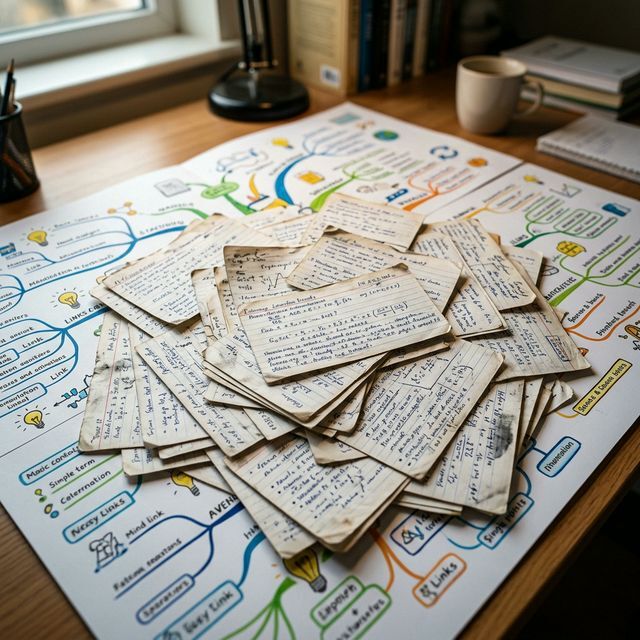
Understanding Complexity Bias in IB Revision
Complexity Bias is a cognitive trap where IB students mistakenly believe intricate study plans are superior to simple, effective ones. This often leads to procrastination. Overcoming it means prioritizing straightforward, high-impact strategies like active recall and spaced repetition to ensure consistent, sustainable progress and better IB grades.
The Hidden Trap: Why We Overcomplicate Things
As an IB student, you've probably felt the pull towards elaborate study schedules, colour-coded notes, and the latest productivity apps. It's a natural human tendency, known as Complexity Bias. Our brains often equate 'complicated' with 'effective' or 'intelligent'. We think that if something is hard to understand or implement, it must be better. But in the world of IB revision, this couldn't be further from the truth.
Tutor Tip: Resist the urge to create a masterpiece of a study plan before you even open a textbook. A simple, actionable plan you stick to is infinitely better than a perfect, complicated one you abandon.
The Fluency Illusion: Confusing Familiarity with Mastery
Hand-in-hand with Complexity Bias is the Fluency Illusion. This is where you re-read your notes, highlight every other sentence, and feel like you "know" the material because it looks familiar. You've seen it before, so it feels easy. But familiarity is not the same as recall. On exam day, when the pressure is on, you need to produce information, not just recognise it. This illusion often leads students to waste countless hours on passive study methods that yield minimal results under pressure.
- Passive Methods: Re-reading, highlighting, summarising (without active engagement).
- Active Methods: Flashcards, past paper questions, explaining concepts aloud, teaching others.
The Mathematical Edge: Pareto Principle & Spaced Repetition
The 80/20 Rule: Focusing Your Efforts Where It Counts
Let's talk about the Pareto Principle, or the 80/20 rule. In IB revision, this means roughly 80% of your exam success will come from 20% of your focused efforts. Think about it: not all syllabus points are equally weighted. Some concepts are foundational, appear repeatedly, and carry significant marks. Highly effective revision isn't about giving equal time to everything; it's about strategically identifying and mastering those high-yield topics.
How to Apply the Pareto Principle:
- Analyze Past Papers: Look for recurring themes, question types, and command terms. Which topics appear year after year?
- Prioritise Core Concepts: Identify the fundamental theories, formulas, or concepts that underpin entire units. Mastering these first will make understanding everything else easier.
- Allocate Time Proportionally: If a topic consistently accounts for 15% of the exam marks, it deserves more attention than a topic that accounts for 2%.
Tutor Insight: Don't just "study everything." Be a detective. Find the patterns in your past papers and make those your primary targets. This is where your time investment will have the highest return.
Spaced Repetition: The Science of Lasting Memory
Now, let's look at how memory works. Our brains aren't designed to remember everything forever after one exposure. The Forgetting Curve shows that we rapidly forget newly learned information if we don't actively try to retain it. This is where Spaced Repetition comes in – it's a mathematically superior method for embedding information into your long-term memory.
The concept is simple: review material at progressively longer intervals. Imagine you learn a new concept today. You review it:
- Day 1: Initial learning
- Day 2: First review (1 day later)
- Day 5: Second review (3 days after the first review)
- Day 12: Third review (7 days after the second review)
- Day 30: Fourth review (18 days after the third review)
- ...and so on.
Each time you recall the information, your brain strengthens the neural connections, making it harder to forget. This systematic approach leverages the "spacing effect" to make your revision incredibly efficient. A simple 20-minute daily routine using spaced repetition is objectively more effective than a frantic 10-hour cramming session the weekend before an exam.
Mathematical Mechanics of Spaced Repetition:
While the exact intervals can vary (e.g., Anki's algorithm), the core idea is that the optimal time to review an item is just before you're about to forget it. This is a sweet spot – it's challenging enough to strengthen recall but not so difficult that you can't remember it. The longer you remember an item, the longer the next interval should be.
Consider the "strength" of a memory trace, S. Each successful recall attempt increases S. The rate of forgetting is inversely proportional to S. Spaced repetition aims to time recalls such that the effort is maximised for the memory gain.
| Review Attempt | Interval (Example) | Memory Strength Impact |
|---|---|---|
| 1st Review | 1 day | Initial boost, active consolidation |
| 2nd Review | 3 days | Further strengthening, combats initial rapid decay |
| 3rd Review | 7 days | Moves info to more stable long-term memory |
| 4th Review | 30 days | Reinforces for long-term retention, high confidence |
Actionable Advice: Don't overthink the exact intervals. Start with a simple system (1 day, 3 days, 1 week, 1 month) for your flashcards or notes. Consistency is key.
Overcoming Common Pitfalls: The Roadblocks to Simplicity
The "Perfect Plan" Paralysis
Many IB students fall into the trap of over-researching and trying to create the "perfect" study schedule or the "perfect" set of notes before they even begin actual revision. This pursuit of perfection is a manifestation of Complexity Bias. You spend hours planning, colour-coding, and designing, but very little time actually doing the work. The truth is, "done is better than perfect" when it comes to learning. An iterative approach – start small, learn, adapt, improve – is far more effective.
Aesthetic Over Substance: Pretty Notes vs. Powerful Recall
It's tempting to create beautiful, elaborate notes. While neatness has its place, if your notes are aesthetically pleasing but don't facilitate active recall, they're not serving their primary purpose. The goal of notes is to help you learn and remember, not to win an art competition. Active recall, where you test yourself without looking at the answers, is the gold standard for memory consolidation.
The Sleep Sacrifice: False Productivity
Pulling all-nighters might feel like you're being productive, but it's often counterproductive. Sleep is crucial for memory consolidation and cognitive function. Sacrificing sleep for extra study hours usually means you're operating at a lower capacity, making more mistakes, and ultimately retaining less information. Prioritise your sleep; it's one of the simplest yet most powerful revision tools you have.
Your Action Plan: Embracing a Bias for Action
Occam's Razor for Revision
Apply Occam's Razor to your study habits: the simplest explanation or solution is usually the best. Choose the revision system that requires the fewest assumptions and logistical steps. If a method feels overly complicated, it probably is. Streamline your process.
Practical Steps:
- Prioritise Active Recall:
- Flashcards: Create physical or digital flashcards (e.g., Anki) for key definitions, formulas, and concepts.
- Blurting: After reading a topic, close your book and write down everything you can remember. Then compare with your notes.
- Practice Questions: Immediately attempt past paper questions or textbook problems without looking at the solutions first. Struggle is good; it forces your brain to work.
- Implement Simple Spaced Repetition:
- For each topic, schedule quick reviews at increasing intervals.
- Use a simple calendar or a spreadsheet to track your review dates.
- Focus on recalling during these reviews, not just re-reading.
- Be Ruthless with Prioritisation:
- Use the Pareto Principle to identify your high-yield topics.
- Don't get bogged down in low-impact tasks.
- Focus on understanding concepts deeply rather than memorising superficial details.
- Embrace Iteration: "Done is Better Than Perfect":
- Start revising now with a simple system, even if it's not perfect.
- Adjust and refine your methods as you go. Learning what works for you is part of the process.
- Don't wait for the "ideal" time or "perfect" resources.
Final Thought: Your IB journey is demanding enough. Don't add unnecessary complexity to your revision. By understanding and counteracting Complexity Bias, you're not just studying smarter; you're building sustainable habits that will serve you well beyond the IB diploma. Trust in simplicity, embrace action, and watch your grades climb.