Kinematics: notes and practice questions
- This topic describes motion quantitatively and qualitatively using position, velocity, and acceleration.
- Velocity is the rate of change of position, and acceleration is the rate of change of velocity.
- Distinguish between distance and displacement, and instantaneous and average values.
- For uniformly accelerated motion, use , , , and .
- Projectile motion is analyzed by resolving motion into horizontal and vertical components, neglecting fluid resistance for quantitative problems.
- Understand the qualitative effects of fluid resistance, including terminal speed.
How it is examined
Both papers. In Paper 1A this is often a definitional multiple choice: May 2025 SL TZ1 opened with "Instantaneous velocity is defined as..." as question 1. In Paper 2 it is usually the graph work that carries the marks: state what an area under a graph represents (1 mark), then calculate from it (2 marks). Command terms cluster on state, calculate, determine, sketch. Tariffs 1 to 3.
All four equations of motion. Students are not asked to recall them. They are asked to select the right one, which is the actual skill. Gradient and area interpretations of displacement-time, velocity-time and acceleration-time graphs are not equations and are not given: those must be known.
- that motion through space and time is described and analysed in terms of position, velocity and acceleration
- velocity is the rate of change of position, acceleration is the rate of change of velocity
- the change in position is the displacement, and the difference between distance and displacement
- the difference between instantaneous and average values of velocity, speed and acceleration, and how to determine them
The trajectory of projectile motion is parabolic in the absence of fluid resistance, but the equation of the trajectory is not required.
Guiding questions
- How can the motion of a body be described quantitatively and qualitatively?
- How can the position of a body in space and time be predicted?
- How can the analysis of motion in one and two dimensions be used to solve real-life problems?
Linking questions
- How does the motion of a mass in a gravitational field compare to the motion of a charged particle in an electric field?
- How are the equations for rotational motion related to those for linear motion?
- When can certain types of problems on projectile motion be solved by applying conservation of energy instead of kinematic equations?
- How effectively do the equations of motion model Newton's laws of dynamics?
- How does a gravitational force allow for orbital motion?
- How does the motion of an object change within a gravitational field?
- How does graphical analysis allow for the determination of other physical quantities? (NOS)
Practice questions
48 questions · 9 easy · 37 medium · 2 hardQuestion 1
EasyPaper 2 · calculator2 marksA reconnaissance drone is launched from a base with an initial speed of 80 m/s at an angle of 15° above the horizontal. Calculate the time it takes for the drone to cover a horizontal distance of 150 m.
Remember that horizontal motion is independent of vertical motion. What component of the initial velocity is relevant for horizontal distance?
Question 2
MediumPaper 2 · calculator6 marks(a) A delivery driver places a package on the flat trunk of their car. The car then accelerates forward.
State the nature and direction of the force that causes the package to accelerate with the car.
(b) The mass of the package is 25 kg, and the mass of the car is 1500 kg. The coefficient of static friction between the package and the car's trunk is 0.65.
Determine the maximum acceleration the car can have without the package sliding relative to the trunk.
(c) Calculate the maximum engine force that can be applied to the car for the package to remain stationary relative to the trunk. Assume no other horizontal forces act on the car.
Consider the interaction between the package and the trunk surface. What type of force prevents relative motion?
The maximum static friction force is what provides the acceleration for the package. Use Newton's second law for the package alone.
Consider the car and the package as a single system. What is the total mass of this system?
Question 3
HardPaper 2 · calculator18 marksAn electric ski lift is powered by a motor at the base station. The motor is connected to a 750 V DC power supply by a cable with a total resistance of 0.15 Ω. When operating at full capacity, the motor draws a constant current of 400 A.
(a) Determine the potential difference across the terminals of the motor.
(b) The motor has an efficiency of 92%. Calculate the useful mechanical power output of the motor.
The ski lift carries skiers up a slope of length 1800 m that rises by a vertical height of 500 m. There are 50 chairs on the ascending side. Each empty chair has a mass of 25 kg and carries, on average, 1.5 skiers of average mass 75 kg. A constant resistive force of 12 kN opposes the motion.
(c) Determine the total upward force the motor must provide via the cable to maintain a constant speed.
(d) Estimate the maximum speed, , of the ski lift.
(e) The lift operates continuously. Estimate the maximum number of skiers that can be transported to the top station in one hour.
(f) In an emergency stop, a brake is applied to a large solid steel disc, bringing the lift to a halt from its maximum speed. The total mass of the moving system (chairs, skiers, and cable) is 18 000 kg. Assume all the kinetic energy of the system is converted into thermal energy in the brake disc.
Calculate the temperature rise of the disc.
Data for this question:
Brake disc radius = 0.75 m
Brake disc thickness = 0.10 m
Density of steel = 7850 kg m⁻³
Specific heat capacity of steel = 450 J kg⁻¹ K⁻¹
(g) The speed of a chair is monitored using a radar device at the base station that emits microwaves of frequency 30 GHz. It measures the waves reflected from a chair as it moves away. The frequency shift, , for a source moving directly away from a stationary observer can be approximated by the formula . In this radar measurement, this formula gives a good approximation for the shift detected.
Calculate the expected frequency shift.
First, calculate the voltage that is 'lost' in the power cable due to its resistance. Then, consider how this affects the voltage available for the motor from the main power supply.
First, find the electrical power being supplied to the motor using your answer from part (a). Then, use the efficiency to find how much of this is converted into useful mechanical power.
The total upward force must balance all the downward forces. This includes the component of the total weight acting parallel to the slope and the resistive force. First, find the angle of the slope or the sine of the angle.
At a constant speed, the mechanical power output of the motor is used to overcome the total force at that speed. Use the relationship between power, force, and velocity.
You can calculate the number of skiers arriving per second, then convert to per hour. Alternatively, find how long it takes for one chair to travel the full length, which tells you the rate at which chairs arrive at the top.
This is a conservation of energy problem. The initial kinetic energy of the entire moving system is converted into thermal energy (heat) in the brake disc. You'll need to calculate the kinetic energy first, then the mass of the disc, and finally use the specific heat capacity formula.
You are given the formula for the Doppler shift. Rearrange it to find the change in frequency, Δf. Make sure all your values are in SI units before you calculate.
Question 4
EasyPaper 1A · calculator1 markInstantaneous acceleration is defined as...
A. the total change in velocity divided by the total time taken.
B. the rate of change of velocity.
C. the rate of change of speed.
D. the net force acting on a body divided by its mass.
Think about the difference between an average quantity, calculated over a time interval, and an instantaneous quantity, which describes the situation at a single moment in time. Also, consider the difference between a kinematic definition and a relationship derived from a physical law.
Question 5
MediumPaper 1A · calculator1 markA child on a sledge has a combined mass of 50 kg. The child starts from rest at the top of a snowy hill which has a vertical drop of 40 m. At the bottom of the hill, the sledge is moving at a speed of 24 m s⁻¹.
Assume the acceleration of free fall . What is the work done by friction on the sledge?
A. 5.6 kJ
B. 14.4 kJ
C. 20.0 kJ
D. 34.4 kJ
Work done by friction represents the energy 'lost' from the mechanical energy of the system. Calculate the total mechanical energy (potential + kinetic) at the start and at the end, and find the difference.
Question 6
HardPaper 2 · calculator12 marksA small drone is being tested. Its motion is tracked by a high-precision GPS system.
(a) The drone accelerates horizontally from rest. During this phase of motion, a student claims the drone has a changing speed but a constant velocity. Explain why this claim is incorrect.
(b) The drone is then programmed to fly in a perfect horizontal circle at a constant altitude and a constant speed of . Explain whether the drone has a constant velocity during this circular motion.
(c) In another test, the drone flies vertically upwards, slows to a stop at its maximum height, and then descends. Discuss the drone's velocity and acceleration at the instant it reaches its maximum height.
(d) A programmer suggests a flight path is possible where the drone moves with both a constant non-zero acceleration and a constant non-zero speed. Explain why this is not physically possible.
Remember the definitions of speed and velocity. How are they related? What makes velocity a vector quantity?
Velocity is a vector. What two properties does a vector have? Is the drone's direction of motion changing?
At the very peak of its motion, what is the drone's instantaneous velocity? Is its velocity still changing at that instant? What does a change in velocity imply about acceleration?
Consider the components of the acceleration vector relative to the velocity vector. What happens to the speed if acceleration has a component parallel to velocity? What happens to the direction if it has a component perpendicular to velocity? Can a constant acceleration vector maintain a constant relationship with a changing velocity vector?
Question 7
EasyPaper 1A · calculator1 markA high-speed industrial centrifuge completes one full rotation every seconds.
What is the angular velocity of the centrifuge?
A.
B.
C.
D.
Recall the relationship between angular velocity and the period of rotation.
Question 8
MediumPaper 1A · calculator1 markA spacecraft approaches a docking station with an initial speed of . Its thrusters fire, causing it to decelerate uniformly at until it comes to a complete stop.
What is the distance travelled by the spacecraft during this deceleration?
A.
B.
C.
D.
Consider the kinematic equation that relates initial velocity, final velocity, acceleration, and displacement without involving time.
Question 9
EasyPaper 1A · calculator1 markInstantaneous acceleration is defined as...
A. the change in velocity divided by the time taken.
B. the rate of change of speed.
C. the rate of change of velocity.
D. the rate of change of displacement.
Recall the definitions of velocity and acceleration. Acceleration describes how velocity changes over time. Consider the difference between an average change over a time interval and an instantaneous rate of change at a specific moment.
Question 10
MediumPaper 2 · calculator10 marksA spaceship departs from a space station, which is at rest in an inertial reference frame S. The spaceship travels at a constant velocity . The clocks on the station and the spaceship are synchronized to zero at the moment of departure (). At a later time, the spaceship emits a distress signal. According to an observer on the space station (frame S), this emission event occurs at a distance of 12 ly from the station and at a time of 13 years after departure.
(a) State what is meant by the spacetime interval between two events.
(b) Calculate the value of the spacetime interval between the departure of the spaceship and the emission of the signal, according to the observer on the space station.
(c) The emission of the signal occurs at the location of the spaceship. Determine the time elapsed on the spaceship's clock between departure and the emission of the signal.
(d) Explain why the time interval measured on the spaceship is known as the proper time interval.
(e) Calculate the velocity of the spaceship relative to the space station, as a fraction of the speed of light .
Recall the formula for the spacetime interval and its key property across different inertial reference frames.
Apply the formula for the spacetime interval using the coordinates given for the space station's frame. Remember that the departure event is at the origin (0,0).
Remember that the spacetime interval is invariant. What is the spatial separation of the two events (departure and signal emission) in the spaceship's own reference frame?
Think about the definition of proper time. In which reference frame do the two events (departure and signal emission) happen at the same spatial coordinates?
You can use the time dilation formula relating the time in the station's frame to the proper time. Alternatively, consider the definition of velocity in the station's frame.
Question 11
EasyPaper 1A · calculator1 markA golf ball is struck with an initial velocity at an angle above the horizontal. The ball lands at the same height from which it was struck. Air resistance is negligible.
What is the maximum vertical height reached by the ball?
A.
B.
C.
D.
Consider the vertical motion of the golf ball. At its maximum height, what is its vertical velocity? Use a suitable kinematic equation that relates initial velocity, final velocity, acceleration, and displacement.
Question 12
MediumPaper 2 · calculator5 marksThe fine-structure constant, , is a fundamental physical constant that characterizes the strength of the electromagnetic interaction. It is given by the expression .
(a) Show that the quantity has units of energy multiplied by distance.
(b) Hence, show that the fine-structure constant is dimensionless.
Consider the formula for either the electrostatic force or the electric potential energy between two elementary charges.
Determine the units of the denominator, . You can find the units of the reduced Planck constant, , from a relationship like or the de Broglie relation. Remember that .
Question 13
EasyPaper 1A · calculator1 markA ball is projected vertically upwards from the ground. Air resistance is negligible. What is correct about the change in velocity of the ball during each consecutive second of its flight?
A. It is constant and directed downwards.
B. It is constant and directed upwards.
C. It decreases during ascent and increases during descent.
D. It is zero at the maximum height.
Recall the definition of acceleration as the rate of change of velocity. What is the acceleration of an object in free fall, both on its way up and on its way down? The change in velocity over a fixed time interval is directly related to this acceleration.
Question 14
MediumPaper 2 · calculator7 marksA delivery drone makes a round trip from its base to a customer's location and back. The outbound journey to the customer is at a constant speed of . The return journey from the customer back to the base is at a constant speed of . The distance to the customer's location is the same as the distance back to the base.
(a) Calculate the average speed of the drone for the entire round trip.
(b) State the average velocity of the drone for the entire round trip.
(c) Explain why the average speed and average velocity for the entire round trip are different.
Average speed is defined as the total distance travelled divided by the total time taken. Consider letting the one-way distance be and express the time for each leg of the journey in terms of and the given speeds.
Consider the definition of displacement and how it relates to the starting and ending points of the journey.
Recall the definitions of speed and velocity, and the scalar/vector nature of distance and displacement.
Question 15
EasyPaper 1A · calculator1 markA ball is projected vertically upwards from the ground. Air resistance is negligible. What is correct about the motion of the ball as it is rising towards its maximum height?
A. The displacement for each successive second is constant.
B. The net force on the ball decreases as it rises.
C. The change in velocity for each successive second is constant.
D. The acceleration of the ball is zero at the highest point.
Consider the forces acting on the ball after it has been projected. According to Newton's second law, what can you conclude about the ball's acceleration? Think about how this constant acceleration affects the velocity over equal time intervals.
Question 16
MediumPaper 2 · calculator16 marksA drone is flying horizontally at a constant altitude of above the ground with a velocity of . It releases a package intended for a target on the ground ahead. Air resistance is negligible.
(a) Calculate the vertical distance the package drops by the time it reaches the horizontal position of the target.
(b) Calculate the total time taken for the package to hit the ground from the moment it is released.
(c) An identical package is held next to the drone and released from rest at the same instant the drone releases its package. Discuss which package, the one released from the drone or the one dropped from rest, will hit the ground first.
The drone is now used to launch a flare vertically upwards with an initial velocity of from the same altitude of . Air resistance is negligible.
(d) (i) Calculate the maximum height the flare reaches above the launch point.
(d) (ii) Outline an assumption needed to answer (d)(i).
(d) (iii) Calculate the time taken for the flare to arrive back at the point of launching.
First, determine the time it takes for the package to travel the horizontal distance to the target. Then, use this time to calculate the vertical distance it falls under gravity.
Consider only the vertical motion of the package. The initial vertical velocity is zero.
Recall the principle of independence of horizontal and vertical motion in projectile motion.
At the maximum height, the vertical velocity of the flare is momentarily zero. Use a kinematic equation that relates initial velocity, final velocity, acceleration, and displacement.
Think about the forces acting on the flare and how they might change over a large distance.
Consider the time to reach the maximum height and the time to fall back to the launch point. These times are equal under ideal conditions.
Question 17
EasyPaper 2 · calculator6 marks(a) A drone flies horizontally with a constant speed at a height above level ground. A package is released from the drone. Air resistance is negligible.
Show that the time taken for the package to reach the ground is given by .
(b) The drone is flying at a speed of and the height is .
Calculate the horizontal distance travelled by the package between its release and hitting the ground.
(c) Determine the vertical component of the velocity of the package just before it hits the ground.
Consider the vertical motion of the package independently of its horizontal motion. What is its initial vertical velocity?
The horizontal motion occurs at a constant velocity. First, calculate the time of flight using the vertical motion.
Use a kinematic equation for the vertical motion to find the final vertical velocity, knowing the initial vertical velocity is zero.
Question 18
MediumPaper 2 · calculator9 marksA rescue helicopter is flying horizontally with a constant velocity at an altitude above level ground. A survival package is released from the helicopter. Air resistance is negligible.
(a) Deduce an expression, in terms of and the acceleration of free fall , for the time it takes for the package to reach the ground.
(b) Determine an expression, in terms of , and , for the horizontal distance travelled by the package before it lands.
(c) Show that the magnitude of the vertical component of velocity, , of the package just before it hits the ground is given by .
(d) The helicopter is flying at an altitude of with a horizontal speed of . Calculate the speed of the package just before it strikes the ground. Use .
Consider the vertical motion of the package. Which kinematic equation relates displacement, initial velocity, acceleration, and time? What is the initial vertical velocity of the package?
Consider the horizontal motion of the package. What is the horizontal acceleration? Use the time of flight found in part (a).
You can use a kinematic equation that relates final velocity, initial velocity, acceleration, and displacement. Alternatively, use the time of flight from part (a) in another kinematic equation.
The final velocity has both horizontal and vertical components. The horizontal component of velocity does not change. Calculate the final vertical component using the given values. Then, combine the two components using vector addition (Pythagoras' theorem).
Question 19
EasyPaper 1A · calculator1 markA rock is dropped from rest from a cliff. Air resistance is negligible. What is correct about the change in velocity of the rock during each consecutive second of its fall?
A. It is constant and directed downwards.
B. It is constant and directed upwards.
C. It increases as the rock falls.
D. It decreases as the rock falls.
Question 20
MediumPaper 1A · calculator1 markA small rocket is launched vertically from rest. The variation with time of the acceleration of the rocket is shown.
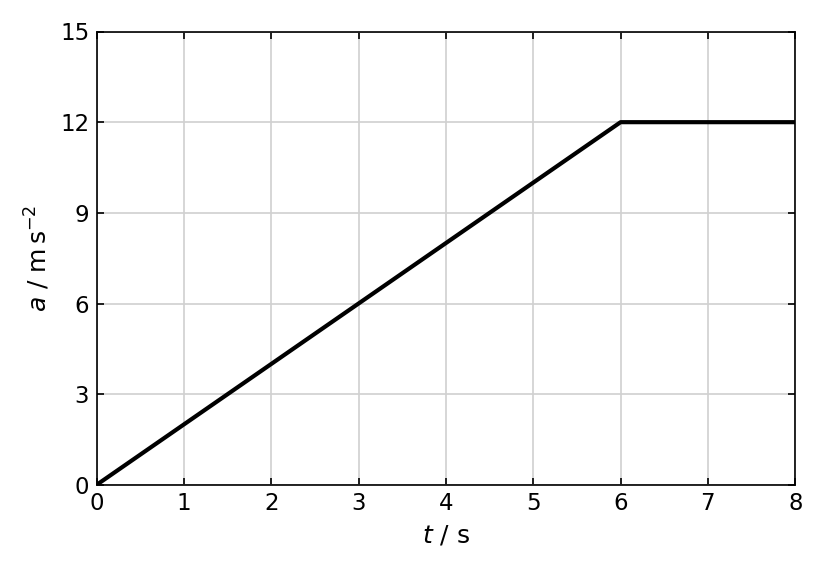
What is the speed of the rocket when ?
A.
B.
C.
D.
The area under an acceleration-time graph represents the change in velocity. Remember the rocket starts from rest.
No question on this page matches those filters. Try another difficulty or paper.
28 more Kinematics questions in the app
Every answer is marked mark by mark, IB-style, and the AI tutor helps when you are stuck.
Where marks are lost
- Stopping one step short of the conclusion. Two numbers and no sentence is two marks out of three.
- Answering a procedure question with a platitude.
- Losing precision in Paper 1B. Uniquely to this paper, quoting the right number badly loses marks.