Standing Waves and Resonance: notes and practice questions
- This topic covers the formation and characteristics of standing waves and the phenomenon of resonance.
- Standing waves form from the superposition of two identical waves travelling in opposite directions.
- Key features include nodes (points of zero displacement) and antinodes (points of maximum displacement).
- Standing wave patterns are observed in strings (fixed/free boundaries) and pipes (open/closed ends).
- Resonance occurs when a system is driven at its natural frequency, leading to large amplitude oscillations.
- Damping affects the maximum amplitude and resonant frequency, categorized as light, critical, or heavy.
- The wavelength and frequency of harmonics can be determined for strings and pipes.
How it is examined
Both papers. Paper 1A likes the "which diagram shows the third harmonic in a pipe closed at one end" item. Paper 2 asks for a sketch of a mode, then a determine of frequency from length and wave speed. Damping is examined qualitatively only: a question asking for a numerical damping coefficient is out of syllabus.
- the nature and formation of standing waves in terms of superposition of two identical waves travelling in opposite directions
- nodes and antinodes, relative amplitude and phase difference of points along a standing wave
- standing wave patterns in strings and pipes
- the nature of resonance including natural frequency and amplitude of oscillation based on driving frequency
- End corrections for open pipes are not required.
- For standing waves in air, pressure nodes and antinodes are not required.
Guiding questions
- What distinguishes standing waves from travelling waves?
- How does the form of standing waves depend on the boundary conditions?
- How can the application of force result in resonance within a system?
Linking questions
- How does the amplitude of vibration at resonance depend on the dissipation of energy in the driven system?
- What is the relationship between resonance and simple harmonic motion?
- How can resonance be explained in terms of conservation of energy?
- How can the idea of resonance of gas molecules be used to model the greenhouse effect? (NOS)
Practice questions
13 questions · 2 easy · 11 mediumQuestion 1
EasyPaper 1A · calculator1 markA flute is modelled as a pipe of length that is open at both ends.
What is the wavelength of the fourth-harmonic standing wave in the flute?
A.
B.
C.
D.
For a pipe open at both ends, the length of the pipe is related to the wavelength by the equation , where is the harmonic number. Use this relationship for the fourth harmonic.
Question 2
MediumPaper 1A · calculator1 markA third-harmonic standing wave is formed on a string of length that is fixed at both ends.
What two points along the string have a phase difference of ?
A. and
B. and
C. and
D. and
First, determine the wavelength of the standing wave using the formula for a string fixed at both ends. Then, identify the positions of the nodes. Points in adjacent loops (sections between nodes) oscillate in antiphase, meaning they have a phase difference of .
Question 3
EasyPaper 1A · calculator1 markA standing wave is formed on a string of length that is fixed at both ends. The standing wave has three antinodes. What is the wavelength of the standing wave?
A.
B.
C.
D.
For a string fixed at both ends, there must be a node at each end. Sketch the standing wave pattern with three antinodes between the two fixed ends. How many half-wavelengths fit into the length ?
Question 4
MediumPaper 2 · calculator6 marksA sound engineer is designing a set of organ pipes, each closed at one end. The speed of sound in the concert hall is measured to be . One particular pipe is designed to resonate at its fundamental frequency when a sound wave of frequency is introduced.
(a) Calculate the wavelength of the sound wave produced by the source.
(b) The organ pipe can be adjusted in length to be between and . Determine all possible lengths of the pipe for which it would resonate with the sound wave.
Recall the relationship between wave speed, frequency, and wavelength.
For a closed-end pipe, resonance occurs when the length is an odd multiple of one-quarter wavelength.
Question 5
MediumPaper 2 · calculator8 marksA musician is designing two new wind instruments: a flute, which can be modelled as an open pipe, and a clarinet, which can be modelled as a closed pipe. The third harmonic frequency produced by the flute is found to be identical to the fifth harmonic frequency produced by the clarinet.
(a) Calculate the ratio .
(b) Determine the ratio .
Recall the formulas for harmonic frequencies in open pipes and closed pipes. Remember that for a closed pipe, only odd harmonics are present.
The fundamental frequency is the first harmonic. Use the relationship between the lengths found in part (a).
Question 6
MediumPaper 1A · calculator1 markA student performs an experiment with a resonating air column, using a tube closed at one end. The effective length of the air column is . The speed of sound in the air inside the tube is measured to be .
What are the frequencies of the first two harmonics that can be produced in this tube?
A. and
B. and
C. and
D. and
Recall the formula for the fundamental frequency of a pipe closed at one end. Remember that only odd harmonics are present in such a pipe.
Question 7
MediumPaper 1A · calculator1 markA musician designs two wind instruments. The first instrument is a flute, effectively a pipe open at both ends, with a length of . Its fundamental (first harmonic) frequency is . The second instrument is a pan flute pipe, effectively open at one end and closed at the other, designed to produce the same fundamental frequency .
If the length of the flute (open at both ends) is , what is the length of the pan flute pipe (open at one end and closed at the other)?
A.
B.
C.
D.
Recall the relationship between length and wavelength for the first harmonic in pipes open at both ends and pipes open at one end and closed at the other. The frequency is given by , where is the speed of sound.
Question 8
MediumPaper 1A · calculator1 markA car's suspension system is designed to be heavily damped. The car travels over a series of bumps on a road. The frequency of the bumps, , depends on the speed of the car. The natural frequency of the car's vertical oscillation is . Which graph best shows the variation of the amplitude of the car's vertical oscillations with the frequency ?
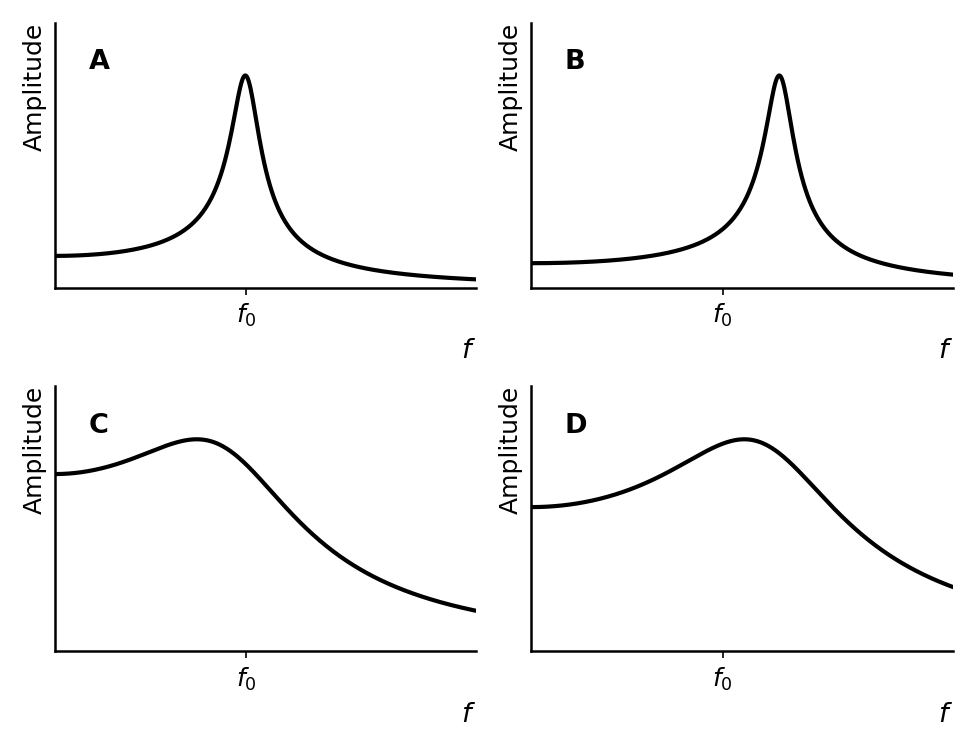
Consider how heavy damping affects two key features of the resonance curve: the maximum amplitude and the sharpness (or broadness) of the peak.
Question 9
MediumPaper 1A · calculator1 markA standing sound wave is formed in a pipe of length that is closed at one end. The standing wave has two nodes. What is the wavelength of the standing wave?
A.
B.
C.
D.
A pipe closed at one end must have a node at the closed end and an antinode at the open end. Sketch the wave pattern for a standing wave with two nodes that fits these boundary conditions. How many quarter-wavelengths fit into the length ?
Question 10
MediumPaper 1A · calculator1 markThe absorption of infrared radiation by greenhouse gases is a key part of the greenhouse effect. This absorption is particularly effective because
A. the greenhouse gases are at a much higher temperature than the Earth's surface.
B. the infrared radiation causes the gas molecules to undergo nuclear fission.
C. the frequency of the infrared radiation matches the natural vibrational frequency of the greenhouse gas molecules.
D. the greenhouse gas molecules are much larger than the other molecules in the atmosphere.
Think about the conditions required for resonance to occur. How does energy transfer from a wave to an oscillator?
Question 11
MediumPaper 1A · calculator1 markAn organ pipe that is closed at one end resonates in its first overtone with a frequency of .
What are two other resonant frequencies, in , for this pipe?
A. and
B. and
C. and
D. and
For a pipe closed at one end, only odd harmonics are present. The 'first overtone' is the next possible frequency after the fundamental frequency. First, determine which harmonic number corresponds to the first overtone. Then, calculate the fundamental frequency and use it to find other possible resonant frequencies.
Question 12
MediumPaper 1A · calculator1 markAn organ pipe is closed at one end. It resonates in the fifth harmonic with a frequency of .
What are two other harmonic frequencies, in Hz, at which this pipe can resonate?
A. and
B. and
C. and
D. and
Recall the relationship between the harmonic frequencies for a pipe that is closed at one end. Which harmonics are possible in this system? Use the given harmonic to find the fundamental frequency.
Question 13
MediumPaper 1A · calculator1 markA string of length is fixed at both ends and vibrates in its second harmonic. What is the phase difference between a point on the string at a distance of from one end and a point at a distance of from the same end?
A.
B.
C.
D.
Identify the positions of the nodes for the second harmonic. Are the two points in the same loop (between the same two adjacent nodes) or in different loops?
No question on this page matches those filters. Try another difficulty or paper.
Every Standing Waves and Resonance question, marked for you
Every answer is marked mark by mark, IB-style, and the AI tutor helps when you are stuck.
Where marks are lost
- Stopping one step short of the conclusion. Two numbers and no sentence is two marks out of three.
- Answering a procedure question with a platitude.
- Losing precision in Paper 1B. Uniquely to this paper, quoting the right number badly loses marks.