Rigid Body Mechanics: notes and practice questions
- This topic extends linear motion concepts to rotational motion, focusing on torques, angular kinematics, and angular momentum for rigid bodies.
- Torque causes angular acceleration , related by Newton's second law for rotation .
- Rotational motion is described by angular displacement , angular velocity , and angular acceleration .
- Equations for uniform angular acceleration are analogous to linear kinematics.
- Moment of inertia depends on mass distribution, with for a system of point masses.
- Angular momentum is conserved if no resultant external torque acts on the system.
- Rotational kinetic energy is given by .
How it is examined
HL Paper 1A and HL Paper 2 only. Typical shapes are a rotational-equilibrium calculation, a "coupled bodies" angular momentum conservation problem, and a rolling-without-slipping energy split. Command terms: determine, show, calculate, explain. If a question needs a moment of inertia formula, the formula belongs in the stem.
All four rotational equations of motion, , , , , , . Moments of inertia of standard shapes (disc, hoop, rod, sphere) are not in the booklet: the guidance says the equation "will be provided when necessary", meaning in the question stem. A generated question must supply it too.
There is no standard level content in A.4.
- A calculation of the centre of mass of bodies is not required; there should be an understanding that when considering linear motion, the mass of an extended body may be taken as concentrated at the centre of mass.
- The term angular velocity will be used although a formal vector treatment is not required.
Guiding questions
- How can the understanding of linear motion be applied to rotational motion?
- How is the understanding of the torques acting on a system used to predict changes in rotational motion?
- How does the distribution of mass within a body affect its rotational motion?
Linking questions
- How does rotation apply to the motion of charged particles or satellites in orbit?
- How does conservation of angular momentum lead to the determination of the Bohr radius?
- How does a torque lead to simple harmonic motion?
- How are the laws of conservation and equations of motion in the context of rotational motion analogous to those governing linear motion?
- How can rotation lead to the generation of an electric current?
Practice questions
25 questions · 3 easy · 21 medium · 1 hardQuestion 1
EasyPaper 1A · calculator1 markWhat is the SI base unit of moment of inertia?
A.
B.
C.
D.
Recall the definition of moment of inertia for a point mass, . Consider the SI base units for mass and distance (radius).
Question 2
MediumPaper 1A · calculator1 markA potter's wheel with a moment of inertia of 8.0 kg m is rotating freely with an angular speed of 20 rad s. The potter applies a gentle braking force, slowing the wheel to an angular speed of 5.0 rad s.
What is the magnitude of the angular impulse exerted on the wheel?
A. 40 kg m s
B. 120 kg m s
C. 160 kg m s
D. 200 kg m s
Recall the relationship between angular impulse and the change in angular momentum. Angular momentum is the product of the moment of inertia and angular velocity.
Question 3
HardPaper 2 · calculator9 marksA large potter's wheel, with a moment of inertia of , is initially at rest. A motor uniformly accelerates it to an angular speed of in .
(a) Calculate the resultant torque acting on the potter's wheel during this acceleration.
(b) Calculate the rotational kinetic energy of the potter's wheel when it reaches an angular speed of .
(c) The potter's wheel has a radius of . After the motor is switched off, a friction pad is applied to its circumference, bringing it to rest from an angular speed of in exactly revolutions. Determine the magnitude of the braking force applied by the friction pad.
First, determine the angular acceleration using the given angular speeds and time. Then, use the relationship between torque, moment of inertia, and angular acceleration.
Recall the formula for rotational kinetic energy in terms of moment of inertia and angular speed.
First, convert the number of revolutions to radians. Then, use a rotational kinematic equation to find the angular deceleration. From the angular deceleration and moment of inertia, find the braking torque. Finally, relate the torque to the braking force and the radius.
Question 4
EasyPaper 2 · calculator4 marksA flywheel in an energy storage system is accelerated uniformly from an angular velocity of to in a time of .
Calculate the angular acceleration of the flywheel.
Calculate the angular displacement of the flywheel during this interval.
Use the kinematic equation for angular motion that relates initial angular velocity, final angular velocity, time, and angular acceleration.
You can use the equation for angular displacement involving average angular velocity and time, or the one involving initial angular velocity, time, and angular acceleration.
Question 5
MediumPaper 2 · calculator4 marks(a) A solid cylinder of mass and radius is given an initial horizontal speed of at the base of an inclined plane. The cylinder rolls without slipping up the incline. The moment of inertia of a solid cylinder about its central axis is .
Determine the maximum vertical height, , that the cylinder reaches up the incline.
Apply the principle of conservation of mechanical energy. The initial energy is purely kinetic (translational and rotational), and the final energy at maximum height is purely gravitational potential energy. Remember the condition for rolling without slipping: .
Question 6
EasyPaper 2 · calculator2 marksAn electric motor drives a large industrial fan at a constant angular velocity of . The motor supplies a useful power of to the fan.
Calculate the magnitude of the torque exerted by the motor on the fan.
Recall the relationship between power, torque, and angular velocity for a rotating system.
Question 7
MediumPaper 2 · calculator10 marksA figure skater is spinning on a horizontal ice surface. There is a small frictional torque exerted by the ice on the skates.
(a) State and explain the effect of this frictional torque on the skater's angular momentum.
(b) While spinning, the skater pulls their arms in towards their body. Ignoring the effects of friction, explain why the total angular momentum of the skater is conserved during this action.
(c) Deduce the effect of pulling their arms in on the skater's angular velocity.
(d) Explain what happens to the skater's rotational kinetic energy when they pull their arms in.
Consider the relationship between torque and the rate of change of angular momentum. Is the frictional torque in the direction of motion or opposing it?
Consider the forces the skater uses to pull their arms in. Are these forces external or internal to the skater as a system? What is the condition for conservation of angular momentum?
How does pulling the arms in affect the skater's moment of inertia? Use the principle of conservation of angular momentum to relate this change to the angular velocity.
Write the rotational kinetic energy in terms of angular momentum and moment of inertia. You know what happens to both of these quantities. Where does any change in energy come from?
Question 8
MediumPaper 2 · calculator4 marks(a) A laboratory centrifuge starts from rest and uniformly increases its angular speed to in . Calculate the angular acceleration of the centrifuge.
(b) Calculate the total angular displacement of the centrifuge during this interval.
Recall the definition of angular acceleration, which is the rate of change of angular velocity. Use the appropriate kinematic equation for constant angular acceleration.
You can use the angular acceleration calculated in part (a), or a kinematic equation that relates initial and final angular speeds, time, and angular displacement directly.
Question 9
MediumPaper 2 · calculator2 marks(a) A large wind turbine generates electrical power at a rate of when its blades are rotating at . Calculate the magnitude of the torque exerted by the wind on the turbine shaft.
Remember to convert the angular speed from revolutions per minute to radians per second before using the power-torque relationship.
Question 10
MediumPaper 2 · calculator5 marksA potter's wheel, designed with most of its mass concentrated at the rim, rotates around a central axis. Its angular speed is increased uniformly from to over a period of . The wheel has a mass of and a radius of .
Calculate the work done by the motor's torque acting on the wheel.
Calculate the average power supplied to the wheel by the motor during this time.
Recall the work-energy theorem for rotational motion. The moment of inertia for a wheel with mass concentrated at the rim is .
Average power is the total work done divided by the time taken.
Question 11
MediumPaper 2 · calculator4 marksA horizontal playground carousel, initially rotating freely about a vertical axis through its centre, has a uniform rotational frequency of . A child of mass is standing at a distance of from the centre of the carousel. The child then walks towards the centre, stopping at a distance of from the centre. The rotational frequency of the carousel and child system increases to .
Calculate the moment of inertia of the carousel.
Consider the principle of conservation of angular momentum. The angular momentum of the system (carousel + child) remains constant. The moment of inertia of the child changes as their distance from the axis of rotation changes. Remember that angular frequency .
Question 12
MediumPaper 2 · calculator5 marksA large industrial flywheel, initially at rest, is subjected to a constant torque of . The flywheel has a moment of inertia of about its central axis.
(a) Calculate the angular acceleration produced.
(b) Calculate the linear speed of a point on the rim of the flywheel after . The radius of the flywheel is .
Recall the rotational analogue of Newton's second law.
First, determine the final angular velocity using the angular acceleration from part (a). Then, relate angular velocity to linear speed.
Question 13
MediumPaper 1A · calculator1 markA flywheel of moment of inertia is accelerated from rest by a constant net torque. The resulting angular acceleration is constant.
What is the rotational kinetic energy of the flywheel after it has completed two full rotations?
A.
B.
C.
D.
First, find the angular displacement in radians for two full rotations. Then, use a rotational kinematic equation to find the square of the final angular velocity in terms of and the displacement. Finally, substitute this into the formula for rotational kinetic energy.
Question 14
MediumPaper 1A · calculator1 markA ceiling fan, initially at rest, accelerates uniformly for . The final angular velocity of the fan blades is .
How many revolutions did the fan blades complete during this time?
A.
B.
C.
D.
Recall the rotational kinematic equation that relates initial angular velocity, final angular velocity, time, and angular displacement. Remember to convert the angular displacement from radians to revolutions.
Question 15
MediumPaper 1A · calculator1 markA solid uniform cylinder of mass and radius rolls without slipping on a horizontal surface. The linear speed of its centre of mass is . The moment of inertia of the cylinder about its central axis is .
What is the ratio ?
A.
B.
C.
D.
The total kinetic energy is the sum of the translational kinetic energy and the rotational kinetic energy. Remember the relationship between linear speed and angular speed for an object rolling without slipping.
Question 16
MediumPaper 1A · calculator1 markTwo celestial bodies, a planet and a moon, are observed to have the same rotational kinetic energy about their respective axes. The planet has a moment of inertia and the moon has a moment of inertia .
What is the ratio ?
A.
B.
C.
D.
Recall the relationship between rotational kinetic energy, angular momentum, and moment of inertia. Express angular momentum in terms of rotational kinetic energy and moment of inertia.
Question 17
MediumPaper 1A · calculator1 markA solid sphere of mass and radius is released from rest at the top of a ramp of vertical height . The sphere rolls without slipping.
The moment of inertia of a solid sphere about its center is .
What is the speed of the sphere when it reaches the bottom of the ramp?
A.
B.
C.
D.
Apply the principle of conservation of energy. Consider both translational and rotational kinetic energy, and relate the angular speed to the translational speed for rolling without slipping.
Question 18
MediumPaper 1A · calculator1 markA laboratory experiment investigates the rotational motion of a uniform disk. The graph shows how the angular acceleration of the disk varies with the net torque applied to it.
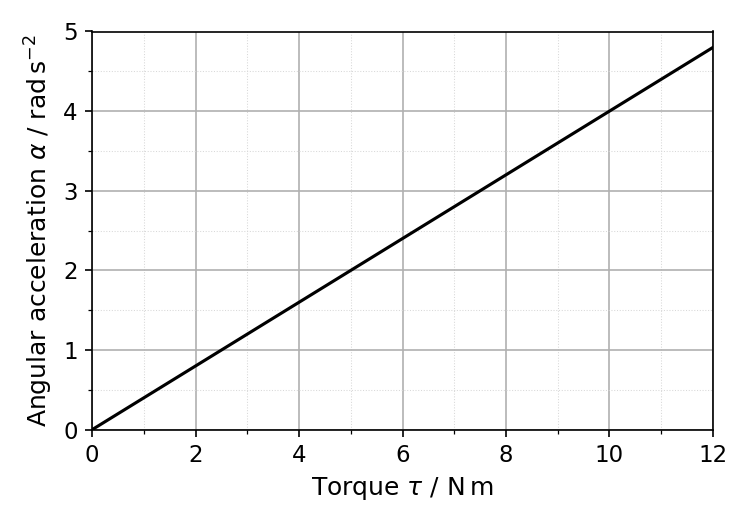
What is the moment of inertia of the disk?
A.
B.
C.
D.
The relationship between net torque , moment of inertia , and angular acceleration is given by . Rearrange this equation to find and consider how the graph of versus relates to this formula.
Question 19
MediumPaper 2 · calculator3 marksA horizontal circular platform rotates freely about a vertical axis through its centre with an angular velocity of . A lump of clay of mass is dropped onto the platform and sticks to it at a distance of from the axis of rotation. The angular velocity of the platform decreases to .
Determine the moment of inertia of the platform.
Remember that angular momentum is conserved when no external torque acts on the system. The final moment of inertia includes both the platform and the clay.
Question 20
MediumPaper 2 · calculator5 marksA uniform solid cylindrical flywheel rotates around an axis through its centre. The angular velocity of the flywheel is increased from to in . The mass of the flywheel is and its radius is .
(a) Calculate the work done by the torque acting on the flywheel.
(b) Calculate the average power applied to the flywheel during this time.
Recall the formula for the moment of inertia of a solid cylinder from the data booklet. Then, use the work-energy theorem for rotational motion, which states that the work done equals the change in rotational kinetic energy.
Average power is the total work done divided by the time taken.
No question on this page matches those filters. Try another difficulty or paper.
5 more Rigid Body Mechanics questions in the app
Every answer is marked mark by mark, IB-style, and the AI tutor helps when you are stuck.
Where marks are lost
- Stopping one step short of the conclusion. Two numbers and no sentence is two marks out of three.
- Answering a procedure question with a platitude.
- Losing precision in Paper 1B. Uniquely to this paper, quoting the right number badly loses marks.