Fission: notes and practice questions
- This topic explores nuclear fission, focusing on how energy is released and harnessed.
- Understand energy release in spontaneous and neutron-induced fission.
- Know the role of chain reactions in nuclear fission reactors.
- Identify the functions of control rods, moderators, heat exchangers, and shielding in nuclear power plants.
- Describe the properties and management of nuclear fission products.
- Perform calculations to determine the energy released in fission reactions.
- Consider the impact of long-term storage of nuclear waste.
How it is examined
Both papers, both levels, and small: 4 hours of teaching. The two shapes are a mass-defect energy calculation from supplied nuclide masses, and a describe or outline of what a moderator or control rod does. This is one of the few places in the syllabus where a well-formed question can be almost pure AO1 recall.
- that energy is released in spontaneous and neutron-induced fission
- the role of chain reactions in nuclear fission reactions
- the role of control rods, moderators, heat exchangers and shielding in a nuclear power plant
- the properties of the products of nuclear fission and their management
Guiding questions
- In which form is energy stored within the nucleus of the atom?
- How can the energy released from the nucleus be harnessed?
Linking questions
- In which form is energy released as a result of nuclear fission?
- How is binding energy used to determine the rate of energy production in a nuclear power plant?
- To what extent is there a role for fission in addressing climate change? (NOS)
Practice questions
21 questions · 10 easy · 9 medium · 2 hardQuestion 1
EasyPaper 1A · calculator1 markWhat is the primary function of the moderator in a thermal nuclear fission reactor?
A. To absorb excess neutrons to control the rate of the chain reaction.
B. To reduce the kinetic energy of fast neutrons.
C. To transfer thermal energy from the reactor core to the heat exchanger.
D. To provide shielding against ionizing radiation.
Consider the conditions required for a neutron to be captured by a U-235 nucleus and induce fission. How does the moderator help create these conditions?
Question 2
MediumPaper 1A · calculator1 markIn a conceptual model of a fusion-fission hybrid reactor, an average of five neutrons are produced for every fission event.
The average number of neutrons absorbed by a surrounding lithium blanket to breed tritium is per fission.
The average number of neutrons that escape the reaction chamber is per fission.
The remaining neutrons are available to induce further fission events.
What are possible values for and for the reactor to operate in a critical state?
| A. | 1 | 2 |
| B. | 2 | 2 |
| C. | 3 | 2 |
| D. | 2 | 1 |
For a reactor to be in a critical state (maintain a steady reaction), how many neutrons from each fission event must go on to cause exactly one more fission event? Consider how the total number of neutrons produced is distributed among the different processes.
Question 3
HardPaper 2 · calculator16 marksA prototype nuclear reactor uses Plutonium-239 () as fuel. When a neutron is captured by a Plutonium-239 nucleus, one of two possible fission reactions can occur.
Reaction 1:
Reaction 2:
The following data are available:
| Nuclide/Particle | Mass / u |
|---|---|
| Plutonium-239 () | 239.05216 |
| Xenon-134 () | 133.90539 |
| Zirconium-103 () | 102.92658 |
| Cerium-144 () | 143.91365 |
| Krypton-94 () | 93.93436 |
| Neutron (n) | 1.00867 |
| Nuclide/Particle | Mass / u |
|---|---|
| Plutonium-239 () | 239.05216 |
| Xenon-134 () | 133.90539 |
| Zirconium-103 () | 102.92658 |
| Cerium-144 () | 143.91365 |
| Krypton-94 () | 93.93436 |
| Neutron (n) | 1.00867 |
| 1 u is equivalent to 931.5 MeV |
(a) Show that the energy released in Reaction 1 is approximately 189 MeV.
(b) Determine the energy released in Reaction 2.
(c) Outline why the neutrons produced in a fission reaction must be slowed down in a thermal nuclear reactor.
The reactor has a useful electrical power output of 550 MW and an overall efficiency of 32%. Assume that all fission events in the reactor follow Reaction 1.
(i) Calculate the total thermal power produced by the fission reactions.
(ii) Calculate the number of Plutonium-239 nuclei that undergo fission every second.
(iii) Calculate the mass of Plutonium-239 that undergoes fission in one week.
Calculate the total mass of the reactants and the total mass of the products. The difference in mass (mass defect) is converted into energy according to Einstein's mass-energy equivalence principle. Remember to use the conversion factor provided.
Follow the same procedure as in part (a), but for Reaction 2.
Think about what makes a neutron more likely to be captured by a fissile nucleus. What is the energy state of the neutrons produced by fission?
Efficiency is the ratio of useful output power to total input power. You are given the useful electrical power and the efficiency.
You know the total thermal energy produced per second (from d.i) and the energy released per single fission event (from a). How can you find the number of events per second?
First, find the total number of fission events in one week. Then, use Avogadro's constant to convert this number of atoms into moles. Finally, use the molar mass of Plutonium-239 to find the total mass.
Question 4
EasyPaper 1A · calculator1 markWhat is the primary function of the control rods in a thermal nuclear reactor?
A. To slow down fast-moving neutrons to thermal speeds.
B. To absorb neutrons, thereby controlling the rate of fission reactions.
C. To transfer thermal energy from the reactor core to a heat exchanger.
D. To undergo fission and release energy.
Consider how a chain reaction is controlled. The rate of reaction depends on the number of available particles that can induce further reactions. Which component manages this number?
Question 5
MediumPaper 2 · calculator14 marksThis question is about a nuclear reactor for a submarine.
A new design for a compact nuclear reactor for a deep-sea exploration submarine uses plutonium-239 as its fuel. The fission of a plutonium-239 nucleus is induced by a single neutron. One possible reaction is:
(a) Explain, with reference to binding energy, why this fission reaction releases a significant amount of energy.
(b) The reaction shown in part (a) produces more neutrons than it consumes. Describe how this can lead to a self-sustaining chain reaction.
(c) For the reactor to operate safely and efficiently, several key components are required. Outline the function of the following components in the submarine's reactor.
(i) The moderator.
(ii) The control rods.
(iii) The heat exchanger.
(d) The spent fuel from the submarine's reactor is highly radioactive. Discuss two problems associated with the safe disposal of this nuclear waste.
Think about the relationship between binding energy and the stability of a nucleus. How does the total binding energy of the reactants compare to that of the products?
What do the neutrons produced in one fission event go on to do? What condition is needed for the reaction to be 'self-sustaining'?
Fission of Pu-239 is most likely with slow-moving neutrons. What is the role of the moderator in this process?
How is the rate of the chain reaction controlled to prevent it from becoming too fast or too slow?
The fission reactions produce a huge amount of thermal energy. How is this energy transferred out of the reactor core to be used, for example, to power the submarine's turbines?
Consider the properties of the waste (e.g., how long it remains dangerous) and the challenges this poses for storage. Think about environmental and security risks.
Question 6
HardPaper 2 · calculator20 marksAn exoplanet named Xylos orbits a star named Aethel. Scientists are studying its atmospheric conditions and the properties of its host star.
(a) State what is meant by the stellar constant for Xylos.
(b) The following data are given for exoplanet Xylos:
Average albedo of Xylos
Average orbital distance from Aethel
Average global surface temperature of Xylos
Luminosity of star Aethel
(i) Outline the physical mechanism by which some of the infrared radiation emitted by the surface of Xylos is absorbed by its atmospheric gases and re-radiated back towards the surface.
(ii) Show that the average global intensity of radiation absorbed by the surface of Xylos is about .
(iii) Determine the average intensity re-radiated by Xylos's atmosphere towards its surface. Assume that the emissivity of the surface is .
(c) Calculate the total power (luminosity) radiated by the star Aethel, based on the stellar constant at Xylos's orbit.
(d) A possible fusion reaction occurring in stars like Aethel is the deuterium-tritium (D-T) fusion reaction:
Relevant atomic masses are:
Mass of deuterium ()
Mass of tritium ()
Mass of helium-4 ()
Mass of neutron ()
(i) Calculate, in , the energy released in the reaction.
(ii) Outline the role of fusion reactions in maintaining a stable radius for a star like Aethel.
(iii) Outline how the presence of hydrogen in Aethel can be confirmed empirically.
(e) Aethel has a surface temperature of and a luminosity times that of the Sun.
(i) State the star type of Aethel.
(ii) Discuss how nuclear fusion processes in a red dwarf star differ from those in the Sun.
Recall the definition of the solar constant and adapt it to a general star-planet system.
Consider the interaction of infrared radiation with greenhouse gas molecules at a molecular level.
First, calculate the stellar constant at Xylos's orbit. Then, consider the average incoming intensity over the planet's surface and the effect of albedo.
Use the Stefan-Boltzmann law to calculate the intensity emitted by the surface. Then apply the energy balance principle.
The stellar constant is the intensity at a given distance. The total power is radiated spherically outwards.
Calculate the mass defect () in atomic mass units (u) and then convert it to energy using the conversion factor .
Consider the forces acting within a star and how fusion affects them.
Think about how light from stars is analyzed to determine their composition.
Compare Aethel's temperature and luminosity to that of the Sun and other common star types on the Hertzsprung-Russell diagram.
Consider the core temperature, mass, and lifespan of red dwarfs compared to the Sun, and how these factors influence fusion.
Question 7
EasyPaper 1A · calculator1 markIn a prototype fast breeder reactor, the fission of a uranium-238 nucleus by a fast neutron produces, on average, 5 neutrons.
In this reactor model:
- The average number of neutrons absorbed by the moderator and control systems is per fission.
- The average number of neutrons that escape the reactor core is per fission.
- For the reaction to be self-sustaining and critical, one neutron from each fission must induce a subsequent fission.
What are possible average values for and for the reactor to operate at a critical state?
| A. | 2 | 1 |
| B. | 3 | 1 |
| C. | 2 | 3 |
| D. | 4 | 2 |
For a critical or steady reaction, the number of neutrons produced in one generation must exactly equal the number of neutrons lost plus the one neutron needed to start the next fission. Set up an equation to represent this balance.
Question 8
MediumPaper 1A · calculator1 markA proposed fusion power plant uses the reaction of one deuterium nucleus () and one tritium nucleus (). This reaction converts a mass of into energy. In a conventional fission power plant, the fission of one uranium-235 nucleus converts a mass of into energy.
What is the ratio of ?
A.
B.
C.
D.
To calculate the energy released per unit mass of fuel, divide the mass converted into energy (mass defect) by the total initial mass of the fuel involved in that specific reaction. For the hydrogen fuel, consider the combined mass of the deuterium and tritium nuclei.
Question 9
EasyPaper 1A · calculator1 markWhat is the primary function of control rods in a nuclear fission reactor?
A. To slow down fast neutrons to thermal energies.
B. To absorb excess neutrons to control the reaction rate.
C. To transfer thermal energy from the reactor core.
D. To provide shielding against ionizing radiation.
A chain reaction is sustained by neutrons causing further fissions. To control the power output of the reactor, the rate of this chain reaction must be managed. What role could the control rods play in this process?
Question 10
MediumPaper 1A · calculator1 markA nucleus of plutonium-239 () absorbs a neutron and undergoes fission, producing two daughter nuclides, xenon-140 () and zirconium-97 ().
How many neutrons are released in this reaction?
A.
B.
C.
D.
Apply the principle of conservation of mass number (nucleon number) in the nuclear reaction. The mass number of an incident neutron is 1, and for a released neutron, it is also 1.
Question 11
EasyPaper 1A · calculator1 markWhat is the primary role of the control rods in a nuclear fission reactor?
A. To slow down the neutrons produced in fission reactions.
B. To absorb excess neutrons, thereby controlling the rate of reaction.
C. To transfer thermal energy from the reactor to a heat exchanger.
D. To prevent the escape of harmful radiation from the reactor.
Think about what a 'chain reaction' is and how one might control its speed. The number of neutrons available for fission is key.
Question 12
MediumPaper 1A · calculator1 markA reactor uses plutonium-239 () as fuel. When a nucleus of plutonium-239 absorbs a neutron, it undergoes fission, producing barium-144 () and strontium-94 () as fission products.
How many neutrons are released in this reaction?
A.
B.
C.
D.
Recall the conservation of nucleon number (mass number) and proton number (atomic number) in nuclear reactions.
Question 13
EasyPaper 1A · calculator1 markWhat is the primary function of the control rods in a thermal nuclear reactor?
A. To slow down fast-moving neutrons to increase the probability of fission.
B. To absorb neutrons to regulate the rate of the chain reaction.
C. To transfer thermal energy from the reactor core to a secondary fluid.
D. To contain the fissile material such as Uranium-235.
Consider what needs to be controlled to maintain a steady power output in a chain reaction. Each component of the reactor has a specific role.
Question 14
MediumPaper 1A · calculator1 markA graph of the variation with nucleon number of the binding energy per nucleon is shown.
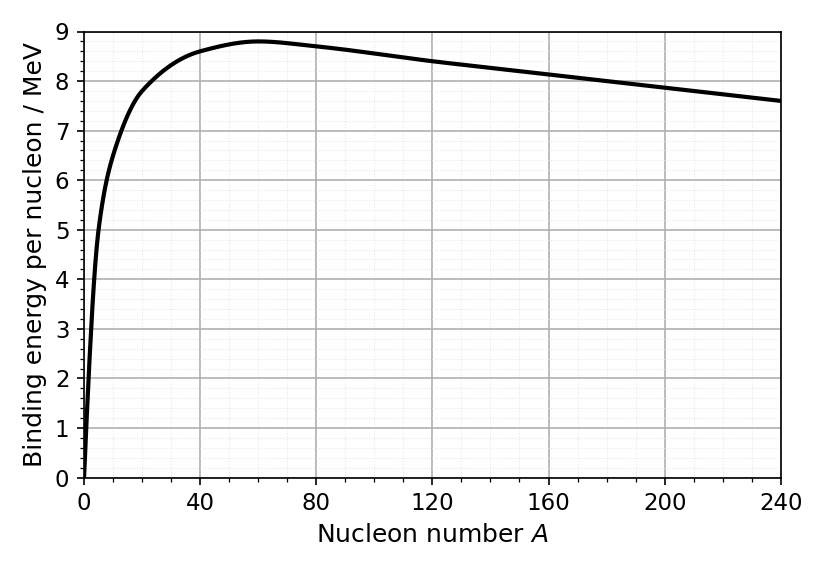
What is the approximate total energy, in , needed to completely separate the nucleons of a nucleus?
A.
B.
C.
D.
Identify the nucleon number for the given nucleus. Use the graph to find the approximate binding energy per nucleon for this value of . Then, multiply this value by the nucleon number to find the total binding energy.
Question 15
EasyPaper 1A · calculator1 markWhat is the primary role of the control rods in a thermal nuclear fission reactor?
A. To slow down neutrons produced in fission reactions.
B. To absorb some of the neutrons to control the reaction rate.
C. To act as a heat transfer medium to remove energy from the core.
D. To provide the fissile material for the chain reaction.
Each component in a nuclear reactor has a specific function. Consider what 'control' means in the context of a chain reaction. What particle is key to sustaining the chain reaction, and how might its quantity be controlled?
Question 16
MediumPaper 1A · calculator1 markConsider the operation of a nuclear fission power plant. Three statements are made:
I. The rate of the chain reaction is controlled by inserting or withdrawing control rods.
II. The moderator is used to absorb the fast neutrons produced in the fission reactions.
III. Uranium fuel is enriched to increase the proportion of the fissionable isotope U-235.
Which of the statements are correct?
A. I and II only
B. I and III only
C. II and III only
D. I, II and III
Review the function of each key component in a nuclear reactor. What is the role of the control rods? What does the moderator do to neutrons, and what does the absorbing? Why is uranium enrichment necessary for many reactor types?
Question 17
EasyPaper 1A · calculator1 markIn a nuclear power station, the operator needs to decrease the power output from the reactor. Which action will achieve this?
A. Inserting the control rods further into the reactor core.
B. Withdrawing the control rods from the reactor core.
C. Increasing the temperature of the moderator.
D. Decreasing the pressure of the steam in the turbine circuit.
Consider the components inside a nuclear reactor that are designed to manage the rate of the chain reaction. What is the function of control rods and how does their position affect the number of neutrons available for fission?
Question 18
MediumPaper 1A · calculator1 markA pressurized water reactor (PWR) is a type of nuclear fission reactor. Consider the following statements about its operation:
I. In the heat exchanger, thermal energy is transferred from the primary coolant loop to a secondary water loop, producing steam to drive a turbine.
II. Withdrawing the control rods from the reactor core causes a decrease in the reactor's power output.
III. The moderator slows down fast neutrons to thermal energies, which increases the probability of them inducing further fission in uranium-235 nuclei.
Which of the statements are correct?
A. I and II only
B. I and III only
C. II and III only
D. I, II and III
Consider the role of each component mentioned: the heat exchanger, the control rods, and the moderator. What is the purpose of each in the overall process of generating electricity from nuclear fission?
Question 19
EasyPaper 1A · calculator1 markA nuclear fission reactor is operating at a steady power output. Which of the following adjustments would cause the power output to begin to increase?
A. Inserting the control rods further into the reactor core.
B. Removing some of the moderator material.
C. Withdrawing the control rods partially from the reactor core.
D. Increasing the pressure within the heat exchanger.
Consider the role of each component in a nuclear reactor. Which component is directly used to control the rate of the chain reaction by affecting the number of available neutrons?
Question 20
MediumPaper 1A · calculator1 markA heavy nucleus P with total binding energy undergoes nuclear fission into two lighter nuclei, Q and R, with total binding energies and respectively. The reaction releases energy. What is the correct relation between these binding energies?
A.
B.
C.
D.
Remember that binding energy is the energy required to break a nucleus apart into its constituent nucleons. If a reaction releases energy, the products must be more tightly bound (have a higher total binding energy) than the reactants.
No question on this page matches those filters. Try another difficulty or paper.
1 more Fission question in the app
Every answer is marked mark by mark, IB-style, and the AI tutor helps when you are stuck.
Where marks are lost
- Stopping one step short of the conclusion. Two numbers and no sentence is two marks out of three.
- Answering a procedure question with a platitude.
- Losing precision in Paper 1B. Uniquely to this paper, quoting the right number badly loses marks.