Quantum Physics: notes and practice questions
- This topic explores the wave-particle duality of light and matter, and the experimental evidence supporting these concepts.
- The photoelectric effect demonstrates light's particle nature, where the maximum kinetic energy of photoelectrons is .
- Matter exhibits wave-like properties, with a de Broglie wavelength given by .
- Compton scattering provides further evidence for the particle nature of light, showing a shift in photon wavelength .
- These phenomena challenge classical wave theory and support the quantum model.
How it is examined
HL Paper 1A and HL Paper 2. The three standard shapes are a photoelectric stopping-potential-against-frequency graph with the gradient giving h and the intercept giving the work function, a de Broglie wavelength calculation for an accelerated electron, and a Compton shift calculation at a stated scattering angle.
, , the Compton shift formula, plus h, and c. Work functions of named metals are supplied in the question. The stopping-potential relation is not printed and has to be reasoned from the definition of potential difference.
There is no standard level content in E.2.
The derivation of the Compton formula is not required.
Guiding questions
- How can light be used to create an electric current?
- What is meant by wave-particle duality?
Linking questions
- How can particles diffract?
- What are the defining features and behaviours of waves?
- What evidence indicates the diffraction of a wave?
- How is photon scattering off an electron similar to and how is it different from the collision of two solid balls?
- Can the Bohr model help explain the photoelectric effect? (NOS)
- How did the explanation of the photoelectric effect lead to the falsification that light was purely a wave? (NOS)
- Why is Compton scattering more convincing evidence for the particle nature of light than that from the photoelectric effect? (NOS)
Practice questions
17 questions · 2 easy · 12 medium · 3 hardQuestion 1
EasyPaper 1A · calculator1 markThe black-body radiation spectrum for a star with a surface temperature of is shown. The intensity units are arbitrary.
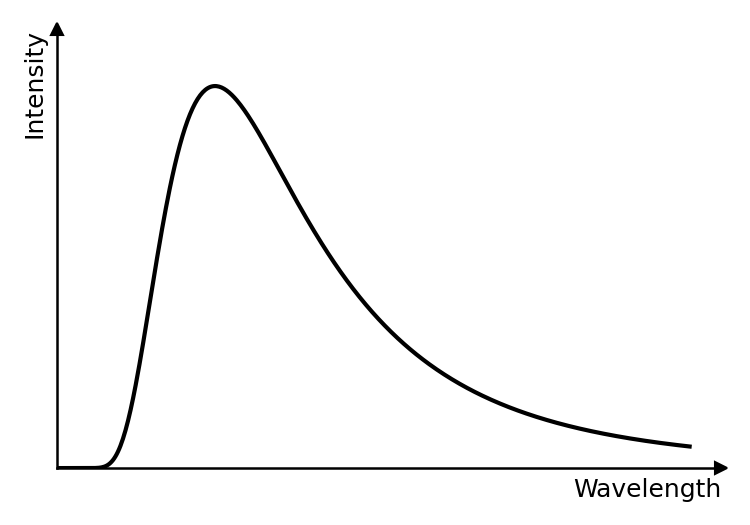
Later in its life cycle, the star's surface temperature increases to . Which graph shows the new radiation spectrum? The original spectrum is shown as a dashed line.
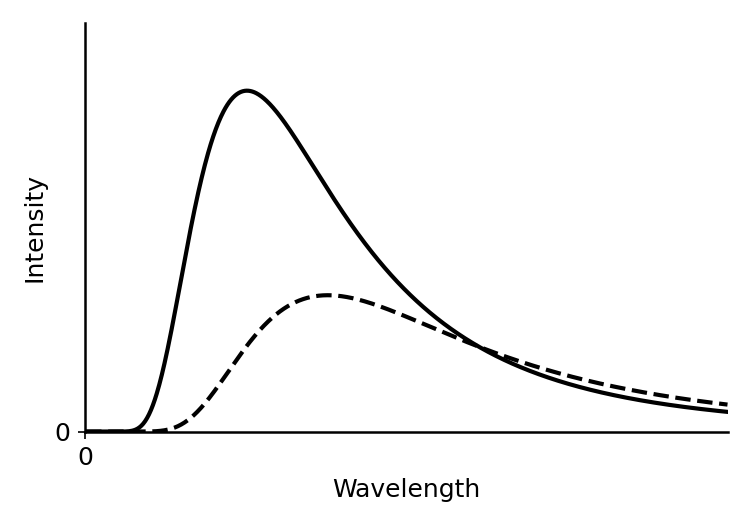
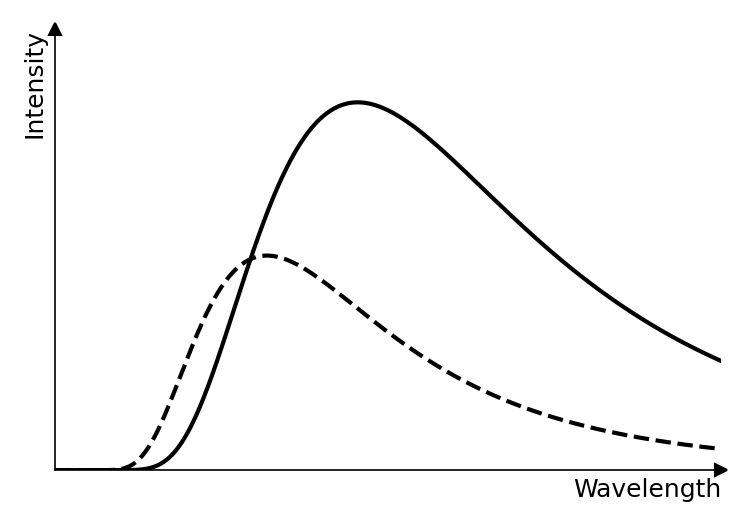
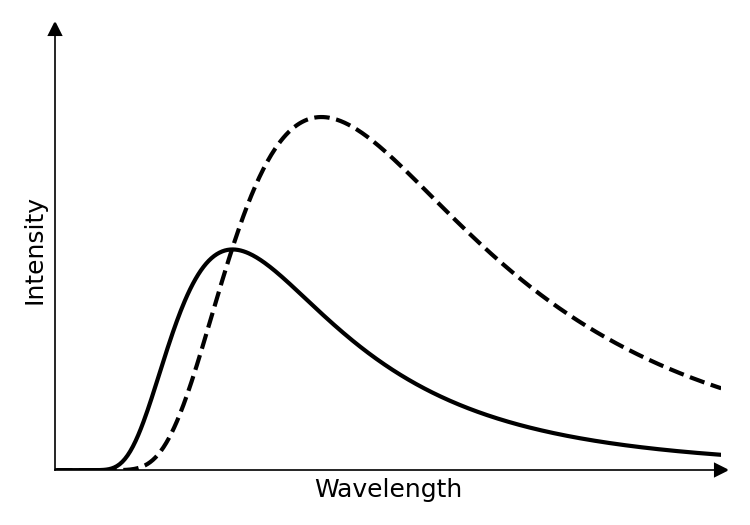
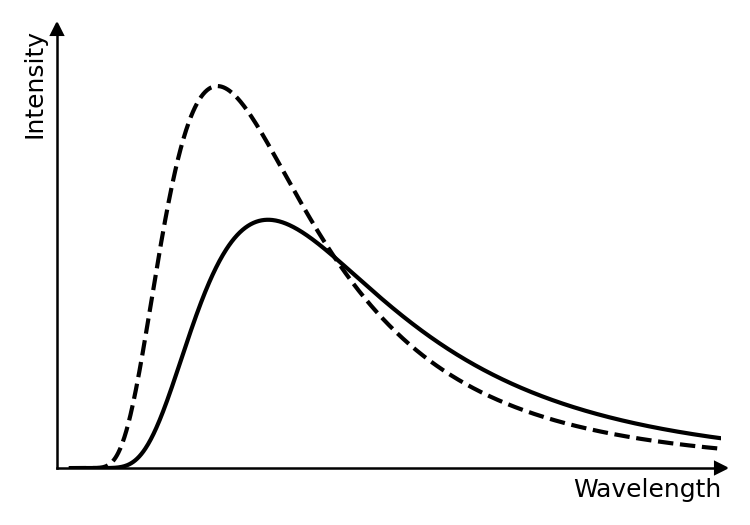
Consider how the peak wavelength and the total power radiated change with temperature. Wien's displacement law relates peak wavelength to temperature, and the Stefan-Boltzmann law relates total power radiated to temperature.
Question 2
MediumPaper 2 · calculator8 marksThis question is about the wave nature of matter.
(a) State the de Broglie hypothesis.
(b)(i) The Davisson-Germer experiment provided evidence for the wave nature of electrons. Outline the experimental setup.
(b)(ii) Explain how the results of this experiment support the de Broglie hypothesis.
Recall the relationship proposed by de Broglie that connects a particle's momentum with a wave property.
Describe the main components of the apparatus. What was the source of particles, what did they interact with, and how were the results detected?
What pattern was observed in the scattered electrons? What phenomenon, typically associated with waves, produces such a pattern? How did the quantitative results confirm de Broglie's idea?
Question 3
HardPaper 2 · calculator12 marksIn an experiment to investigate the photoelectric effect, light of varying frequency is incident on a metal surface. For each frequency, the stopping potential required to prevent any photoelectrons from reaching the collector is measured. The data are used to plot a graph of the maximum kinetic energy of the photoelectrons against the frequency of the incident light. The graph is shown below.
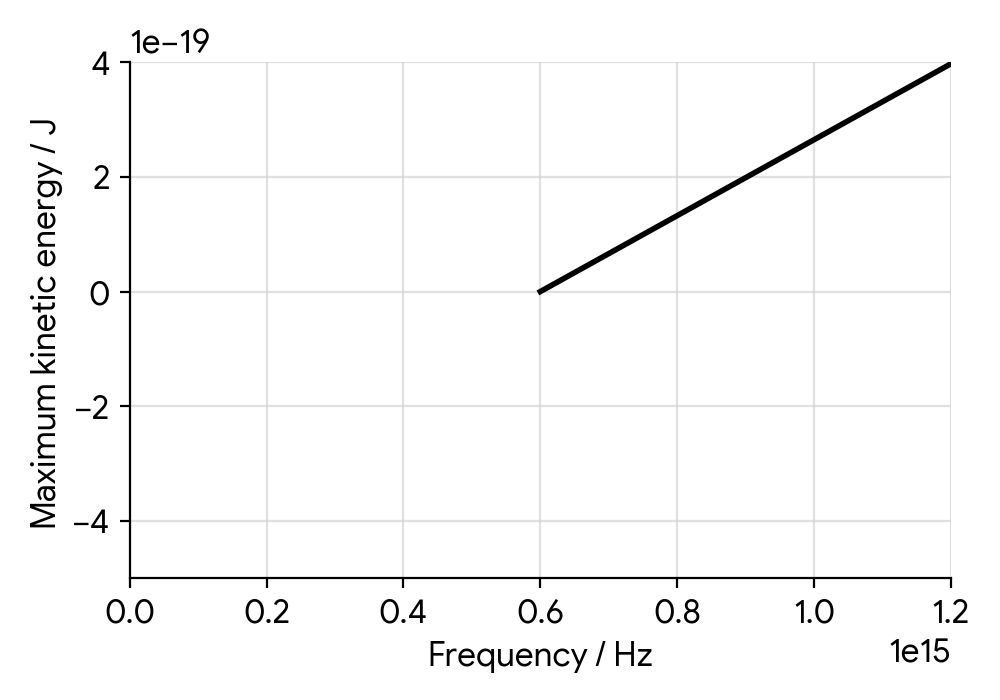
(a) Explain how this graph supports the particle model of light (the photon model) and contradicts the classical wave model.
(b) Use the graph to determine a value for Planck's constant.
(c) Determine the work function, , of the metal surface.
(d) The light source is now changed so that the intensity of the incident light is doubled, but the frequency remains the same at Hz. State and explain the effect of this change on:
i. the maximum kinetic energy of the photoelectrons.
ii. the photoelectric current.
Think about the key predictions of each model. How does the experimental evidence shown in the graph (like the x-intercept and the straight line) align with one model over the other?
The photoelectric equation is . How does this relate to the equation of a straight line, ? What does the gradient, , represent?
The work function is the minimum energy required to release an electron. How can you find this minimum energy from the graph? Consider the intercepts.
Intensity is related to the number of photons, while frequency is related to the energy of each individual photon. How does this affect the energy of the emitted electrons and the number of emitted electrons?
Question 4
EasyPaper 1A · calculator1 markAn X-ray photon is scattered by a stationary electron. The scattered photon moves at an angle of relative to its original direction.
What is the change in the wavelength of the photon?
A.
B.
C.
D.
Use the Compton scattering formula and recall the exact value of .
Question 5
MediumPaper 2 · calculator6 marks3. This question is about the de Broglie wavelength.
In a research laboratory, physicists investigate the wave-particle duality of matter. They perform experiments with various particles and objects.
(a) Calculate:
i. the de Broglie wavelength of electrons moving at (one-tenth the speed of light) in an electron microscope.
(a) Calculate:
ii. the de Broglie wavelength for protons accelerated to a speed of m s in a particle accelerator.
(a) Calculate:
iii. the de Broglie wavelength of a tiny dust particle with a mass of kg drifting slowly at m s.
Recall the de Broglie wavelength formula: . Use the given speed and the mass of an electron. Remember to use Planck's constant.
Recall the de Broglie wavelength formula: . Use the given speed and the mass of a proton. Remember to use Planck's constant.
Recall the de Broglie wavelength formula: . Use the given mass and speed. Remember to use Planck's constant.
Question 6
HardPaper 2 · calculator12 marksIn a specialized medical imaging technique, high-energy X-rays are directed at a target to probe its atomic structure. During this process, a photon with an initial wavelength of m collides with a stationary electron in the target material. After the collision, the photon's wavelength is observed to have increased by exactly m.
(a) Calculate the wavelength of the photon after the collision.
(b) Deduce the angle through which the photon has been deflected in this collision.
(c) Explain whether the angle between the original direction of the photon and the final direction of the electron is greater, smaller or equal to your answer in (b).
(d) Determine the kinetic energy of the electron after the collision. Express your answer in keV.
The change in wavelength is given. To find the final wavelength, consider whether the wavelength increases or decreases in a Compton scattering event.
Use the Compton scattering formula, which relates the change in wavelength to the scattering angle. Remember the Compton wavelength constant.
Consider the principle of conservation of momentum in two dimensions. How does the electron's recoil direction relate to the photon's scattering direction?
Use the principle of conservation of energy. The energy lost by the photon is gained by the electron as kinetic energy. Remember the formula for photon energy and the conversion factor to keV.
Question 7
MediumPaper 1A · calculator1 markA photon of energy is incident on a metal surface with work function . An electron is emitted from the surface.
What is the minimum de Broglie wavelength of the emitted electron? ( is the rest mass of the electron and is the Planck constant.)
A.
B.
C.
D.
First, determine the maximum possible kinetic energy of the emitted electron using the photoelectric effect equation. Then, relate this kinetic energy to the electron's momentum. Finally, use the de Broglie wavelength formula.
Question 8
HardPaper 1A · calculator1 markIn a photoelectric effect experiment, a graph of stopping potential is plotted against the wavelength of the incident light for a particular metal surface. What is the magnitude of the gradient of the graph at wavelength ?
A.
B.
C.
D.
Start with the photoelectric effect equation relating maximum kinetic energy, frequency, and work function. Express this equation in terms of stopping potential and wavelength . The gradient of a graph of versus is given by the derivative .
Question 9
MediumPaper 1A · calculator1 markA gamma-ray photon is incident on a stationary proton. The photon is scattered inelastically by the proton.
What are the changes, if any, to the magnitude of the momentum and the speed of the photon?
| Magnitude of momentum | Speed | |
|---|---|---|
| A. | Decreases | Decreases |
| B. | Decreases | Unchanged |
| C. | Unchanged | Decreases |
| D. | Unchanged | Unchanged |
In an inelastic collision, the photon transfers energy to the proton. How does this affect the photon's own energy? Recall the relationships between a photon's energy, momentum (), and its speed in a vacuum.
Question 10
MediumPaper 1A · calculator1 markAn experiment investigates the photoelectric effect using a caesium metal surface. The graph shows the variation of the maximum kinetic energy of photoelectrons with the frequency of the incident light, represented by line C.
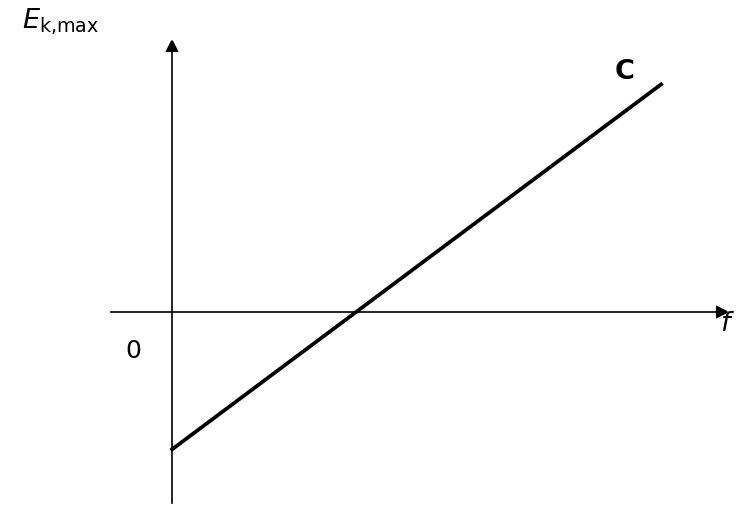
The caesium surface is then replaced with a zinc surface, which has a larger work function. Which statement correctly describes the new graph for zinc?
A. The new graph will be a line parallel to C, but shifted to the left.
B. The new graph will be a line parallel to C, but shifted to the right.
C. The new graph will be a line with a steeper slope than C.
D. The new graph will be a line with a shallower slope than C.
Recall the photoelectric effect equation, . How do the slope and intercepts of the graph relate to the constants in this equation? Consider how a larger work function would change the graph's position and slope.
Question 11
MediumPaper 1A · calculator1 markA beam of monochromatic light of intensity is incident on a metal plate. The source of light is changed. The wavelength of the new light is tripled. The number of photons incident on the plate per unit area per unit time is increased by a factor of six.
What is the new intensity of the light beam?
A.
B.
C.
D.
Intensity is defined as power per unit area. Power is the total energy delivered per unit time. Consider how the energy of a single photon depends on its wavelength, and how the total power depends on the number of photons arriving per second.
Question 12
MediumPaper 1A · calculator1 markA tiny dust particle, with a mass of , is observed to have a kinetic energy of . Which of the following expressions gives the de Broglie wavelength, in metres, of this dust particle?
A.
B.
C.
D.
Recall the relationship between de Broglie wavelength, momentum, and kinetic energy. The de Broglie wavelength , where is the momentum. Kinetic energy . Use these to find in terms of and .
Question 13
MediumPaper 1A · calculator1 markThe photoelectric effect is the emission of electrons from a metal surface when electromagnetic radiation is incident on it. Which of the following are predictions of the classical wave model for this effect?
I. The maximum kinetic energy of an emitted electron increases as the intensity of the radiation increases.
II. There is a significant time delay between the radiation first striking the surface and the emission of the first electron, especially at low intensities.
III. Electron emission occurs for any frequency of radiation, provided the intensity is sufficiently high.
A. I and II only
B. I and III only
C. II and III only
D. I, II and III
Consider how energy is transferred in the classical wave model. Is it delivered in discrete packets or continuously? How does this affect the energy of the electrons and the time it takes for them to be emitted?
Question 14
MediumPaper 1A · calculator1 markAn X-ray photon has an initial wavelength . It scatters from a stationary electron and emerges with a final wavelength . What is the kinetic energy of the electron after the scattering event?
A.
B.
C.
D.
Apply the principle of conservation of energy to the photon-electron system. The total energy before the collision must equal the total energy after. How is the energy of a photon related to its wavelength?
Question 15
MediumPaper 1A · calculator1 markA proton and a deuteron are accelerated from rest through the same potential difference. The mass of a deuteron is approximately twice the mass of a proton, and they have the same magnitude of charge.
What are the values for the ratio of the final kinetic energies and the ratio of the final de Broglie wavelengths ?
A. Kinetic energy ratio = 1; Wavelength ratio =
B. Kinetic energy ratio = 1; Wavelength ratio =
C. Kinetic energy ratio = 2; Wavelength ratio = 2
D. Kinetic energy ratio = 1; Wavelength ratio = 1
The kinetic energy gained by a charged particle is equal to the work done on it by the electric field, which is given by . How does this compare for the proton and the deuteron? The de Broglie wavelength is given by . First, express momentum in terms of kinetic energy and mass . Then, determine the ratio of the wavelengths.
Question 16
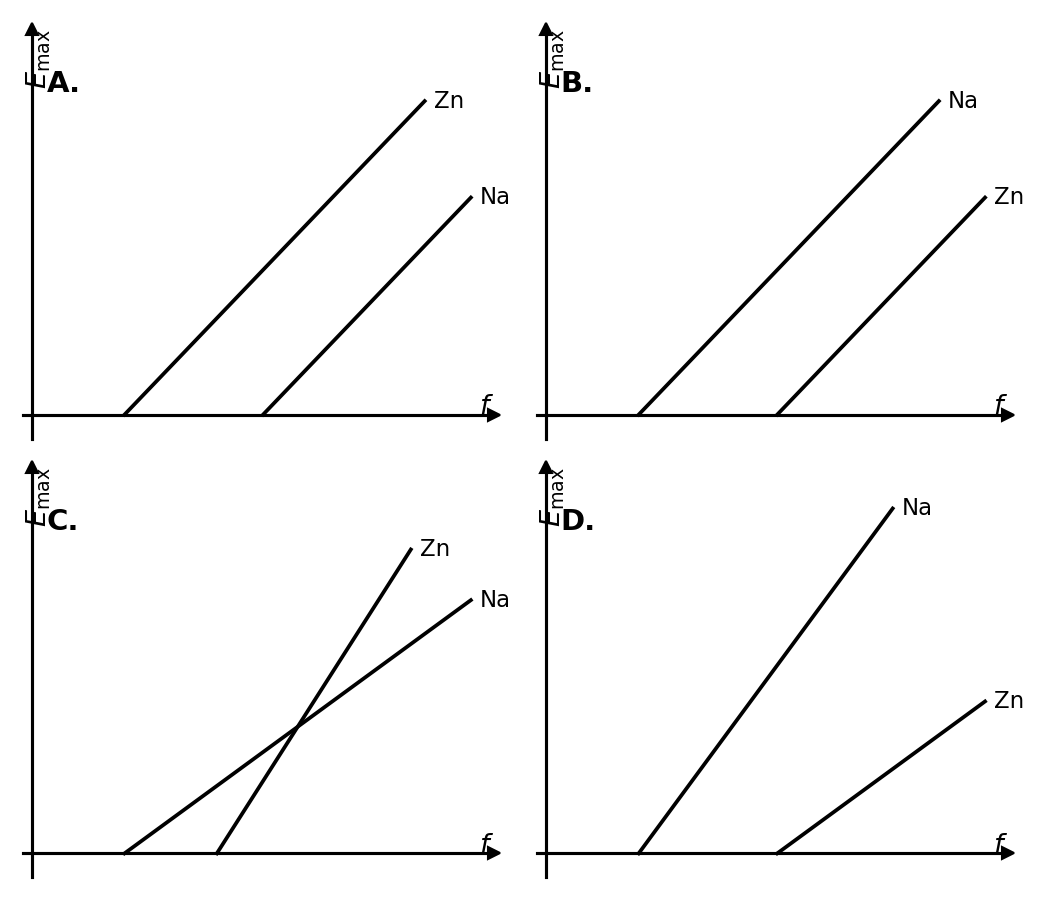
MediumPaper 1A · calculator1 markAn experiment investigates the photoelectric effect for two different metals, Zinc (Zn) and Sodium (Na). The work function for Zinc is eV and for Sodium is eV.
Which graph shows the variation with light frequency of the maximum kinetic energy of photoelectrons emitted from both metals?
A. A
B. B
C. C
D. D
The photoelectric effect is described by the equation . Consider how this linear equation relates to the graphs. What physical constant does the gradient represent? How is the work function related to the threshold frequency, which is the x-intercept of the graph?
Question 17
MediumPaper 1A · calculator1 markBlue light incident on a metallic surface causes the emission of photoelectrons. The blue light is replaced by ultraviolet light of the same intensity.
What is the effect on the maximum kinetic energy of the photoelectrons and the rate of emission of photoelectrons?
A. Maximum kinetic energy increases and rate of emission increases
B. Maximum kinetic energy increases and rate of emission decreases
C. Maximum kinetic energy decreases and rate of emission increases
D. Maximum kinetic energy decreases and rate of emission decreases
Consider how the energy of individual photons changes from blue to ultraviolet light. If the total energy arriving per second (intensity) is constant, what does this mean for the number of photons arriving per second?
No question on this page matches those filters. Try another difficulty or paper.
Every Quantum Physics question, marked for you
Every answer is marked mark by mark, IB-style, and the AI tutor helps when you are stuck.
Where marks are lost
- Stopping one step short of the conclusion. Two numbers and no sentence is two marks out of three.
- Answering a procedure question with a platitude.
- Losing precision in Paper 1B. Uniquely to this paper, quoting the right number badly loses marks.