Thermodynamics: notes and practice questions
- This topic explores energy transfers and storage, the evolution of systems, and the fundamental role of entropy.
- The first law of thermodynamics states .
- Work done by a closed system is .
- Internal energy change for an ideal monatomic gas is .
- Entropy is a measure of disorder, defined as or .
- The second law states that entropy of an isolated system always increases.
- Heat engine efficiency is .
- Carnot efficiency is .
How it is examined
HL Paper 1A and HL Paper 2. May 2025 HL Paper 2 TZ1 question 4 was a pure microstates question worth 5 marks: ten distinguishable particles exchanging energy in integer quanta, outline which configuration has more microstates (2), then explain why one process is more likely (3). The mark scheme accepted "degree of disorder" as a synonym for entropy and accepted the reverse statement, which shows how much latitude the wording gets. -diagram cycle questions and Carnot efficiency comparisons are the other two standard shapes.
, , both forms of , , , , the heat-engine efficiency ratio and . The sign convention is not printed anywhere the student can see it in the exam, so a question relying on it needs the convention stated or the physics made unambiguous.
There is no standard level content in B.4.
Guiding questions
- How can energy transfers and energy storage within a system be analysed?
- How can the future evolution of a system be determined?
- In what way is entropy fundamental to the evolution of the universe?
Linking questions
- What are the consequences of the second law of thermodynamics to the universe as a whole?
- Why is there an upper limit on the efficiency of any energy source or engine?
- How are efficiency considerations important in motors and generators?
- What paradigm shifts enabling change to human society, such as harnessing the power of steam, can be attributed to advancements in physics understanding? (NOS)
Practice questions
23 questions · 3 easy · 15 medium · 5 hardQuestion 1
EasyPaper 1A · calculator1 markA gas in a sealed container undergoes a process where of thermal energy is supplied to it, and of work is done on the gas.
What is the change in the internal energy of the gas?
A.
B.
C.
D.
Recall the first law of thermodynamics and the sign conventions for thermal energy and work done.
Question 2
MediumPaper 2 · calculator6 marksA geothermal power plant uses steam from underground reservoirs to drive turbines. The steam enters the turbine at a temperature of and is then condensed by cooling water at an average temperature of .
(a) Calculate the maximum theoretical efficiency of this geothermal power plant, assuming it operates as an ideal Carnot engine.
(b) Discuss why the actual efficiency of the geothermal power plant will be significantly lower than the maximum theoretical efficiency calculated in (a).
Remember to convert all temperatures to the absolute temperature scale (Kelvin) before using the Carnot efficiency formula.
Consider the assumptions made for an ideal Carnot cycle and how real-world engines deviate from these assumptions.
Question 3
HardPaper 2 · calculator6 marksA student is in a perfectly sealed and insulated room. They have two portable electrical devices: a space heater and an air conditioning unit. The air conditioning unit is a heat pump designed to cool the room by transferring thermal energy to the outside via an exhaust hose.
(a) The student switches on the space heater. State and explain the effect on the average temperature of the room.
(b) The student then switches off the heater and switches on the air conditioning unit. However, they leave the exhaust hose inside the sealed room. Explain, by applying the laws of thermodynamics, why this arrangement will not cool the room and will in fact increase its average temperature.
Think about energy conservation. Where does the electrical energy supplied to the heater go?
Consider the air conditioner as a system. What are the energy inputs and outputs? Remember that an air conditioner is a type of heat pump and must obey the laws of thermodynamics.
Question 4
EasyPaper 1A · calculator1 markA heat engine contains a fixed mass of an ideal gas as the working substance. The gas undergoes a cyclic process. In one cycle, the engine absorbs a quantity of thermal energy from a hot source and expels a quantity of thermal energy to a cold sink. The engine performs a net amount of work . What is the net change in the internal energy of the gas for one complete cycle?
A.
B.
C. Zero
D.
Internal energy is a state function. What does this mean for a process that starts and ends in the same thermodynamic state?
Question 5
MediumPaper 2 · calculator4 marksA proposed solar thermal power plant operates using a Carnot cycle. It generates an electrical output power of . The plant extracts thermal energy from a high-temperature molten salt reservoir at and rejects thermal energy to a cooling tower at .
(a) Calculate the rate of thermal energy supplied by the hot reservoir.
Remember to convert temperatures to Kelvin when calculating Carnot efficiency. The efficiency relates the useful power output to the total thermal energy input.
Question 6
HardPaper 2 · calculator10 marksA thermally insulated container is divided into two equal compartments by a partition. One compartment contains a fixed amount of an ideal monatomic gas at a temperature . The other compartment is a vacuum. The partition is suddenly removed, and the gas undergoes a free expansion to fill the entire container.
(a) From a microscopic perspective, explain how the entropy of the gas changes during this free expansion. Your explanation should include a formula relating entropy change to the number of microstates.
In a separate experiment, the same amount of ideal gas is initially at volume and temperature . The gas undergoes a reversible isothermal expansion to a final volume . During this process, an amount of thermal energy is supplied to the gas from a thermal reservoir.
(b) State the formula for the change in entropy, , of the gas in terms of and . Explain why this formula is applicable to this process.
Consider a third process where the same amount of ideal gas is heated at constant pressure (isobaric expansion), causing both its volume and temperature to increase.
(c) Explain why the formula from part (b) cannot be directly used to calculate the total entropy change for this isobaric process. Outline a method by which the entropy change could be estimated.
Think about what a microstate represents for a gas particle. How does the number of available positions for each particle change when the volume doubles? Recall the Boltzmann equation for entropy.
The term 'isothermal' is key here. What does it imply about the temperature? The formula for entropy change at the macroscopic level depends on this.
Compare the conditions of the isobaric process to the conditions required for the formula in part (b). If the formula doesn't apply directly, how can we adapt our calculation for a changing variable? Think about how integrals are approximated by sums.
Question 7
EasyPaper 1A · calculator1 markConsider a system of four coins. What is the entropy of a state in which two coins show heads and two coins show tails?
A.
B.
C.
D.
First determine the number of possible microstates that correspond to this macrostate (how many different ways can you arrange two heads and two tails?), then apply the formula .
Question 8
MediumPaper 1A · calculator1 markAn ideal gas is the working substance for four different heat engines. The pressure-volume (P-V) diagrams for the cycles are shown. Each engine operates between the same two thermal reservoirs. Which cycle has the highest possible theoretical efficiency?
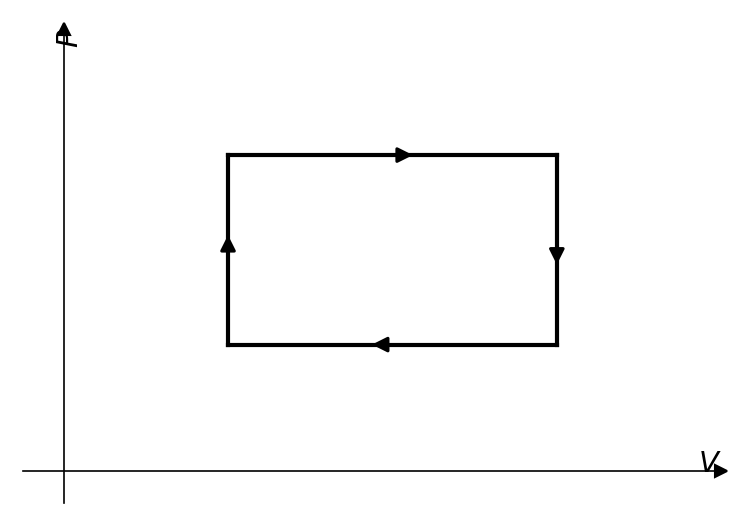
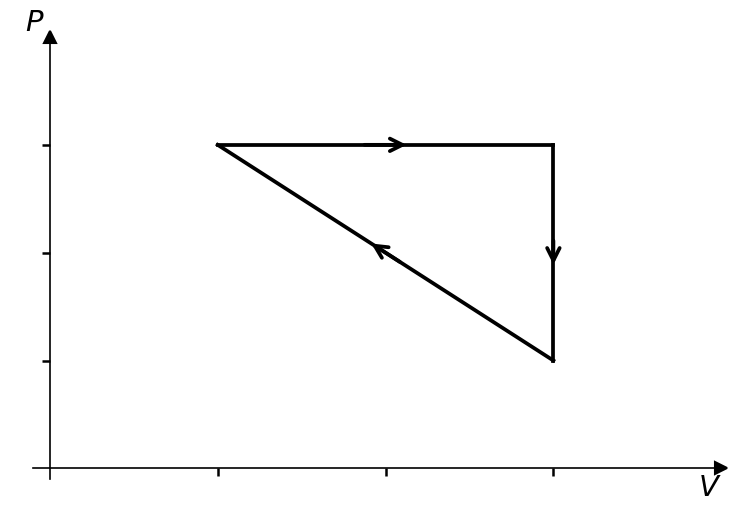
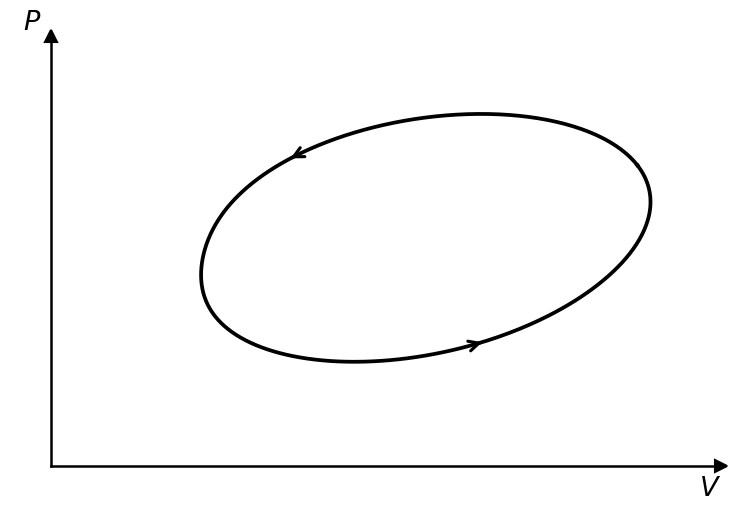
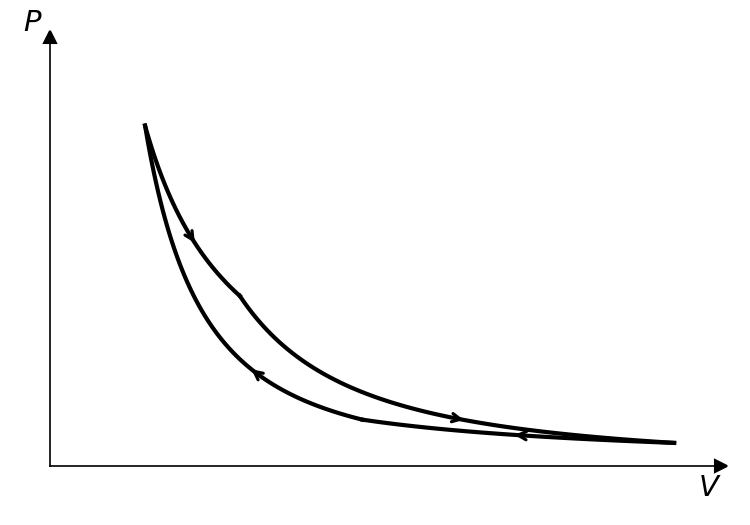
Carnot's theorem states that no engine operating between two heat reservoirs can be more efficient than a Carnot engine operating between the same reservoirs. Identify the diagram that represents a Carnot cycle.
Question 9
HardPaper 2 · calculator10 marksA large weather balloon is filled with helium gas at ground level. The helium can be modelled as an ideal gas. The balloon is released and rises through the atmosphere.
(a) Explain, in terms of the kinetic model of an ideal gas, how the helium exerts a pressure on the inner surface of the balloon.
(b) As the balloon rises to a high altitude, the external atmospheric pressure decreases significantly. Assuming the temperature of the helium remains constant, explain why the volume of the balloon increases.
(c) In reality, if the balloon rises very quickly, the temperature of the helium gas inside is observed to decrease. Explain this observation in terms of the motion of the helium atoms and the walls of the balloon.
Think about the individual gas atoms. What are they doing? How do they interact with the walls of the balloon? Connect this to the concepts of force and momentum from Newton's laws.
Consider the pressure balance between the inside and outside of the balloon. How does the behaviour of the gas atoms change when the volume changes?
What happens to the energy of a gas atom when it collides with a wall that is moving away from it? How is the temperature of a gas related to the energy of its atoms?
Question 10
MediumPaper 1A · calculator1 markA fixed mass of an ideal gas undergoes the cyclic process A → B → C → D → A as shown in the pressure-volume (PV) diagram.
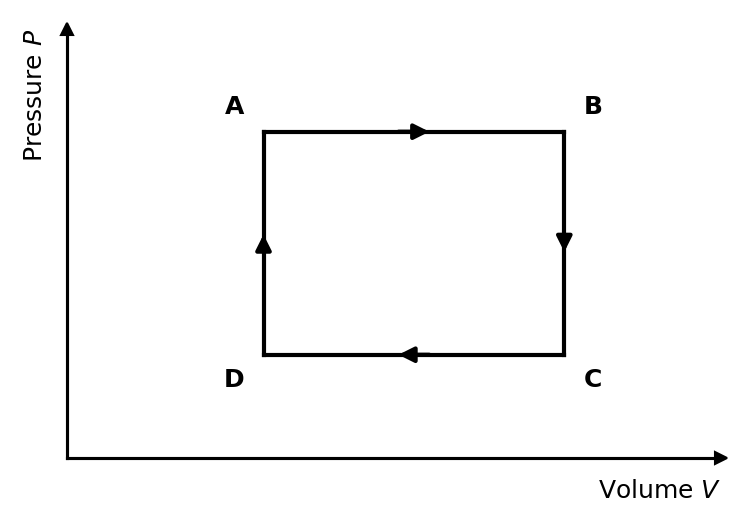
Which statement correctly describes the net work done () and the net thermal energy transferred () during one complete cycle?
A. is done on the gas and is transferred out of the gas.
B. is done by the gas and is transferred into the gas.
C. is done on the gas and is transferred into the gas.
D. is done by the gas and is transferred out of the gas.
Consider the first law of thermodynamics for a complete cycle. What does the area enclosed by the loop on a P-V diagram represent? What is the significance of the direction of the cycle (clockwise vs. anti-clockwise)?
Question 11
HardPaper 2 · calculator6 marksA closed, thermally insulated laboratory contains an electric oven and a refrigerator. Both appliances are connected to the laboratory's electrical supply.
The oven is switched on with its door open. Outline the energy transfers that lead to the laboratory warming up.
The oven is switched off. The refrigerator is switched on with its door open.
Discuss, with reference to the first law of thermodynamics, the effect of this on the temperature of the laboratory.
Consider what type of energy is supplied to the oven and the mechanisms by which this energy moves into the surrounding air.
Think about the refrigerator as a heat pump. Where does it extract thermal energy from, where does it exhaust it to, and what extra energy is added to the system to make this happen?
Question 12
MediumPaper 1A · calculator1 markA sealed cylinder fitted with a movable piston contains an ideal monatomic gas. of thermal energy is supplied to the gas, causing it to expand at a constant pressure of . The volume of the gas increases from to .
What is the change in the internal energy of the gas?
A.
B.
C.
D.
Recall the first law of thermodynamics, , where is the thermal energy transferred to the system and is the work done by the system. For expansion at constant pressure, the work done by the gas is given by .
Question 13
HardPaper 2 · calculator11 marksA fixed mass of an ideal monatomic gas is confined in a cylinder by a movable piston.
Explain, with reference to Newton's laws of motion, how the gas exerts a pressure on the piston.
The piston is slowly pulled outwards, increasing the volume of the gas at a constant temperature.
Explain, in terms of the motion of the particles, why the pressure of the gas decreases.
The piston is now pushed inwards rapidly. No thermal energy is transferred between the gas and its surroundings.
Explain, in terms of the collisions between the particles and the piston, why the temperature of the gas increases.
The initial volume of the gas before the rapid compression was at a pressure of .
Calculate the internal energy of the gas before the compression.
Think about what happens to the momentum of a gas particle when it collides with the piston, and how Newton's second and third laws relate this to force and pressure.
Consider how the constant temperature affects the speed of the particles, and how the increased volume affects how often they hit the piston.
Think about the relative velocity of the particle and the piston during a collision when the piston is moving inwards.
Use the ideal gas law to relate pressure and volume to the equation for the internal energy of a monatomic gas.
Question 14
MediumPaper 1A · calculator1 markA sample of liquid water at its freezing point is placed in a freezer. The water turns into ice at a constant temperature.
What are the changes in the entropy of the water and the entropy of the freezer (the surroundings) during this process?
| Entropy of the water | Entropy of the surroundings | |
|---|---|---|
| A. | Increases | Increases |
| B. | Increases | Decreases |
| C. | Decreases | Increases |
| D. | Decreases | Decreases |
Consider the change in the state of matter for the water. Is a solid more or less ordered than a liquid? For the surroundings, consider the direction of thermal energy transfer. Does the freezer gain or lose thermal energy from the water?
Question 15
MediumPaper 1A · calculator1 markA sealed container holds a sample of an ideal monatomic gas. When the gas is at a temperature of °C, its internal energy is J. is the gas constant.
How many moles of the gas are in the sample?
A.
B.
C.
D.
Recall the formula for the internal energy of an ideal monatomic gas. Remember to convert the temperature to the appropriate units.
Question 16
MediumPaper 1A · calculator1 markA geothermal power plant operates with a hot reservoir (geothermal fluid) at a constant temperature. The cold reservoir is cooling water from a nearby river. When the river water temperature is K, the maximum theoretical (Carnot) efficiency of the plant is .
Due to seasonal changes, the river water temperature drops to K. What is the new maximum theoretical efficiency of the plant?
A.
B.
C.
D.
Recall the formula for Carnot efficiency in terms of hot and cold reservoir temperatures. Use the initial conditions to find the constant hot reservoir temperature.
Question 17
MediumPaper 1A · calculator1 markTwo identical, isolated systems, X and Y, each have an entropy of and a number of accessible microstates of . The two systems are brought into thermal contact to form a single combined system. What is the number of accessible microstates for the combined system?
A.
B.
C.
D.
Consider how the number of possible arrangements (microstates) of two independent systems combine to give the total number of arrangements for the combined system. Do they add or multiply?
Question 18
MediumPaper 1A · calculator1 markAn ideal gas and a real gas are at the same temperature and occupy the same volume. The number of particles in both gases is the same. How does the internal energy of the real gas, , compare to the internal energy of the ideal gas, ?
A. because real gas particles have volume.
B. because there are attractive forces between real gas particles.
C. because temperature is the same.
D. The relationship cannot be determined without knowing the pressure.
Recall the definition of internal energy for both an ideal gas and a real gas. What is the key difference? Consider the nature of intermolecular forces and how they affect potential energy. By convention, where is the potential energy defined to be zero?
Question 19
MediumPaper 1A · calculator1 markAn electric fan is operating inside a thermally insulated and sealed room.
The entropy of the air in the room
A. decreases.
B. remains unchanged.
C. increases.
D. is zero.
Consider all the energy transformations that occur because the fan is running. The fan does work on the air. What happens to this energy in the long term in a sealed room? How does a change in the internal energy of a gas affect its entropy?
Question 20
MediumPaper 1A · calculator1 markCycle KLMK is composed of an isothermal, an adiabatic and an isovolumetric process.
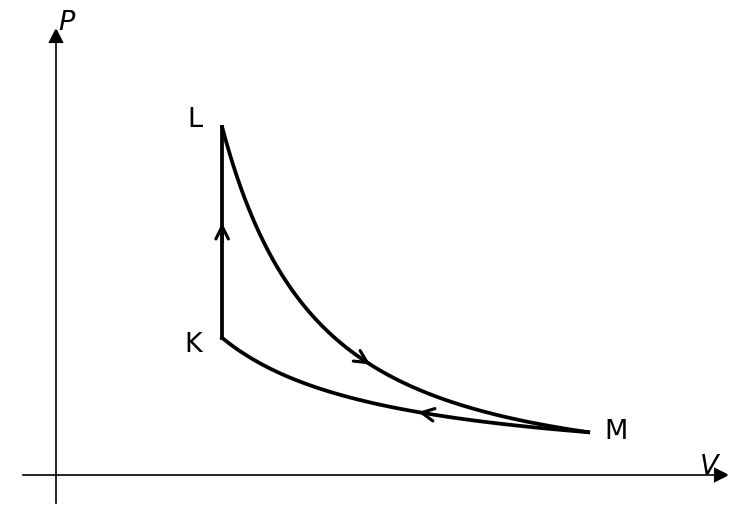
What can be said about the change in internal energy and the sign of the work done by the gas in process LM?
| Change in internal energy | Sign of work done | |
|---|---|---|
| A. | Positive | Negative |
| B. | Positive | Positive |
| C. | Negative | Negative |
| D. | Negative | Positive |
First, deduce which curve is adiabatic and which is isothermal by considering the temperature changes required to close the cycle. Then, recall how temperature and volume change during an adiabatic expansion.
No question on this page matches those filters. Try another difficulty or paper.
3 more Thermodynamics questions in the app
Every answer is marked mark by mark, IB-style, and the AI tutor helps when you are stuck.
Where marks are lost
- Stopping one step short of the conclusion. Two numbers and no sentence is two marks out of three.
- Answering a procedure question with a platitude.
- Losing precision in Paper 1B. Uniquely to this paper, quoting the right number badly loses marks.