Simple Harmonic Motion: notes and practice questions
- This topic introduces simple harmonic motion (SHM), a type of oscillatory motion.
- SHM occurs when the restoring force is proportional to the displacement from equilibrium and directed towards it.
- The defining equation for SHM is , where is acceleration, is angular frequency, and is displacement.
- Key terms include time period , frequency , angular frequency , amplitude, and equilibrium position.
- The relationships and are fundamental.
- For a mass-spring system, , and for a simple pendulum, .
- Energy in SHM (kinetic and potential) continuously transforms, with total mechanical energy conserved in the absence of damping.
How it is examined
Both papers. May 2025 HL Paper 2 TZ1 question 9 built a whole 20-mark question on a bar magnet oscillating on a spring: calculate the elastic potential energy at equilibrium (2), state and explain the direction of motion at a given time (2), describe the energy transfers over an interval (2), show the amplitude is about 0.1 m (3), calculate the maximum speed (2), determine the kinetic energy at a stated time (2), then rolled into D.4 induction for the last 7 marks. The energy parts of that question are HL-only content.
SL: , , both period formulas. HL adds the five equations above. The SL/HL boundary here is sharp and worth repeating: an SL question may ask a student to describe energy changes over a cycle, but may not ask them to calculate or from amplitude, and may not use phase angle at all.
- conditions that lead to simple harmonic motion
- the defining equation of simple harmonic motion as given by
- that a particle undergoing simple harmonic motion is described using time period T, frequency f, angular frequency , amplitude, equilibrium position and displacement
- the time period in terms of frequency of oscillation and angular frequency, as given by
- that a particle undergoing simple harmonic motion can be described using phase angle
- that problems can be solved using the equations for simple harmonic motion, as given by
Guiding questions
- What makes the harmonic oscillator model applicable to a wide range of physical phenomena?
- Why must the defining equation of simple harmonic motion take the form it does?
- How can the energy and motion of an oscillation be analysed both graphically and algebraically?
Linking questions
- How can greenhouse gases be modelled as simple harmonic oscillators?
- How can circular motion be used to visualize simple harmonic motion?
- How does damping affect periodic motion?
- How can the understanding of simple harmonic motion apply to the wave model? (NOS)
- What physical explanation leads to the enhanced greenhouse effect? (NOS)
Practice questions
28 questions · 8 easy · 19 medium · 1 hardQuestion 1
EasyPaper 1A · calculator1 markAn object is undergoing simple harmonic motion (SHM). Which row correctly describes the direction of the net force acting on the object and the object's displacement when its kinetic energy is at a minimum?
| Direction of net force relative to displacement | Displacement when kinetic energy is a minimum | |
|---|---|---|
| A. | same | maximum |
| B. | same | zero |
| C. | opposite | zero |
| D. | opposite | maximum |
Recall the defining condition for SHM in terms of force. The restoring force is always directed towards the equilibrium position. Consider where the object has zero velocity in its cycle; this is where its kinetic energy will be at a minimum.
Question 2
MediumPaper 1A · calculator1 markA block is attached to a vertical spring and is displaced from its equilibrium position. It is then released and oscillates with simple harmonic motion (SHM).
Which row of the table correctly describes the direction of the net force on the block and the position where the block has its maximum kinetic energy?
| Direction of net force relative to displacement from equilibrium | Position of maximum kinetic energy | |
|---|---|---|
| A. | Same | At the equilibrium position |
| B. | Same | At maximum displacement |
| C. | Opposite | At the equilibrium position |
| D. | Opposite | At maximum displacement |
Recall the defining condition for simple harmonic motion in terms of force and displacement. Also, consider the relationship between kinetic energy, potential energy, and the speed of the block at different points in its oscillation.
Question 3
HardPaper 2 · calculator23 marks(a.i) A spring has a natural length of and negligible mass. Its spring constant is . The spring obeys Hooke's law when stretched and when compressed.
The spring is horizontal with its left end attached to a rigid support. A block is attached to the free end of the spring and can move on a friction-free horizontal surface. The block is pulled to the right and held in position.
Calculate the force on the block from the spring when held in position.
(a.ii) Calculate the elastic potential energy stored in the spring when held in position.
(a.iii) The block is released. Calculate the speed of the block when it returns to its original position.
(b.i) The spring is turned to be vertical with the top end attached to a rigid support. The block is attached to the bottom of the spring causing it to extend. The block is at rest in its equilibrium position.
Calculate the extension of the spring.
(b.ii) Calculate the elastic potential energy stored in the spring.
(c.i) The block is now pulled down a further from the equilibrium position and held in position.
State the total extension of the spring in this new position.
(c.ii) Calculate the total elastic potential energy stored in the spring.
(c.iii) The block is released and accelerates upwards, reaching the equilibrium position with a vertical speed.
Calculate the increase in gravitational potential energy gained by the block as it moves to the equilibrium position.
(c.iv) Calculate the increase in kinetic energy gained by the block as it moves to the equilibrium position.
(c.v) Calculate the speed of the block when it reaches the equilibrium position.
(d) Discuss your answers to (a.iii) and (c.v).
Use Hooke's law to find the force. Remember to check your units.
Use the formula for elastic potential energy stored in a spring.
Apply the principle of conservation of energy. The stored elastic potential energy is converted into kinetic energy.
At equilibrium, the upward force from the spring equals the downward weight of the block.
Use the extension found in the previous part to calculate the stored energy.
Add the new displacement to the equilibrium extension.
Use the total extension to find the total elastic potential energy.
Use the formula for change in gravitational potential energy, considering the vertical distance moved.
Consider the total energy of the system. The change in kinetic energy is the difference between the change in elastic potential energy and the change in gravitational potential energy.
Use the kinetic energy calculated in the previous part to find the speed.
Compare the values and consider the net force acting on the block as a function of displacement in both situations.
Question 4
EasyPaper 1A · calculator1 markA pendulum is oscillating with simple harmonic motion.
Which graph represents the variation of the kinetic energy, , of the pendulum bob with its displacement, , from the equilibrium position?
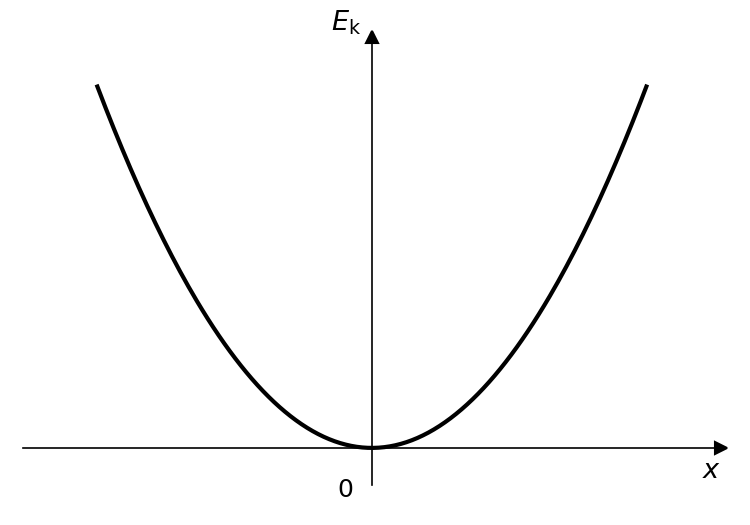
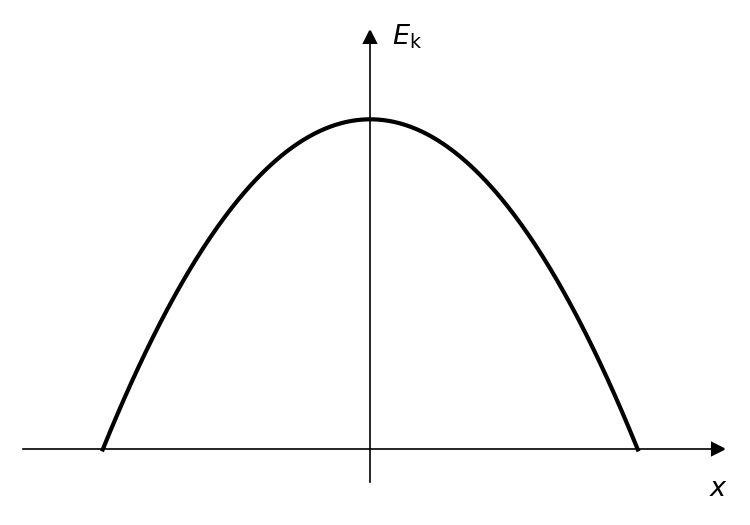
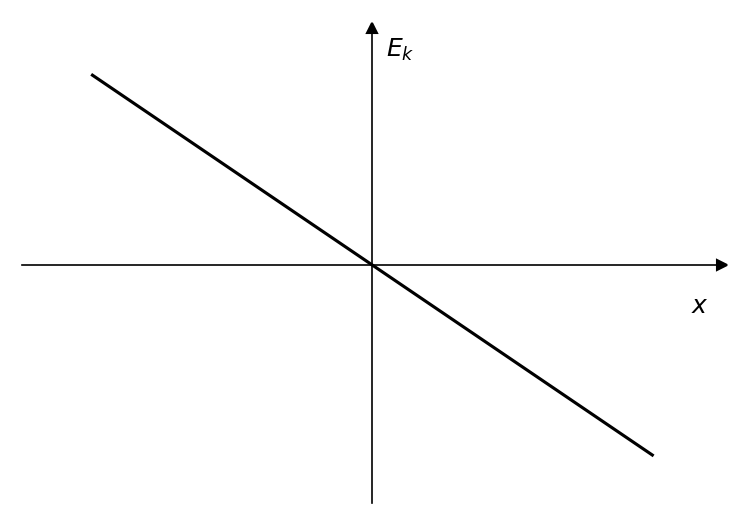
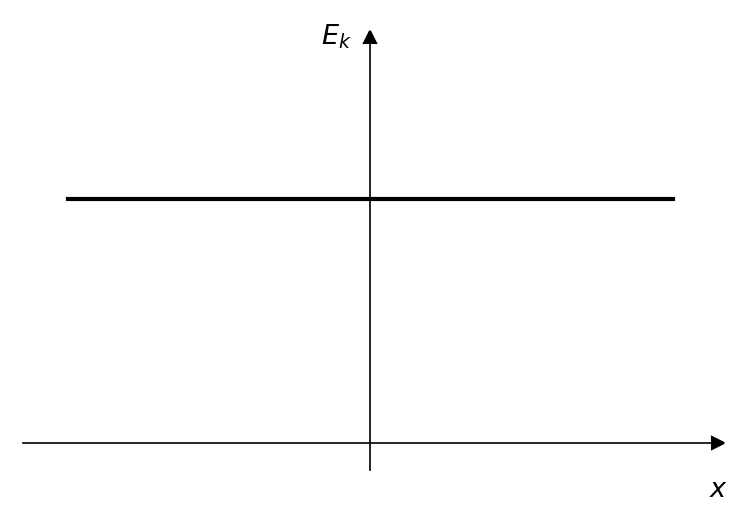
Consider the points of maximum and minimum speed for the pendulum bob. Kinetic energy is proportional to the square of the speed. How does the speed change as the displacement from the equilibrium position changes?
Question 5
MediumPaper 1A · calculator1 markA piston in a simplified engine model undergoes simple harmonic motion with period . The amplitude of the motion is .
What is the speed of the piston at the instant when its kinetic energy is equal to its elastic potential energy?
A.
B.
C.
D.
In SHM, the total energy is constant and is the sum of kinetic and potential energy. First, find the displacement from the equilibrium position where the kinetic energy equals the potential energy. Then, use the formula for velocity as a function of displacement.
Question 6
EasyPaper 1A · calculator1 markA child on a swing is gently pushed and then let go. Due to air resistance, the amplitude of the swing's motion gradually decreases. Which statement correctly describes this motion?
A. The amplitude of the swing decreases by the same amount in each successive oscillation.
B. The period of the oscillation remains approximately constant.
C. The mechanical energy of the child-swing system remains constant.
D. The frequency of the oscillation is slightly greater than the natural frequency of the swing.
Consider the definition of light damping. How do the key properties of an oscillation (amplitude, period, energy) change over time when a small resistive force is present? Think about whether the changes are constant, or if the properties themselves remain constant.
Question 7
MediumPaper 2 · calculator4 marksA cylindrical buoy of mass and cross-sectional area floats vertically in calm water of density . The buoy is pushed down a small distance from its equilibrium position and released.
(a) By considering the forces acting on the buoy, explain why its subsequent oscillation is approximately simple harmonic.
Start by identifying the forces on the buoy at equilibrium. Then, consider how the forces change when the buoy is displaced from equilibrium. What is the net force? How does this net force relate to the definition of simple harmonic motion?
Question 8
EasyPaper 1A · calculator1 markA simple pendulum oscillates with a period . The length of the pendulum is quadrupled and the amplitude of its oscillation is doubled. Assume the small angle approximation is valid.
What is the new period of oscillation?
A.
B.
C.
D.
Recall the formula for the period of a simple pendulum. How does the period depend on the length of the pendulum and the amplitude of oscillation (for small angles)?
Question 9
MediumPaper 2 · calculator7 marksA simple pendulum is used to demonstrate simple harmonic motion inside the cabin of a vertical drop tower ride.
(a) The cabin is moving upwards at a constant speed. State and explain the effect on the period of oscillation of the pendulum.
(b) The cabin is then accelerated upwards at a constant rate of . State and explain the effect on the period of oscillation.
(c) At the top of the ride, the cabin is released and undergoes free-fall. Describe the motion of the pendulum bob, as observed from within the cabin, immediately after release.
Consider the relationship between the period of a pendulum and the acceleration due to gravity. How does constant velocity affect the net acceleration experienced by the pendulum?
The upward acceleration of the cabin creates an effect similar to being in a stronger gravitational field. Determine the new 'effective g' and use the formula for the period of a pendulum to predict the outcome.
During free-fall, both the cabin and the pendulum bob accelerate downwards at the same rate, . What does this imply about the apparent weight of the bob and the tension in the string?
Question 10
EasyPaper 1A · calculator1 markAn object is undergoing simple harmonic motion (SHM). Which graph shows the relationship between the acceleration of the object and its displacement from the equilibrium position?
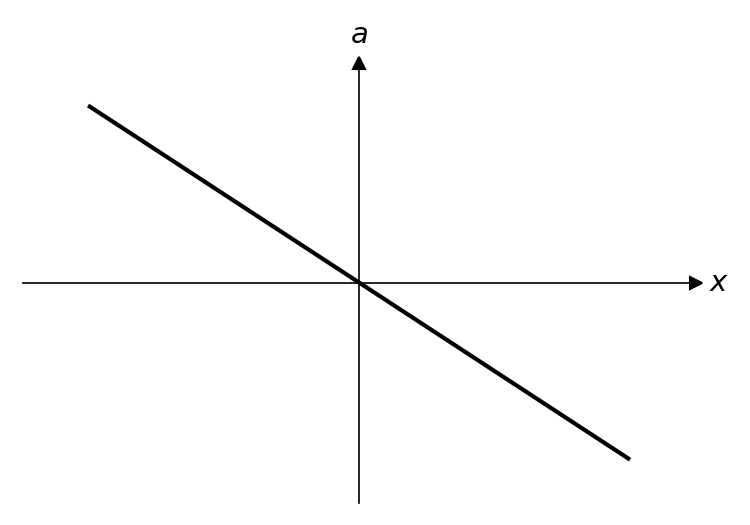
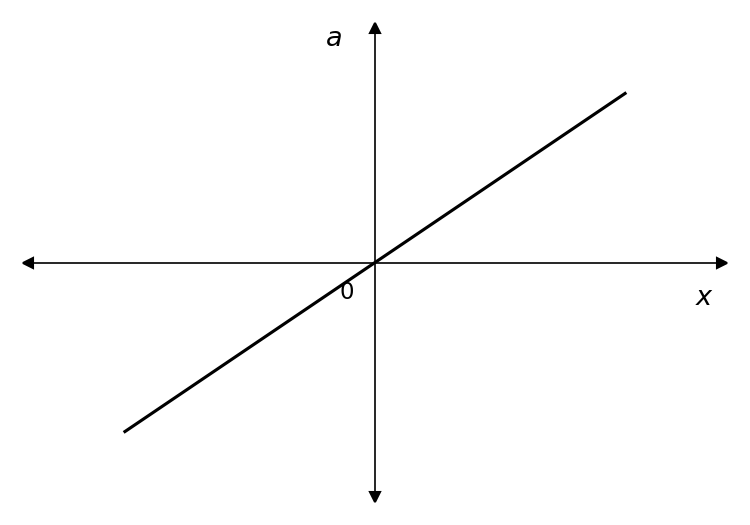
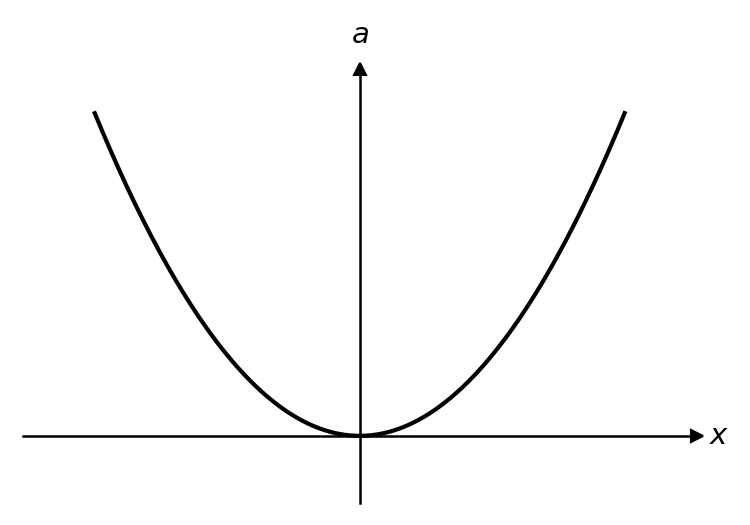
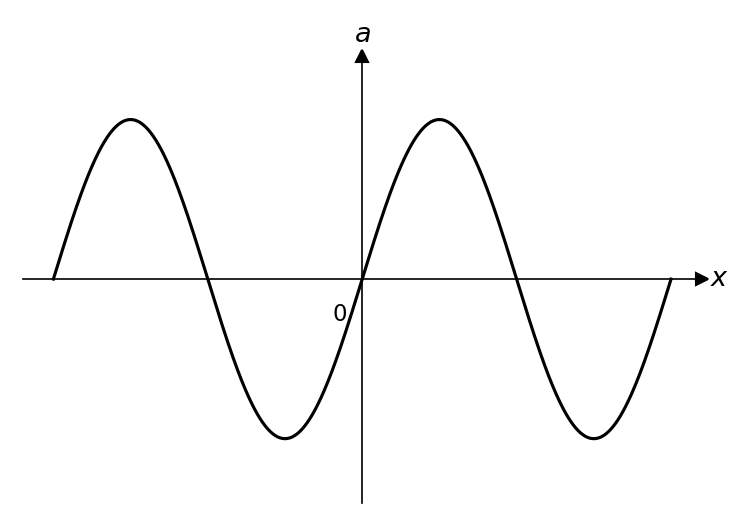
Recall the defining equation for simple harmonic motion. How does acceleration relate to displacement in SHM? Consider Newton's second law and the restoring force.
Question 11
MediumPaper 2 · calculator10 marksA small laboratory cart of mass is attached to a horizontal spring with a spring constant of . The cart is placed on a frictionless track and displaced by from its equilibrium position, then released. Its subsequent motion is simple harmonic.
(a) Calculate the maximum value of stored elastic potential energy.
(b) Calculate the maximum speed of the cart.
(c) Calculate the maximum acceleration of the cart.
(d) Calculate the frequency of vibration.
(e) Calculate the displacement when the stored elastic potential energy equals the kinetic energy.
Consider the energy stored in a spring when it is stretched or compressed from its equilibrium position. At maximum displacement, all the energy is potential.
The maximum speed occurs at the equilibrium position. You can use energy conservation or the relationship between maximum speed, angular frequency, and amplitude.
Maximum acceleration occurs at maximum displacement. Recall the relationship between acceleration, angular frequency, and displacement in SHM.
The frequency is related to the angular frequency. Remember the conversion factor between angular frequency and frequency.
At this point, the total mechanical energy is equally split between potential and kinetic energy. Use the principle of conservation of energy.
Question 12
EasyPaper 1A · calculator1 markA block is placed on a frictionless horizontal surface and attached to a spring with a spring constant of . The block is displaced slightly from its equilibrium position and released.
What is the natural frequency of oscillation for this system?
A.
B.
C.
D.
Recall the formula for the natural frequency of a mass-spring system. Ensure you use the correct units for mass and spring constant.
Question 13
MediumPaper 1A · calculator1 markA mass-spring system oscillates in simple harmonic motion with a total energy . The spring is replaced with one that has double the spring constant, and the mass is halved. The amplitude of oscillation is also halved.
What is the new total energy of the system?
A.
B.
C.
D.
The total energy of a mass-spring system in SHM is equal to its maximum elastic potential energy. How does this energy depend on the spring constant and the amplitude? Does it depend on the mass?
Question 14
EasyPaper 1A · calculator1 markA mass attached to a vertical spring is oscillating with simple harmonic motion of period . The mass is released from rest at its lowest position at time . At what time does the mass first have maximum speed?
A.
B.
C.
D.
Maximum speed in simple harmonic motion occurs at a specific position. Where is this position, and how long does it take for the mass to reach it from its starting point?
Question 15
MediumPaper 1A · calculator1 markA simple pendulum has a period of oscillation on Earth, where the acceleration of free fall is . The pendulum is taken to a planet where the acceleration of free fall is . The new period of oscillation is .
What is the ratio ?
A.
B.
C.
D.
Recall the formula for the period of a simple pendulum. How does the period depend on the acceleration of free fall, ? Set up a ratio of the period on the planet to the period on Earth using the formula.
Question 16
EasyPaper 1A · calculator1 markA child on a swing is oscillating with simple harmonic motion of period . At time the swing is at its maximum displacement from the equilibrium position.
What is the first time when the swing is at the equilibrium position?
A.
B.
C.
D.
Consider the standard displacement-time graphs for SHM. An oscillation starting from maximum displacement can be described by a cosine function. The equilibrium position corresponds to zero displacement. At what fraction of the period does the cosine function first become zero?
Question 17
MediumPaper 1A · calculator1 markA block of mass is attached to a horizontal spring with spring constant . The block oscillates with simple harmonic motion with an angular frequency . The block is replaced by a new block of mass and the spring is replaced with a new spring of constant .
What is the new angular frequency of the system?
A.
B.
C.
D.
Recall the formula for the angular frequency of a mass-spring system. How do changes in mass and spring constant affect the angular frequency? Substitute the new values into the formula and compare it to the original.
Question 18
MediumPaper 1A · calculator1 markA simple pendulum has a period when oscillating on Planet Alpha. The length of the pendulum is then doubled, and its bob mass is tripled. This modified pendulum is moved to Planet Beta, where the acceleration due to gravity is half that on Planet Alpha.
What is the period of the pendulum on Planet Beta?
A.
B.
C.
D.
Recall the formula for the period of a simple pendulum. Pay close attention to which variables affect the period.
Question 19
MediumPaper 1A · calculator1 markA mass of is attached to a spring and oscillates horizontally on a frictionless surface, undergoing simple harmonic motion. The amplitude of the oscillation is and its period is .
What is the total energy of the oscillating mass?
A.
B.
C.
D.
Recall the relationship between angular frequency and period. The total energy in simple harmonic motion can be expressed in terms of mass, angular frequency, and amplitude.
Question 20
MediumPaper 1A · calculator1 markThe diagram shows a snapshot of a transverse wave propagating along a stretched string. The wave travels from right to left.
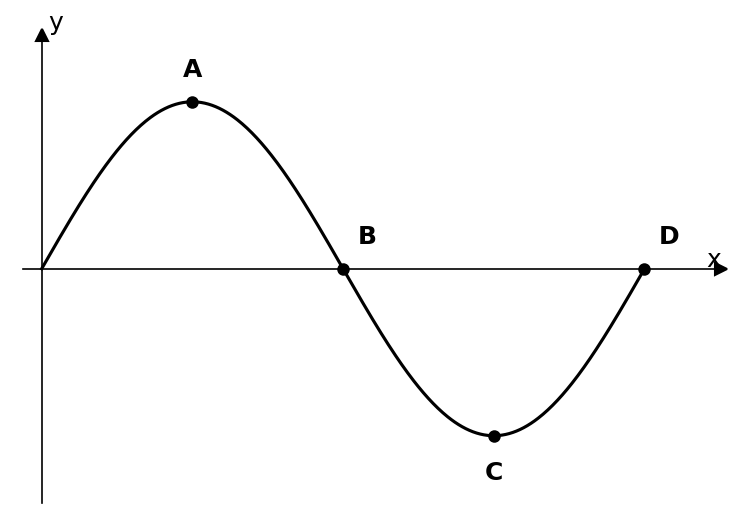
At the instant shown, which point on the string has the maximum positive acceleration?
Consider the relationship between the acceleration of a particle in simple harmonic motion and its displacement from the equilibrium position. How does this apply to the particles of the string as the wave passes?
No question on this page matches those filters. Try another difficulty or paper.
8 more Simple Harmonic Motion questions in the app
Every answer is marked mark by mark, IB-style, and the AI tutor helps when you are stuck.
Where marks are lost
- Stopping one step short of the conclusion. Two numbers and no sentence is two marks out of three.
- Answering a procedure question with a platitude.
- Losing precision in Paper 1B. Uniquely to this paper, quoting the right number badly loses marks.