Galilean and Special Relativity: notes and practice questions
- This topic covers how observers in different inertial reference frames describe events in terms of space and time, contrasting Galilean and special relativity.
- Galilean relativity states Newton's laws are the same in all inertial frames, with and .
- Special relativity is based on two postulates, leading to Lorentz transformations for coordinates and velocities.
- Key relativistic effects include time dilation and length contraction , where .
- The space-time interval is an invariant quantity.
- Space-time diagrams are used to visualize relativistic motion.
How it is examined
HL only. May 2025 HL Paper 2 TZ1 question 7 was a space-time diagram question worth 6 marks: calculate the space-time interval between two events (2), outline what an invariant quantity is (1), sketch the primed axes on the given diagram (2), determine the relative speed (1). That is the shape to imitate. A derivation of the Lorentz equations is not a legitimate question.
Galilean and Lorentz transformations, , relativistic velocity addition, the space-time interval, , , . The two postulates must be stated in words from memory.
There is no standard level content in A.5.
- The derivation of the Lorentz transformation equations and the relativistic velocity addition equations are not required.
- The derivation of the time dilation and length contraction equations is not required.
Guiding questions
- How do observers in different reference frames describe events in terms of space and time?
- How does special relativity change our understanding of motion compared to Galilean relativity?
- How are space-time diagrams used to represent relativistic motion?
Linking questions
- How are equations of linear motion adapted in relativistic contexts?
- Why is the equation for the Doppler effect for light so different from that for sound?
- Special relativity places a limit on the speed of light. What other limits exist in physics? (NOS)
Practice questions
16 questions · 1 easy · 13 medium · 2 hardQuestion 1
EasyPaper 2 · calculator2 marksA spacecraft is designed for interstellar travel and reaches a constant velocity of 0.950, where is the speed of light, relative to a stationary observer on Earth.
(a) Calculate the Lorentz factor, , for the spacecraft.
You will need to use the formula for the Lorentz factor, γ, which relates it to the particle's speed, v. This formula is provided in the IB Physics data booklet under Topic A.5.
Question 2
MediumPaper 2 · calculator4 marksA very long train travels at a relativistic speed with respect to a station platform. An observer on the platform measures two separate events, a lightning strike at the front of the train (event F) and a lightning strike at the back of the train (event B), to be simultaneous.
(a) An observer is located at the midpoint of the train. Explain, from the perspective of this observer on the train, why the two lightning strikes are not simultaneous.
(b) State the condition under which two events that are simultaneous in the platform frame would also be simultaneous in the train frame.
Consider the time it takes for the light from each strike to reach the observer at the midpoint of the train. Remember that the speed of light is constant for all inertial observers, but the observer on the train is moving relative to the points where the lightning struck (in the platform's frame).
Think about the Lorentz transformation for time, . If two events are simultaneous in the unprimed frame (), what must be true about their positions () for them to also be simultaneous in the primed frame ()?
Question 3
HardPaper 2 · calculator11 marksA muon is produced in a particle accelerator at detector D1 and travels towards a second detector, D2. In the laboratory's frame of reference, the detectors are stationary and the distance between them is 900 m.
(a) State the maximum possible distance that can be measured between detector D1 and detector D2.
The muon travels at a speed of 0.98c relative to the laboratory. An electron is travelling in the opposite direction at a speed of 0.80c relative to the laboratory.
(b) Calculate the speed of the muon relative to the electron using Galilean relativity.
(c) Calculate the distance between detector D1 and detector D2 in the reference frame of the electron.
(d) Show that the speed of the muon, as measured in the reference frame of the electron, is approximately 0.998c.
(e) Calculate the time taken for the muon to travel from D1 to D2, according to an observer in the electron's reference frame.
(f) State and explain the reference frame in which the proper time for the muon's journey from detector D1 to detector D2 is measured.
What does 'proper length' mean in relativity, and how does it compare to lengths measured by moving observers? The length measured in the rest frame of the object is the greatest.
Galilean relativity assumes that velocities simply add or subtract. How would you combine the velocities of two objects moving in opposite directions classically?
An observer moving relative to an object measures its length to be different. What is the name of this effect and what is the formula for it? You will first need to calculate the Lorentz factor for the electron's speed.
Classical velocity addition doesn't work at relativistic speeds. What is the correct formula for adding velocities in special relativity?
There are two main ways to solve this. You could consider it as a 'chase problem' in the electron's frame of reference, where you know the distance between the detectors and their speeds. Alternatively, you can define the start and end events in the lab frame and use the Lorentz transformations for time and position.
Proper time is the time interval between two events measured by a single clock that is present at both the start and end locations of the events. Which reference frame contains such a clock for this journey?
Question 4
MediumPaper 2 · calculator10 marksA spaceship departs from a space station, which is at rest in an inertial reference frame S. The spaceship travels at a constant velocity . The clocks on the station and the spaceship are synchronized to zero at the moment of departure (). At a later time, the spaceship emits a distress signal. According to an observer on the space station (frame S), this emission event occurs at a distance of 12 ly from the station and at a time of 13 years after departure.
(a) State what is meant by the spacetime interval between two events.
(b) Calculate the value of the spacetime interval between the departure of the spaceship and the emission of the signal, according to the observer on the space station.
(c) The emission of the signal occurs at the location of the spaceship. Determine the time elapsed on the spaceship's clock between departure and the emission of the signal.
(d) Explain why the time interval measured on the spaceship is known as the proper time interval.
(e) Calculate the velocity of the spaceship relative to the space station, as a fraction of the speed of light .
Recall the formula for the spacetime interval and its key property across different inertial reference frames.
Apply the formula for the spacetime interval using the coordinates given for the space station's frame. Remember that the departure event is at the origin (0,0).
Remember that the spacetime interval is invariant. What is the spatial separation of the two events (departure and signal emission) in the spaceship's own reference frame?
Think about the definition of proper time. In which reference frame do the two events (departure and signal emission) happen at the same spatial coordinates?
You can use the time dilation formula relating the time in the station's frame to the proper time. Alternatively, consider the definition of velocity in the station's frame.
Question 5
HardPaper 2 · calculator9 marksThe spacetime diagram below shows two events, P and Q, as observed in a reference frame . Each event emits a light signal.
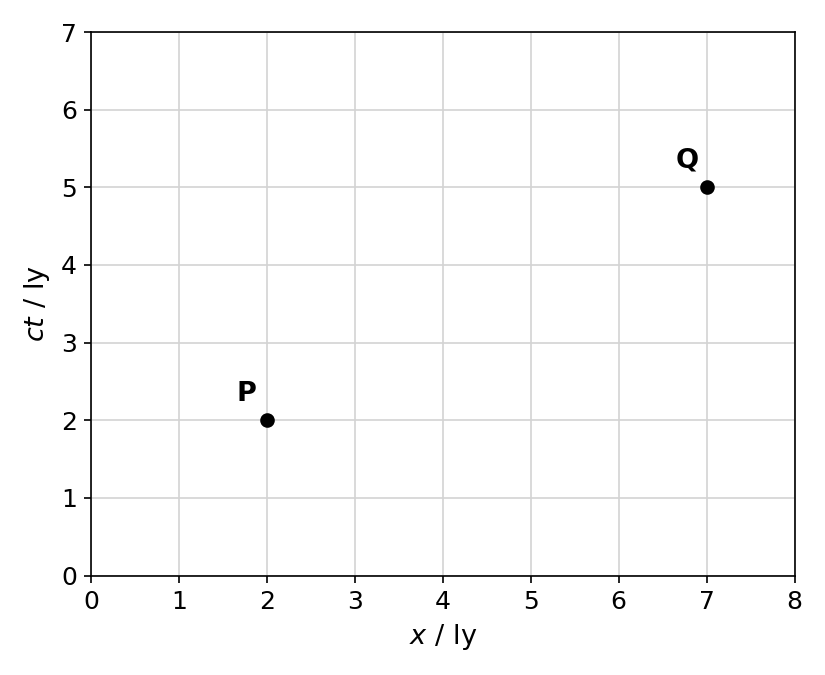
Calculate the time between event P and event Q, according to frame .
Calculate the time taken for the light signal leaving event P to arrive at the position of event Q, according to frame .
Calculate the location of a stationary observer in frame who receives the light signal from event P simultaneously with receiving the light signal from event Q.
Determine the velocity of a moving frame of reference in which event P and event Q occurred simultaneously.
Find the difference in the coordinates for the two events on the diagram.
Determine the spatial distance between the two events. How long does light take to travel this distance?
Set up an equation for the time the light from each event reaches an observer at position , and set them equal.
Use the Lorentz transformation for time, setting the time interval in the moving frame to zero.
Question 6
MediumPaper 2 · calculator10 marksAn interstellar civilization monitors two distant space probes, "Voyager Alpha" (event P) and "Explorer Beta" (event Q), from their stationary reference frame S. The spacetime coordinates of these events, representing the moments they transmit unique data packets, are observed as:
Event P:
Event Q:
A spacetime diagram illustrating these events is shown below.
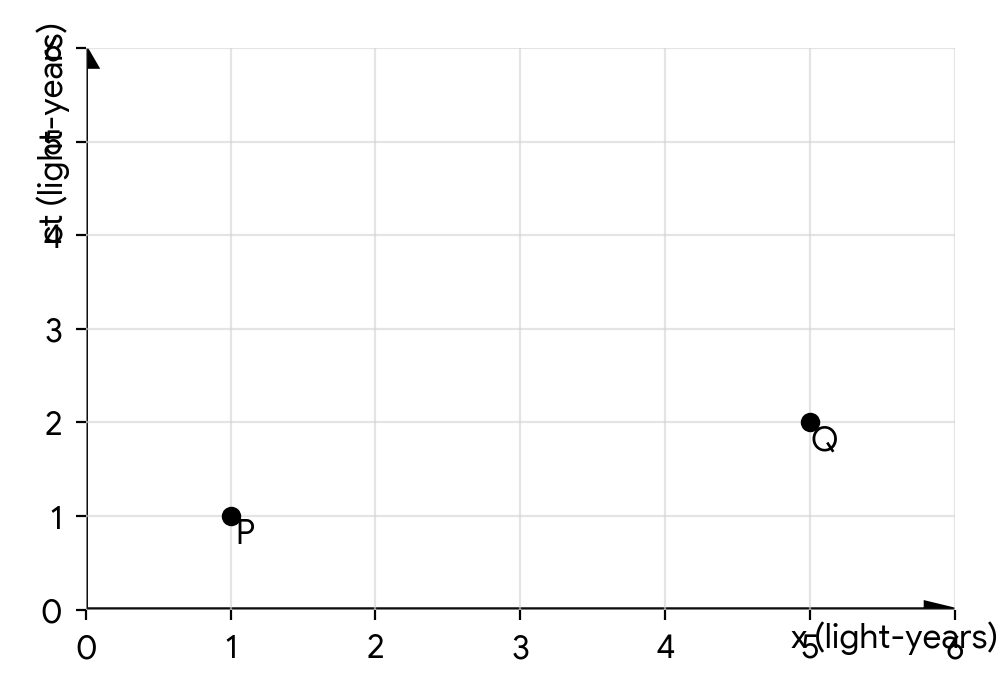
Calculate, according to frame S, the time difference between the transmission of data packets from Voyager Alpha and Explorer Beta.
Determine the time taken for a light signal (representing data) from Voyager Alpha's transmission location to reach Explorer Beta's transmission location, as observed in frame S.
Find the spatial coordinate in frame S of a stationary alien observation post that receives the data packets from Voyager Alpha and Explorer Beta at the exact same moment.
Calculate the velocity of a hypothetical alien spacecraft (a moving reference frame) in which the transmissions from Voyager Alpha and Explorer Beta would be observed to occur simultaneously.
The y-axis represents . Remember that time is .
Consider the spatial separation between the events and the speed of light.
Set up equations for the arrival time of light from each event at the observer's location, assuming simultaneous reception. Remember light travels at speed c.
Use the Lorentz transformation for time, setting .
Question 7
MediumPaper 1A · calculator1 markAn observer on a stationary space station sees two probes, P1 and P2. P1 is moving away from the station at a speed of . P2 is moving away from the station in the opposite direction, also at a speed of .
What is the speed of P2 as measured by an observer on P1?
A.
B.
C.
D.
This is a problem of relative velocity in special relativity. You cannot simply add the speeds as you would in classical mechanics. Recall the relativistic velocity addition formula.
Question 8
MediumPaper 1A · calculator1 markA hypothetical unstable particle has a proper lifetime of . The particle is moving at a speed of relative to a stationary laboratory observer.
What is the lifetime of the particle as measured by the laboratory observer?
A.
B.
C.
D.
Recall the formula for time dilation in special relativity. Remember that the proper time is the time interval measured in the frame where the event occurs at the same spatial point.
Question 9
MediumPaper 1A · calculator1 markA spacecraft travels from a space station to a distant planet at a relativistic speed . The journey takes a proper time as measured by an astronaut on the spacecraft. What is the distance between the space station and the planet in the reference frame of the space station?
A.
B.
C.
D.
The time measured in the space station's reference frame is different from the proper time measured on the spacecraft. This phenomenon is called time dilation. First, find the time of the journey as measured by an observer at the space station. Then, use the formula distance = speed × time.
Question 10
MediumPaper 1A · calculator1 markA space-time diagram shows the coordinate axes of an inertial reference frame S () and another inertial reference frame S' () which moves at a constant velocity relative to S. Four events, P, Q, R, and X, are shown on the diagram.
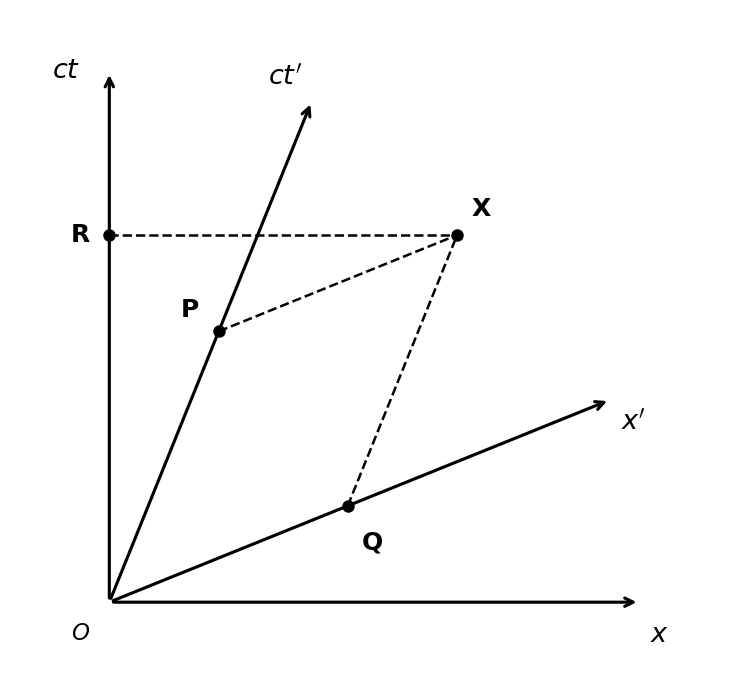
Which row correctly identifies an event that is simultaneous with event X in frame S', and an event that occurs at the same position as event X in frame S'?
| Simultaneous with X in S' | Same position as X in S' | |
|---|---|---|
| A. | P | Q |
| B. | P | R |
| C. | R | P |
| D. | Q | P |
Recall the geometric interpretation of simultaneity and constant position in a Minkowski diagram. Lines of constant time in a given frame are parallel to the spatial axis of that frame. Lines of constant position are parallel to the time axis of that frame.
Question 11
MediumPaper 1A · calculator1 markThe proper length of a spaceship is . The spaceship travels at a constant speed of relative to a space station. An observer on the space station measures the length of the spaceship to be .
What is the ratio ?
A.
B.
C.
D.
Recall the formula for length contraction in special relativity. Identify which length is the proper length and which is the contracted length.
Question 12
MediumPaper 1A · calculator1 markA muon is created by a cosmic ray interaction at an altitude above the Earth's surface, as measured in the Earth's reference frame. The muon travels vertically downwards with a constant speed relative to the Earth.
What is the time for the journey as measured by an observer on Earth and the time as measured in the muon's reference frame?
| Option | Time in Earth frame | Time in muon's frame |
|---|---|---|
| A | ||
| B | ||
| C | ||
| D |
A. Time in Earth frame: , Time in muon's frame:
B. Time in Earth frame: , Time in muon's frame:
C. Time in Earth frame: , Time in muon's frame:
D. Time in Earth frame: , Time in muon's frame:
The proper time is the time interval between two events measured in the reference frame where the events occur at the same location. Identify which frame measures the proper time for the muon's journey. The time measured in any other inertial frame will be dilated (longer).
Question 13
MediumPaper 2 · calculator3 marksA probe travels at a constant relativistic speed relative to a planetary base along the -axis. A scientist on the base records two sensor malfunctions, Event 1 and Event 2, as occurring simultaneously.
Explain, by referring to the Lorentz transformation equations, the condition under which the computer on the probe will also record Event 1 and Event 2 as occurring simultaneously.
Consider the Lorentz transformation equation for a time interval . What are the values of and if the events are simultaneous in both reference frames?
Question 14
MediumPaper 2 · calculator12 marksAn observer on a space station is at rest. A spacecraft carrying observer travels at a constant velocity relative to the space station. The origins of their coordinate systems coincide at for observer and for observer .
According to observer , an explosion occurs at at .
Outline what is meant by the spacetime interval between two events.
Calculate the spacetime interval between the explosion and the coincidence of the origins.
According to observer , the explosion takes place at the origin of their reference frame.
Determine the time of the explosion according to observer .
Explain, with reference to your answer in (c), the concept of time dilation.
Determine, in , the velocity of the spacecraft relative to the space station.
Think about how the spatial and temporal coordinates of two events are combined, and what happens to this value when measured by different inertial observers.
Use the formula for the spacetime interval: . Remember that .
Since the explosion happens at the origin of 's frame, what is its spatial coordinate ? Use the invariance of the spacetime interval.
Compare the time measured by (who is present at both events) with the time measured by . Which one is the proper time, and what does this show about moving clocks?
You can find the velocity by dividing the distance traveled in 's frame by the time taken in 's frame, or by using the Lorentz factor . Don't forget to convert your final answer to .
Question 15
MediumPaper 1A · calculator1 markA spaceship travels with speed with respect to the Earth. A comet travels in the same direction as the spaceship with speed with respect to the Earth.
What is the speed of the comet in the spaceship's reference frame?
A.
B.
C.
D.
Use the relativistic velocity addition formula from the data booklet. Since you are finding the velocity of the comet relative to the spaceship, you need to subtract the spaceship's velocity, paying close attention to the signs in both the numerator and the denominator.
Question 16
MediumPaper 1A · calculator1 markA radioactive particle travels at a constant velocity relative to a laboratory. Observer X measures the proper time interval between the creation and the decay of the particle. Which statement is correct?
A. Observer X is at rest relative to the laboratory.
B. Observer X is at rest relative to the particle.
C. Observer X measures the longest possible time interval between the two events.
D. Observer X measures the two events to occur at different positions in space.
Proper time is the time interval measured by an observer who sees both events occur at the exact same location in their frame of reference.
No question on this page matches those filters. Try another difficulty or paper.
Every Galilean and Special Relativity question, marked for you
Every answer is marked mark by mark, IB-style, and the AI tutor helps when you are stuck.
Where marks are lost
- Stopping one step short of the conclusion. Two numbers and no sentence is two marks out of three.
- Answering a procedure question with a platitude.
- Losing precision in Paper 1B. Uniquely to this paper, quoting the right number badly loses marks.