Current and Circuits: notes and practice questions
- This topic introduces direct current (DC) circuits, covering sources of electromotive force (emf) and the flow of charge.
- Current is .
- Electric potential difference is .
- Electrical resistance is .
- Resistivity is .
- Electrical power dissipated by a resistor is .
- Resistors in series: .
- Resistors in parallel: .
- Cells have emf and internal resistance , with .
- Ohm's law describes ohmic conductors; non-ohmic behaviour and variable resistors are also studied.
How it is examined
Both papers. Paper 2 questions are typically a V-I graph with a non-ohmic component in series with an ohmic one. May 2025 SL Paper 2 TZ1 question 3 did exactly that across four short parts, 1 + 1 + 1 + 2 marks: calculate a resistance from the graph, outline how a non-ohmic resistance changes with current, state an ammeter reading in a stated unit, determine the emf. The mark scheme gave two full alternative routes for the emf part, which is normal in circuits. ac circuits are explicitly excluded: never generate one.
, , , , the three power forms, the series and parallel combination rules, . The booklet also carries the full set of electrical circuit symbols, which the guidance points at directly, so a circuit diagram in a question may use any of them without a key.
- that cells provide a source of emf
- chemical cells and solar cells as the energy source in circuits
- that circuit diagrams represent the arrangement of components in a circuit
- direct current (dc) I as a flow of charge carriers, as given by
Alternating current (ac) circuits are not required.
Guiding questions
- How do charged particles flow through materials?
- How are the electrical properties of materials quantified?
- What are the consequences of resistance in conductors?
Linking questions
- In what ways can an electrical circuit be described as a system like the Earth's atmosphere or a heat engine?
- How are the fields in other areas of physics similar to and different from each other?
- How can the heating of an electrical resistor be explained using other areas of physics?
- What are the advantages of cells as a source of electrical energy?
- How does a particle model allow electrical resistance to be explained? (NOS)
- What are the parallels in the models for thermal and electrical conductivity? (NOS)
Practice questions
12 questions · 2 easy · 9 medium · 1 hardQuestion 1
EasyPaper 1A · calculator1 markTwo cylindrical resistors, X and Y, are connected in series to a cell. Resistor X has twice the length and half the diameter of resistor Y. Both resistors are made of the same material.
The current in X is and the current in Y is . What is the ratio ?
A.
B.
C.
D.
In a series circuit, there is only one path for the charge carriers to flow. Consider how the rate of flow of charge compares at different points along a single path, regardless of the resistance.
Question 2
MediumPaper 2 · calculator11 marksA portable power supply, designed for drone operation, consists of a battery with an internal resistance. It is initially connected to two identical heating elements, each with a resistance of , arranged in parallel. The total current drawn from the power supply in this configuration is .
For a different operational mode, the two heating elements are reconnected in series to the same power supply. In this series configuration, the total current drawn from the power supply is .
(a) Calculate the internal resistance of the power supply.
(b) Determine the electromotive force (emf) of the power supply.
(c) Calculate the power dissipated in one of the heating elements:
i. when connected in parallel.
ii. when connected in series.
Start by finding the equivalent resistance of the heating elements for both the parallel and series configurations. Then, use the equation for both scenarios to form a system of simultaneous equations.
Use the internal resistance calculated in part (a) along with one of the current and external resistance values to find the emf.
Remember that for parallel components, the voltage across each component is the same. Find the terminal potential difference of the battery in the parallel configuration.
In a series circuit, the current is the same through all components.
Question 3
HardPaper 2 · calculator18 marksAn electric ski lift is powered by a motor at the base station. The motor is connected to a 750 V DC power supply by a cable with a total resistance of 0.15 Ω. When operating at full capacity, the motor draws a constant current of 400 A.
(a) Determine the potential difference across the terminals of the motor.
(b) The motor has an efficiency of 92%. Calculate the useful mechanical power output of the motor.
The ski lift carries skiers up a slope of length 1800 m that rises by a vertical height of 500 m. There are 50 chairs on the ascending side. Each empty chair has a mass of 25 kg and carries, on average, 1.5 skiers of average mass 75 kg. A constant resistive force of 12 kN opposes the motion.
(c) Determine the total upward force the motor must provide via the cable to maintain a constant speed.
(d) Estimate the maximum speed, , of the ski lift.
(e) The lift operates continuously. Estimate the maximum number of skiers that can be transported to the top station in one hour.
(f) In an emergency stop, a brake is applied to a large solid steel disc, bringing the lift to a halt from its maximum speed. The total mass of the moving system (chairs, skiers, and cable) is 18 000 kg. Assume all the kinetic energy of the system is converted into thermal energy in the brake disc.
Calculate the temperature rise of the disc.
Data for this question:
Brake disc radius = 0.75 m
Brake disc thickness = 0.10 m
Density of steel = 7850 kg m⁻³
Specific heat capacity of steel = 450 J kg⁻¹ K⁻¹
(g) The speed of a chair is monitored using a radar device at the base station that emits microwaves of frequency 30 GHz. It measures the waves reflected from a chair as it moves away. The frequency shift, , for a source moving directly away from a stationary observer can be approximated by the formula . In this radar measurement, this formula gives a good approximation for the shift detected.
Calculate the expected frequency shift.
First, calculate the voltage that is 'lost' in the power cable due to its resistance. Then, consider how this affects the voltage available for the motor from the main power supply.
First, find the electrical power being supplied to the motor using your answer from part (a). Then, use the efficiency to find how much of this is converted into useful mechanical power.
The total upward force must balance all the downward forces. This includes the component of the total weight acting parallel to the slope and the resistive force. First, find the angle of the slope or the sine of the angle.
At a constant speed, the mechanical power output of the motor is used to overcome the total force at that speed. Use the relationship between power, force, and velocity.
You can calculate the number of skiers arriving per second, then convert to per hour. Alternatively, find how long it takes for one chair to travel the full length, which tells you the rate at which chairs arrive at the top.
This is a conservation of energy problem. The initial kinetic energy of the entire moving system is converted into thermal energy (heat) in the brake disc. You'll need to calculate the kinetic energy first, then the mass of the disc, and finally use the specific heat capacity formula.
You are given the formula for the Doppler shift. Rearrange it to find the change in frequency, Δf. Make sure all your values are in SI units before you calculate.
Question 4
EasyPaper 2 · calculator3 marksAn electrical heater is completely immersed in a container of liquid nitrogen which is at its boiling point. The heater operates with a potential difference of and a current of . The specific latent heat of vaporization of nitrogen is .
Calculate the time taken for of the liquid nitrogen to vaporize.
First find the total thermal energy required to vaporize the mass of nitrogen, then determine the electrical power of the heater to find the time.
Question 5
MediumPaper 1A · calculator1 markFour identical resistors are connected as shown. The current at point X is and the current at point Y is .
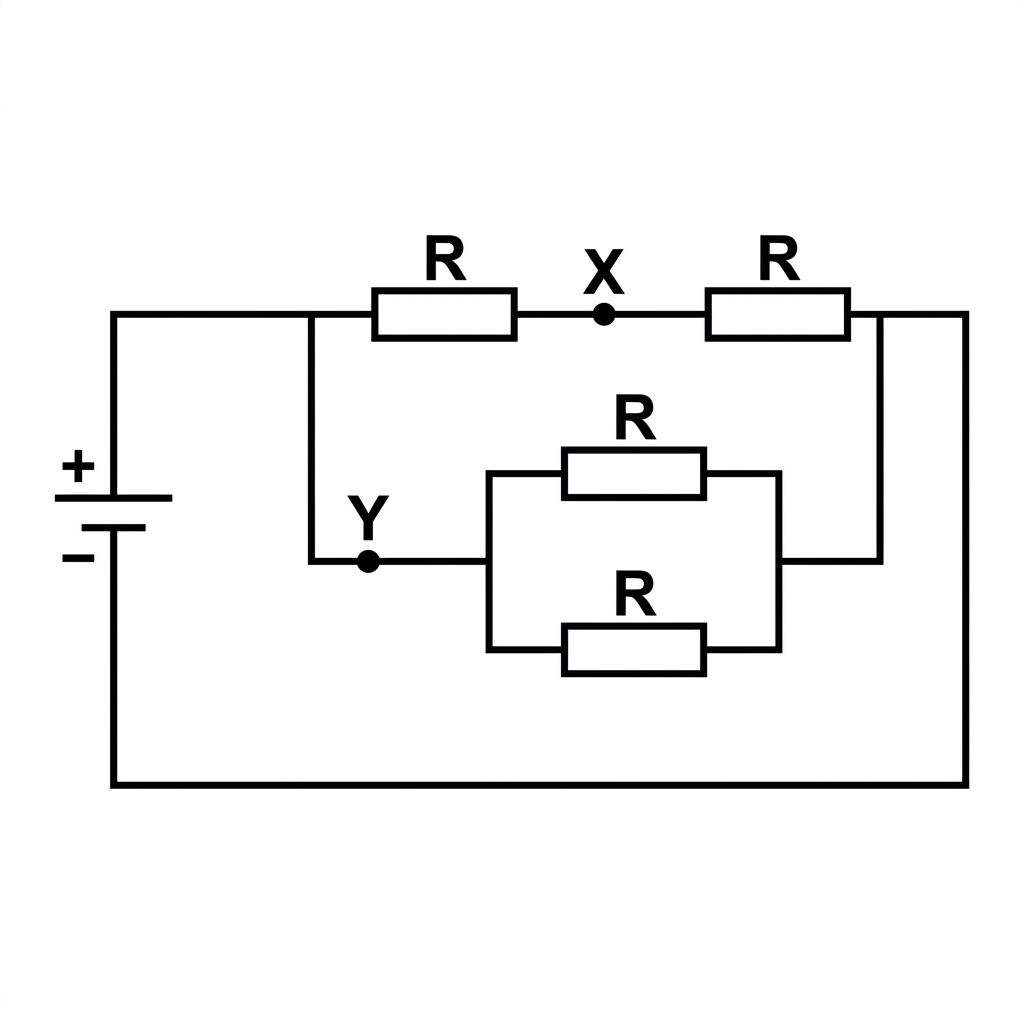
What is the ratio ?
A.
B.
C.
D.
First, determine the equivalent resistance of the top branch (containing X) and the bottom branch (containing Y) in terms of a single resistor . Remember that for parallel branches, the potential difference across them is identical. Use Ohm's law to find the ratio of the currents.
Question 6
MediumPaper 1A · calculator1 markA student is designing a heating system for a small model house using three resistive heating elements. Two heating elements, and , are connected in series. This series combination is then connected in parallel with a third heating element, .
Given that , , and , what is the total equivalent resistance of this circuit?
A.
B.
C.
D.
First, find the equivalent resistance of the two resistors connected in series. Then, combine this equivalent resistance with the third resistor, which is connected in parallel to the series combination.
Question 7
MediumPaper 1A · calculator1 markA heating element in a laboratory hot plate is made from a wire of length . When a potential difference of is applied across the wire, the power dissipated is . A second heating element is constructed using a wire made from the same material and with the same cross-sectional area. When a potential difference of is applied across the second wire, the power dissipated is .
What is the length of the second wire?
A.
B.
C.
D.
Recall the relationship between power, potential difference, and resistance. Also, remember how resistance depends on the length of a wire for a given material and cross-sectional area.
Question 8
MediumPaper 1A · calculator1 markA heating coil (Coil A) in an electric kettle dissipates a power of when connected to a voltage .
Another heating coil (Coil B) is made from the same resistive wire material and has the same length as Coil A, but its diameter is half that of Coil A.
Coil B is connected to a voltage of .
Both coils are assumed to have negligible temperature change effects on resistance.
What power is dissipated in Coil B?
A.
B.
C.
D.
Recall the relationship between resistance, resistivity, length, and cross-sectional area. Remember how the cross-sectional area relates to the diameter. Also, recall the formula for power dissipated in a resistor in terms of voltage and resistance.
Question 9
MediumPaper 1A · calculator1 markA filament lamp, bulb A, is rated to dissipate when connected to a supply.
A second lamp, bulb B, has a filament made of the same material and with the same diameter as bulb A, but the filament is half as long.
Bulb B is connected to a supply.
Both supplies have negligible internal resistance.
What is the power dissipated in bulb B?
A.
B.
C.
D.
First, determine how the resistance of bulb B compares to the resistance of bulb A. Remember that resistance is proportional to length for a uniform conductor. Then, use the formula for power that relates voltage and resistance, , to find the new power dissipation.
Question 10
MediumPaper 2 · calculator7 marksA student performs an experiment to determine the resistivity of a metal wire. The resistance , length , and diameter of the wire are measured.
(a) The diameter is measured with a micrometer screw gauge. State one experimental precaution that should be taken to ensure this measurement is accurate.
(b) The following data are collected:
Resistance
Length
Diameter
Calculate the resistivity of the wire and its absolute uncertainty.
(c) State the value of the resistivity with its uncertainty to an appropriate number of significant figures.
(d) The accepted value for the resistivity of nichrome at the experimental temperature is . Deduce, using your answer from (c), whether the wire is likely to be made of nichrome.
Think about what could cause inconsistent readings when using a micrometer. Is there any initial error to check for before taking measurements?
First, write down the formula for resistivity in terms of resistance, length, and diameter. Remember to convert all quantities to SI units before substituting. For the uncertainty, recall the rule for combining fractional uncertainties for multiplication, division, and powers.
The number of decimal places in your value should match the number of decimal places in your uncertainty. The uncertainty itself is usually quoted to one significant figure.
Calculate the upper and lower bounds of your experimental value using the uncertainty. Check if the accepted value falls within this range.
Question 11
MediumPaper 1A · calculator1 markA current in a wire of length and diameter dissipates a power of 400 W. A second wire of the same material has length and diameter . What is the power dissipated in the second wire when it carries the same current ?
A. 100 W
B. 200 W
C. 400 W
D. 800 W
Recall how resistance depends on both length and cross-sectional area (which depends on the square of the diameter). Then use the power equation that relates power, current, and resistance.
Question 12
MediumPaper 2 · calculator10 marksA cell of electromotive force (emf) and internal resistance is connected in series with an ideal ammeter and a resistor of resistance . The ammeter reading is .
A second resistor of resistance is then connected in parallel with the resistor. The ammeter reading increases to .
(a) Determine the internal resistance of the cell.
(b) Calculate the emf of the cell.
(c) Determine the change in the power dissipated by the resistor when the resistor is added to the circuit.
(d) The resistor is removed and replaced by a variable resistor. Explain how the terminal potential difference of the cell changes as the resistance of the variable resistor is decreased.
Set up two equations for the electromotive force (emf) of the cell, one for each circuit configuration.
Substitute the value of the internal resistance back into one of your equations from part (a).
Calculate the power for the resistor in both configurations. Remember that in the parallel circuit, the total current splits between the two resistors.
Consider how decreasing the resistance affects the total current, and how that in turn affects the potential difference across the internal resistance.
No question on this page matches those filters. Try another difficulty or paper.
Every Current and Circuits question, marked for you
Every answer is marked mark by mark, IB-style, and the AI tutor helps when you are stuck.
Where marks are lost
- Stopping one step short of the conclusion. Two numbers and no sentence is two marks out of three.
- Answering a procedure question with a platitude.
- Losing precision in Paper 1B. Uniquely to this paper, quoting the right number badly loses marks.