Gas Laws: notes and practice questions
- This topic covers the macroscopic and microscopic properties of gases, including pressure, temperature, and the ideal gas law.
- Pressure is defined as .
- The amount of substance is .
- Ideal gases are described by the kinetic theory, approximating real gas behavior.
- The ideal gas law is given by , , and .
- Pressure is related to the average (translational speed)² of molecules by .
- Internal energy of an ideal monatomic gas is or .
- Understand conditions for ideal gas approximation and differences from real gases.
How it is examined
Both papers, and it is a favourite of Paper 1B because a gas experiment produces clean linear data once you plot the right pair of variables. May 2025 SL and HL Paper 1B TZ2 question 2 opened with "The equation describes the behaviour of an ideal gas" and ran a full data analysis off it. In Paper 2 the common shapes are a two-state calculation and an explain-in-molecular-terms question. Asking for a diagram of an adiabatic process is HL B.4 territory, not B.3.
, , , , , , and both forms of the monatomic internal energy. , and are in the constants table. The assumptions of the kinetic model are prose and must be recalled.
- pressure as given by , where F is the force exerted perpendicular to the surface
- the amount of substance n as given by , where N is the number of molecules and the Avogadro constant
- that ideal gases are described by kinetic theory and are a modelled system used to approximate real gases
- that the ideal gas law can be derived from the empirical gas laws for constant pressure, constant volume and constant temperature, as given by
Guiding questions
- How are the macroscopic characteristics of a gas related to the behaviour of individual molecules?
- What assumptions and observations lead to universal gas laws?
- How can models be used to help explain observed phenomena?
Linking questions
- How does the concept of force and momentum link mechanics and thermodynamics?
- How does a consideration of the kinetic energy of molecules relate to the development of the gas laws?
- How can gas particles of high kinetic energy be used to perform work?
- What other simplified models are relied upon to communicate the understanding of complex phenomena? (NOS)
Practice questions
23 questions · 5 easy · 16 medium · 2 hardQuestion 1
EasyPaper 1A · calculator1 markA chemical plant stores various industrial gases in identical containers, each designed to hold a specific volume. Four different pure gases are stored, each in a separate container. The gases are hydrogen (), oxygen (), nitrogen (), and carbon monoxide ().
Each container has the same volume, and the gases are maintained at the same pressure and temperature.
Which sample has the smallest mass?
A.
B.
C.
D.
Recall Avogadro's law, which states that equal volumes of all gases, at the same temperature and pressure, have the same number of molecules. How does the number of molecules relate to the mass of the sample for different gases?
Question 2
MediumPaper 1A · calculator1 markAn ideal gas is a theoretical model used to describe the behavior of real gases. Which of the following statements about an ideal gas are correct?
I. The internal energy of the gas consists only of the kinetic energy of its particles.
II. For a fixed mass of the gas at constant temperature, its pressure is directly proportional to its volume.
III. The root mean square speed of the gas particles is proportional to the square root of the absolute temperature.
A. II and III only
B. I and II only
C. I and III only
D. I, II and III
Review the key assumptions of the kinetic model of an ideal gas. How does internal energy relate to kinetic and potential energy in this model? What is the relationship between pressure and volume at constant temperature (Boyle's Law)? How does temperature relate to the kinetic energy and speed of gas particles?
Question 3
HardPaper 2 · calculator10 marksA large weather balloon is filled with helium gas at ground level. The helium can be modelled as an ideal gas. The balloon is released and rises through the atmosphere.
(a) Explain, in terms of the kinetic model of an ideal gas, how the helium exerts a pressure on the inner surface of the balloon.
(b) As the balloon rises to a high altitude, the external atmospheric pressure decreases significantly. Assuming the temperature of the helium remains constant, explain why the volume of the balloon increases.
(c) In reality, if the balloon rises very quickly, the temperature of the helium gas inside is observed to decrease. Explain this observation in terms of the motion of the helium atoms and the walls of the balloon.
Think about the individual gas atoms. What are they doing? How do they interact with the walls of the balloon? Connect this to the concepts of force and momentum from Newton's laws.
Consider the pressure balance between the inside and outside of the balloon. How does the behaviour of the gas atoms change when the volume changes?
What happens to the energy of a gas atom when it collides with a wall that is moving away from it? How is the temperature of a gas related to the energy of its atoms?
Question 4
EasyPaper 1A · calculator1 markA fixed mass of moles of an ideal gas is maintained at a constant pressure. The graph shows the variation of the volume of the gas with its absolute temperature .
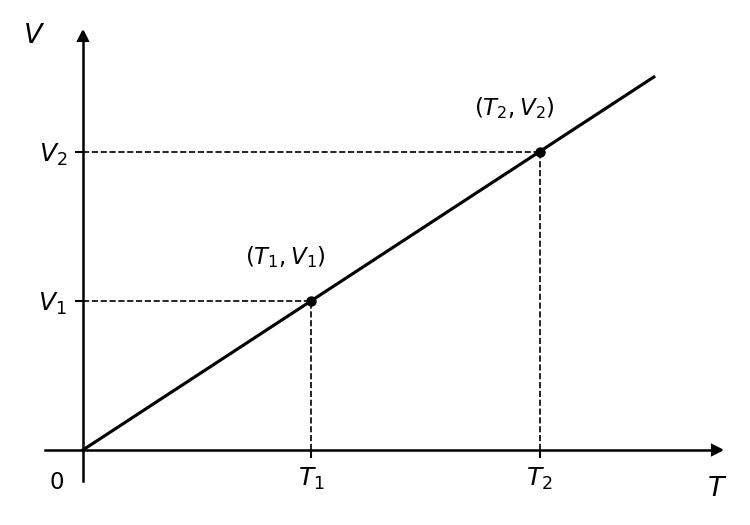
What is the pressure of the gas?
A.
B.
C.
D.
Start with the ideal gas law equation, . Rearrange it to make the volume the subject, so it looks like the equation of a straight line (). How does the gradient of the graph, which can be calculated from the two points, relate to the pressure ?
Question 5
MediumPaper 1A · calculator1 markA flexible weather balloon contains 0.75 mol of helium gas. At an altitude where the pressure is 90.0 kPa and the volume of the balloon is 0.020 m, what is the temperature of the helium gas?
A. -12.0 ºC
B. 15.0 ºC
C. 288 ºC
D. 561 ºC
Remember to use the ideal gas law equation, PV = nRT. Pay close attention to the units of pressure and temperature. The ideal gas constant R is 8.31 J mol⁻¹ K⁻¹.
Question 6
HardPaper 2 · calculator11 marksA fixed mass of an ideal monatomic gas is confined in a cylinder by a movable piston.
Explain, with reference to Newton's laws of motion, how the gas exerts a pressure on the piston.
The piston is slowly pulled outwards, increasing the volume of the gas at a constant temperature.
Explain, in terms of the motion of the particles, why the pressure of the gas decreases.
The piston is now pushed inwards rapidly. No thermal energy is transferred between the gas and its surroundings.
Explain, in terms of the collisions between the particles and the piston, why the temperature of the gas increases.
The initial volume of the gas before the rapid compression was at a pressure of .
Calculate the internal energy of the gas before the compression.
Think about what happens to the momentum of a gas particle when it collides with the piston, and how Newton's second and third laws relate this to force and pressure.
Consider how the constant temperature affects the speed of the particles, and how the increased volume affects how often they hit the piston.
Think about the relative velocity of the particle and the piston during a collision when the piston is moving inwards.
Use the ideal gas law to relate pressure and volume to the equation for the internal energy of a monatomic gas.
Question 7
EasyPaper 1A · calculator1 markThe internal energy of an ideal gas is equal to the total random kinetic energy of its particles. For a real gas, the internal energy is
A. also equal to the total random kinetic energy of its particles.
B. equal to the sum of the total random kinetic energy and the intermolecular potential energy of its particles.
C. equal only to the intermolecular potential energy of its particles.
D. zero.
Recall the definition of internal energy. What is the key assumption made for an ideal gas that is not true for a real gas? How does this assumption affect the components of internal energy?
Question 8
MediumPaper 1A · calculator1 markTwo sealed gas cylinders, Cylinder P and Cylinder Q, contain ideal gases.
The volume of Cylinder P is half the volume of Cylinder Q. The pressure of the gas in Cylinder P is double the pressure of the gas in Cylinder Q.
The temperature of the gas in P is 27 °C and the temperature of the gas in Q is 127 °C.
What is the ratio ?
A.
B.
C.
D.
Start with the ideal gas law equation, . Rearrange it to make 'n' the subject. Remember to convert all temperatures to the absolute scale (Kelvin) before using them in the equation. Then, set up a ratio of to and substitute the given relationships.
Question 9
EasyPaper 1A · calculator1 markAn ideal gas is held in a rigid container at an initial temperature of . Thermal energy is transferred to the gas until its pressure is doubled. What is the final temperature of the gas?
A.
B.
C.
D.
The proportional relationship between pressure and temperature for a fixed mass of gas at constant volume only applies when the temperature is measured in Kelvin. Convert the initial temperature to Kelvin before doubling it, then convert back to Celsius.
Question 10
MediumPaper 2 · calculator8 marks(a) A weather balloon is filled with hydrogen gas at a pressure of 1.0 x 10 Pa and a temperature of 290 K. The volume of the balloon is 5.0 m. Assume that this sample of hydrogen gas behaves as an ideal gas.
The molar mass of hydrogen (H) is 2.016 g mol. Show that the mass of a hydrogen molecule is approximately 3.35 x 10 kg.
(b) Estimate the average speed of the hydrogen molecules in the balloon.
(c) Calculate the number of hydrogen molecules in the balloon.
(d.i) A hydrogen molecule has an approximate volume of 2.0 x 10 m. Calculate the ratio .
(d.ii) Explain, using your answer to (d)(i) and with reference to the kinetic model, why this sample of hydrogen can be assumed to be an ideal gas.
Recall the relationship between molar mass, Avogadro's number, and the mass of a single molecule. Ensure units are consistent.
The average kinetic energy of gas molecules is related to the absolute temperature. Use the formula for kinetic energy and the Boltzmann constant.
The ideal gas law can be expressed in terms of the number of molecules (N) and the Boltzmann constant (k).
Multiply the number of molecules by the volume of a single molecule to find the total volume occupied by the molecules themselves.
Consider the assumptions of the kinetic model of ideal gases, particularly regarding the volume of particles.
Question 11
EasyPaper 2 · calculator2 marksA sealed flask contains krypton gas maintained at a temperature of . The gas behaves as an ideal gas.
(a) Calculate the mean translational kinetic energy of a krypton atom in the flask.
Use the equation relating the absolute temperature of an ideal gas to the average kinetic energy of its particles. The Boltzmann constant can be found in the data booklet.
Question 12
MediumPaper 2 · calculator13 marksThis question is about ideal gases and real gases.
(a) Explain what is meant by an ideal gas and state two ways in which a real gas differs from an ideal gas.
(b) State the conditions of temperature and pressure under which the behaviour of a real gas most closely approximates that of an ideal gas.
(c) Outline three assumptions of the kinetic model of an ideal gas.
(d) Deduce why the internal energy of an ideal gas is considered to be solely its total random kinetic energy.
(e) A sealed cylinder contains a fixed mass of an ideal gas. Initially, the gas has a volume of , a pressure of , and a temperature of . The gas is then compressed to a new volume of and heated to a new temperature of . Calculate the final pressure of the gas.
Recall the definition of an ideal gas and the assumptions made about its particles. Consider how real gas particles behave differently, especially regarding volume and intermolecular forces.
Think about the conditions where the assumptions of an ideal gas (like negligible particle volume and no intermolecular forces) are most likely to hold true for a real gas.
Consider the key characteristics of ideal gas particles as described by the kinetic theory. Think about their motion, size, and interactions.
Relate the assumptions of an ideal gas, particularly regarding intermolecular forces, to the concept of potential energy.
Use the combined gas law, ensuring all temperatures are in Kelvin. The combined gas law is .
Question 13
MediumPaper 1A · calculator1 markA sealed, rigid container is filled with a certain number of moles of helium (He) gas. An identical container is filled with the same number of moles of argon (Ar) gas. Both containers are maintained at the same temperature.
Which row correctly compares the density of the gas and the pressure in the two containers?
| Density | Pressure | |
|---|---|---|
| A | same | same |
| B | same | different |
| C | different | same |
| D | different | different |
Consider the definition of density (). How does the total mass of gas compare if the number of moles is the same but the molar mass is different? For pressure, consider the ideal gas law, .
Question 14
MediumPaper 1A · calculator1 markTwo identical rigid containers, X and Y, are held at the same temperature. Container Y contains double the number of molecules of the same ideal gas as container X.
What is the ratio of the density in Y to the density in X, and the ratio of the pressure in Y to the pressure in X?
| Ratio of densities (Y/X) | Ratio of pressures (Y/X) | |
|---|---|---|
| A. | 1 | 1 |
| B. | 1 | 2 |
| C. | 2 | 1 |
| D. | 2 | 2 |
Recall the definition of density in terms of mass and volume. How does the total mass of the gas in container Y compare to that in container X? Then, apply the ideal gas law () to compare the pressures.
Question 15
MediumPaper 1A · calculator1 markA sample of an ideal monatomic gas has an internal energy of when its temperature is . The gas constant .
How many moles of the gas are in the sample?
A.
B.
C.
D.
Recall the formula for the internal energy of an ideal monatomic gas. Remember to convert the temperature to Kelvin.
Question 16
MediumPaper 1A · calculator1 markA fixed mass of an ideal gas, equivalent to moles, is contained in a cylinder fitted with a movable, frictionless piston, maintaining a constant pressure. The graph shows how the volume of the gas varies with absolute temperature .
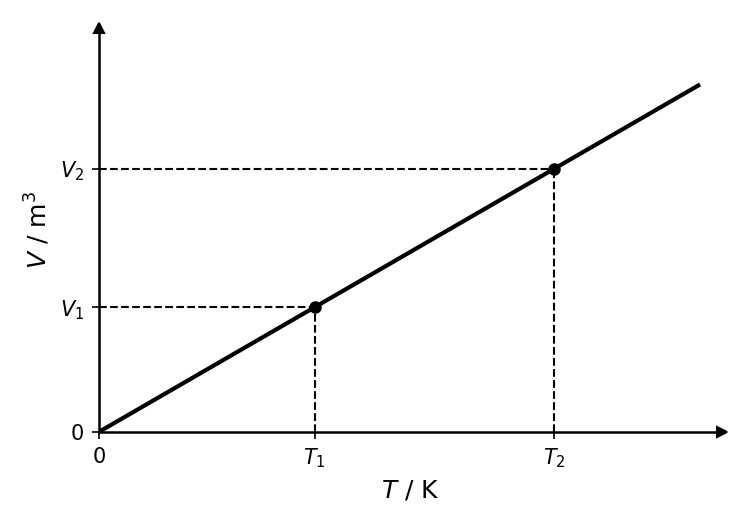
What is the pressure of the gas?
A.
B.
C.
D.
Start with the ideal gas law equation, . Since the pressure is constant, you can write equations for the two states shown on the graph, and . Try subtracting one equation from the other to find an expression for .
Question 17
MediumPaper 1A · calculator1 markTwo identical sealed vessels contain monatomic ideal gases. One vessel contains argon (Ar) and the other contains neon (Ne).
The total mass of the gas in each vessel is the same, and both gases are at the same pressure.
The mass of an argon atom is approximately twice the mass of a neon atom.
What is ?
A.
B.
C.
D.
The internal energy of a monatomic ideal gas can be expressed in terms of pressure and volume. How do the pressures and volumes of the two gases compare?
Question 18
MediumPaper 1A · calculator1 markTwo sealed laboratory flasks, A and B, contain samples of an ideal gas at the same pressure.
Flask A has a volume of and is at a temperature of . Flask B has a volume of and is at a temperature of .
What is ?
A.
B.
C.
D.
Recall the ideal gas law, . Remember to convert all temperatures to the Kelvin scale before performing any calculations.
Question 19
MediumPaper 1A · calculator1 markAn ideal gas and a real gas are at the same temperature and occupy the same volume. The number of particles in both gases is the same. How does the internal energy of the real gas, , compare to the internal energy of the ideal gas, ?
A. because real gas particles have volume.
B. because there are attractive forces between real gas particles.
C. because temperature is the same.
D. The relationship cannot be determined without knowing the pressure.
Recall the definition of internal energy for both an ideal gas and a real gas. What is the key difference? Consider the nature of intermolecular forces and how they affect potential energy. By convention, where is the potential energy defined to be zero?
Question 20
MediumPaper 1A · calculator1 markTwo sealed containers, P and Q, are filled with different samples of an ideal gas at the same pressure.
The volume of container P is twice the volume of container Q. The temperature of P is and the temperature of Q is .
What is ?
A.
B.
C.
D.
Recall the ideal gas law and how it relates pressure, volume, amount of substance, and temperature. Remember to convert temperatures to the absolute scale (Kelvin) before performing calculations.
No question on this page matches those filters. Try another difficulty or paper.
3 more Gas Laws questions in the app
Every answer is marked mark by mark, IB-style, and the AI tutor helps when you are stuck.
Where marks are lost
- Stopping one step short of the conclusion. Two numbers and no sentence is two marks out of three.
- Answering a procedure question with a platitude.
- Losing precision in Paper 1B. Uniquely to this paper, quoting the right number badly loses marks.