Induction: notes and practice questions
- This topic covers the principles of electromagnetic induction, including magnetic flux, Faraday's law, Lenz's law, and induced electromotive force (emf).
- Magnetic flux through a surface is given by .
- Faraday's law of induction states that the induced emf is .
- Lenz's law determines the direction of induced emf, ensuring energy conservation.
- For a straight conductor of length moving at speed perpendicular to a uniform magnetic field , the induced emf is .
- A coil rotating in a uniform magnetic field induces a sinusoidal varying emf.
How it is examined
HL Paper 1A and HL Paper 2. May 2025 HL Paper 2 TZ1 question 9(d) closed a long SHM question with induction: discuss two factors that affect the magnitude of the induced emf, with the question stem explicitly listing what each bullet had to cover (4 marks, the largest single part on that paper), then explain why connecting a resistor across the coil damps the oscillation (3 marks).
, Faraday's law with the factor N, . Lenz's law is a statement to be recalled and applied. Transformers, rectification and RL circuits are not on this syllabus at all: the 2016 course had more of this content than the 2025 course does.
There is no standard level content in D.4.
A discussion of inductance and resistance-inductor (RL) circuits is not required.
Guiding questions
- What are the effects of relative motion between a conductor and a magnetic field?
- How can the power output of electrical generators be increased?
- How did the discovery of electromagnetic induction effect industrialization?
Linking questions
- How is the efficiency of electricity generation dependent on the source of energy?
- Faraday's law of induction includes a rate of change. Which other areas of physics relate to rates of change? (NOS)
Practice questions
4 questions · 4 mediumQuestion 1
MediumPaper 2 · calculator3 marksA high-speed maglev train travels at along a track. The vertical component of the Earth's magnetic field at that location is . The effective length of the conducting axle connecting the wheels is .
(a) Determine the maximum potential difference induced across the train's axle.
Consider the formula for motional electromotive force (EMF) induced in a conductor moving through a magnetic field. Assume the motion is perpendicular to the magnetic field for maximum potential difference.
Question 2
MediumPaper 2 · calculator4 marksA student is performing an experiment to investigate electromagnetic induction. They use a single-turn circular coil connected to a sensitive voltmeter. The coil is placed in a uniform magnetic field.
(a) The coil has a radius of 5.0 cm and is initially oriented such that its plane is perpendicular to a uniform magnetic field of strength 0.10 T. The student then quickly rotates the coil through 90° in 0.050 s so that its plane becomes parallel to the magnetic field. Calculate the magnitude of the average electromotive force (emf) induced in the coil during this rotation.
Consider the change in magnetic flux through the coil. Remember that the angle in is between the normal to the coil's plane and the magnetic field direction.
Question 3
MediumPaper 1A · calculator1 markA small electrical generator contains a coil of wire rotating at a constant angular speed in a uniform magnetic field. The variation with time of the induced emf in the coil is shown in the graph.
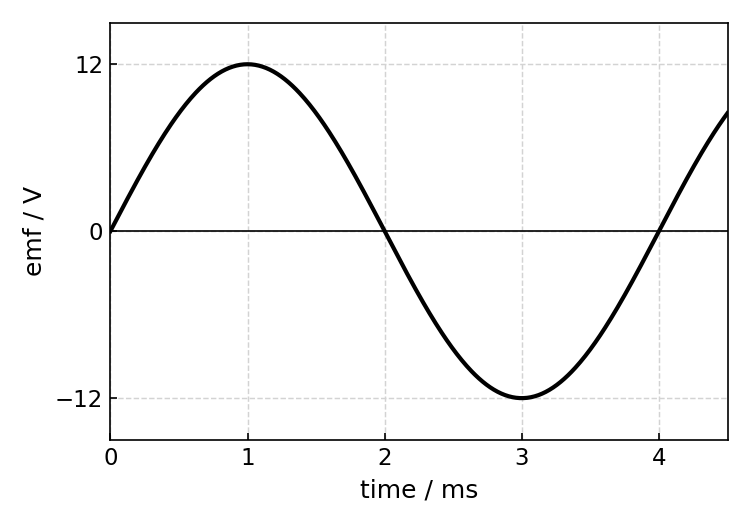
The angular speed of the coil is now increased to .
What is the amplitude of the emf and the time period for the variation of the emf in the coil after this change?
| Amplitude of emf/V | Time period/ms | |
|---|---|---|
| A. | ||
| B. | ||
| C. | ||
| D. |
Recall the relationship between the peak induced EMF, angular speed, and the number of turns, area, and magnetic field strength. Also, recall the relationship between angular speed and the time period of rotation.
Question 4
MediumPaper 1A · calculator1 markA multi-turn coil is placed in a uniform magnetic field. The coil is initially oriented such that its plane is parallel to the magnetic field lines. It is then rotated through so its plane becomes perpendicular to the field lines. An average emf of is induced in the coil during this rotation. The coil has turns and encloses an area of . The rotation takes .
What is the magnitude of the magnetic field?
A.
B.
C.
D.
Recall Faraday's law of induction. The change in magnetic flux linkage for a coil rotating from its plane being parallel to the field to perpendicular to the field involves a change from zero flux to maximum flux. Remember to convert units appropriately.
No question on this page matches those filters. Try another difficulty or paper.
Every Induction question, marked for you
Every answer is marked mark by mark, IB-style, and the AI tutor helps when you are stuck.
Where marks are lost
- Stopping one step short of the conclusion. Two numbers and no sentence is two marks out of three.
- Answering a procedure question with a platitude.
- Losing precision in Paper 1B. Uniquely to this paper, quoting the right number badly loses marks.