Wave Phenomena: notes and practice questions
- This topic describes wave behaviour, including reflection, refraction, diffraction, and interference.
- Waves are represented by wavefronts and rays, reflecting, refracting, and transmitting at boundaries.
- Diffraction occurs around bodies and apertures, visualized with wavefront-ray diagrams.
- Snell's law: , critical angle, and total internal reflection.
- Superposition leads to interference; double-source interference requires coherent sources.
- Constructive interference: path difference . Destructive interference: path difference .
- Young's double-slit fringe separation: .
How it is examined
All three papers, and one of the most productive Paper 1B topics because refraction and double-slit experiments both linearize cleanly. May 2025 Paper 1B TZ1 question 2 was a semi-circular glass block investigation across seven marks, including drawing a maximum-gradient line and quoting a refractive index with its uncertainty. May 2025 Paper 1B TZ3 question 2 was a double-slit determination of . In Paper 2 the standard 3-mark shape is: find the angle of incidence, compare with the critical angle, conclude. Single-slit and grating questions are HL only.
SL: Snell's law in the three-part form above, both path-difference conditions, . HL adds and . Note the direction of the Snell ratio in the booklet: , which is the reciprocal of the arrangement many textbooks print. A student who copies it straight out gets it right; a student working from memory often inverts it. Refractive indices of named materials are given in the question, not the booklet.
- that waves travelling in two and three dimensions can be described through wavefronts and rays
- wave behaviour at boundaries in terms of reflection, refraction and transmission
- wave diffraction around a body and through an aperture
- wavefront-ray diagrams showing refraction and diffraction
- single-slit diffraction including intensity patterns, as given by , where b is the slit width
- that the single-slit pattern modulates the double-slit interference pattern
- interference patterns from multiple slits and diffraction gratings, as given by
Guiding questions
- How are observations of wave behaviours at a boundary between different media explained?
- How is the behaviour of waves passing through apertures represented?
- What happens when two waves meet at a point in space?
Linking questions
- What can an understanding of the results of Young's double-slit experiment reveal about the nature of light?
- What evidence is there that particles possess wave-like properties such as wavelength? (NOS)
Practice questions
15 questions · 3 easy · 11 medium · 1 hardQuestion 1
EasyPaper 1A · calculator1 markA ray of monochromatic light travels from air and enters a block of glass. Part of the light is refracted.
Three statements are made about the refracted light compared to the incident light.
I. The speed of the light is different.
II. The frequency of the light is different.
III. The wavelength of the light is different.
Which of the statements are correct?
A. I and II only
B. I and III only
C. II and III only
D. I, II and III
Consider the fundamental properties of a wave as it passes from one medium to another. Which property is determined by the source of the wave and remains constant? How does the wave equation, , connect the other properties?
Question 2
MediumPaper 1A · calculator1 markMicrowaves of wavelength are emitted from two identical horn antennas. The antennas act as single slits of width and their centres are separated by a distance . A detector measures the intensity of the microwaves at different angles from the central axis.
The resulting intensity pattern is shown.
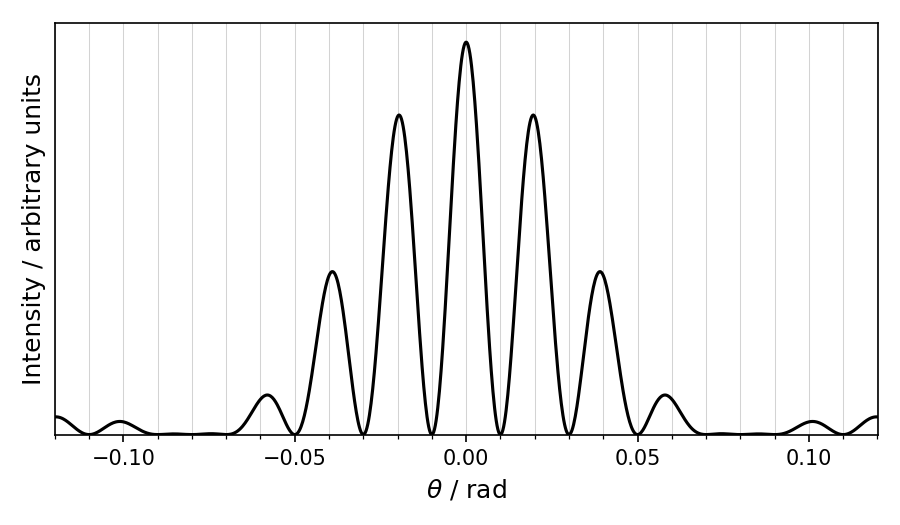
What are the approximate values of the ratios and ?
| A. | ||
| B. | ||
| C. | ||
| D. |
The narrow, closely spaced peaks are due to interference between the two sources. The wider envelope that modulates the intensity is due to diffraction from each individual source. Recall the formulas for the angular position of the first interference maximum and the first diffraction minimum.
Question 3
HardPaper 2 · calculator8 marksA research team is developing a high-resolution spectrometer for analyzing light from distant astronomical sources. The core component is a diffraction grating with 300 lines per mm. When light of a specific spectral line, with a wavelength of 630 nm, is incident normally on the grating.
(a) Calculate the angular position of the first-order maximum.
(b) The entrance slit of the spectrometer, which acts as the source for the grating, has a finite width of m.
(i) Sketch a graph to show the variation, with angle, of the relative intensity of the diffraction pattern produced by this single slit.
(ii) Suggest whether the fifth-order spectral line (maximum) from the diffraction grating would be clearly observable for this spectrometer setup. Justify your answer.
Recall the diffraction grating equation. Ensure all units are consistent (e.g., meters).
Remember the characteristic features of a single-slit diffraction pattern, especially the width and intensity of the central maximum compared to secondary maxima.
Consider the relationship between the grating maxima and the single-slit diffraction envelope. Calculate the angle for the fifth-order grating maximum and compare it to the angle of the first minimum of the single-slit diffraction pattern.
Question 4
EasyPaper 1A · calculator1 markA pulse of monochromatic light travelling in air is incident on a diamond block. Part of the pulse is transmitted into the diamond.
Three statements are made about the transmitted pulse compared to the incident pulse.
I. The wavelength is different.
II. The amplitude is different.
III. The frequency is different.
Which of the statements are correct?
A. I and II only
B. I and III only
C. II and III only
D. I, II and III
Recall which properties of a wave are determined by its source and which depend on the medium it is travelling through. Also, consider what happens to the energy of a wave when it crosses a boundary between two media.
Question 5
MediumPaper 1A · calculator1 markAn optical fibre consists of a core with refractive index and a cladding with refractive index . Light travels from the core to the cladding.
The refractive index of the core is and the refractive index of the cladding is .
What is the critical angle for total internal reflection at the core-cladding interface?
A.
B.
C.
D.
Recall the formula for the critical angle when light travels from a medium of higher refractive index to a medium of lower refractive index.
Question 6
EasyPaper 1A · calculator1 markA student directs a beam of monochromatic red light from a laser normally onto a diffraction grating. A pattern of maxima is observed on a screen far from the grating.
The student then replaces the red light source with a source of monochromatic blue light. All other experimental conditions, including the grating and distances, remain the same.
What is the primary change observed in the diffraction pattern on the screen?
A. The angular separation between the maxima increases.
B. The angular separation between the maxima decreases.
C. The number of observable maxima necessarily decreases.
D. The intensity of all maxima increases.
Recall the relationship between the color of light and its wavelength. Then, consider the diffraction grating equation, , and analyze how a change in wavelength affects the diffraction angle for a given order .
Question 7
MediumPaper 2 · calculator4 marksA laser emits green light with a frequency of Hz.
(a) Calculate the wavelength of this light in air.
(b) Determine the wavelength of this light when it travels through water, which has a refractive index of .
Recall the relationship between the speed of light, frequency, and wavelength. The speed of light in air can be approximated as the speed of light in a vacuum.
Consider how the refractive index of a medium affects the speed and wavelength of light. The frequency of light remains constant when it passes from one medium to another.
Question 8
MediumPaper 1A · calculator1 markA laser beam is directed from air into a thick slab of optical glass, which then rests on a layer of liquid ethanol. The interfaces are parallel.
The refractive index of air is .
The refractive index of optical glass is .
The refractive index of liquid ethanol is .
The angle of incidence of the laser beam at the air-glass interface is .
What is the angle of refraction in the ethanol layer?
A.
B.
C.
D.
Apply Snell's Law at each interface. Remember that for parallel layers, the angle of refraction from the first interface becomes the angle of incidence for the second interface.
Question 9
MediumPaper 1A · calculator1 markTwo coherent laser beams, originating from slits and , illuminate a point P on a screen. The wavelength of the light is m. Point P is located m from and m from . At point P, the amplitude of the wave from is , and the amplitude from is .
What is the resultant amplitude at P?
A.
B.
C.
D.
First, calculate the path difference between the two waves arriving at point P. Then, determine the phase difference using the given wavelength. Finally, apply the principle of superposition to find the resultant amplitude, considering whether the interference is constructive or destructive.
Question 10
MediumPaper 1A · calculator1 markTwo coherent light sources, and , emit light waves of wavelength in phase. A point P is located such that its distance from is and from is . The amplitude of the wave from at P is , and from at P is .
What is the resultant amplitude at P?
A.
B.
C.
D.
First, calculate the path difference between the two waves arriving at point P. Then, use the path difference and the wavelength to find the phase difference. Finally, apply the principle of superposition to determine the resultant amplitude based on the individual amplitudes and the phase difference.
Question 11
MediumPaper 1A · calculator1 markTwo coherent point sources of light, operating in phase, emit monochromatic light. A detector at point P registers a minimum intensity (dark fringe).
Point P is located at a distance of from one source and from the other.
What is a possible wavelength of the light?
A.
B.
C.
D.
For destructive interference (minimum intensity) from two coherent sources in phase, the path difference must be an odd multiple of half a wavelength. Remember to convert units appropriately.
Question 12
MediumPaper 1A · calculator1 markA new type of optical fibre is being developed using a novel polymer. Light traveling from this polymer core into the surrounding air experiences total internal reflection if the angle of incidence exceeds a certain critical angle.
The critical angle for light passing from the polymer into air is . The speed of light in vacuum is .
What is the approximate value for the speed of light in the polymer?
A.
B.
C.
D.
Recall the relationship between critical angle, refractive index, and the speed of light in a medium. Snell's law at the critical angle can be used to find the refractive index.
Question 13
MediumPaper 1A · calculator1 markA monochromatic light source illuminates a diffraction grating in air, producing a pattern of principal maxima on a distant screen. A total of 11 principal maxima are observed.
The diffraction grating and the screen are then submerged in water (refractive index ). The light source remains in the air, and the beam enters the water before reaching the grating.
What are the changes, if any, to the angular separation of the principal maxima and the total number of principal maxima observed?
| Option | Angular separation of maxima | Total number of maxima |
|---|---|---|
| A | Decreases | Increases |
| B | Decreases | Decreases |
| C | Increases | Increases |
| D | Increases | Decreases |
A. A
B. B
C. C
D. D
Recall the relationship between the wavelength of light in a vacuum and in a medium with refractive index . Use this to determine the new wavelength. Then, apply the diffraction grating formula, , and the condition for the maximum number of orders, , to see how the pattern changes. Note that the question uses for refractive index, so we use for the order of the maximum to avoid confusion.
Question 14
MediumPaper 1A · calculator1 markA student performs a single-slit diffraction experiment using a red laser. The resulting diffraction pattern is observed on a screen. The graph shows the variation of light intensity with position on the screen.
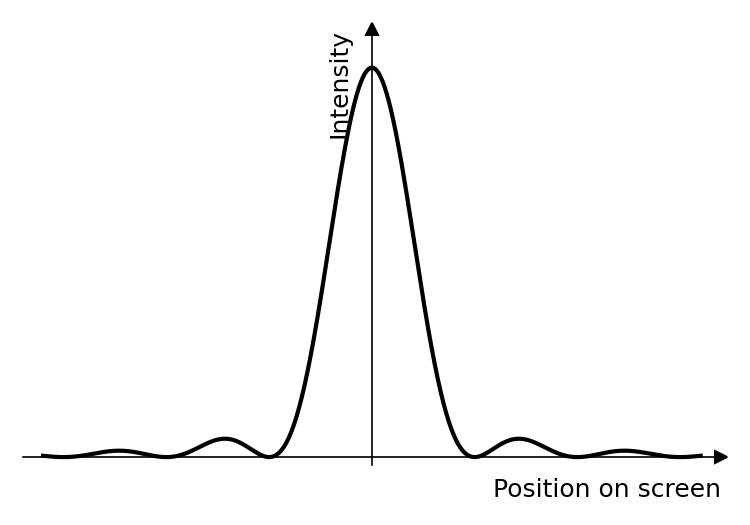
The student replaces the red laser with a blue laser of the same power output. The slit width and distance to the screen are unchanged.
Which graph correctly shows the new diffraction pattern? The original pattern from the red laser is shown as a dashed line.
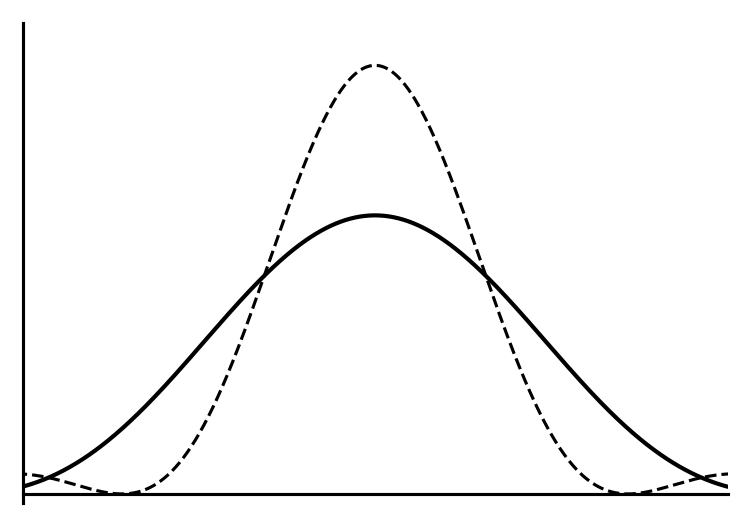
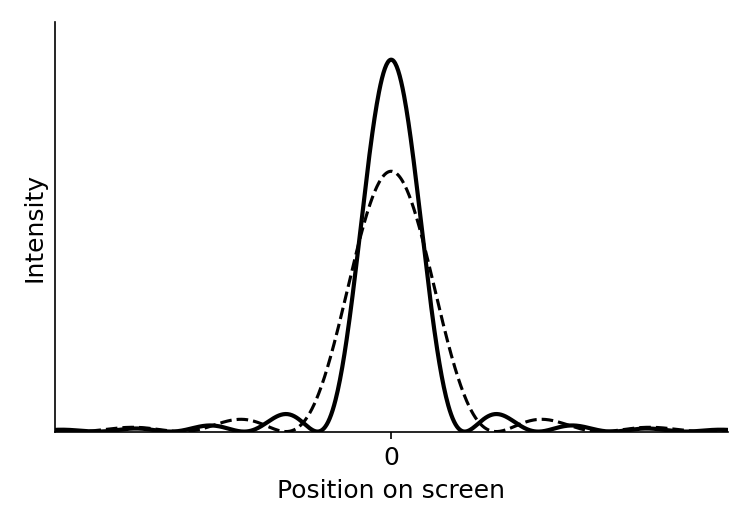
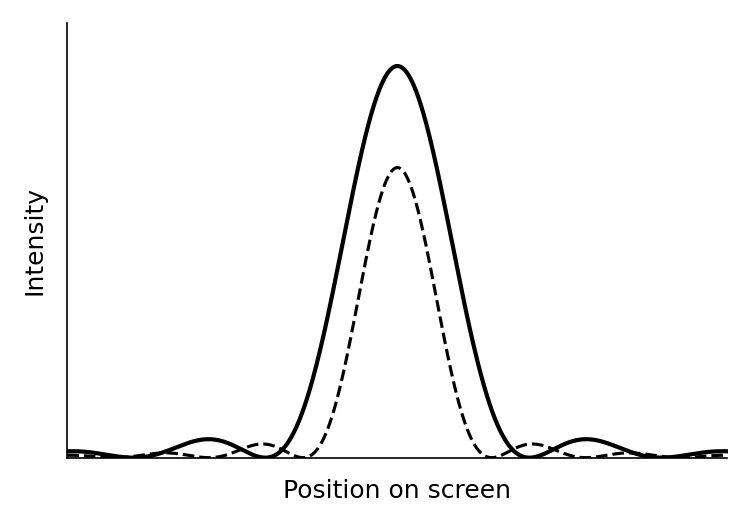
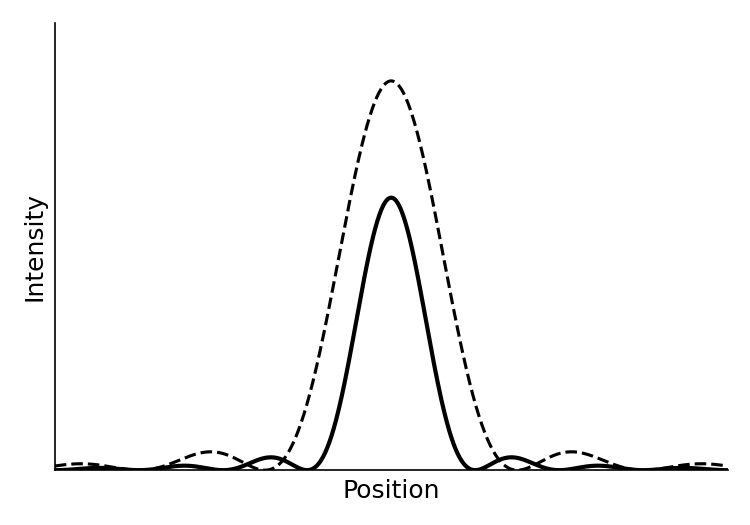
Recall the relationship between the wavelength of light and the angular width of the central diffraction maximum. Blue light has a shorter wavelength than red light. Consider what happens to the intensity if the same amount of power is distributed over a smaller area.
Question 15
MediumPaper 1A · calculator1 markA monochromatic light ray travels from a vacuum into a transparent medium P, and then separately from a vacuum into a transparent medium Q.
The refractive index of medium P relative to vacuum, , and the refractive index of medium Q relative to vacuum, , are such that:
What is the ratio ?
A.
B.
C.
D.
Recall the relationship between the speed of light in a medium, the speed of light in a vacuum, and the refractive index of the medium. Then, set up the ratio carefully.
No question on this page matches those filters. Try another difficulty or paper.
Every Wave Phenomena question, marked for you
Every answer is marked mark by mark, IB-style, and the AI tutor helps when you are stuck.
Where marks are lost
- Stopping one step short of the conclusion. Two numbers and no sentence is two marks out of three.
- Answering a procedure question with a platitude.
- Losing precision in Paper 1B. Uniquely to this paper, quoting the right number badly loses marks.