Wave Model: notes and practice questions
- This topic covers the fundamental properties and characteristics of travelling waves, including their classification and how they transfer energy.
- Waves can be classified as transverse or longitudinal.
- Key wave properties are wavelength , frequency , time period , and wave speed .
- The wave speed is given by .
- Sound waves are mechanical, longitudinal waves that require a medium for propagation.
- Electromagnetic waves are transverse waves that can travel through a vacuum.
- Travelling waves transfer energy without a net displacement of the medium.
- The motion of particles in a medium due to a wave can be described by displacement over time.
How it is examined
Mostly a supporting subtopic: a one-mark step inside a longer wave question. May 2025 Paper 2 TZ1 asked, at both levels, for one difference between sound and electromagnetic waves (1 mark, "1 max" from three acceptable marking points) and then a straight calculate the wavelength of a 1700 Hz sound in air (1 mark). Displacement-position and displacement-time graph reading is the other common shape.
, the speed of light c, and the electromagnetic spectrum with approximate wavelength orders of magnitude. Students do not have to recall that visible light is around 400 to 700 nm, but they do have to read the booklet's table to find it.
- transverse and longitudinal travelling waves
- wavelength , frequency f, time period T and wave speed v applied to wave motion, as given by
- the nature of sound waves
- the nature of electromagnetic waves
Guiding questions
- What are the similarities and differences between different types of waves?
- How can the wave model describe the transmission of energy as a result of local disturbances in a medium?
- What effect does a change in the frequency of oscillation or medium through which the wave is travelling have on the wavelength of a travelling wave?
Linking questions
- How can light be modelled as an electromagnetic wave?
- What happens when waves overlap or coincide?
- How can the length of a wave be determined using concepts from kinematics?
- Why does the intensity of an electromagnetic wave decrease with distance according to the inverse square law?
- How are electromagnetic waves able to travel through a vacuum?
- How were X-rays discovered? (NOS)
- Can the wave model inform the understanding of quantum mechanics? (NOS)
- How are waves used in technology to improve society? (NOS)
Practice questions
20 questions · 7 easy · 13 mediumQuestion 1
EasyPaper 2 · calculator4 marksA teacher demonstrates two types of mechanical waves using a long slinky spring stretched out on a smooth floor.
Demonstration 1: The teacher pushes and pulls the end of the slinky back and forth, parallel to the length of the spring. This creates a series of compressions and rarefactions.
Demonstration 2: The teacher moves the end of the slinky up and down, perpendicular to the length of the spring. This creates a series of crests and troughs.
(a) Discuss the similarities and differences between the two waves produced in the demonstrations.
Start by identifying the name for each type of wave. Then, think about the fundamental definition of each wave type in terms of particle motion and energy flow. What properties do all waves share, regardless of their type?
Question 2
MediumPaper 1A · calculator1 markA small particle attached to a vibrating speaker cone oscillates with simple harmonic motion. The variation with time of the displacement of the particle from its equilibrium position is shown.
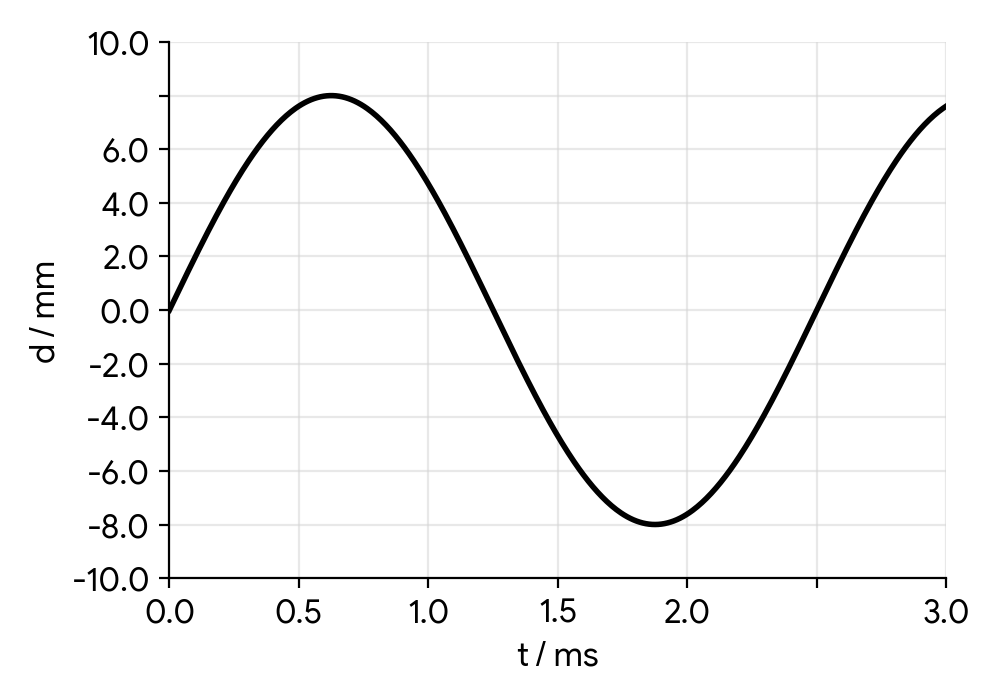
What is the frequency and the amplitude of the particle's oscillation?
| Frequency/Hz | Amplitude/mm | |
|---|---|---|
| A. | ||
| B. | ||
| C. | ||
| D. |
The amplitude is the maximum displacement from the equilibrium position. The period is the time taken for one complete oscillation. Frequency is the reciprocal of the period. Pay attention to units.
Question 3
EasyPaper 1A · calculator1 markAn X-ray is travelling through the air.
What is a possible frequency and what is the nature of the wave?
| Wave frequency / | Nature of the wave |
|---|---|
| A. | transverse |
| B. | longitudinal |
| C. | transverse |
| D. | longitudinal |
Recall the properties common to all electromagnetic waves. Then, consider where X-rays are located in the electromagnetic spectrum to estimate their frequency.
Question 4
MediumPaper 2 · calculator7 marksAn earthquake generates seismic waves. A seismograph, located from the earthquake's epicentre, records the vertical displacement of the ground. The graph shows the displacement due to the arrival of the primary (P) wave. Time is measured from the instant the earthquake occurs.
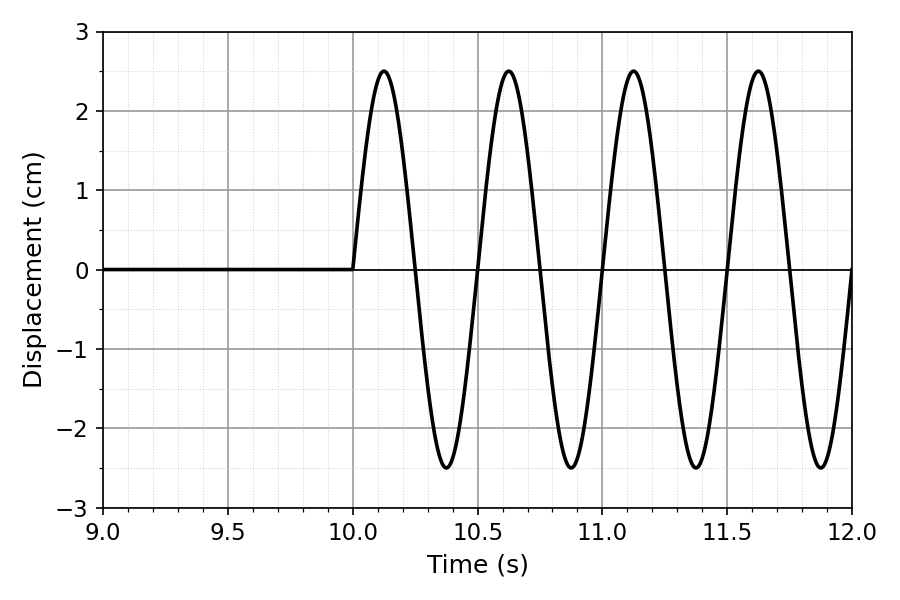
(a) Determine the amplitude of the P-wave.
(b) Calculate the speed of the P-wave.
(c) Determine the frequency of the P-wave.
(d) Calculate the wavelength of the P-wave.
The amplitude is the maximum displacement from the equilibrium position. Read this value directly from the vertical axis of the graph.
Wave speed can be calculated by dividing the distance the wave travelled by the time it took to travel that distance. The distance to the seismograph is given, and the travel time can be read from the graph as the time of first arrival.
First, find the period (T) of the wave from the graph. The period is the time for one complete oscillation. The frequency (f) is the reciprocal of the period.
Use the wave speed equation, which relates wave speed (v), frequency (f), and wavelength (λ). You have calculated v and f in the previous parts.
Question 5
EasyPaper 1A · calculator1 markA sensor records the displacement of a point on a vibrating guitar string as a sound wave propagates. The variation with time of the displacement of this point is shown.
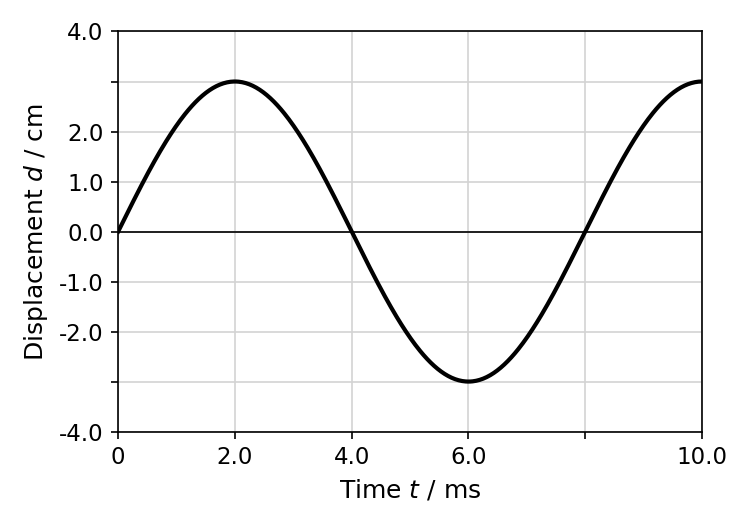
What is the frequency and the amplitude of the vibration?
| Frequency/Hz | Amplitude/cm | |
|---|---|---|
| A. | ||
| B. | ||
| C. | ||
| D. |
The period of the wave can be read directly from the graph. Remember that frequency is the reciprocal of the period. The amplitude is the maximum displacement from the equilibrium position.
Question 6
MediumPaper 1A · calculator1 markA musician plucks a guitar string, generating a transverse wave. The wave has an amplitude of cm, a wavelength of cm, and a frequency of Hz.
What is the average speed of a particle on the string and the direction of its motion relative to the direction of wave propagation during one full oscillation?
Average speed of particle / | Direction of particle motion
---|---
A. | parallel
B. | perpendicular
C. | parallel
D. | perpendicular
Recall that for a transverse wave, the particles oscillate perpendicular to the direction of wave propagation. For a particle undergoing simple harmonic motion, the total distance travelled in one period is four times the amplitude. Use the given frequency to find the period.
Question 7
EasyPaper 1A · calculator1 markA ray of monochromatic light travels from air and enters a block of glass. Part of the light is refracted.
Three statements are made about the refracted light compared to the incident light.
I. The speed of the light is different.
II. The frequency of the light is different.
III. The wavelength of the light is different.
Which of the statements are correct?
A. I and II only
B. I and III only
C. II and III only
D. I, II and III
Consider the fundamental properties of a wave as it passes from one medium to another. Which property is determined by the source of the wave and remains constant? How does the wave equation, , connect the other properties?
Question 8
MediumPaper 2 · calculator6 marksA sound engineer is designing a set of organ pipes, each closed at one end. The speed of sound in the concert hall is measured to be . One particular pipe is designed to resonate at its fundamental frequency when a sound wave of frequency is introduced.
(a) Calculate the wavelength of the sound wave produced by the source.
(b) The organ pipe can be adjusted in length to be between and . Determine all possible lengths of the pipe for which it would resonate with the sound wave.
Recall the relationship between wave speed, frequency, and wavelength.
For a closed-end pipe, resonance occurs when the length is an odd multiple of one-quarter wavelength.
Question 9
EasyPaper 1A · calculator1 markA remote control for a television emits electromagnetic radiation to send signals. The wavelength of this radiation is slightly longer than that of red light.
What region of the electromagnetic spectrum does this radiation belong to?
A. Microwaves
B. Infrared
C. Ultraviolet
D. Radio waves
Recall the order of the electromagnetic spectrum by wavelength. Which region is adjacent to the red end of the visible spectrum?
Question 10
MediumPaper 2 · calculator11 marksIn a geological survey, a controlled explosion on the surface generates seismic waves that travel through the Earth's crust. Two types of waves are produced: primary (P-waves) and secondary (S-waves). In a particular region of granite bedrock, P-waves travel at a speed of and S-waves travel at .
(a) (i) Outline the nature of P-waves.
(ii) Outline the nature of S-waves.
(b) (i) The explosion generates P-waves with a dominant frequency of . Calculate the wavelength of these P-waves.
(ii) A particular component of the S-waves has a wavelength of . Calculate the frequency of these S-waves.
(c) A seismograph station detects the arrival of the P-waves first, followed by the S-waves. The time interval between the arrival of the two wave types is . Estimate the distance from the explosion to the seismograph station.
What is the key difference between longitudinal and transverse waves in terms of particle motion relative to wave direction?
S-waves are the other main type of mechanical wave. How does their particle motion differ from P-waves?
Recall the fundamental wave equation that relates speed, frequency, and wavelength.
Use the same wave equation as in the previous part, but with the values for S-waves.
Let the distance to the station be . Write expressions for the travel time of the P-wave () and the S-wave (). You are given the difference between these times.
Question 11
EasyPaper 1A · calculator1 markAn electromagnetic wave has a wavelength that is about the size of the head of a pin.
What region of the electromagnetic spectrum does the wave belong to?
A. Ultraviolet
B. Visible light
C. Infrared
D. Radio waves
Recall the approximate wavelengths for the different regions of the electromagnetic spectrum. The head of a pin is about 1-2 millimetres in size. Which region includes this wavelength?
Question 12
MediumPaper 1A · calculator1 markA beam of monochromatic light of intensity is incident on a metal plate. The source of light is changed. The wavelength of the new light is tripled. The number of photons incident on the plate per unit area per unit time is increased by a factor of six.
What is the new intensity of the light beam?
A.
B.
C.
D.
Intensity is defined as power per unit area. Power is the total energy delivered per unit time. Consider how the energy of a single photon depends on its wavelength, and how the total power depends on the number of photons arriving per second.
Question 13
EasyPaper 1A · calculator1 markAn electromagnetic wave has a wavelength that is approximately equal to the diameter of a typical human red blood cell.
What region of the electromagnetic spectrum does this wave belong to?
A. Radio waves
B. Microwaves
C. Infrared
D. Ultraviolet
Recall the approximate wavelength ranges for different regions of the electromagnetic spectrum. Consider the typical diameter of a human red blood cell.
Question 14
MediumPaper 1A · calculator1 markA geophone detects a transverse seismic wave propagating through the ground. The wave has a period of ms. The graph shows the instantaneous vertical displacement of the ground particles against the horizontal distance from the geophone at a specific moment.
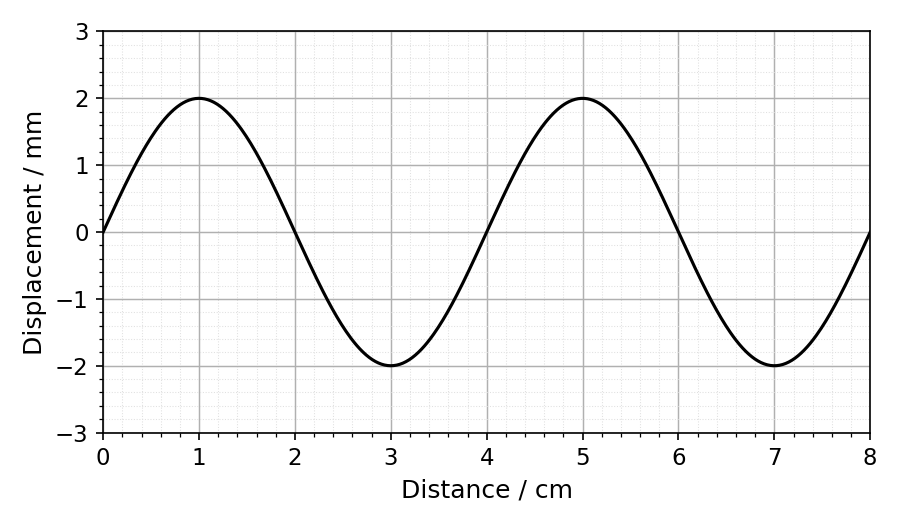
What is the average speed of the ground particles and the direction of particle motion relative to the direction of the wave travel during one cycle?
A. m s parallel
B. m s perpendicular
C. m s parallel
D. m s perpendicular
For a transverse wave, consider the relationship between particle oscillation and wave propagation direction. To find the average speed of a particle over one cycle, consider the total distance travelled by a particle during one period.
Question 15
MediumPaper 1A · calculator1 markThe diagram shows a snapshot of a transverse wave propagating along a stretched string. The wave travels from right to left.
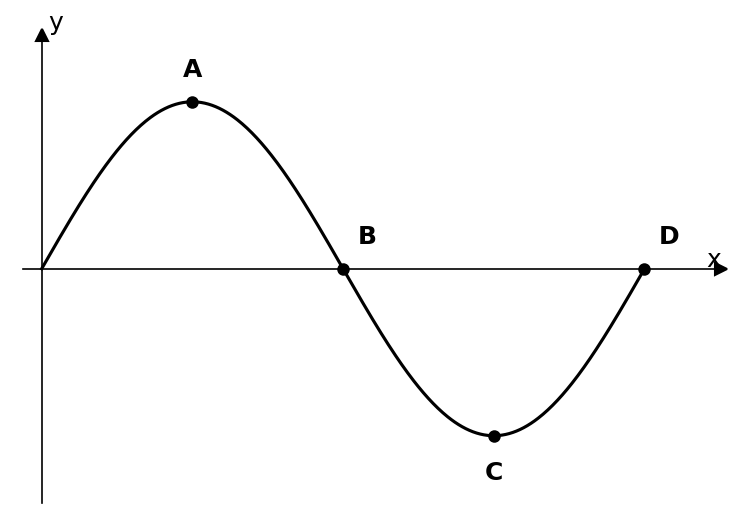
At the instant shown, which point on the string has the maximum positive acceleration?
Consider the relationship between the acceleration of a particle in simple harmonic motion and its displacement from the equilibrium position. How does this apply to the particles of the string as the wave passes?
Question 16
MediumPaper 1A · calculator1 markThe graph shows a snapshot of a transverse wave on a string. The wave is travelling from right to left (in the negative direction).
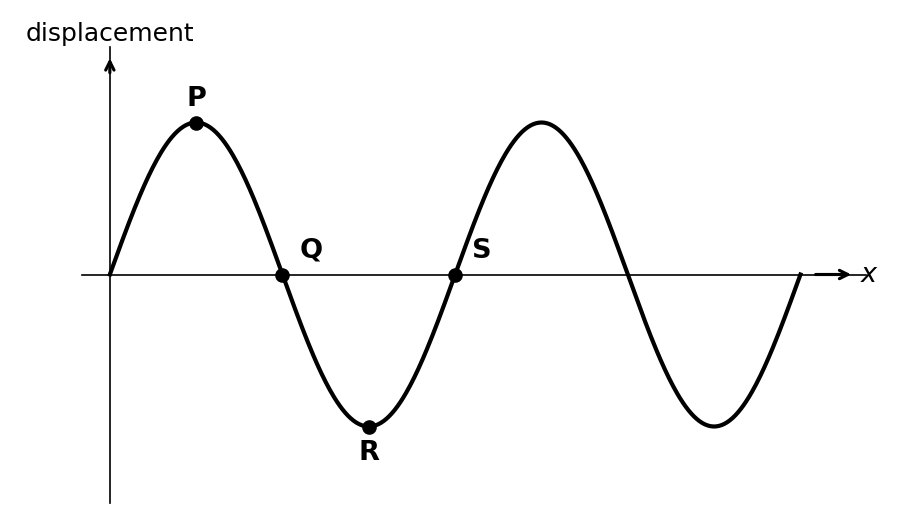
At this instant, which point has the maximum negative velocity?
A. P
B. Q
C. R
D. S
To determine the direction of motion for a point on the wave, imagine the entire wave pattern shifting slightly in its direction of travel. Observe whether the point moves up (positive velocity) or down (negative velocity). The speed is greatest at the equilibrium position.
Question 17
MediumPaper 1A · calculator1 markA monochromatic light source illuminates a diffraction grating in air, producing a pattern of principal maxima on a distant screen. A total of 11 principal maxima are observed.
The diffraction grating and the screen are then submerged in water (refractive index ). The light source remains in the air, and the beam enters the water before reaching the grating.
What are the changes, if any, to the angular separation of the principal maxima and the total number of principal maxima observed?
| Option | Angular separation of maxima | Total number of maxima |
|---|---|---|
| A | Decreases | Increases |
| B | Decreases | Decreases |
| C | Increases | Increases |
| D | Increases | Decreases |
A. A
B. B
C. C
D. D
Recall the relationship between the wavelength of light in a vacuum and in a medium with refractive index . Use this to determine the new wavelength. Then, apply the diffraction grating formula, , and the condition for the maximum number of orders, , to see how the pattern changes. Note that the question uses for refractive index, so we use for the order of the maximum to avoid confusion.
Question 18
MediumPaper 1A · calculator1 markA loudspeaker S emits sound with a power . An observer at a distance from S measures a sound intensity .
A second loudspeaker T has a power of .
At what distance from T will an observer measure the same sound intensity ?
A.
B.
C.
D.
The intensity of a wave from a point source follows an inverse square law with distance. Set up the intensity equation for both loudspeakers and equate them, since the measured intensity is the same in both cases.
Question 19
MediumPaper 1A · calculator1 markA longitudinal wave travels through a fluid to the right. The graph shows the variation of the displacement of the fluid particles with position along the wave at time .
Positive values of represent displacements to the right and negative values represent displacements to the left.
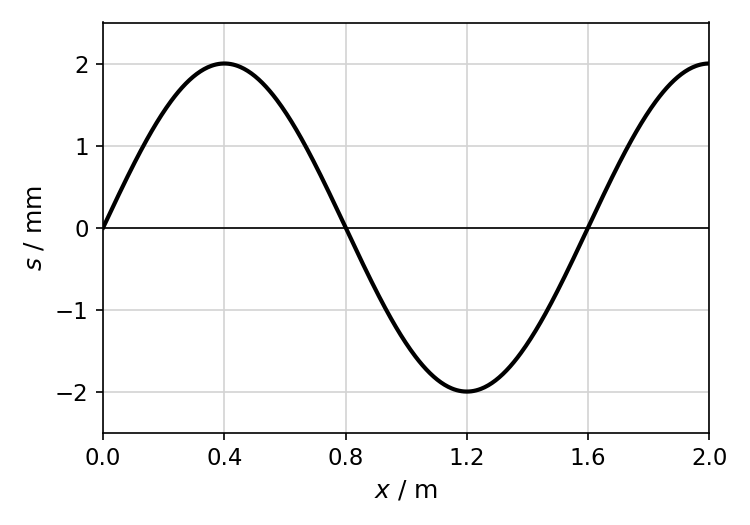
At which position is there a rarefaction at ?
A.
B.
C.
D.
A rarefaction is a region where particles are pulled apart. Look for a position where particles to the left have moved left (negative displacement) and particles to the right have moved right (positive displacement).
Question 20
MediumPaper 1A · calculator1 markA sound wave travels through a medium with a frequency of . The shortest distance between two points on the wave that have a phase difference of is . What is the speed of the sound wave?
A.
B.
C.
D.
Recall the relationship between phase difference, path difference, and wavelength. Then use the wave equation to find the speed.
No question on this page matches those filters. Try another difficulty or paper.
Every Wave Model question, marked for you
Every answer is marked mark by mark, IB-style, and the AI tutor helps when you are stuck.
Where marks are lost
- Stopping one step short of the conclusion. Two numbers and no sentence is two marks out of three.
- Answering a procedure question with a platitude.
- Losing precision in Paper 1B. Uniquely to this paper, quoting the right number badly loses marks.