Fusion and Stars: notes and practice questions
- This topic covers the processes of fusion in stars, stellar stability, evolution, and methods for determining stellar properties.
- Stellar stability relies on an equilibrium between outward thermal or radiation pressure and inward gravitational forces.
- Fusion is the energy source in stars, requiring high density and temperature.
- Stellar mass affects a star's evolution.
- The Hertzsprung-Russell (HR) diagram describes stellar properties (luminosity vs. temperature).
- Stellar distance can be found using parallax:
- Stellar radii are determined using luminosity and surface temperature.
- Energy release calculations and conversions between AU, ly, and pc are required.
How it is examined
Both papers, both levels. May 2025 Paper 2 TZ1 ran E.5 as the tail of the long greenhouse question at both levels: calculate in MeV the energy released by the proton-proton chain from a given helium mass (2), outline the role of fusion in maintaining a stable stellar radius (2), outline how helium in the Sun is confirmed empirically (2), then from an HR diagram state a star type (1) and discuss how fusion in a supergiant differs from fusion in the Sun (3). Note how often outline appears at 2 marks: two distinct points, briefly.
The parallax relation, the AU, light year and parsec conversions, the solar luminosity, mass and radius. Stellar radius comes from combining (B.1) with , which is not printed as a single equation. The HR diagram itself is not in the booklet, so its axes, orientation and regions are recall. Cepheid variables were on the retired 2016 option and are explicitly excluded now.
Note on the November 2024 update
The first understanding used to read "outward radiation pressure". The Nov 2024 update inserted "thermal or", so it now reads "outward thermal or radiation pressure", to account for low and medium mass stars where gas pressure dominates against high mass stars where radiation pressure does. Any source predating Nov 2024 has the older wording.
- that the stability of stars relies on an equilibrium between outward thermal or radiation pressure and inward pressure due to gravitational forces
- that fusion is a source of energy in stars
- the conditions leading to fusion in stars in terms of density and temperature
- the effect of stellar mass on the evolution of a star
Cepheid variables are not required.
Guiding questions
- How are elements created?
- What physical processes lead to the evolution of stars?
- Can observations of the present state of the universe predict the future outcome of the universe?
Linking questions
- How is fusion like and unlike fission?
- How can the understanding of black-body radiation help determine the properties of stars?
- How do emission spectra provide information about observations of the cosmos?
- HR diagrams have been helpful in the classification of stars by finding patterns in their properties. Which other areas of physics use classification to help our understanding? (NOS)
- In which ways has technology helped to collect data from observations of distant stars? (NOS)
- How can gas laws be used to model stars? (NOS)
Practice questions
31 questions · 10 easy · 19 medium · 2 hardQuestion 1
EasyPaper 1A · calculator1 markWhich graph best shows the variation of binding energy per nucleon with nucleon number?
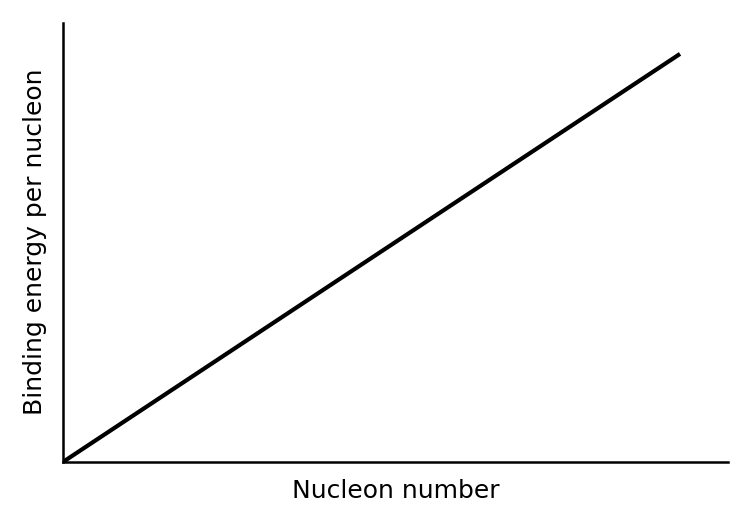
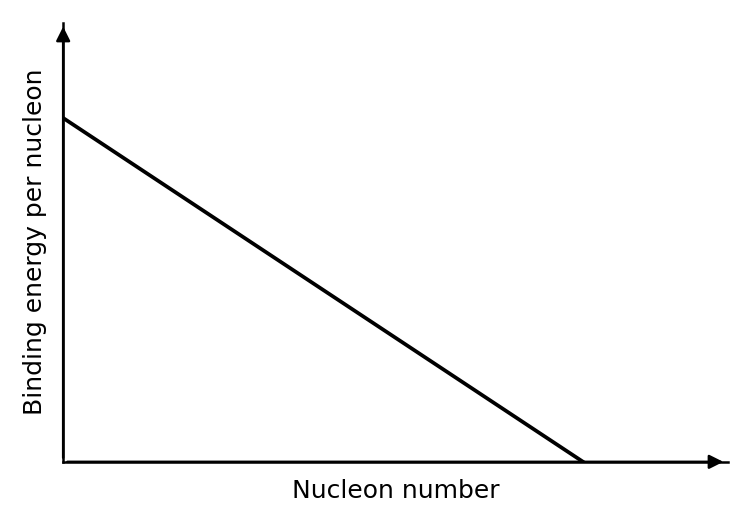
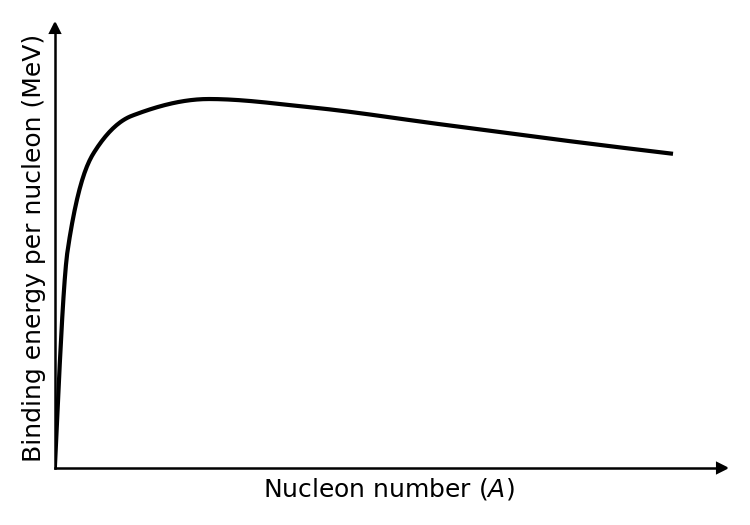
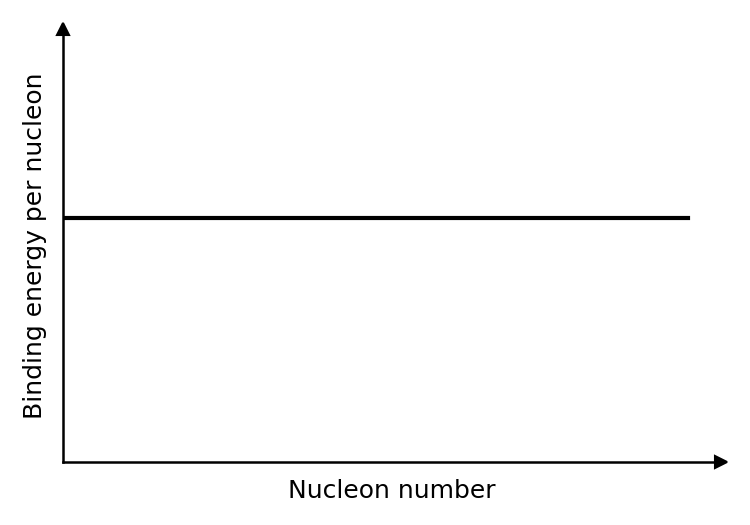
Recall the shape of the binding energy curve. Consider which nuclei are the most stable. How does this relate to energy release in fusion and fission?
Question 2
MediumPaper 2 · calculator3 marksA newly discovered exoplanet system orbits a star named Celestia. Observations indicate that Celestia is located at a distance of m from Earth.
(a) Calculate the parallax angle of star Celestia as observed from Earth.
Remember the relationship between parallax angle (in arcseconds) and distance (in parsecs). You will need to convert the given distance to the appropriate units first.
Question 3
HardPaper 2 · calculator13 marksAn astronomical observatory is studying a distant exoplanet system. They collect the following data for the host star, named "Exo-Star", and compare it with known data for the Sun.
Data about the Exo-Star:
Luminosity = luminosity of the Sun
Observed brightness on Earth = W m
Peak wavelength of its emitted radiation = nm
Data about the Sun:
Observed brightness on Earth (solar constant) = W m
Average distance of the Sun from the Earth = AU
(a) Calculate the luminosity of the Sun.
(b) Calculate the distance of the Exo-Star from Earth.
(c) Explain why the distance of the Exo-Star cannot be determined using stellar parallax.
(d) Calculate the radius of the Exo-Star.
Recall the relationship between brightness, luminosity, and distance for a star. You will need to convert the astronomical unit (AU) to meters. Use the formula .
First, determine the luminosity of the Exo-Star using its given ratio relative to the Sun's luminosity from part (a). Then, use the brightness-luminosity-distance relationship to find the distance to the Exo-Star.
Consider the relationship between distance and the parallax angle. What happens to the parallax angle for very distant objects?
You will need to use Wien's Displacement Law to find the surface temperature of the star from its peak wavelength. Then, use the Stefan-Boltzmann Law, along with the star's luminosity, to determine its radius.
Question 4
EasyPaper 1A · calculator1 markAstronomers are studying a newly discovered exoplanet orbiting a distant star. They measure the star's parallax angle to be arc-seconds.
What is the distance from Earth to this star?
A.
B.
C.
D.
Recall the relationship between parallax angle and distance in parsecs. The distance is the reciprocal of the parallax angle when the angle is expressed in arc-seconds.
Question 5
MediumPaper 2 · calculator4 marksAn astronomer observes a distant main-sequence star. The star is stable and maintains a constant radius.
(a) Explain, in terms of forces, why the star does not collapse under its own gravity.
(b) The star has a mass similar to the Sun and is powered by the fusion of hydrogen into helium. State the name of the primary reaction sequence for this process in such a star.
There must be an outward-acting force to counteract gravity. What process inside the star could produce such a force, and what is the condition for stability?
This is a specific multi-step nuclear reaction named after its discoverers, common in stars of the Sun's mass or less.
Question 6
HardPaper 2 · calculator20 marksAn exoplanet named Xylos orbits a star named Aethel. Scientists are studying its atmospheric conditions and the properties of its host star.
(a) State what is meant by the stellar constant for Xylos.
(b) The following data are given for exoplanet Xylos:
Average albedo of Xylos
Average orbital distance from Aethel
Average global surface temperature of Xylos
Luminosity of star Aethel
(i) Outline the physical mechanism by which some of the infrared radiation emitted by the surface of Xylos is absorbed by its atmospheric gases and re-radiated back towards the surface.
(ii) Show that the average global intensity of radiation absorbed by the surface of Xylos is about .
(iii) Determine the average intensity re-radiated by Xylos's atmosphere towards its surface. Assume that the emissivity of the surface is .
(c) Calculate the total power (luminosity) radiated by the star Aethel, based on the stellar constant at Xylos's orbit.
(d) A possible fusion reaction occurring in stars like Aethel is the deuterium-tritium (D-T) fusion reaction:
Relevant atomic masses are:
Mass of deuterium ()
Mass of tritium ()
Mass of helium-4 ()
Mass of neutron ()
(i) Calculate, in , the energy released in the reaction.
(ii) Outline the role of fusion reactions in maintaining a stable radius for a star like Aethel.
(iii) Outline how the presence of hydrogen in Aethel can be confirmed empirically.
(e) Aethel has a surface temperature of and a luminosity times that of the Sun.
(i) State the star type of Aethel.
(ii) Discuss how nuclear fusion processes in a red dwarf star differ from those in the Sun.
Recall the definition of the solar constant and adapt it to a general star-planet system.
Consider the interaction of infrared radiation with greenhouse gas molecules at a molecular level.
First, calculate the stellar constant at Xylos's orbit. Then, consider the average incoming intensity over the planet's surface and the effect of albedo.
Use the Stefan-Boltzmann law to calculate the intensity emitted by the surface. Then apply the energy balance principle.
The stellar constant is the intensity at a given distance. The total power is radiated spherically outwards.
Calculate the mass defect () in atomic mass units (u) and then convert it to energy using the conversion factor .
Consider the forces acting within a star and how fusion affects them.
Think about how light from stars is analyzed to determine their composition.
Compare Aethel's temperature and luminosity to that of the Sun and other common star types on the Hertzsprung-Russell diagram.
Consider the core temperature, mass, and lifespan of red dwarfs compared to the Sun, and how these factors influence fusion.
Question 7
EasyPaper 1A · calculator1 markThe Hertzsprung–Russell (HR) diagram shows four stars P, Q, R and S.
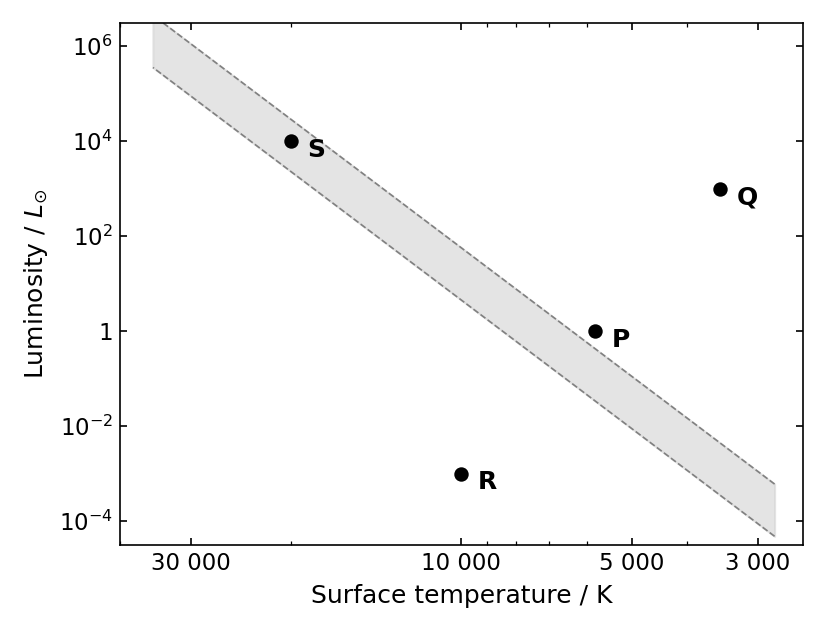
Which of the following sequences represents a possible evolutionary path for a star with a mass similar to the Sun?
A. S → Q → R
B. P → Q → R
C. P → S
D. Q → P → R
Consider the life cycle of a low-mass star like our Sun. Identify which regions on the HR diagram correspond to the main sequence, red giant, and white dwarf stages.
Question 8
MediumPaper 2 · calculator4 marksA meteorite is found to contain various elements. Spectroscopic analysis reveals the presence of silicon-28 (), nickel-58 (), and gold-197 (). The early universe consisted almost entirely of hydrogen and helium.
(a) Outline the stellar processes that are responsible for the creation of these three elements found in the meteorite.
Consider the different stages of a star's life and the types of nuclear reactions that occur. Think about the maximum mass of an element that can be produced by fusion and what happens in the most dramatic stellar events.
Question 9
EasyPaper 1A · calculator1 markThe stellar parallax method is used to determine the distance to nearby stars. What is the primary reason this method is not suitable for determining the distance to very distant stars?
A. The parallax angle becomes too large to measure accurately.
B. The parallax angle becomes too small to measure accurately.
C. The light from distant stars is redshifted, which affects the measurement.
D. Interstellar dust absorbs too much light from distant stars.
Consider the geometry of the stellar parallax measurement. How does the parallax angle change as the distance to the star increases?
Question 10
MediumPaper 2 · calculator11 marksThe Hertzsprung-Russell (HR) diagram below shows four regions, labelled A, B, C, and D, where stars are typically found.
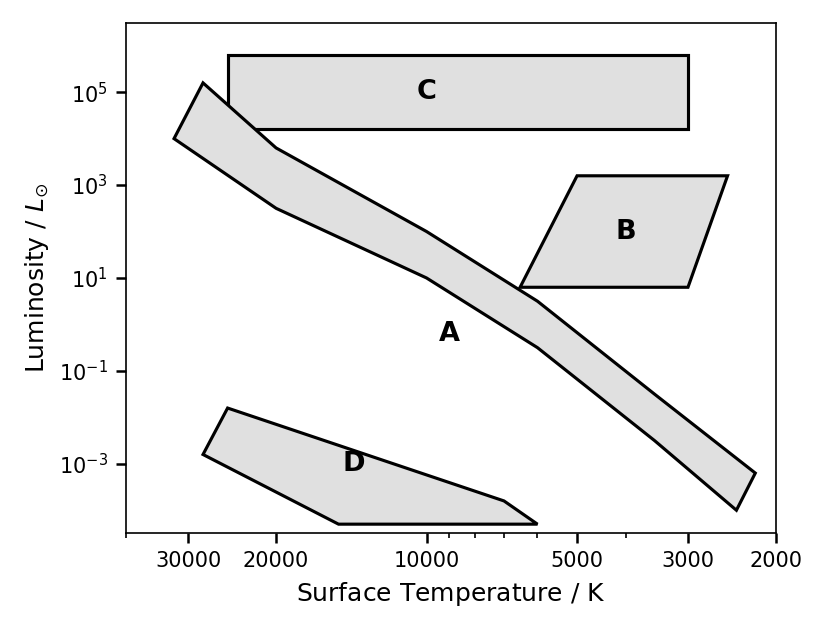
(a) Identify the group of stars found in each region.
An astronomer collects data for three stars, X, Y, and Z, in a newly discovered star cluster. The data are shown in the table. The luminosity is given in terms of the Sun's luminosity, , and the surface temperature is in Kelvin. The Sun's surface temperature is K.
| Star | Luminosity () | Temperature (/K) |
|---|---|---|
| X | 5 | 7000 |
| Y | 850 | 3500 |
| Z | 0.01 | 15000 |
(b) (i) Using the data, show that the radius of Star Y is approximately 80 times the radius of the Sun ().
(ii) Star X is on the main sequence. State the principal process of energy production within Star X.
(iii) Star Z is a white dwarf. Outline the stages of evolution for a low-mass star, similar to the one that became Star Z, after it leaves the main sequence. Your answer should refer to the regions on the HR diagram from part (a).
Consider the axes of the HR diagram. What does a star's position in terms of luminosity and temperature tell you about its type and evolutionary stage?
Recall the Stefan-Boltzmann law, which relates a star's luminosity (), radius (), and surface temperature (). Write the law as a ratio for Star Y and the Sun to cancel out the constants.
What nuclear reaction powers stars during the longest phase of their life cycle?
Trace the path of a Sun-like star on the HR diagram after its main sequence phase. What happens to its core and its outer layers?
Question 11
EasyPaper 1A · calculator1 markA Hertzsprung–Russell (HR) diagram shows the position of the Sun and four other stars W, X, Y and Z.
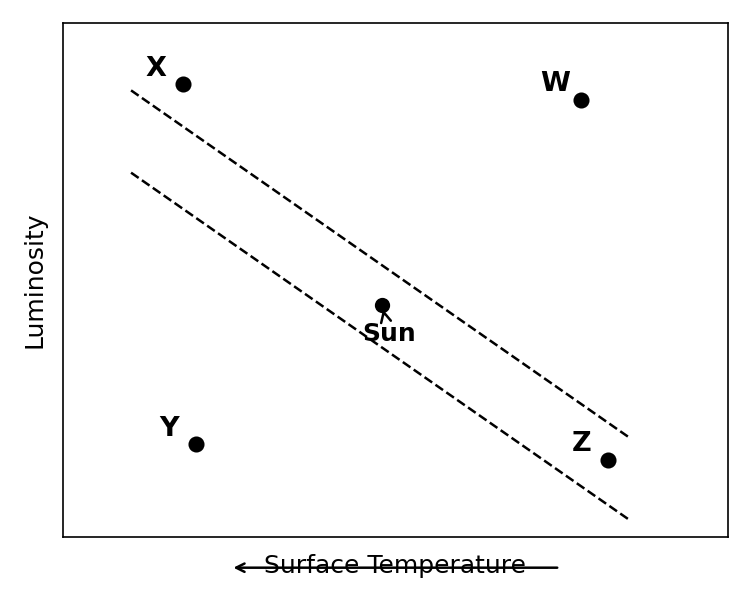
Which star is a red supergiant?
A. W
B. X
C. Y
D. Z
Red supergiants are very luminous but have a relatively low surface temperature. Identify the region on the HR diagram that corresponds to these characteristics.
Question 12
MediumPaper 2 · calculator8 marksA protostar is a very young star that is still gathering mass from its parent molecular cloud.
(a) State the nuclear process that will eventually power the star once it reaches the main sequence.
For the process identified in (a) to begin in the core of the protostar, two key conditions must be met.
(i) Outline why a very high temperature is a necessary condition.
(ii) Outline why a very high density is a necessary condition.
(c) Explain how the core of the protostar reaches the extreme temperature and density required for nuclear fusion to begin.
What is the name of the process where light atomic nuclei combine to form heavier nuclei, releasing a large amount of energy?
Consider the electric charge of hydrogen nuclei. What force exists between them, and what is needed for them to get close enough to fuse?
How does the spacing between particles affect the frequency of their collisions?
Think about the energy transformations that occur as a large cloud of gas collapses under its own gravity.
Question 13
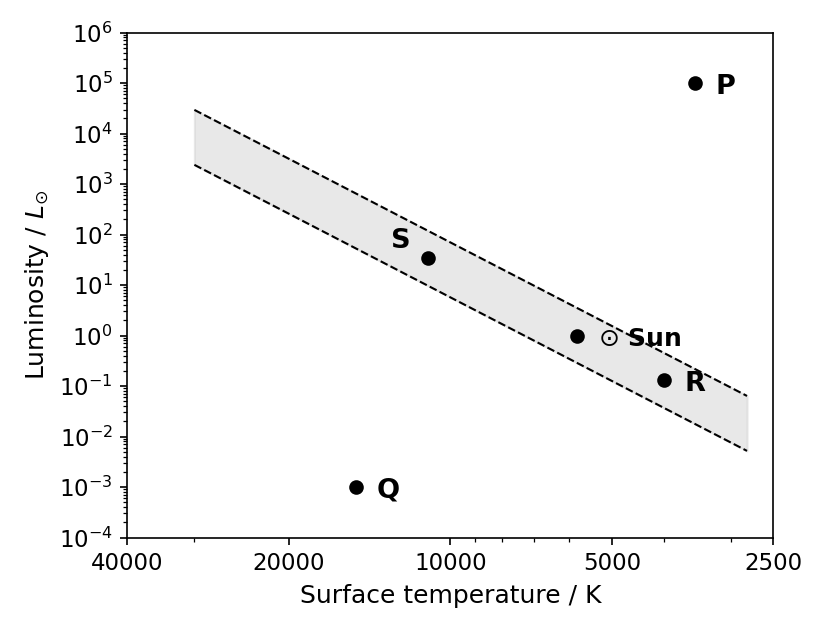
EasyPaper 1A · calculator1 markA Hertzsprung-Russell (HR) diagram is shown with four stars labelled P, Q, R, and S. The Sun is also shown for reference on the main sequence. Which star is a red supergiant?
A. P
B. Q
C. R
D. S
Red supergiants are characterized by their very high luminosity and relatively low surface temperature. Locate the region on the HR diagram that corresponds to these properties.
Question 14
MediumPaper 1A · calculator1 markStar Alpha and Star Beta are main sequence stars. Star Alpha has a radius and a surface temperature . It is located at a distance from Earth. Star Beta has the same radius but its surface temperature is . It is located at a distance from Earth.
What is the ratio of the apparent brightness of Star Beta to Star Alpha, ?
A.
B.
C.
D.
Recall the Stefan-Boltzmann law relating luminosity, radius, and temperature, and the inverse square law for apparent brightness. Combine these relationships to form an expression for apparent brightness in terms of radius, temperature, and distance. Then, form a ratio for Star Beta and Star Alpha.
Question 15
EasyPaper 1A · calculator1 markThe black-body radiation spectrum for a star with a surface temperature of is shown. The intensity units are arbitrary.
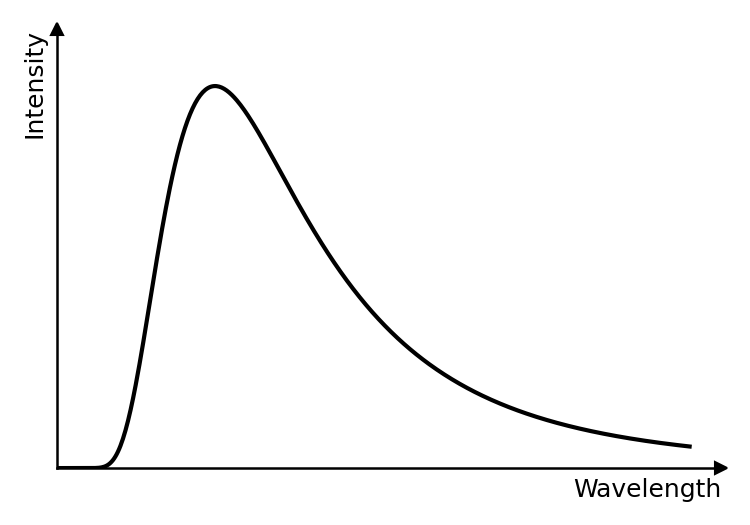
Later in its life cycle, the star's surface temperature increases to . Which graph shows the new radiation spectrum? The original spectrum is shown as a dashed line.
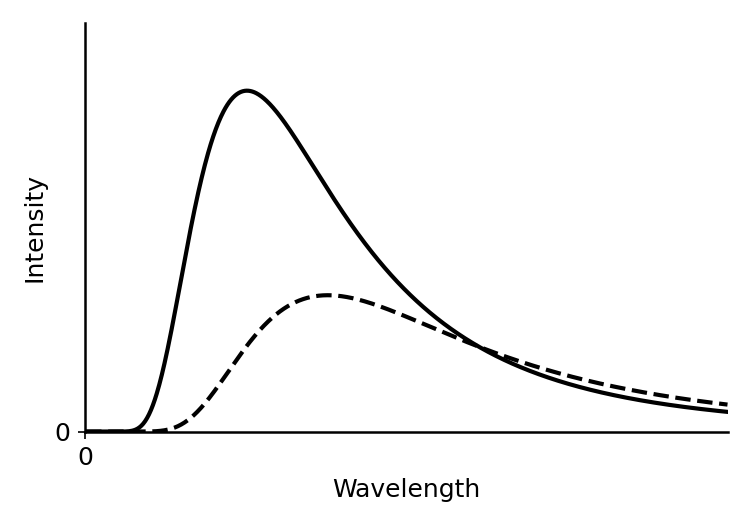
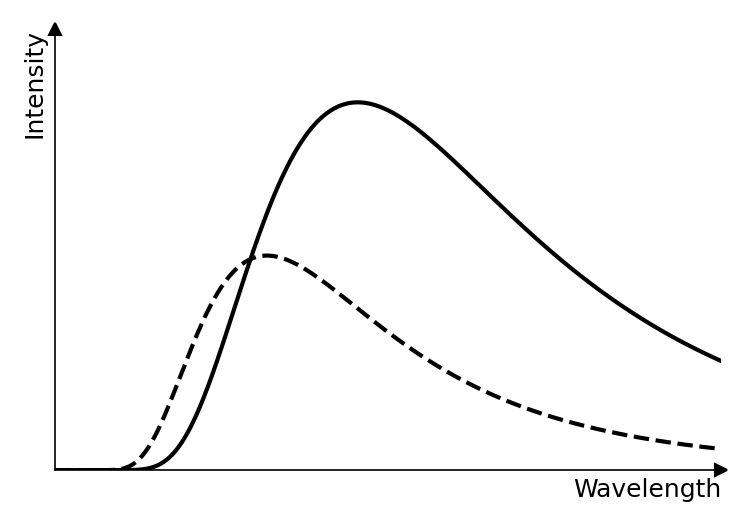
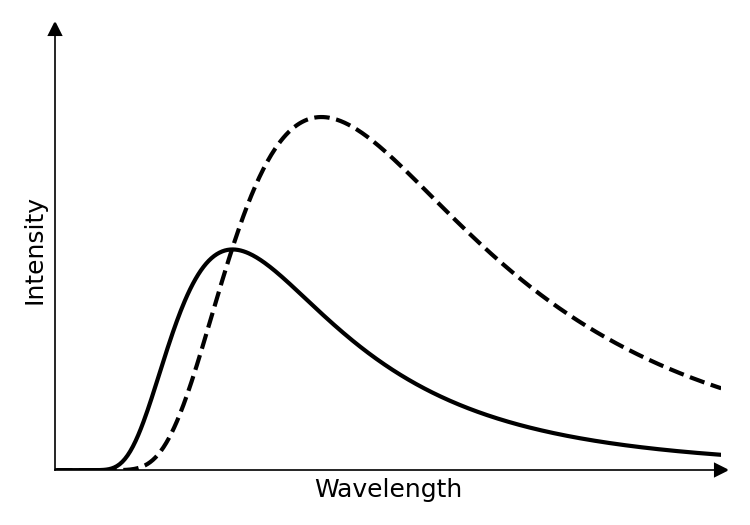
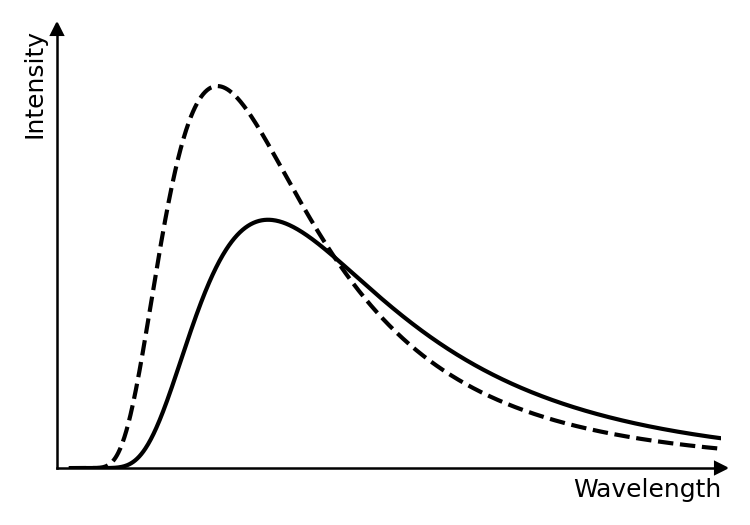
Consider how the peak wavelength and the total power radiated change with temperature. Wien's displacement law relates peak wavelength to temperature, and the Stefan-Boltzmann law relates total power radiated to temperature.
Question 16
MediumPaper 1A · calculator1 markStar Alpha has a surface temperature , luminosity and radius .
Star Beta has a luminosity and a surface temperature .
What is the radius of Star Beta?
A.
B.
C.
D.
Recall the Stefan-Boltzmann law relating luminosity, radius, and surface temperature. Consider the ratio of luminosities for the two stars.
Question 17
EasyPaper 1A · calculator1 markA star on the main sequence has a mass of approximately solar masses. What is the expected evolutionary sequence for this star after it leaves the main sequence?
A. Red giant → Planetary nebula → White dwarf
B. Red supergiant → Supernova → Neutron star
C. Red giant → Supernova → Black hole
D. Red supergiant → Planetary nebula → White dwarf
Consider the relationship between a star's initial mass and its evolutionary pathway. Stars are generally categorized as low-mass or high-mass, and each category follows a distinct sequence of stages after leaving the main sequence.
Question 18
MediumPaper 1A · calculator1 markThe black-body radiation curves for two stars, P and Q, are shown. Star P has a peak wavelength of nm, and star Q has a peak wavelength of nm.
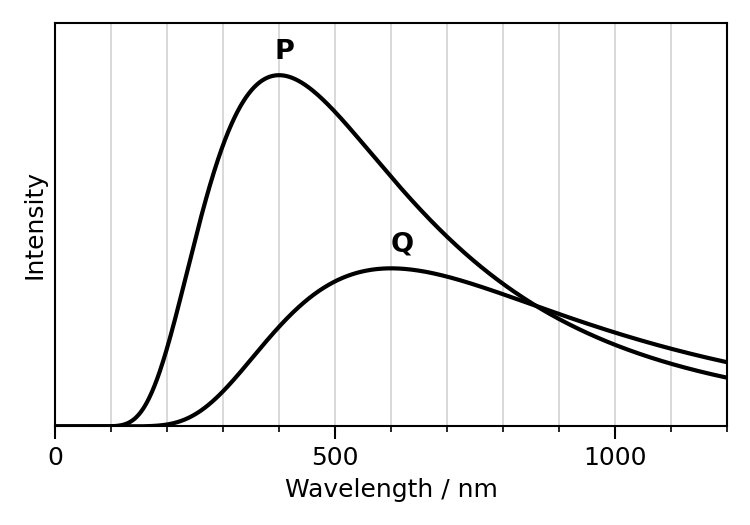
What is ?
A.
B.
C.
D.
Recall Wien's displacement law, which relates the peak wavelength of emitted radiation to the absolute temperature of the black body. How does temperature depend on peak wavelength?
Question 19
EasyPaper 1A · calculator1 markWhich of the following correctly describes the sequence of the main evolutionary stages for a star of approximately one solar mass, after it leaves the main sequence?
A. Red giant → Supernova → Neutron star
B. Red supergiant → Planetary nebula → White dwarf
C. Red giant → Planetary nebula → White dwarf
D. Red supergiant → Supernova → Black hole
Recall the evolutionary pathways for low-mass and high-mass stars. A star of one solar mass is considered a low-mass star. What is its final fate?
Question 20
MediumPaper 1A · calculator1 markA proposed fusion power plant uses the reaction of one deuterium nucleus () and one tritium nucleus (). This reaction converts a mass of into energy. In a conventional fission power plant, the fission of one uranium-235 nucleus converts a mass of into energy.
What is the ratio of ?
A.
B.
C.
D.
To calculate the energy released per unit mass of fuel, divide the mass converted into energy (mass defect) by the total initial mass of the fuel involved in that specific reaction. For the hydrogen fuel, consider the combined mass of the deuterium and tritium nuclei.
No question on this page matches those filters. Try another difficulty or paper.
11 more Fusion and Stars questions in the app
Every answer is marked mark by mark, IB-style, and the AI tutor helps when you are stuck.
Where marks are lost
- Stopping one step short of the conclusion. Two numbers and no sentence is two marks out of three.
- Answering a procedure question with a platitude.
- Losing precision in Paper 1B. Uniquely to this paper, quoting the right number badly loses marks.