Simple Harmonic Motion: notes and practice questions
- This topic covers the quantitative description of simple harmonic motion (SHM) using phase angle and energy considerations.
- A particle undergoing SHM can be described using phase angle .
- Displacement is given by .
- Velocity is given by or .
- Total energy of oscillation: .
- Potential energy of oscillation: .
- Quantitative analysis of energy changes (kinetic, potential, total) in SHM is required.
- Radians must be used for phase angle calculations.
How it is examined
Both papers. May 2025 HL Paper 2 TZ1 question 9 built a whole 20-mark question on a bar magnet oscillating on a spring: calculate the elastic potential energy at equilibrium (2), state and explain the direction of motion at a given time (2), describe the energy transfers over an interval (2), show the amplitude is about 0.1 m (3), calculate the maximum speed (2), determine the kinetic energy at a stated time (2), then rolled into D.4 induction for the last 7 marks. The energy parts of that question are HL-only content.
SL: , , both period formulas. HL adds the five equations above. The SL/HL boundary here is sharp and worth repeating: an SL question may ask a student to describe energy changes over a cycle, but may not ask them to calculate or from amplitude, and may not use phase angle at all.
- conditions that lead to simple harmonic motion
- the defining equation of simple harmonic motion as given by
- that a particle undergoing simple harmonic motion is described using time period T, frequency f, angular frequency , amplitude, equilibrium position and displacement
- the time period in terms of frequency of oscillation and angular frequency, as given by
Guiding questions
- What makes the harmonic oscillator model applicable to a wide range of physical phenomena?
- Why must the defining equation of simple harmonic motion take the form it does?
- How can the energy and motion of an oscillation be analysed both graphically and algebraically?
Linking questions
- How can greenhouse gases be modelled as simple harmonic oscillators?
- How can circular motion be used to visualize simple harmonic motion?
- How does damping affect periodic motion?
- How can the understanding of simple harmonic motion apply to the wave model? (NOS)
- What physical explanation leads to the enhanced greenhouse effect? (NOS)
Practice questions
6 questions · 2 easy · 4 mediumQuestion 1
EasyPaper 1A · calculator1 markA child on a swing is given a small push and released from rest. The swing undergoes oscillations that are lightly damped by air resistance. Which statement correctly describes the subsequent motion of the swing?
A. The amplitude of the oscillations decreases exponentially with time.
B. The total energy of the swing remains constant.
C. The period of oscillation decreases steadily with time.
D. The swing comes to rest at the equilibrium position in the shortest possible time without oscillating.
Consider the definitions of different types of damping. How does light damping affect the amplitude, energy, and period of an oscillation over time?
Question 2
MediumPaper 2 · calculator10 marksA component in a high-precision mechanical watch oscillates with simple harmonic motion. The component has a mass . Its displacement from the equilibrium position at time is described by the equation , where is the amplitude of oscillation and is the angular frequency.
(a) Determine an expression for the velocity, , of the component as a function of time, .
(b) Hence, show that the kinetic energy of the component is given by .
(c) The restoring force on the component is provided by a spring of spring constant . Determine an expression for the potential energy, , stored in the spring as a function of time, .
(d) Using your answers to (b) and (c), deduce that the total mechanical energy of the oscillator is constant and independent of time.
Velocity is the rate of change of displacement. How can you find the rate of change of a function with respect to time?
Recall the formula for kinetic energy in terms of mass and velocity. Use your expression for velocity from part (a).
What is the formula for the elastic potential energy stored in a spring? How does it relate to the displacement ?
Total mechanical energy is the sum of kinetic and potential energy. After summing them, you will need to use the relationship between , , and for an SHM system, as well as a fundamental trigonometric identity.
Question 3
EasyPaper 1A · calculator1 markA block of mass is attached to a horizontal spring and oscillates with simple harmonic motion (SHM) on a frictionless surface.
What is the phase difference between the velocity of the block and its acceleration?
A.
B.
C.
D.
Recall the definitions of displacement, velocity, and acceleration in simple harmonic motion and their relationships as derivatives of each other. Consider their sinusoidal forms.
Question 4
MediumPaper 2 · calculator2 marksA small sensor attached to a vibrating machine component undergoes simple harmonic motion (SHM) at a frequency of . The maximum speed recorded for this sensor is .
(a) Determine the amplitude of its oscillation.
Recall the relationship between maximum speed, angular frequency, and amplitude for an object undergoing SHM. Also, remember how angular frequency relates to linear frequency.
Question 5
MediumPaper 1A · calculator1 markA mass-spring system is forced to oscillate by a driver with variable frequency . The system has a natural frequency . Curve X shows the variation of amplitude with driving frequency when the system oscillates in air (light damping). Curve Y shows the variation when the system oscillates while submerged in a viscous fluid (heavy damping).
Which diagram correctly shows curves X and Y?
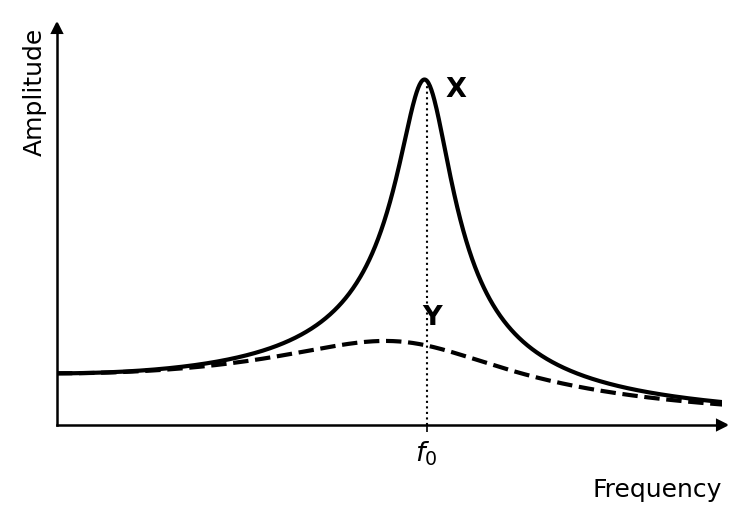
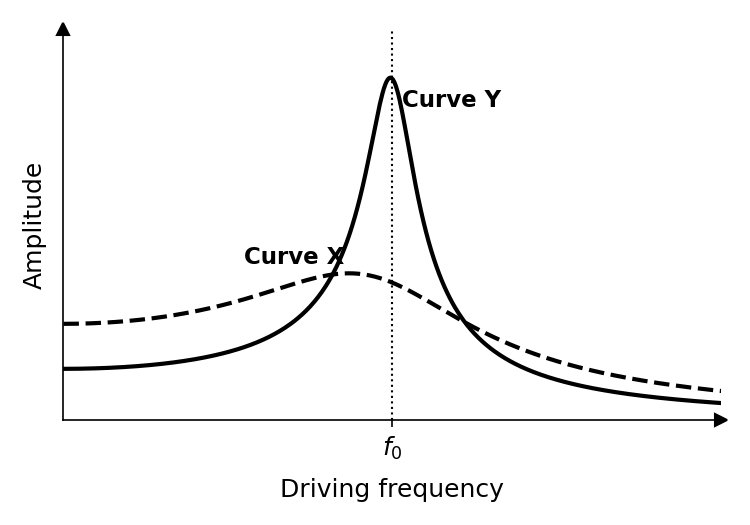
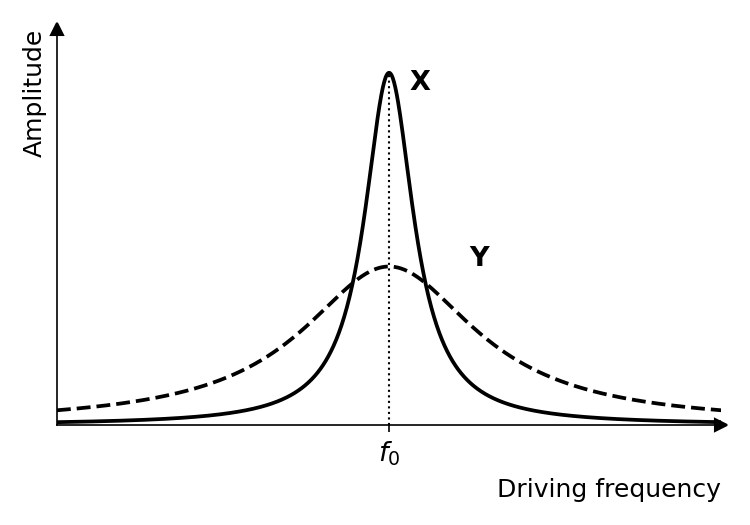
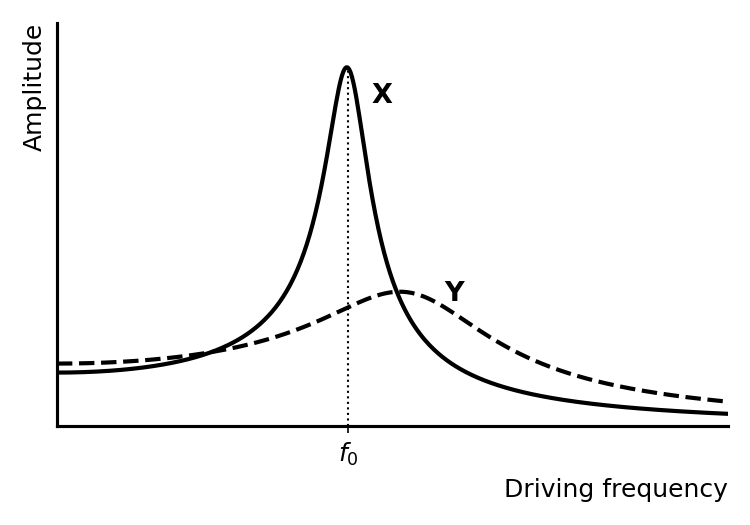
Consider how damping affects both the maximum amplitude of resonance and the frequency at which this maximum amplitude occurs. How does damping in a viscous fluid compare to damping in air?
Question 6
MediumPaper 1A · calculator1 markThe graph shows the variation with time of the displacement from the equilibrium position of a mass undergoing simple harmonic motion.
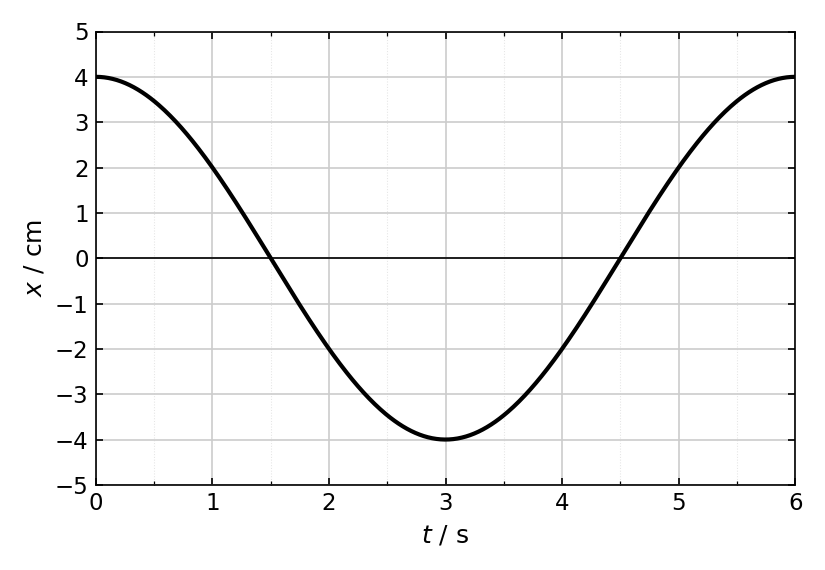
What is the speed of the mass at ?
A.
B.
C.
D.
First, determine the amplitude and the time period from the graph to find the angular frequency. Then, use the kinematic equation for velocity in simple harmonic motion at a specific time.
No question on this page matches those filters. Try another difficulty or paper.
Every Simple Harmonic Motion question, marked for you
Every answer is marked mark by mark, IB-style, and the AI tutor helps when you are stuck.
Where marks are lost
- Stopping one step short of the conclusion. Two numbers and no sentence is two marks out of three.
- Answering a procedure question with a platitude.
- Losing precision in Paper 1B. Uniquely to this paper, quoting the right number badly loses marks.