Structure of the Atom: notes and practice questions
- This topic covers the historical development of the atomic model and how atomic spectra provide evidence for discrete energy levels.
- The Geiger-Marsden-Rutherford experiment provided evidence for the existence of the atomic nucleus.
- Nuclear notation indicates the nucleon number and proton number .
- Emission and absorption spectra demonstrate the existence of discrete atomic energy levels.
- Photons are emitted or absorbed during atomic transitions.
- The energy of a photon is related to its frequency by the equation .
- Emission and absorption spectra provide information about the chemical composition of substances.
How it is examined
Both papers, with the scattering and Bohr content HL only. May 2025 HL Paper 2 TZ1 question 3(a) asked, in two parts, explain why alpha scattering deviates from the Rutherford model at high energy (1 mark: the alpha is within range of the strong nuclear force) and explain how an initial energy estimates the nuclear radius (2 marks: recognize that the nuclear radius is approximately the distance of closest approach, then set initial kinetic energy equal to ). The mark scheme said explicitly that using r in an algebraic expression is not enough for the first marking point, which is a good illustration of how tightly "explains" is read.
SL: , Planck's constant, the electronvolt conversion. HL adds with , the Bohr energy-level formula and . Chemical symbols are explicitly not required, so a question that depends on knowing that Au is gold should name the element in words.
- the Geiger-Marsden-Rutherford experiment and the discovery of the nucleus
- nuclear notation , where A is the nucleon number, Z the proton number and X the chemical symbol
- that emission and absorption spectra provide evidence for discrete atomic energy levels
- that photons are emitted and absorbed during atomic transitions
Recall of chemical symbols is not required.
- the relationship between the radius and the nucleon number for a nucleus, as given by , and its implications for nuclear densities
- deviations from Rutherford scattering at high energies
- the distance of closest approach in head-on scattering experiments
- the discrete energy levels in the Bohr model for hydrogen, as given by
Guiding questions
- What is the current understanding of the nature of an atom?
- What is the role of evidence in the development of models of the atom?
- In what ways are previous models of the atom still valid despite recent advances in understanding?
Linking questions
- How can emission spectra allow for the properties of stars to be deduced?
- How is the distance of closest approach calculated using conservation of energy?
- How can emission spectra be used to calculate the distances and velocities of celestial bodies?
- Under what circumstances does the Bohr model fail? (NOS)
- How have observations led to developments in the model of the atom? (NOS)
Practice questions
17 questions · 7 easy · 8 medium · 2 hardQuestion 1
EasyPaper 1A · calculator1 markWhich experiment provided the first evidence for a small, dense, positively charged nucleus within the atom?
A. Millikan's oil drop experiment
B. Rutherford's gold foil experiment
C. The Davisson-Germer experiment
D. Thomson's cathode ray tube experiments
Consider the experiment that involved firing alpha particles at a thin sheet of metal. The unexpected scattering of some particles at large angles led to a new model of the atom.
Question 2
MediumPaper 1A · calculator1 markIn a particle scattering experiment, a proton is accelerated from rest through a potential difference of . The proton is aimed directly at a stationary lithium nucleus. The proton number of lithium is .
What is the distance of closest approach between the proton and the lithium nucleus?
A.
B.
C.
D.
At the point of closest approach, the initial kinetic energy of the proton has been completely converted into electric potential energy. Set up an equation for the conservation of energy. Remember the formula for kinetic energy gained by a charge in a potential difference, and the formula for electric potential energy between two point charges.
Question 3
HardPaper 2 · calculator9 marksA stationary isotope of U (Uranium) undergoes alpha decay, transforming into a new element, Thorium (Th), and an alpha particle.
(a)(i) Identify the proton number of the Thorium nucleus.
(a)(ii) The following data are available:
Atomic mass of U u
Atomic mass of Th u
Mass of u
Show that the energy released in this decay is approximately MeV.
(a)(iii) The following data are available:
Atomic mass of U u
Atomic mass of Th u
Mass of u
Calculate the percentage of the total energy released that is carried by the alpha particle.
In a historical experiment, a beam of alpha particles was directed at a thin gold foil to probe the structure of the atom.
(b)(i) Describe two key observations from this experiment.
(b)(ii) Outline how these observations led to the nuclear model of the atom.
Recall the conservation of proton number in nuclear reactions. An alpha particle consists of two protons.
Calculate the mass defect in atomic mass units (u) and then convert this mass defect into energy using the conversion factor .
Use the conservation of momentum for the alpha particle and the Thorium nucleus. Relate kinetic energy to momentum and mass (). The total kinetic energy is equal to the energy released in the decay.
Consider what happened to the majority of alpha particles and what happened to a small fraction of them.
Relate each observation to a specific characteristic of the atomic structure, such as the size, density, and charge distribution within the atom.
Question 4
EasyPaper 1A · calculator1 markAn ion Y contains the following particles:
- protons
- neutrons
- electrons.
What is the nuclear notation for Y?
A.
B.
C.
D.
Recall the definitions of atomic number (Z) and mass number (A) in the standard nuclear notation . The atomic number is the number of protons, and the mass number is the total number of protons and neutrons. The number of electrons determines the ion's charge but does not appear in the nuclear notation.
Question 5
MediumPaper 1A · calculator1 markA nucleus of element P has a radius and density .
Another nucleus of element Q has a nucleon number that is times that of P.
What is the radius and density of the nucleus of Q?
| Radius of nucleus of Q | Density of nucleus of Q |
|---|---|
A. ,
B. ,
C. ,
D. ,
Recall the relationship between nuclear radius and nucleon number. Also, consider how nuclear density varies across different nuclei.
Question 6
HardPaper 2 · calculator20 marksAn exoplanet named Xylos orbits a star named Aethel. Scientists are studying its atmospheric conditions and the properties of its host star.
(a) State what is meant by the stellar constant for Xylos.
(b) The following data are given for exoplanet Xylos:
Average albedo of Xylos
Average orbital distance from Aethel
Average global surface temperature of Xylos
Luminosity of star Aethel
(i) Outline the physical mechanism by which some of the infrared radiation emitted by the surface of Xylos is absorbed by its atmospheric gases and re-radiated back towards the surface.
(ii) Show that the average global intensity of radiation absorbed by the surface of Xylos is about .
(iii) Determine the average intensity re-radiated by Xylos's atmosphere towards its surface. Assume that the emissivity of the surface is .
(c) Calculate the total power (luminosity) radiated by the star Aethel, based on the stellar constant at Xylos's orbit.
(d) A possible fusion reaction occurring in stars like Aethel is the deuterium-tritium (D-T) fusion reaction:
Relevant atomic masses are:
Mass of deuterium ()
Mass of tritium ()
Mass of helium-4 ()
Mass of neutron ()
(i) Calculate, in , the energy released in the reaction.
(ii) Outline the role of fusion reactions in maintaining a stable radius for a star like Aethel.
(iii) Outline how the presence of hydrogen in Aethel can be confirmed empirically.
(e) Aethel has a surface temperature of and a luminosity times that of the Sun.
(i) State the star type of Aethel.
(ii) Discuss how nuclear fusion processes in a red dwarf star differ from those in the Sun.
Recall the definition of the solar constant and adapt it to a general star-planet system.
Consider the interaction of infrared radiation with greenhouse gas molecules at a molecular level.
First, calculate the stellar constant at Xylos's orbit. Then, consider the average incoming intensity over the planet's surface and the effect of albedo.
Use the Stefan-Boltzmann law to calculate the intensity emitted by the surface. Then apply the energy balance principle.
The stellar constant is the intensity at a given distance. The total power is radiated spherically outwards.
Calculate the mass defect () in atomic mass units (u) and then convert it to energy using the conversion factor .
Consider the forces acting within a star and how fusion affects them.
Think about how light from stars is analyzed to determine their composition.
Compare Aethel's temperature and luminosity to that of the Sun and other common star types on the Hertzsprung-Russell diagram.
Consider the core temperature, mass, and lifespan of red dwarfs compared to the Sun, and how these factors influence fusion.
Question 7
EasyPaper 1A · calculator1 markA particle accelerator is used to create a specific ion. Analysis shows that a single ion has the following composition:
- protons
- neutrons
- electrons.
What is the nuclear notation for this ion?
A.
B.
C.
D.
Remember the definitions of mass number (A) and atomic number (Z) in the nuclear notation . Which subatomic particles determine these numbers? The number of electrons determines the charge of the ion, but does it affect the nuclear notation?
Question 8
MediumPaper 1A · calculator1 markAn astronomer analyses the spectrum of light received from a distant star. Three assertions are made about this spectrum.
I. The dark lines in the star's absorption spectrum correspond to the emission lines of elements in the star's outer atmosphere.
II. The redshift of these spectral lines can be used to determine the star's surface temperature.
III. The existence of discrete spectral lines provides evidence for the quantization of electron energy levels in atoms.
Which of the assertions are correct?
A. I and II only
B. I and III only
C. II and III only
D. I, II and III
Consider the physical origin of absorption and emission spectra. What information can be derived from the specific wavelengths of spectral lines, and what information can be derived from shifts in these wavelengths? How do spectral lines relate to atomic structure?
Question 9
EasyPaper 1A · calculator1 markIn the Geiger-Marsden experiment, a beam of alpha particles was directed at a thin gold foil. What was the key observation that led to the conclusion that the atom has a small, dense, positively charged nucleus?
A. Most alpha particles passed through the foil with no deflection.
B. A small number of alpha particles were deflected by large angles.
C. Alpha particles were observed to have discrete kinetic energies after passing through the foil.
D. The gold foil became electrically charged during the experiment.
The conclusion about a small, dense nucleus was made to explain a very surprising and rare event observed in the experiment. Which of the options describes this unexpected observation?
Question 10
MediumPaper 1A · calculator1 markA graph of the variation with nucleon number of the binding energy per nucleon is shown.
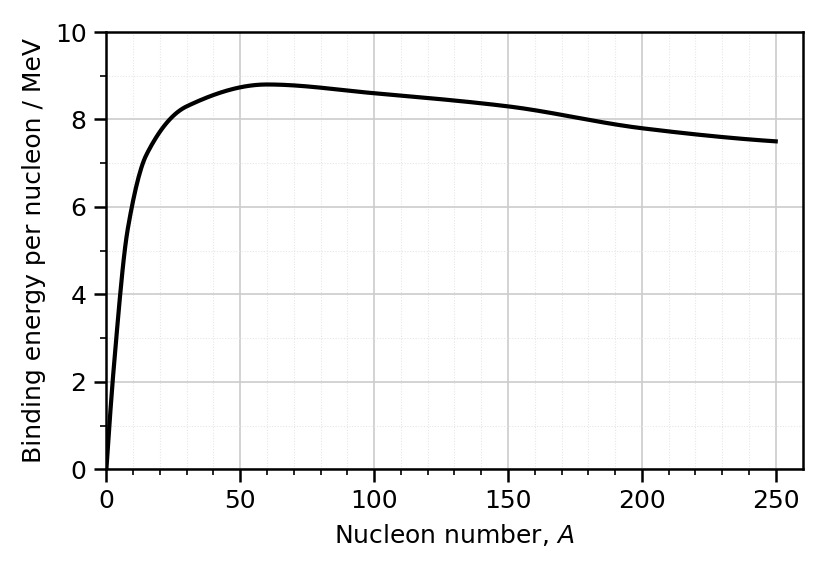
What is the approximate total energy, in MeV, needed to completely separate the nucleons of a nucleus?
A.
B.
C.
D.
To find the total binding energy, you need to multiply the binding energy per nucleon by the total number of nucleons (nucleon number A). Read the approximate binding energy per nucleon for from the provided graph.
Question 11
EasyPaper 1A · calculator1 markIn the Geiger-Marsden experiment, a small proportion of alpha particles were observed to be deflected through angles greater than 90°. What was concluded from this observation?
A. The atom is electrically neutral.
B. The nucleus of the atom is positively charged and has a very small volume.
C. Most of the atom consists of empty space.
D. Electrons are located in discrete energy levels.
Consider the interaction between the alpha particles (which are positive) and the components of the atom. What must be true about the atom's structure to cause a strong repulsion that deflects a massive alpha particle through a large angle?
Question 12
MediumPaper 1A · calculator1 markThe diagram shows some of the energy levels for a hypothetical atom. The atom is in a cool gas.
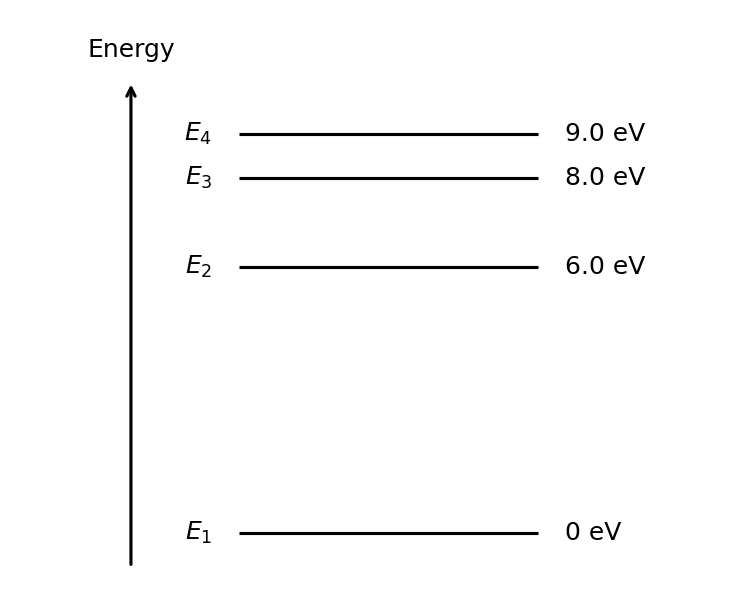
A continuous spectrum of electromagnetic radiation is passed through the cool gas. Which diagram correctly shows the resulting absorption spectrum?
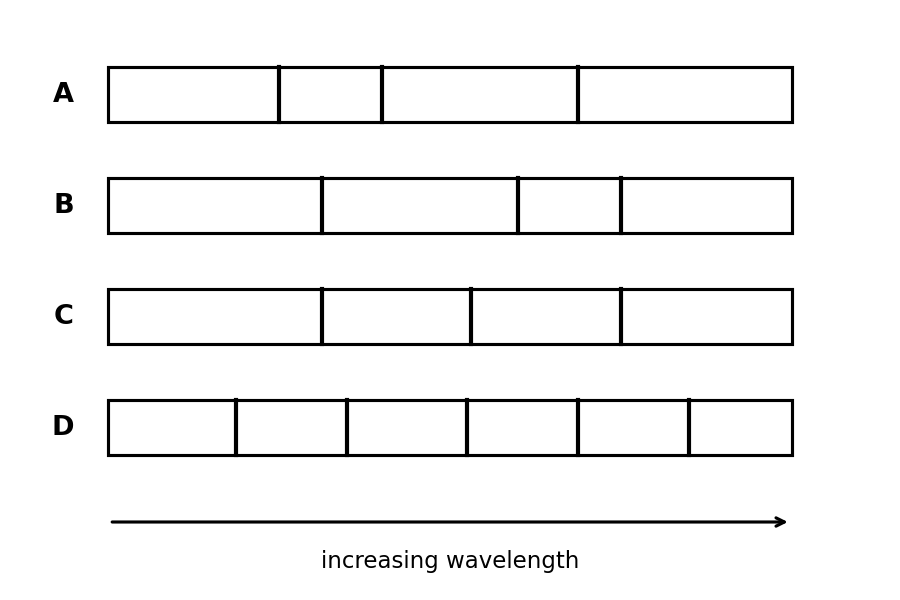
A. A
B. B
C. C
D. D
Absorption spectra are produced when atoms absorb photons and electrons move to higher energy levels. In a cool gas, which energy level will the electrons start from? How does the energy of a photon relate to its wavelength?
Question 13
EasyPaper 1A · calculator1 markThree statements are made regarding atomic spectra.
I. An absorption spectrum is formed when a continuous spectrum of light passes through a cool gas.
II. The frequencies of the lines in an emission spectrum are directly proportional to the energy differences between electron energy levels.
III. The study of atomic spectra provides evidence for the existence of neutrons.
Which of the statements are correct?
A. I and II only
B. I and III only
C. II and III only
D. I, II and III
Review the formation of absorption and emission spectra. Consider the equation that links the energy of a photon to its frequency, . What part of the atom is involved in these light-matter interactions?
Question 14
MediumPaper 1A · calculator1 markAn electron in an atom de-excites from an excited state to the ground state via a two-step cascade. In the first step, a photon of wavelength is emitted. In the second step, a photon of wavelength is emitted. What is the wavelength of a single photon that could cause the excitation from the ground state to the initial excited state?
A.
B.
C.
D.
Energy is conserved in atomic transitions. The total energy released in the two-step de-excitation must equal the energy required for the single-step excitation. Recall the relationship between a photon's energy and its wavelength.
Question 15
EasyPaper 1A · calculator1 markThe Bohr model is successful in predicting the spectral lines of hydrogen. For which of the following systems would the Bohr model also be applicable?
A. A neutral helium atom ()
B. A singly ionized lithium ion ()
C. A triply ionized beryllium ion ()
D. A singly ionized hydrogen molecule ()
The Bohr model applies to systems with a single electron orbiting a single, central nucleus. Such systems are called 'hydrogenic'. For each option, determine the number of electrons and the number of nuclei.
Question 16
MediumPaper 1A · calculator1 markThe energy of an electron in a hydrogen atom is given by the formula , where is the principal quantum number and is a positive constant. What is the frequency of a photon that is absorbed when an electron transitions from the state to the state ?
A.
B.
C.
D.
The energy of the absorbed photon must be equal to the difference in energy between the final and initial states. Remember the formula relating photon energy to its frequency.
Question 17
MediumPaper 1A · calculator1 markThe diagram shows three energy levels of an atom.
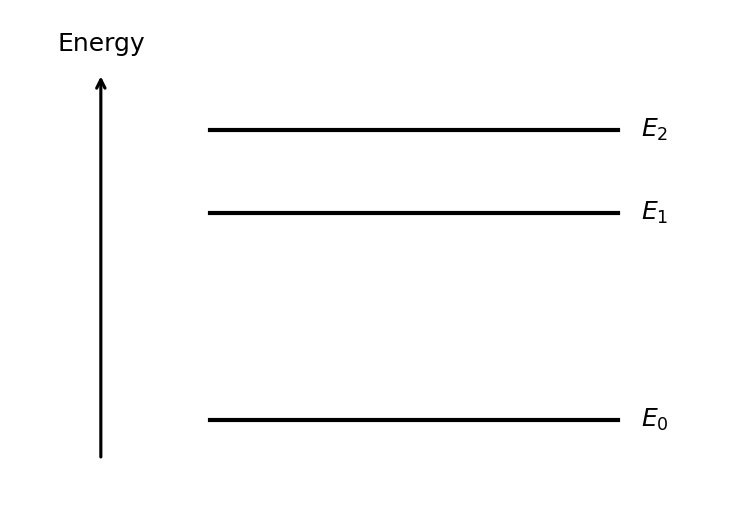
The frequencies of the photons emitted in all possible transitions between these levels are , and , where . What are and ?
| A. | ||
| B. | ||
| C. | ||
| D. |
The energy of an emitted photon is equal to the difference between the two energy levels. Use the diagram to determine which transition corresponds to the largest, middle, and smallest energy differences.
No question on this page matches those filters. Try another difficulty or paper.
Every Structure of the Atom question, marked for you
Every answer is marked mark by mark, IB-style, and the AI tutor helps when you are stuck.
Where marks are lost
- Stopping one step short of the conclusion. Two numbers and no sentence is two marks out of three.
- Answering a procedure question with a platitude.
- Losing precision in Paper 1B. Uniquely to this paper, quoting the right number badly loses marks.