Measuring enthalpy changes: notes and practice questions
- This topic covers the measurement and interpretation of energy changes in chemical and physical processes.
- Chemical reactions involve energy transfer between the system and surroundings, with total energy conserved.
- Heat is energy transferred, while temperature is a measure of the average kinetic energy of particles.
- Endothermic reactions absorb energy, causing a temperature decrease; exothermic reactions release energy, causing a temperature increase.
- Energy profiles illustrate the relative stabilities of reactants and products, and the activation energy.
- The standard enthalpy change, , is calculated using and .
- The units for are kJ mol.
How it is examined
Calorimetry is a Paper 1B favourite because it has an experiment attached. The usual chain is Q from mcΔT, then n of the limiting reactant, then ΔH with a sign and a unit, 3 to 4 marks with error carried forward through the chain. The mass in Q = mcΔT is the mass of solution, not of the solute, and that substitution is the single most common way students lose the first mark. Energy profile sketches are 1 to 2 marks and want labelled axes, reactants, products and the relative levels.
Q = mcΔT and the specific heat capacity of water. The negative sign in ΔH = −Q/n, and the reasoning for it, is recall, and it is the mark students most often drop.
- 1.1.1 Chemical reactions involve a transfer of energy between the system and the surroundings, while total energy is conserved. Students understand the difference between heat and temperature.
- 1.1.2 Reactions are described as endothermic or exothermic depending on the direction of energy transfer between the system and the surroundings. Students understand the temperature change, decrease or increase, that accompanies each.
- 1.1.3 The relative stability of reactants and products determines whether reactions are endothermic or exothermic. Students sketch and interpret energy profiles for endothermic and exothermic reactions.
- 1.1.4 The standard enthalpy change for a chemical reaction, ΔH⦵, refers to the heat transferred at constant pressure under standard conditions and states, and can be determined from the change in temperature of a pure substance. Students apply `Q = mcΔT` and `ΔH = −Q / n` in the calculation of the enthalpy change of a reaction.
None for Reactivity 1.1.
Guiding questions
- What can be deduced from the temperature change that accompanies chemical or physical change?
Linking questions
- Structure 1.1 What is the relationship between temperature and kinetic energy of particles?
- Structure 2.2 Most combustion reactions are exothermic; how does the bonding in N₂ explain the fact that its combustion is endothermic?
- Tool 1, Inquiry 1, 2, 3 How can the enthalpy change for combustion reactions, such as for alcohols or food, be investigated experimentally?
- Tool 1, Inquiry 3 Why do calorimetry experiments typically measure a smaller change in temperature than is expected from theoretical values?
Practice questions
23 questions · 11 easy · 11 medium · 1 hardQuestion 1
EasyPaper 2 · calculator1 markA student is investigating the thermal properties of ethanol. They heat a sample of ethanol with a mass of from an initial temperature of to a final temperature of . The specific heat capacity of ethanol is .
How much thermal energy, in joules, is absorbed by the ethanol during this heating process?
A
B
C
D
Use the formula , where is the thermal energy, is the mass, is the specific heat capacity, and is the change in temperature.
Question 2
MediumPaper 1A · calculator1 markA student measures the temperature change when a salt is dissolved in water to determine the enthalpy of solution, . What is the expression for the enthalpy of solution for ammonium nitrate in kJ mol?
Data:
- Initial temperature of water: 25.0 °C
- Final temperature of solution: 21.0 °C
- Mass of water: 50.0 g
- Mass of ammonium nitrate dissolved: 4.00 g
- Molar mass, , of ammonium nitrate, : 80.06 g mol
- Specific heat capacity of water, : 4.18 J g K
A.
B.
C.
D.
First, calculate the heat absorbed by the water using q=mcΔT. Then, determine the sign of the enthalpy change: did the reaction release or absorb heat from the water? Finally, calculate the moles of the salt and combine these to find the enthalpy change per mole, ensuring your units are correct.
Question 3
HardPaper 1B · calculator16 marksNitrogen dioxide, a pollutant from car exhausts, reacts with water in the atmosphere to form nitric acid and nitrous acid. This is a disproportionation reaction.
(a) Deduce the oxidation states of nitrogen in the reactant and products.
Reactant:
Products: ,
(b) Explain, with reference to the equilibrium, why more nitrogen dioxide gas dissolves when the reaction occurs in alkaline rainwater.
(c) The solubility of nitrogen dioxide gas in water was measured by different scientific groups. A summary of their results is shown.
| Source | Temperature / °C | Solubility of gas in 0.100 dm³ of water |
|---|---|---|
| A | 0 | 0.380 dm³ |
| B | 10 | 0.28 dm³ |
| C | 20 | 200 cm³ |
| D | 25 | 0.15 L |
| E | 30 | 0.120 dm³ |
(i) Identify a problem in comparing the data from the different sources as presented in the table.
(ii) The units of solubility are converted to mol dm⁻³. Complete the table by calculating the value for source A. Assume the atmospheric pressure is 100 kPa and the density of the resulting solution is 1.00 g cm⁻³.
(iii) Suggest an explanation for the effect of temperature on the solubility of nitrogen dioxide gas.
(d) Suggest one reason why nitrogen dioxide is considered a major air pollutant.
(e) Nitrous acid, , is a weak acid. The graph shows the percentage of nitrous acid and its conjugate base, the nitrite ion (), present at different pH values.
(GRAPH IS A STANDARD SPECIATION PLOT FOR A WEAK ACID. X-AXIS: pH from 0 to 8. Y-AXIS: Percentage from 0 to 100. A curve for HA starts at 100% and goes down, a curve for A- starts at 0% and goes up. The two curves cross at pH = 3.3, where each is at 50%.)
(i) Deduce the pH range where nitrous acid, , is the dominant nitrogen-containing species in the solution.
(ii) Determine, with reference to the graph, the of nitrous acid.
(f) Nitrous acid can react with secondary amines to form N-nitrosamines, which are potent carcinogens. An example is the reaction with dimethylamine, .
(i) Deduce a balanced chemical equation for the formation of N-nitrosodimethylamine, , from dimethylamine and nitrous acid.
(ii) The rate of N-nitrosamine formation is highly dependent on pH. The reaction rate is highest under mildly acidic conditions where there is a sufficient concentration of both the unprotonated amine and nitrous acid. State two conditions that could be maintained in an industrial process to minimize the formation of N-nitrosamines.
(g) To combat the effects of acid rain, powdered limestone () is sometimes added to lakes. Suggest two distinct reasons why this 'liming' process is effective at restoring the aquatic ecosystem.
Remember the rules for assigning oxidation states. Oxygen is usually -2 and hydrogen is usually +1. The sum of oxidation states in a neutral molecule is zero.
Alkaline conditions imply the presence of a base, like hydroxide ions (). How would a base react with the acidic products of the forward reaction? Consider Le Châtelier's principle.
Look closely at the units used for solubility in the table. Are they all consistent? What other variable that affects gas solubility might be missing?
To find the concentration in mol dm⁻³, you first need to find the moles of gas. You are given the volume of the gas, the temperature, and the pressure. The ideal gas law might be useful here.
Observe the trend in the table: as temperature increases, what happens to the volume of gas that dissolves? The dissolution of a gas in a liquid is an equilibrium process. How does temperature affect exothermic and endothermic equilibria?
Consider the direct effect of on human health or its role in forming other harmful substances in the environment.
The 'dominant' species is the one present in a higher concentration (or percentage). Find the part of the graph where the curve for is above the curve for .
The has a special significance on a speciation graph. It is the pH at which the concentrations of the weak acid and its conjugate base are equal.
The reactants are and . The products are and one other small molecule. Identify the atoms that are not part of the nitrosamine product to deduce the other product.
To minimize the formation of a product, you can either remove one of the reactants or change the conditions (like pH) to make the reaction much slower. Consider what pH would minimize the concentration of one of the key reactants, .
Think about the direct chemical effect of adding a base () to an acidified lake. Then, consider how this action might affect the equilibrium involving the atmospheric pollutant that caused the acid rain in the first place.
Question 4
EasyPaper 2 · calculator1 markThe reaction of solid calcium oxide with water is an exothermic process, represented by the equation:
What will happen to the temperature of the mixture when water is added to solid calcium oxide in an insulated container?
A. The temperature will decrease.
B. The temperature will increase.
C. The temperature will not change.
D. The reaction will absorb thermal energy from the surroundings.
Recall the definition of an exothermic process. What does it mean in terms of thermal energy transfer between the system (the reaction) and the surroundings (the mixture)?
Question 5
MediumPaper 2 · calculator1 markThe decomposition of calcium carbonate, , into calcium oxide, , and carbon dioxide, , is an important industrial process. The balanced chemical equation for this reaction is:
Using standard enthalpy of formation values:
The enthalpy change associated with the decomposition of of is closest to:
A
B
C
D
First, calculate the standard enthalpy change for the decomposition of one mole of calcium carbonate using the provided standard enthalpy of formation values. Then, determine the number of moles in of calcium carbonate. Finally, use these values to find the total enthalpy change.
Question 6
EasyPaper 2 · calculator1 markFor the complete combustion of propane gas, :
Which statement correctly describes this process?
A. The process is endothermic and is positive.
B. The process is endothermic and is negative.
C. The process is exothermic and is positive.
D. The process is exothermic and is negative.
Think about what happens to the temperature of the surroundings during a combustion reaction. Does it increase or decrease? How does this relate to the terms 'endothermic' and 'exothermic', and the sign of the enthalpy change, ?
Question 7
MediumPaper 1A · calculator1 markWhen g of ammonium nitrate, , was dissolved in of water in a calorimeter, the temperature of the solution changed from K to K.
What is the molar enthalpy change of dissolution, , for ammonium nitrate in ? Assume the specific heat capacity of the solution is J and the density of water is g .
Relative atomic masses: N = , H = , O = .
A.
B.
C.
D.
First, calculate the heat absorbed by the water using . Remember that the heat change for the reaction is the opposite sign of the heat change for the water. Then, calculate the moles of ammonium nitrate and divide the reaction heat by the moles to find the molar enthalpy change. Pay attention to units (J to kJ) and the sign of the enthalpy change.
Question 8
EasyPaper 2 · calculator1 markA student conducts an experiment to determine the specific heat capacity of an unknown metal. A sample of the metal is heated, causing its temperature to rise from to . If of thermal energy were absorbed by the metal, what is its specific heat capacity?
A
B
C
D
Recall the formula relating heat absorbed, mass, specific heat capacity, and temperature change.
Question 9
MediumPaper 2 · calculator7 marksThe reversible reaction between nitrogen dioxide, , and dinitrogen tetroxide, , is an important equilibrium system. Nitrogen dioxide is a brown gas, while dinitrogen tetroxide is a colourless gas.
(a) State Le Chatelier's principle.
(b) The pressure of the system at equilibrium is increased by decreasing the volume at constant temperature. Predict and explain the effect on the position of equilibrium and the resulting colour of the gaseous mixture.
(c) State the effect of increasing the pressure, as described in part (b), on the value of the equilibrium constant, .
(d) The temperature of the system is increased. Deduce and explain the effect on the value of the equilibrium constant, .
Recall the formal definition of Le Chatelier's principle. How does a system at equilibrium respond to an external change?
According to Le Chatelier's principle, how will the system respond to an increase in pressure? Consider the number of moles of gas on each side of the equation. How does this shift affect the concentration of the brown gas, ?
What is the only factor that can change the value of the equilibrium constant, ?
Consider the enthalpy change of the forward reaction. Is it exothermic or endothermic? How does an increase in temperature affect an exothermic equilibrium? How does this relate to the value of ?
Question 10
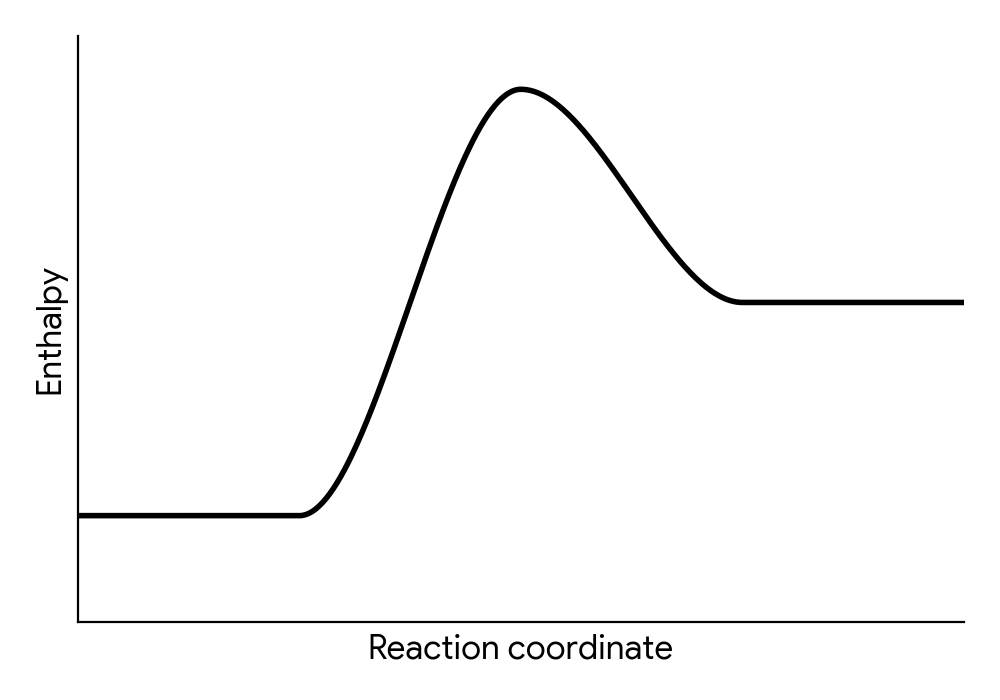
EasyPaper 1A · calculator1 markThe energy profile for the thermal decomposition of a metal carbonate is shown. Identify the correct statement describing the reaction.
A. The enthalpy change is positive and the products are more stable than the reactants.
B. The enthalpy change is positive and the reactants are more stable than the products.
C. The enthalpy change is negative and the products are more stable than the reactants.
D. The enthalpy change is negative and the reactants are more stable than the products.
Consider the relative enthalpy levels of the reactants and products. How does this relate to the sign of the enthalpy change ()? How does the enthalpy level relate to chemical stability?
Question 11
MediumPaper 1A · calculator1 markA student performs an experiment to determine the enthalpy of combustion of ethanol, . When g of ethanol is completely burned, the thermal energy released causes the temperature of of water to increase by K.
What is the enthalpy of combustion of ethanol in ?
Specific heat capacity of water:
ethanol
A.
B.
C.
D.
First, calculate the thermal energy absorbed by the water using the formula . Remember that the density of water is approximately . Then, calculate the moles of ethanol burned. Finally, divide the thermal energy by the moles of ethanol and convert the units to , ensuring the correct sign for an exothermic reaction.
Question 12
EasyPaper 1A · calculator1 markWhich statement about an endothermic reaction is correct?
A. Temperature decreases and the products have higher enthalpy than the reactants.
B. Temperature decreases and the products have lower enthalpy than the reactants.
C. Temperature increases and the products have higher enthalpy than the reactants.
D. Temperature increases and the products have lower enthalpy than the reactants.
Consider the meaning of 'endothermic' in terms of energy flow between the system and the surroundings. How does this relate to the temperature change of the surroundings and the sign of the enthalpy change, ?
Question 13
MediumPaper 1A · calculator1 markThe Haber process for the synthesis of ammonia is represented by the equation: . The reaction is exothermic and requires a catalyst, indicating a high activation energy for the uncatalysed reaction.
Which potential energy profile best represents the forward uncatalysed reaction of the Haber process?
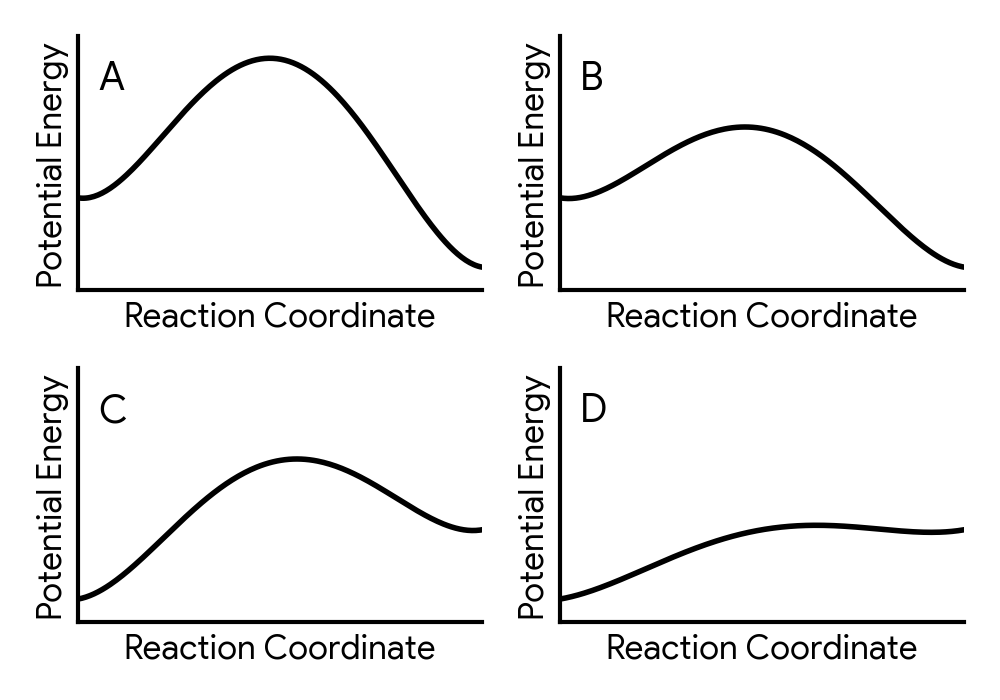
Consider what 'exothermic' means for the relative potential energy of reactants and products. Then, consider what 'high activation energy' implies about the energy barrier shown on the profile.
Question 14
EasyPaper 1A · calculator1 markA neutralization reaction is carried out in a calorimeter, which is in thermal equilibrium with the laboratory. The temperature inside the calorimeter is observed to rise.
Which row correctly describes the energy changes for this process?
| Energy of system | Energy of surroundings | |
|---|---|---|
| A. | increases | increases |
| B. | increases | decreases |
| C. | decreases | increases |
| D. | decreases | decreases |
First, determine if the reaction is exothermic or endothermic based on the temperature increase. Then, consider what this means for the energy of the chemical system (the reactants and products) and the energy of the surroundings according to the first law of thermodynamics.
Question 15
MediumPaper 1A · calculator1 markA student investigated the dissolution of ammonium chloride, , in water. of solid ammonium chloride was added to of distilled water in an insulated calorimeter.
The dissolution reaction is given by:
The initial temperature of the water was and the final temperature of the solution was .
Determine the enthalpy of this reaction in . Assume the specific heat capacity of the solution is and the density of water is .
A.
B.
C.
D.
First, calculate the moles of ammonium chloride. Then, determine the mass of the solution. Use the temperature change and specific heat capacity to find the heat absorbed or released by the solution (). Remember to consider the sign convention for enthalpy change of the reaction relative to the heat change of the solution, and convert units to .
Question 16
EasyPaper 1A · calculator1 markThe energy profile for a chemical reaction is shown.
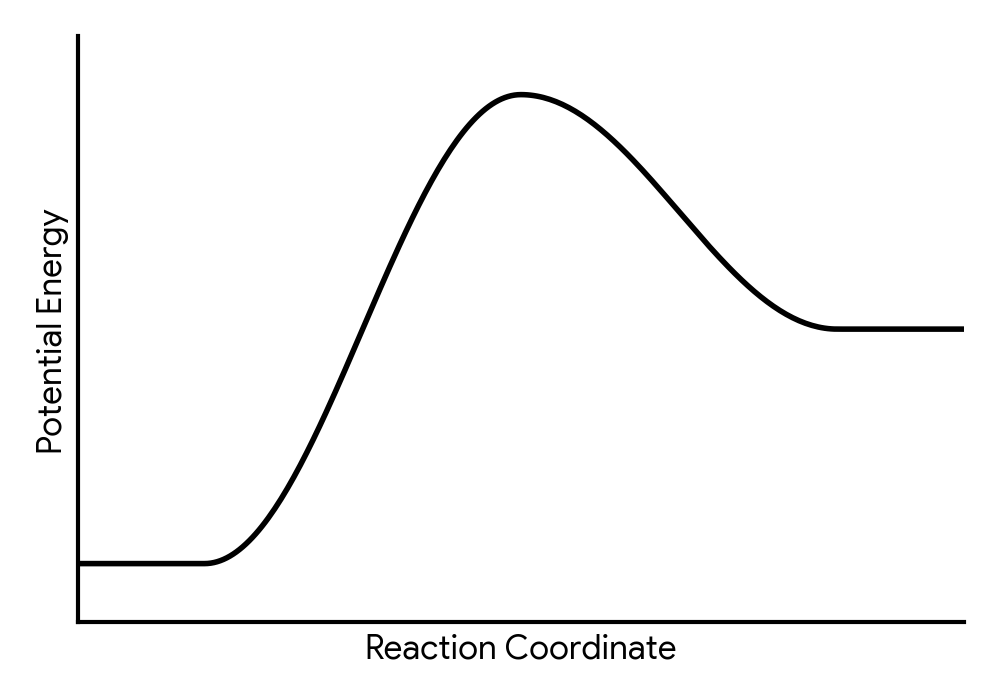
What is the correct interpretation of this energy profile?
| Relative stability of products vs reactants | Temperature of surroundings | |
|---|---|---|
| A | Less stable | Decreases |
| B | Less stable | Increases |
| C | More stable | Decreases |
| D | More stable | Increases |
First, determine if the reaction is endothermic or exothermic by comparing the potential energy of the reactants and products. Then, consider how this type of reaction affects the temperature of its surroundings. How does potential energy relate to stability?
Question 17
MediumPaper 1A · calculator1 markA student performed an experiment to determine the enthalpy change of dissolution for ammonium nitrate, . They dissolved mol of solid ammonium nitrate in g of water in a coffee cup calorimeter.
Initial temperature of water =
Final temperature of solution =
Specific heat capacity of water,
Assume the specific heat capacity of the solution is the same as water and the density of the solution is . The thermal energy absorbed by the calorimeter is negligible.
What is the enthalpy change of dissolution, , for ammonium nitrate according to these experimental results?
A.
B.
C.
D.
First, calculate the thermal energy change () of the water using . Remember that is the final temperature minus the initial temperature. Then, consider the sign convention: if the water's temperature decreased, the dissolution process absorbed energy from the water, meaning the reaction is endothermic. Finally, divide the total thermal energy change of the reaction by the moles of ammonium nitrate dissolved to find the molar enthalpy change.
Question 18
EasyPaper 1A · calculator1 markThe diagram shows the potential energy profile for a chemical reaction carried out in an insulated container.
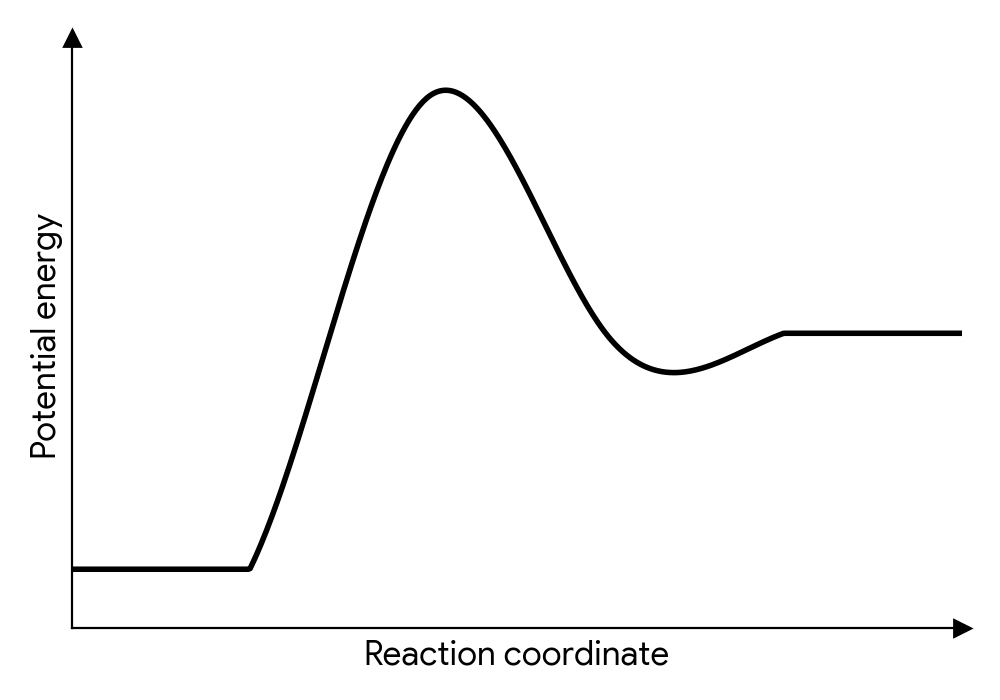
What would be observed during this reaction?
| Temperature of surroundings | Enthalpy change () | |
|---|---|---|
| A. | increases | positive |
| B. | increases | negative |
| C. | decreases | positive |
| D. | decreases | negative |
First, determine from the potential energy profile whether the reaction is exothermic or endothermic by comparing the energy of reactants and products. Then, relate the sign of the enthalpy change to the temperature change of the surroundings.
Question 19
MediumPaper 1A · calculator1 markA student conducted an experiment to determine the enthalpy of combustion of ethanol. They found that burning g of ethanol () caused the temperature of of water to increase by K.
What is the enthalpy of combustion of ethanol in ?
Specific heat capacity of water:
ethanol:
First, calculate the heat absorbed by the water using the formula . Remember that the density of water is approximately . Then, calculate the moles of ethanol burned. Finally, determine the enthalpy change per mole, ensuring the correct sign and units.
Question 20
EasyPaper 1A · calculator1 markWhich statement about an endothermic reaction is correct?
A. Temperature decreases and the products have higher enthalpy than the reactants.
B. Temperature decreases and the products have lower enthalpy than the reactants.
C. Temperature increases and the products have higher enthalpy than the reactants.
D. Temperature increases and the products have lower enthalpy than the reactants.
Consider what 'endothermic' means in terms of energy transfer between the system and the surroundings. How does this affect the temperature of the surroundings and the relative enthalpy of reactants and products?
No question on this page matches those filters. Try another difficulty or paper.
3 more Measuring enthalpy changes questions in the app
Every answer is marked mark by mark, IB-style, and the AI tutor helps when you are stuck.
Where marks are lost
- Reaching for "human error" or "only one trial." A source of error has to be a specific step in the method, not a general apology for the result.
- Joining the dots instead of drawing a curve.
- Naming a chemical instead of the property that distinguishes it, or vice versa. Answering with the nearest fact that comes to mind rather than the fact the command term and stem jointly ask for is a recurring way to answer a question that was not, quite, the one asked.