Experimental techniques: notes and practice questions
- This topic covers essential experimental techniques and safety practices in chemistry.
- Recognize and address relevant safety, ethical, and environmental issues in an investigation.
- Accurately measure variables such as mass, volume, time, temperature, length, pH of a solution, and electric current to an appropriate level of precision.
- Understand the purpose and practice of preparing standard solutions, carrying out dilutions, and drying to constant mass.
- Be aware of distillation, reflux, paper or thin layer chromatography, and separation of mixtures.
- Familiarity with calorimetry, acid-base and redox titration, electrochemical cells, and colorimetry or spectrophotometry.
- Knowledge of physical and digital molecular modelling, recrystallization, and melting point determination.
How it is examined
Paper 1B, heavily. May 2025 HL Paper 1B TZ1 opened with a standard-solution question: calculate the mass of Na2S2O3 needed, then describe how to prepare the solution, worth 3 marks with named marking points for dissolving in distilled or deionized water, filling to the mark and inverting the flask. The same paper asked for a safety hazard of a product plus a matching precaution, 2 marks, marked as a paired Safety/Precaution alternative. Command terms here are `Describe`, `Outline`, `State` and `Suggest`. Tariffs are 1 to 4 marks.
- Recognize and address relevant safety, ethical or environmental issues in an investigation.
- Measure, to an appropriate level of precision: mass, volume, time, temperature, length, pH of a solution, electric current, electric potential difference.
- Show awareness of the purpose and practice of: preparing a standard solution, carrying out dilutions, drying to constant mass, distillation and reflux, paper or thin layer chromatography, separation of mixtures, calorimetry, acid-base and redox titration, electrochemical cells, colorimetry or spectrophotometry, physical and digital molecular modelling, recrystallization, melting point determination.
No additional higher level content in Tool 1.
Guiding questions
- The guide gives no guiding question for the tools. They are framed as skills, not as a content subtopic.
Linking questions
- Structure 1.1 What factors are considered in choosing a method to separate the components of a mixture? How can the products of a reaction be purified?
- Structure 1.4 What are the considerations in the choice of glassware used in preparing a standard solution and a serial dilution?
- Reactivity 1.1 How can the enthalpy change for combustion reactions, such as for alcohols or food, be investigated experimentally? Why do calorimetry experiments typically measure a smaller change in temperature than is expected from theoretical values?
- Reactivity 3.1 How can titration be used to calculate the concentration of an acid or base in solution?
Practice questions
23 questions · 11 easy · 10 medium · 2 hardQuestion 1
EasyPaper 1A · calculator1 markA student has a suspension of solid calcium carbonate in water. What is the type of mixture and the best method to separate the solid from the water?
| Type of mixture | Method of separation | |
|---|---|---|
| A. | homogeneous | distillation |
| B. | homogeneous | filtration |
| C. | heterogeneous | distillation |
| D. | heterogeneous | filtration |
First, determine if a suspension, where solid particles are dispersed in a liquid, is a uniform mixture. Then, recall the standard laboratory technique for separating an insoluble solid from a liquid.
Question 2
MediumPaper 1B · calculator3 marksA liquid mixture is prepared containing propanone and butanone. The mole fraction of propanone in the mixture is 0.450. The vapour pressure of pure propanone at 25 °C is 30.8 kPa.
(a) Assuming the mixture behaves as an ideal solution, calculate the partial vapour pressure of propanone above the mixture at 25 °C.
(b) Propanone has a boiling point of 56 °C and butanone has a boiling point of 80 °C. Outline how this mixture can be separated by fractional distillation.
Recall Raoult's Law, which relates the partial vapour pressure of a component in an ideal mixture to its mole fraction and the vapour pressure of the pure component.
Think about the function of a fractionating column and how temperature differences lead to separation. Which substance will turn into a gas more easily?
Question 3
HardPaper 1B · calculator12 marksA student investigates the decomposition of hydrogen peroxide, H₂O₂, in a commercial antiseptic solution when exposed to light over a period of 7 days. The reaction is:
The concentration of H₂O₂ is determined by titration with a standard solution of acidified potassium manganate(VII), KMnO₄. Several identical flasks are prepared. One flask is kept in darkness, while others are exposed to a light source for different durations each day.
(a) Identify two variables, other than the volume of the solution, that should be controlled in this experiment.
(b) (i) The antiseptic solution is diluted with deionized water before titration. Suggest why this is necessary.
(b) (ii) Identify a possible systematic error associated with the control sample kept in darkness.
(b) (iii) Suggest how the experimental setup could be improved to check if the systematic error identified in (b)(ii) is significant.
(c) The following data are collected for one of the titrations:
Final burette reading =
Initial burette reading =
Calculate the percentage uncertainty of the titre.
(d) The initial concentration of H₂O₂ in all flasks was . The concentration after 7 days was measured for each flask.
| Daily light exposure / hours | Final [H₂O₂] after 7 days / |
|---|---|
| 0 (darkness) | 0.85 |
| 1 | 0.76 |
| 2 | 0.61 |
| 4 | 0.34 |
(i) Calculate the average rate of decrease in hydrogen peroxide concentration, in , for the sample exposed to light for 4 hours daily over the 7-day period.
(d) (ii) The student's hypothesis is: "A greater decrease in hydrogen peroxide concentration will be observed in solutions exposed to light for longer durations, due to photochemical decomposition."
Discuss, with reference to the data, the extent to which the results support this hypothesis.
(d) (iii) State one implication of the results for the storage of hydrogen peroxide solutions.
(e) Suggest a relevant extension to this investigation that would provide further information on the stability of hydrogen peroxide solutions.
Think about the factors that could affect the rate of a chemical reaction. Which of these should be kept constant to ensure a fair test comparing the effect of light exposure?
Consider the practical aspects of a titration. What problems might arise if the solution being titrated (the analyte) is very concentrated?
A systematic error is a flaw in the experimental design that causes results to be consistently incorrect in one direction. How might the 'darkness' condition not be perfectly achieved?
Think about how you could make the 'darkness' condition more robust or how you could measure the baseline decomposition without any experimental handling.
First, calculate the titre by subtracting the initial reading from the final reading. Then, find the absolute uncertainty of the titre by adding the uncertainties of the two readings. Finally, use the formula for percentage uncertainty.
The average rate of decrease is the total change in concentration divided by the total time. Use the data for the 4-hour exposure.
A 'discuss' question requires you to consider both sides. Does the data show a trend that matches the first part of the hypothesis? Does the experiment provide conclusive evidence for the reason given in the second part of the hypothesis?
Based on your results, what is the best way to store a solution of hydrogen peroxide to minimize its decomposition?
Think of another variable, apart from light, that might affect the rate of decomposition of hydrogen peroxide. How would you investigate it?
Question 4
EasyPaper 2 · calculator1 markIn a chemical synthesis, a student produces an aqueous solution of copper(II) sulfate. To isolate the solid copper(II) sulfate crystals for further analysis, which separation technique should be employed?
A. Filtration
B. Decantation
C. Evaporation
D. Solvent extraction
Think about the nature of the mixture. Is copper(II) sulfate dissolved in the water, or is it an undissolved solid? Different techniques are used for separating dissolved solids versus undissolved solids from a liquid.
Question 5
MediumPaper 2 · calculator12 marksSolid rocket boosters are used to provide large amounts of thrust for spacecraft launches. A common oxidizer used in these boosters is ammonium nitrate, .
(a) When ignited, ammonium nitrate decomposes to produce nitrogen gas, oxygen gas, and water vapour. Deduce the balanced chemical equation for this decomposition, including state symbols.
(b) Calculate the total number of moles of gas produced from the complete decomposition of 100.0 g of ammonium nitrate.
(c) The gaseous products are ejected at a temperature of 800 °C. Calculate the total volume, in , that these gases would occupy at a pressure of 1.01 × 10⁵ Pa.
(d) Explain why water vapour deviates more from ideal gas behaviour than oxygen gas does, especially at lower temperatures and higher pressures.
(e) Some advanced propellants use ammonium perchlorate, , which produces toxic chlorine gas, , upon decomposition. Suggest, including a relevant equation, one reason why the release of chlorine gas into the atmosphere is an environmental concern.
Start by writing the formulas for the reactant (ammonium nitrate) and the products (nitrogen, oxygen, water). Then, adjust the stoichiometric coefficients to ensure the number of atoms of each element is the same on both sides of the equation. Remember that nitrogen and oxygen are diatomic gases.
First, calculate the molar mass of ammonium nitrate. Then, use this to find the number of moles in 100.0 g. Finally, use the mole ratio from your balanced equation in part (a) to find the total moles of all gaseous products.
You will need to use the ideal gas law, PV = nRT. Make sure all your variables are in the correct SI units before you substitute them into the equation. Remember to convert the temperature from Celsius to Kelvin.
Consider the types of intermolecular forces present in water molecules and in oxygen molecules. How does the strength of these forces relate to the assumptions made about ideal gases?
Think about how chlorine gas might react with other common substances in the environment, such as water. What kind of products would be formed and why would they be a concern?
Question 6
HardPaper 2 · calculator6 marksCaffeine is a stimulant found in tea leaves. A student carried out an experiment to extract caffeine from tea. The procedure involved adding solid sodium carbonate () to boiling water with tea leaves, followed by a liquid-liquid extraction using dichloromethane () as the organic solvent. The crude caffeine obtained after evaporating the dichloromethane was then purified by recrystallization.
(a) State one key property of a solvent required for a liquid-liquid extraction and suggest why dichloromethane is a suitable choice for extracting caffeine from the aqueous solution.
(b) The aqueous solution from the tea leaves is alkaline due to the presence of sodium carbonate. Suggest how the addition of sodium carbonate improves the separation of caffeine from other acidic compounds, such as tannins, also present in tea.
(c) During the final recrystallization step, the student cooled the hot solution of crude caffeine rapidly in an ice bath. Outline how this would affect the purity of the caffeine obtained.
(d) Dichloromethane is a chlorinated hydrocarbon. State one reason, other than its toxicity, why the use of such solvents is being phased out.
For a liquid-liquid extraction, you need two distinct layers. What does this imply about the solvents? Also, consider where the desired substance (caffeine) should preferentially dissolve.
Consider the reaction between a base (sodium carbonate) and an acid (tannins). How does this reaction change the properties, particularly the solubility, of the tannins?
Think about how crystals form. What happens if they form too quickly? Where might impurities get trapped?
Chlorinated hydrocarbons are known to affect a specific protective layer in the Earth's atmosphere. What is this layer?
Question 7
EasyPaper 2 · calculator1 markA student performs an experiment to separate the mixture of pigments extracted from plant leaves. Which technique is most appropriate for this separation?
A. Fractional distillation
B. Chromatography
C. Filtration
D. Evaporation
Consider the properties of the mixture. The pigments are different coloured substances dissolved in a solvent. Which separation technique is based on the differential movement of components through a medium?
Question 8
MediumPaper 2 · calculator10 marksA student investigates the rate of reaction between magnesium and sulfuric acid. The reaction produces hydrogen gas.
(a) Write the balanced chemical equation, including state symbols, for the reaction between magnesium and sulfuric acid.
(b) Describe two different experimental methods to measure the rate of this reaction. For each method, state the variable that would be measured.
The student carries out the reaction using 0.50 g of magnesium and excess 1.0 mol dm⁻³ sulfuric acid. The experiment is performed twice: once with a single ribbon of magnesium and once with the same mass of magnesium powder. The results are plotted on the graph below.
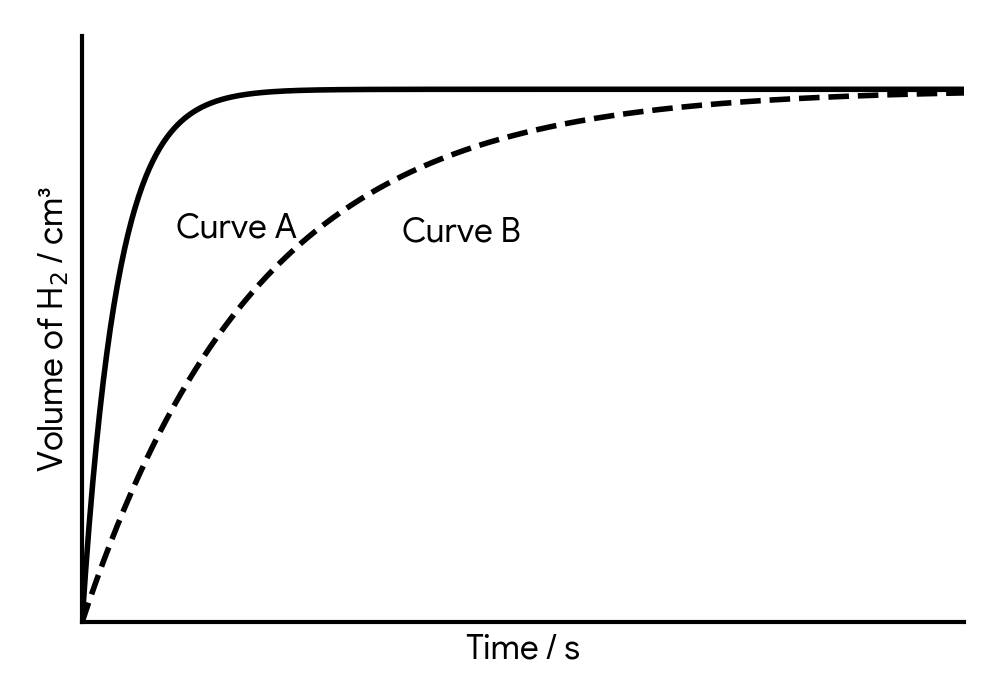
(c) (i) Identify which curve, A or B, represents the reaction with magnesium powder. Explain your answer using collision theory.
(ii) Explain why both curves reach the same final volume of hydrogen gas.
Identify the products of the reaction between a metal and an acid. Remember to include the physical state of each reactant and product at room temperature.
The reaction produces a gas and involves a solid reactant disappearing. How could you measure the change in the amount of gas over time? How could you measure the change in the total mass of the reaction system over time?
Consider how the surface area of the magnesium differs between a ribbon and a powder. How does surface area affect the rate of collisions between reactant particles?
Think about what determines the total amount of product formed in a reaction. Which reactant runs out first? Is the amount of this reactant the same in both experiments?
Question 9
EasyPaper 2 · calculator1 markA student is given a solid mixture of sodium chloride and silicon dioxide (). Which sequence of techniques is most suitable for separating pure, dry sodium chloride from this mixture?
A. Filtration followed by evaporation
B. Dissolving in water, followed by filtration, then evaporation
C. Magnetism followed by distillation
D. Dissolving in ethanol, followed by crystallization
Consider the different physical properties of sodium chloride (salt) and silicon dioxide (sand), specifically their solubility in water. Think about the steps needed to first separate the soluble component from the insoluble one, and then how to recover the soluble component from the solvent.
Question 10
MediumPaper 2 · calculator5 marksA student is presented with several samples of matter and asked to classify them.
(a) Define the term homogeneous mixture.
(b) Classify each of the following substances as an element, a compound, a homogeneous mixture, or a heterogeneous mixture.
• Air
• Graphite
• Sodium chloride solution
• A mixture of sand and iron filings
(c) Describe a method to separate the iron filings from the sand.
Think about what the prefix 'homo-' means. How does the appearance of a solution like salt water differ from a mixture like sand and water?
Consider if each substance is made of one type of atom (element), multiple types of atoms chemically bonded (compound), or multiple substances physically mixed. If it's a mixture, is its composition uniform throughout?
Think about the physical properties of iron and sand. Is there a property that is unique to one of them that you can exploit for separation?
Question 11
EasyPaper 1A · calculator1 markA student performs paper chromatography to separate pigments from a plant extract. After developing the chromatogram, the solvent front travels from the origin, and a specific green pigment spot travels from the origin.
What is the retardation factor, , for this green pigment?
A.
B.
C.
D.
The retardation factor () is calculated as the ratio of the distance traveled by the spot to the distance traveled by the solvent front. Ensure you use the correct distances in the numerator and denominator.
Question 12
MediumPaper 1A · calculator1 markA student performed thin-layer chromatography (TLC) to separate a mixture of benzoic acid () and ethyl benzoate (). A polar silica gel was used as the stationary phase, and a non-polar solvent system was used as the mobile phase. The chromatogram showed two spots, P and Q, and a solvent front.
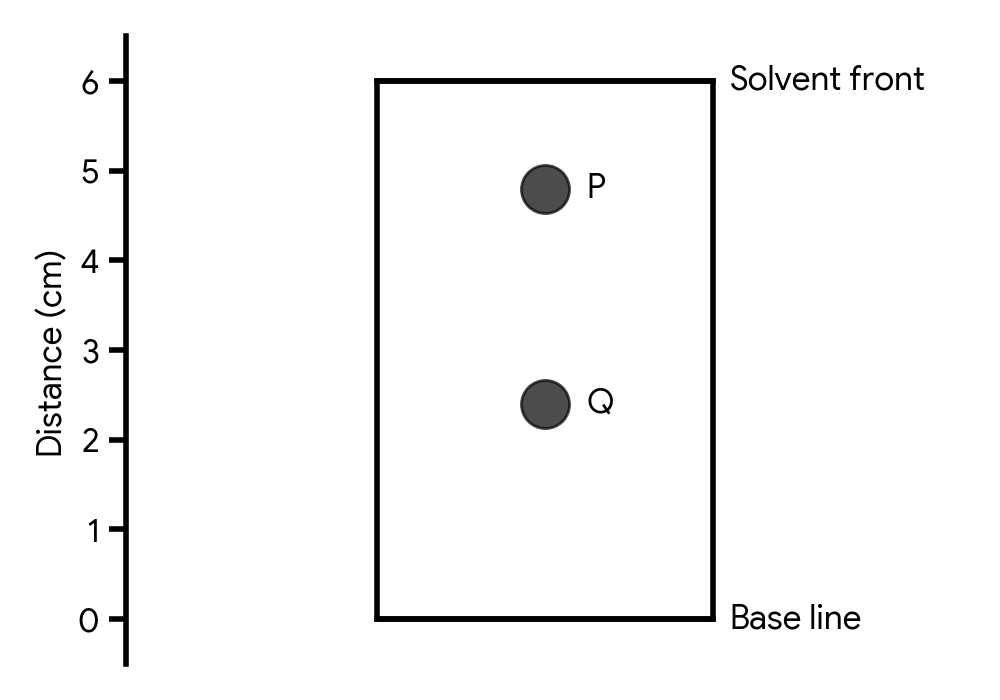
What are the position and retardation factor () of ethyl benzoate?
A. Q and 0.40
B. Q and 0.80
C. P and 0.40
D. P and 0.80
Recall that in thin-layer chromatography with a polar stationary phase and a non-polar mobile phase, less polar compounds travel further up the plate and have higher values. Compare the polarities of benzoic acid and ethyl benzoate. The retardation factor () is calculated as the ratio of the distance travelled by the spot to the distance travelled by the solvent front.
Question 13
EasyPaper 1A · calculator1 markWhich methods are suitable for separating the components of the given mixtures?
| Mixture | Method |
|---|---|
| Sand and sucrose | Filtration followed by evaporation |
| A mixture of amino acids | Paper chromatography |
| Ethanol and water | Fractional distillation |
A. I and II only
B. I and III only
C. II and III only
D. I, II and III
Consider the physical properties of the components in each mixture. For mixture I, think about solubility in a common solvent. For mixture II, consider how chromatography separates substances based on their differential movement. For mixture III, think about the boiling points of the two miscible liquids.
Question 14
MediumPaper 1B · calculator9 marksA food chemist is analyzing the components of a new artificial sweetener mixture using paper chromatography. A small spot of the mixture is applied to a chromatography paper, and the paper is placed in a sealed chamber with a solvent system consisting of ethanol and water. After some time, the solvent front moves up the paper, separating the components.
(a) Define the stationary phase and the mobile phase in this paper chromatography experiment.
(b) Explain why it is important that the initial spot of the sweetener mixture is applied above the solvent level in the chamber, and why the solvent front should not be allowed to reach the very top of the chromatography paper.
(c) After the chromatography run, the solvent front travelled from the start line. Two distinct components, Sweetener A (yellow) and Sweetener B (blue), were observed to have travelled and respectively from the start line.
Calculate the retardation factor, , for Sweetener A and Sweetener B. Show your working.
(d) The stationary phase (paper) is polar due to cellulose, and the mobile phase is a moderately polar mixture of ethanol and water.
Deduce, with a reason, which sweetener (A or B) is more polar.
(e) If Sweetener A and another component had very similar values and were not well separated, suggest one modification to the experiment that could improve their separation.
Recall the definitions of stationary and mobile phases in chromatography. Consider what the paper is made of and what the solvent does.
Consider what would happen if the sample dissolved directly into the solvent pool. Think about the purpose of separating components along the paper and the accuracy of measurements.
The retardation factor () is calculated as the distance travelled by the component divided by the distance travelled by the solvent front.
Consider the principle of 'like dissolves like' and how it applies to the interaction of the sweeteners with the stationary and mobile phases. A higher value indicates a greater affinity for the mobile phase.
Think about factors that influence the differential partitioning of components between the stationary and mobile phases.
Question 15
EasyPaper 1A · calculator1 markA student collects a sample of seawater containing suspended sand particles. What is the type of mixture and the primary method to separate the sand from the saltwater?
| Type of mixture | Method of separation | |
|---|---|---|
| A | Heterogeneous | Filtration |
| B | Homogeneous | Filtration |
| C | Heterogeneous | Distillation |
| D | Homogeneous | Distillation |
First, determine if the sand particles are uniformly distributed and dissolved in the water. Then, consider which separation technique is used to separate an insoluble solid from a liquid.
Question 16
MediumPaper 2 · calculator7 marksA student plans to determine the concentration of copper(II) ions in a sample of industrial wastewater using colorimetry. The blue colour of the solution is due to the hydrated copper(II) ion, . To do this, they must first prepare a standard solution of copper(II) sulfate and construct a calibration curve.
(a) Describe the procedure for preparing a standard aqueous solution of known concentration from solid hydrated copper(II) sulfate, .
(b) Describe how this standard solution can be used to construct a calibration curve.
(c) Explain how this curve can be used to determine the concentration of copper(II) ions in the wastewater sample.
Think about the specific glassware and equipment needed for accuracy. What are the key steps from weighing the solid to preparing the final solution?
A calibration curve requires multiple data points. How can you create solutions of different known concentrations from your single standard solution? What property will you measure with the colorimeter for each solution?
You have a graph that relates absorbance to concentration, and you can measure the absorbance of your unknown sample. How do you connect these two pieces of information?
Question 17
EasyPaper 1A · calculator1 markGas chromatography (GC) is a technique used to separate volatile components of a mixture. What is the primary physical property on which this separation is based?
A. The different polarities of the components.
B. The different volatilities of the components.
C. The different solubilities of the components in an aqueous mobile phase.
D. The different molar masses of the components.
Consider what state the sample must be in to pass through the GC column. How does the temperature of the column affect how quickly different substances travel through it?
Question 18
MediumPaper 1B · calculator7 marksA student is tasked with determining the concentration of copper(II) ions, , in a sample of industrial wastewater using a colorimeter. The blue colour of the solution is due to the hydrated copper(II) ion, . To do this, a calibration curve must first be prepared using a standard solution of hydrated copper(II) sulfate, .
(a) Describe the essential steps to prepare a standard aqueous solution of copper(II) sulfate of a known concentration.
(b) Describe how this standard solution can be used to construct a calibration curve.
(c) Explain how the calibration curve can be used to determine the concentration of in the wastewater sample.
Think about the specific glassware and steps needed to make a solution with a very precise concentration. What do you measure first? What vessel do you use for the final volume?
A calibration curve needs multiple data points. How do you get solutions of different known concentrations from your single standard solution? What two variables do you plot?
You have a curve that relates absorbance to concentration. What measurement do you need to take for your unknown sample? How do you use that measurement with your curve?
Question 19
EasyPaper 1A · calculator1 markWhich apparatus can be used to monitor the rate of the reaction between magnesium and hydrochloric acid?
I. A gas syringe
II. A pH meter
III. A colorimeter
A. I and II only
B. I and III only
C. II and III only
D. I, II and III
Consider the properties of the reactants and products. Does the reaction produce a gas? Does the acidity change? Is there a colour change?
Question 20
MediumPaper 2 · calculator4 marksA voltaic cell is constructed using a copper half-cell, .
(a) A solution of copper(II) ions is required for the half-cell. State the chemical formula of a suitable soluble copper(II) compound.
(b) The copper half-cell is connected to another half-cell to form a complete voltaic cell. A salt bridge is used to connect the two half-cells. Describe the function of the salt bridge.
(c) A high-resistance voltmeter is used to measure the potential difference of the cell. State the units of cell potential.
Think about common salts you have encountered in the lab. Which ones containing copper(II) ions dissolve in water? Remember the solubility rules.
What would happen if the two solutions were not connected by a salt bridge? Consider the movement of both electrons and ions in the cell.
What unit is typically used when discussing the 'voltage' of a battery or cell?
No question on this page matches those filters. Try another difficulty or paper.
3 more Experimental techniques questions in the app
Every answer is marked mark by mark, IB-style, and the AI tutor helps when you are stuck.
Where marks are lost
- Reaching for "human error" or "only one trial." A source of error has to be a specific step in the method, not a general apology for the result.
- Joining the dots instead of drawing a curve.
- Naming a chemical instead of the property that distinguishes it, or vice versa. Answering with the nearest fact that comes to mind rather than the fact the command term and stem jointly ask for is a recurring way to answer a question that was not, quite, the one asked.