The covalent model: notes and practice questions
- This topic covers advanced aspects of covalent bonding, including coordination compounds, separation techniques, resonance, expanded octets, and orbital hybridization.
- Identify coordination bonds in transition element complexes.
- Explain, calculate, and interpret retardation factor values in chromatography.
- Deduce resonance structures and understand delocalization, including for benzene.
- Construct Lewis formulas for expanded octets (5 and 6 electron domains) and predict their VSEPR geometries.
- Apply formal charge to determine preferred Lewis formulas.
- Deduce the presence of sigma and pi bonds.
- Analyze and predict hybridization (sp, sp, sp) and molecular geometry.
How it is examined
The heaviest bonding subtopic. May 2025 HL Paper 2 TZ1 asked for a Lewis formula of the nitrate ion [1] and its molecular geometry [1] as adjacent parts, which is the standard pairing. Bond angle questions want the number and the reason. Intermolecular force explanations are where marks are lost most: a marker wants the force named correctly and the comparison made, so "hydrogen bonding between water molecules is stronger than the London forces between methane molecules" earns, while "water has stronger bonds" does not, because it says bonds rather than forces. HL hybridization is usually a 1-mark deduction attached to a drawn structure.
Electronegativity values. Average bond enthalpies and bond lengths. Bond angles for the standard geometries are recall, as are the names of the shapes, the VSEPR ordering of repulsions, and the RF definition.
- 2.2.1 A covalent bond is formed by the electrostatic attraction between a shared pair of electrons and the positively charged nuclei. The octet rule refers to the tendency of atoms to gain a valence shell with a total of 8 electrons. Students deduce the Lewis formula of molecules and ions for up to four electron pairs on each atom.
- 2.2.2 Single, double and triple bonds involve one, two and three shared pairs of electrons. Students explain the relationship between the number of bonds, bond length and bond strength.
- 2.2.3 A coordination bond is a covalent bond in which both electrons of the shared pair originate from the same atom. Students identify coordination bonds in compounds.
- 2.2.4 The valence shell electron pair repulsion (VSEPR) model enables the shapes of molecules to be predicted from the repulsion of electron domains around a central atom. Students predict the electron domain geometry and the molecular geometry for species with up to four electron domains.
Knowledge of the use of locating agents in chromatography is not required. The technical and operational details of a gas chromatograph or high-performance liquid chromatograph will not be assessed.
Guiding questions
- What determines the covalent nature and properties of a substance?
Linking questions
- Nature of science What are some of the limitations of the octet rule? How useful is the VSEPR model at predicting molecular geometry? How can advances in technology lead to changes in scientific definitions, for example the updated IUPAC definition of the hydrogen bond?
- Structure 1.3 Why do noble gases form covalent bonds less readily than other elements?
- Structure 2.1 Why do ionic bonds only form between different elements while covalent bonds can form between atoms of the same element? What properties of ionic compounds might be expected in compounds with polar covalent bonding?
- Structure 1.5 To what extent can intermolecular forces explain the deviation of real gases from ideal behaviour?
- Structure 3.1 Why are silicon-silicon bonds generally weaker than carbon-carbon bonds? How does the ability of some atoms to expand their octet relate to their position in the periodic table?
- Structure 3.2 To what extent does a functional group determine the nature of the intermolecular forces? (HL) What features of a molecule make it "infrared (IR) active"?
- Reactivity 2.2 How does the presence of double and triple bonds in molecules influence their reactivity?
- Reactivity 3.4 (HL) Why do Lewis acid-base reactions lead to the formation of coordination bonds? What are the structural features of benzene that favour it undergoing electrophilic substitution reactions?
- Tool 1 How can a mixture be separated using paper chromatography or thin layer chromatography (TLC)?
Practice questions
17 questions · 1 easy · 16 mediumQuestion 1
EasyPaper 1A · calculator1 markWhich is the NMR spectrum of propanone?
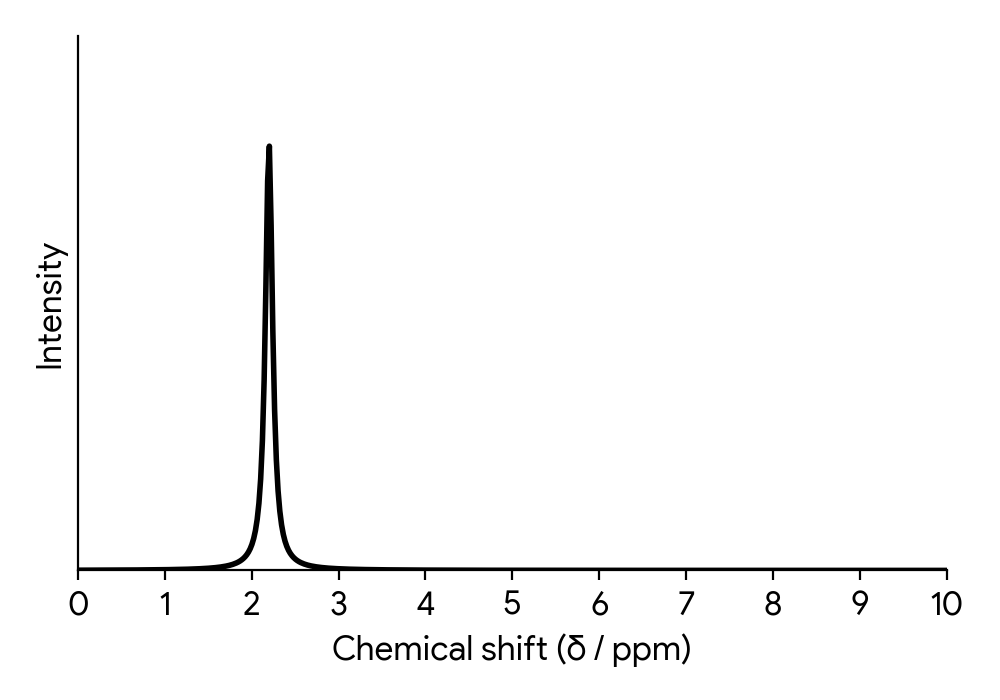
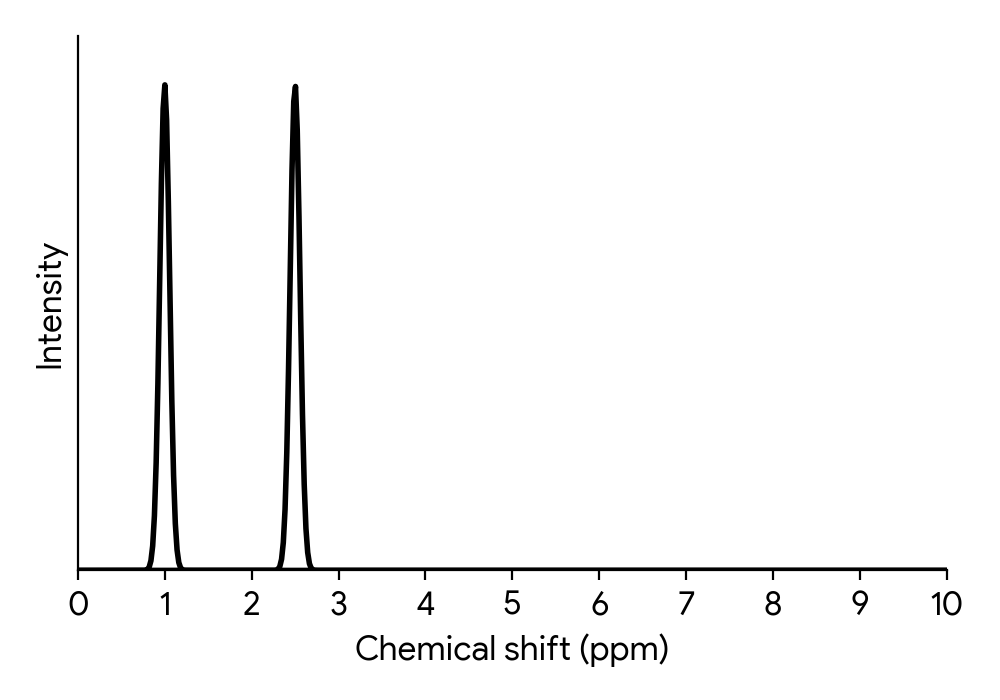
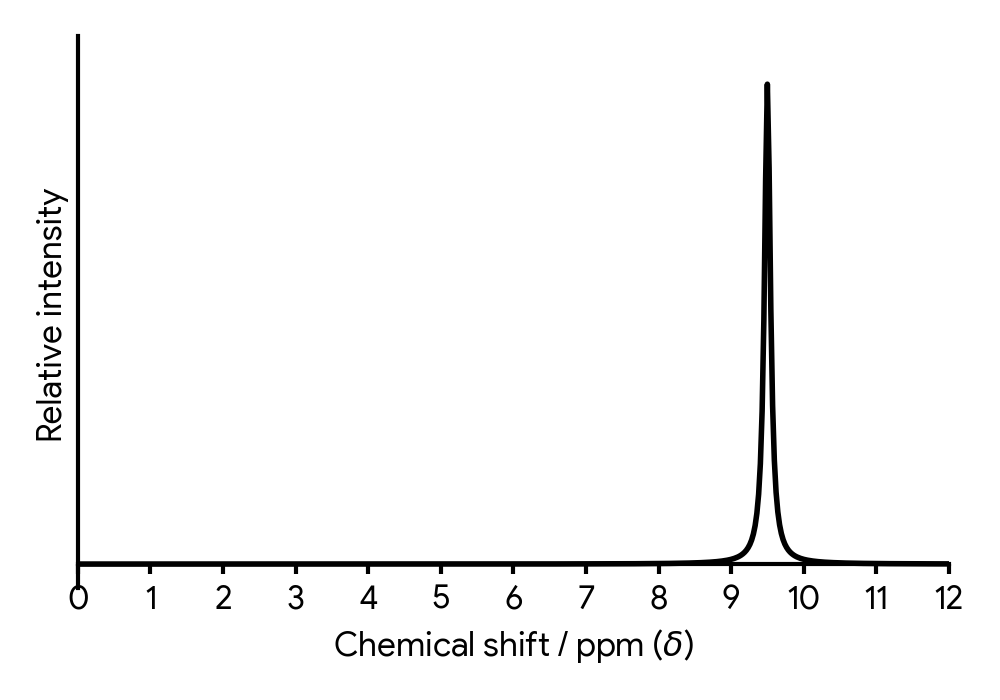
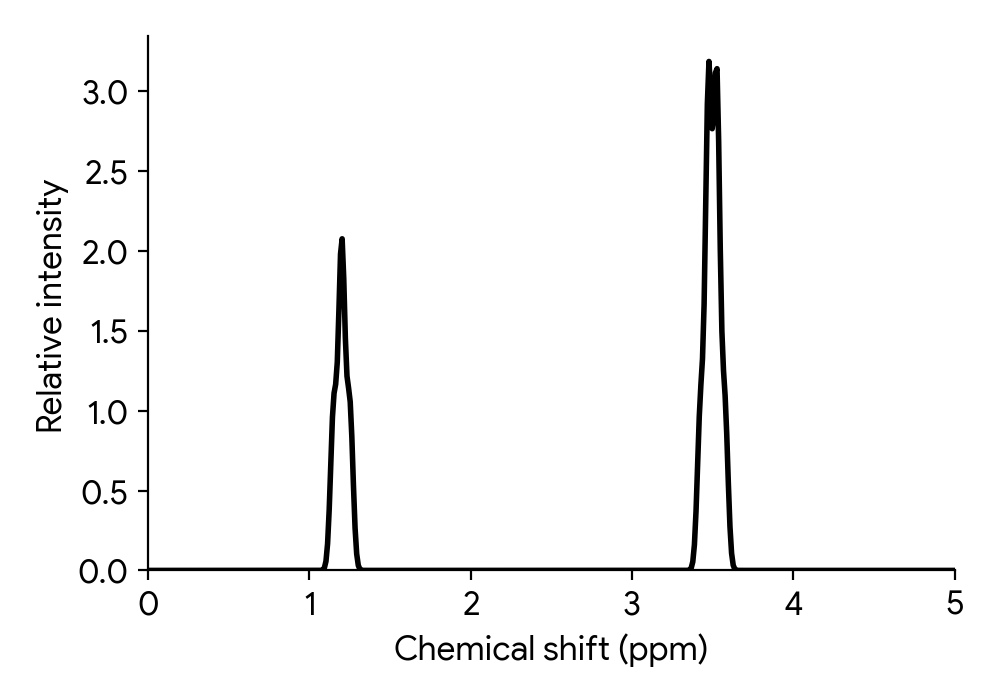
Consider the symmetry of the propanone molecule. How many different chemical environments are there for the hydrogen atoms (protons)? Also, think about the typical chemical shift for protons adjacent to a carbonyl group.
Question 2
MediumPaper 1A · calculator1 markThe thiocyanate ion, , can be represented by several resonance structures. Two possible structures are shown below.
Structure I:
Structure II:
Which row correctly identifies the formal charges on S, C, and N for each structure and identifies the more stable structure?
| Formal Charges (S, C, N) in Structure I | Formal Charges (S, C, N) in Structure II | More stable | |
|---|---|---|---|
| A. | -1, 0, 0 | 0, 0, -1 | I |
| B. | -1, 0, 0 | 0, 0, -1 | II |
| C. | 0, 0, -1 | -1, 0, 0 | I |
| D. | 0, 0, -1 | -1, 0, 0 | II |
Calculate the formal charge for each atom in both structures using the formula: Formal Charge = (Valence Electrons) - (Non-bonding Electrons) - 0.5 × (Bonding Electrons). The most stable resonance structure is the one that minimizes formal charges and places any negative formal charge on the most electronegative atom.
Question 3
MediumPaper 1A · calculator1 markWhich sequence lists the following molecules in order of decreasing bond angle?
A. , , ,
B. , , ,
C. , , ,
D. , , ,
Use VSEPR theory to predict the shape and bond angle for each molecule. Remember that lone pairs repel more strongly than bonding pairs, and consider the geometries associated with 2, 3, and 4 electron domains.
Question 4
MediumPaper 1A · calculator1 markThe standard enthalpy of hydrogenation of cyclohexene is .
Based on this value, what would be the predicted standard enthalpy of hydrogenation for the Kekulé structure of benzene, and what does the experimental value being significantly less exothermic indicate about the stability of benzene?
A. Predicted ; Benzene is less stable than the Kekulé structure.
B. Predicted ; Benzene is more stable than the Kekulé structure.
C. Predicted ; Benzene is less stable than the Kekulé structure.
D. Predicted ; Benzene is more stable than the Kekulé structure.
The Kekulé structure for benzene contains three alternating C=C double bonds. First, calculate the expected enthalpy change for hydrogenating these three bonds using the data for cyclohexene. Then, consider the meaning of 'less exothermic' in terms of energy levels and stability. A more stable compound has a lower enthalpy.
Question 5
MediumPaper 1A · calculator1 markIn which of the following molecules do all atoms obey the octet rule?
I.
II.
III.
A. I and II only
B. I and III only
C. II and III only
D. I, II and III
Draw the Lewis (electron dot) structure for each molecule. Count the number of valence electrons around each atom. Remember that some elements in period 3 and below can have more than eight electrons in their valence shell (an expanded octet).
Question 6
MediumPaper 1A · calculator1 markWhich species has a net dipole moment?
A.
B.
C.
D.
Consider the molecular geometry and symmetry of each species. A molecule has a net dipole moment if the individual bond dipoles do not cancel each other out. Draw the Lewis structure for each to determine the number of electron domains and the resulting shape.
Question 7
MediumPaper 1A · calculator1 markWhat are the electron domain and molecular geometries of ?
| Electron domain geometry | Molecular geometry |
|---|---|
| Trigonal bipyramidal | T-shaped |
| Octahedral | square planar |
| Octahedral | square pyramidal |
| Trigonal bipyramidal | see-saw |
A. Trigonal bipyramidal, T-shaped
B. Octahedral, square planar
C. Octahedral, square pyramidal
D. Trigonal bipyramidal, see-saw
First, determine the number of valence electrons for the central bromine atom. Then, find the number of bonding pairs and lone pairs to determine the total number of electron domains. Use this to find the electron domain geometry and then the molecular geometry.
Question 8
MediumPaper 1A · calculator1 markWhat are the hybridizations of the carbon and oxygen atoms in the ethanoate ion, ?
A. Methyl carbon (): , Carboxylate carbon (COO): , Oxygen atoms:
B. Methyl carbon (): , Carboxylate carbon (COO): , Oxygen atoms:
C. Methyl carbon (): , Carboxylate carbon (COO): , Oxygen atoms:
D. Methyl carbon (): , Carboxylate carbon (COO): , Oxygen atoms:
First, draw the Lewis structure for the ethanoate ion, considering any resonance structures. Then, for each unique atom (the methyl carbon, the carboxylate carbon, and the oxygen atoms), determine the number of electron domains around it. Relate the number of electron domains and the geometry to the type of hybridization.
Question 9
MediumPaper 1A · calculator1 markWhat is the identity of the ester with the molecular formula , which has four peaks in its NMR spectrum with an integration ratio of ?
A. Methyl propanoate
B. Ethyl ethanoate
C. Propyl methanoate
D. Isopropyl methanoate
Consider the structure of each ester isomer. The number of peaks in a NMR spectrum corresponds to the number of different proton environments, and the integration ratio corresponds to the relative number of protons in each environment.
Question 10
MediumPaper 1A · calculator1 markWhat are the electron domain and molecular geometries of the tellurium tetrachloride molecule, ?
<br>
A. Trigonal bipyramidal, Seesaw
B. Octahedral, Square planar
C. Trigonal bipyramidal, Tetrahedral
D. Tetrahedral, Tetrahedral
Start by finding the number of valence electrons for the central atom, tellurium (Te), and the surrounding chlorine atoms. Draw the Lewis structure to determine the number of electron domains (bonding and non-bonding) around the central atom. The arrangement of these domains gives the electron domain geometry, and the arrangement of only the atoms gives the molecular geometry.
Question 11
MediumPaper 1A · calculator1 markWhich statement correctly describes the orbital overlap that forms the carbon-carbon triple bond in ethyne, ?
A. One -bond from the overlap of two orbitals and two -bonds from the sideways overlap of two pairs of p orbitals.
B. One -bond from the overlap of two orbitals and two -bonds from the sideways overlap of two pairs of p orbitals.
C. Three -bonds from the overlap of three pairs of orbitals.
D. One -bond from the overlap of two orbitals and two -bonds from the sideways overlap of one pair of p orbitals and one pair of orbitals.
First, determine the hybridization of the carbon atoms in ethyne by considering the number of electron domains around each carbon atom. Then, recall how sigma () and pi () bonds are formed from the overlap of atomic and hybrid orbitals. A triple bond consists of one sigma bond and two pi bonds.
Question 12
MediumPaper 1A · calculator1 markWhich species contain a coordination bond?
I.
II.
III.
A. I and II only
B. I and III only
C. II and III only
D. I, II and III
Draw the Lewis (electron dot) structure for each species. A coordination bond, also known as a dative covalent bond, is formed when one atom provides both electrons in the covalent bond. Consider the formation of the hydronium ion from water and a proton.
Question 13
MediumPaper 1A · calculator1 markWhat are the electron domain and molecular geometries of sulfur tetrafluoride, ?
Electron domain geometry | Molecular geometry
---|---
A. Trigonal bipyramidal | Trigonal bipyramidal
B. Trigonal bipyramidal | See-saw
C. Octahedral | Square planar
D. Tetrahedral | Tetrahedral
First, determine the number of valence electrons and draw the Lewis structure for . Then, count the number of electron domains (both bonding and non-bonding) around the central sulfur atom to determine the electron domain geometry. Finally, use the number of lone pairs to find the molecular geometry.
Question 14
MediumPaper 1A · calculator1 markNitrogen () and oxygen () are the two most abundant gases in the Earth's atmosphere. Why are they not classified as greenhouse gases?
A. Their bond vibrations do not involve a change in dipole moment.
B. They are elements with low molar masses.
C. They are transparent to ultraviolet radiation.
D. They do not have any polar covalent bonds.
Consider the mechanism by which molecules absorb infrared radiation. What property of a molecule's vibration is essential for this absorption to occur? Think about how this applies to symmetrical diatomic molecules compared to molecules like or .
Question 15
MediumPaper 1A · calculator1 markWhat is the molecular geometry of the central phosphorus atom in the ion?
A. Trigonal bipyramidal
B. Square planar
C. Octahedral
D. See-saw
First, determine the number of valence electrons on the central atom. Remember to account for the overall charge of the ion. Then, determine the number of electron domains (bonding pairs and lone pairs) around the central atom to predict the geometry using VSEPR theory.
Question 16
MediumPaper 1A · calculator1 markIn which set do all species contain delocalized electrons?
A. , , (diamond)
B. , ,
C. , ,
D. , ,
Consider which of these molecules or ions can be represented by two or more valid Lewis structures (resonance structures). Also, think about the bonding in different allotropes of carbon and in aromatic compounds.
Question 17
MediumPaper 1A · calculator1 markCarbon dioxide, , acts as a greenhouse gas. Which statement explains why absorbs infrared radiation?
A. Asymmetrical stretching and bending vibrations result in a change in dipole moment.
B. Symmetrical stretching vibrations result in a change in dipole moment.
C. Infrared radiation promotes electrons to higher energy levels.
D. The polar bonds give the molecule an overall permanent dipole moment.
Consider the symmetry of the different vibrational modes of a linear triatomic molecule and how bond dipole vectors cancel or fail to cancel during each vibration.
No question on this page matches those filters. Try another difficulty or paper.
Every The covalent model question, marked for you
Every answer is marked mark by mark, IB-style, and the AI tutor helps when you are stuck.
Where marks are lost
- Reaching for "human error" or "only one trial." A source of error has to be a specific step in the method, not a general apology for the result.
- Joining the dots instead of drawing a curve.
- Naming a chemical instead of the property that distinguishes it, or vice versa. Answering with the nearest fact that comes to mind rather than the fact the command term and stem jointly ask for is a recurring way to answer a question that was not, quite, the one asked.