How fast? the rate of chemical change: notes and practice questions
- This topic covers advanced reaction kinetics, including multistep mechanisms and the Arrhenius equation.
- The rate-determining step is the slowest elementary step in a reaction mechanism.
- Distinguish reaction intermediates from transition states in energy profiles.
- Molecularity defines the number of reacting particles in an elementary step.
- Rate equations and reaction orders are determined experimentally or deduced from mechanisms.
- The rate constant follows the Arrhenius equation: .
- Activation energy and the Arrhenius factor are found graphically from experimental data.
How it is examined
Maxwell-Boltzmann sketches are 2 to 3 marks and are marked strictly: the curve must start at the origin, not touch the x-axis at high energy, and the two curves at different temperatures must cross once with the higher-temperature curve having a lower, broader peak. A catalyst does not change the curve, it moves the Ea line, and drawing a new curve for a catalyst loses the mark. At HL, deducing a rate equation from an initial-rates table is a 2 to 3 mark chain, and the units of k are a separate mark that students routinely leave off. May 2025 HL Paper 2 TZ1 asked candidates to explain how a catalyst increases the reaction rate [2], to work with the second step of a mechanism [2], and to sketch an energy profile given ΔH and an exothermic assumption [4].
The Arrhenius equation and its linear form, and the gas constant R (HL). What is recall: the shape of a Maxwell-Boltzmann curve and what changes when temperature or Ea changes, how to derive the units of k from the overall order, and the shapes of zero, first and second order graphs.
- 2.2.1 The rate of reaction is expressed as the change in concentration of a particular reactant or product per unit time. Students determine rates of reaction.
- 2.2.2 Species react as a result of collisions of sufficient energy and proper orientation. Students explain the relationship between the kinetic energy of the particles and the temperature in kelvin, and the role of collision geometry.
- 2.2.3 Factors that influence the rate of a reaction include pressure, concentration, surface area, temperature and the presence of a catalyst. Students predict and explain the effects of changing conditions on the rate of a reaction.
- 2.2.4 Activation energy, Ea, is the minimum energy that colliding particles need for a successful collision leading to a reaction. Students construct Maxwell-Boltzmann energy distribution curves to explain the effect of temperature on the probability of successful collisions.
The different mechanisms of homogeneous and heterogeneous catalysts will not be assessed.
Guiding questions
- How can the rate of a reaction be controlled?
Linking questions
- Structure 1.1 What is the relationship between the kinetic molecular theory and collision theory?
- Tool 1, 3, Inquiry 2 Concentration changes in reactions are not usually measured directly. What methods are used to provide data to determine the rate of reactions? What experiments measuring reaction rates might use time as i) a dependent variable ii) an independent variable? (HL) What measurements are needed to deduce the order of reaction for a specific reactant?
- Nature of science, Tool 3, Inquiry 3 How can graphs provide evidence of systematic and random error?
- Reactivity 2.3 What is the relative effect of a catalyst on the rate of the forward and backward reactions?
- Structure 3.1 (HL) What are the features of transition elements that make them useful as catalysts?
- Reactivity 3.4 (HL) Which mechanism in the hydrolysis of halogenoalkanes involves an intermediate? What are the rate equations and units of k for the reactions of primary and tertiary halogenoalkanes with aqueous alkali?
- Nature of science (HL) Why are reaction mechanisms only considered as "possible mechanisms"?
Practice questions
13 questions · 2 easy · 11 mediumQuestion 1
EasyPaper 1A · calculator1 markWhich species is an intermediate in the catalytic decomposition of ozone shown below?
Step 1:
Step 2:
A.
B.
C.
D.
A reaction intermediate is a species that is produced in one elementary step and consumed in a subsequent step. It does not appear in the overall balanced equation. Distinguish this from a catalyst, which is consumed and then regenerated.
Question 2
MediumPaper 1A · calculator1 markThe decomposition of dinitrogen pentoxide, , was studied at various temperatures to determine its activation energy. The following graph was obtained from the processed kinetic data, and the slope was calculated to be .
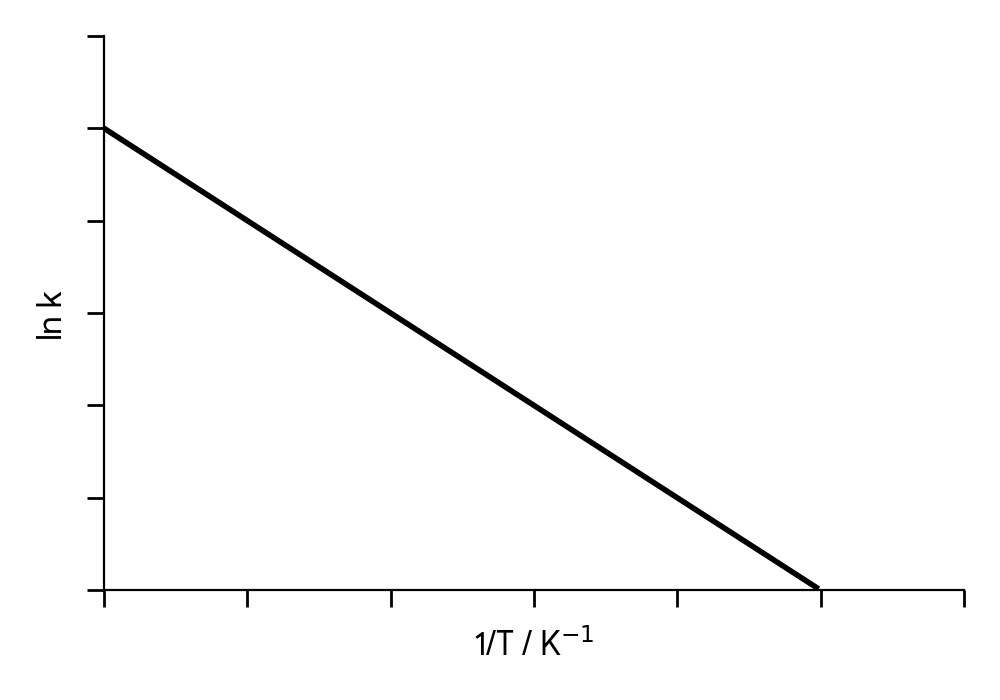
Given the Arrhenius equation in its linear form: .
Which expression gives the activation energy for this reaction?
A.
B.
C.
D.
Recall the relationship between the slope of an Arrhenius plot ( versus ) and the activation energy, . Pay close attention to the sign and units of the gas constant .
Question 3
EasyPaper 1A · calculator1 markThe reaction between nitrogen monoxide and chlorine gas is shown below.
The experimentally determined rate law is: .
What are the units for the rate constant, ?
A.
B.
C.
D.
Rearrange the rate law to make the subject. Then, substitute the standard units for rate () and concentration () into the expression and simplify the units.
Question 4
MediumPaper 1A · calculator1 markFor a reaction that is second order overall, what are the units of the rate constant, ?
A.
B.
C.
D.
The units of the rate constant, , depend on the overall order of the reaction. The general formula for the units of is , where is the overall reaction order. Substitute the correct value for and the standard units for concentration and time.
Question 5
MediumPaper 1A · calculator1 markA student investigates the kinetics of the reaction between hydrogen gas and iodine monochloride gas at a constant temperature. The reaction is represented by the equation:
The following initial rate data were collected for the reaction:
| Experiment | / mol dm | / mol dm | Initial Rate / mol dm s |
|---|---|---|---|
| 1 | 0.10 | 0.10 | |
| 2 | 0.20 | 0.10 | |
| 3 | 0.10 | 0.20 |
What is the overall reaction order?
A. Zero order
B. First order
C. Second order
D. Third order
Compare how the initial rate changes when the concentration of one reactant is varied while the concentration of the other is kept constant. The rate law can be expressed as . Determine the values of and and then sum them to find the overall order.
Question 6
MediumPaper 1A · calculator1 markAccording to the Arrhenius equation, what is the relationship between the rate constant () and absolute temperature ()?
A. is directly proportional to .
B. increases exponentially as decreases.
C. A plot of versus gives a straight line with a negative slope.
D. A plot of versus gives a straight line with a positive slope.
Recall the Arrhenius equation, . How can you rearrange this into the form of a linear equation, ? What would you plot on the y-axis and x-axis to get a straight line?
Question 7
MediumPaper 1A · calculator1 markThe dotted line in the graph below represents the volume of hydrogen gas evolved when excess solid zinc is added to of hydrochloric acid.
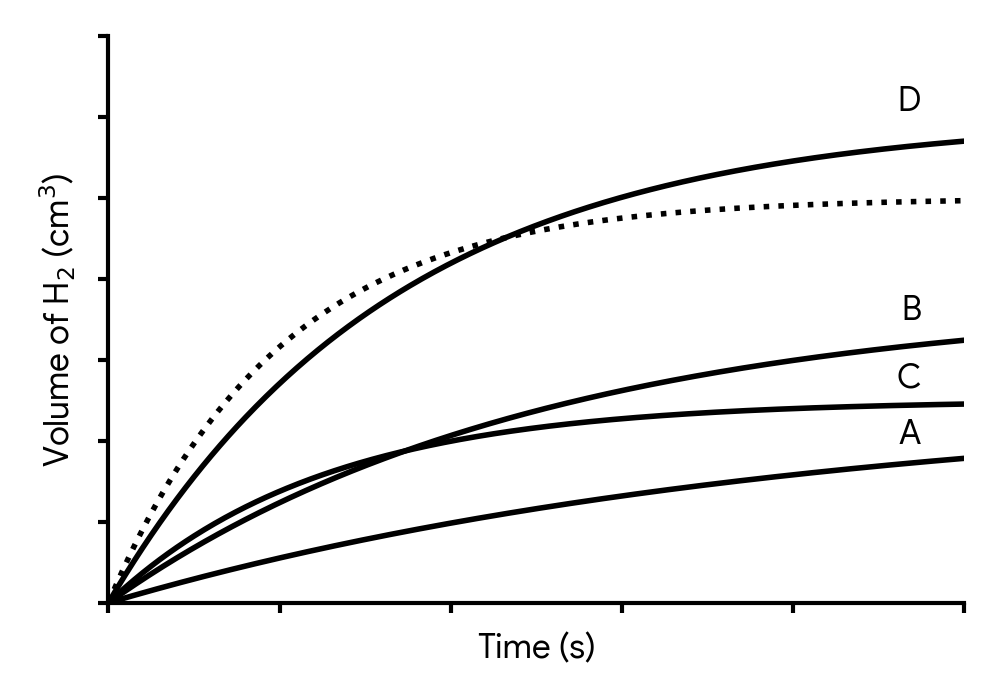
Which curve (A, B, C, or D) represents the production of hydrogen gas when excess solid zinc is added to of hydrochloric acid?
A. Curve A
B. Curve B
C. Curve C
D. Curve D
Consider how changing the concentration and volume of the limiting reactant affects both the total amount of product formed and the initial rate of reaction. The reaction is .
Question 8
MediumPaper 1A · calculator1 markWhich process has the smallest activation energy?
A.
B.
C.
D.
Consider what activation energy represents. Processes that involve breaking stable bonds or removing electrons require a significant energy input to overcome existing forces. Conversely, what can be said about the energy barrier for two highly reactive species, like free radicals, combining to form a stable molecule?
Question 9
MediumPaper 1A · calculator1 markThe gas-phase reaction between nitrogen monoxide and oxygen is believed to occur via the following two-step mechanism.
fast
slow
Deduce the rate equation for the overall reaction.
A. Rate =
B. Rate =
C. Rate =
D. Rate =
The rate of the overall reaction is determined by the slowest step (the rate-determining step). The rate equation should only include reactants, not reaction intermediates. Use the fast equilibrium step to express the concentration of the intermediate in terms of the reactants.
Question 10
MediumPaper 1A · calculator1 markA substance is added to a reversible reaction which is observed to increase the rate at which equilibrium is attained. Which statement correctly describes the function of this substance?
A. It increases the average kinetic energy of the reactant particles.
B. It increases the value of the equilibrium constant, .
C. It provides an alternative reaction pathway with a lower activation energy.
D. It is permanently consumed during the reaction.
Consider the definitions of a catalyst and how it affects both reaction kinetics and chemical equilibrium. Does a catalyst change the energy of the particles, the overall energy change of the reaction, or the path the reaction takes?
Question 11
MediumPaper 1A · calculator1 markThe hydrolysis of 2-chloro-2-methylpropane, , proceeds via a two-step mechanism. The energy profile for this reaction is shown below.
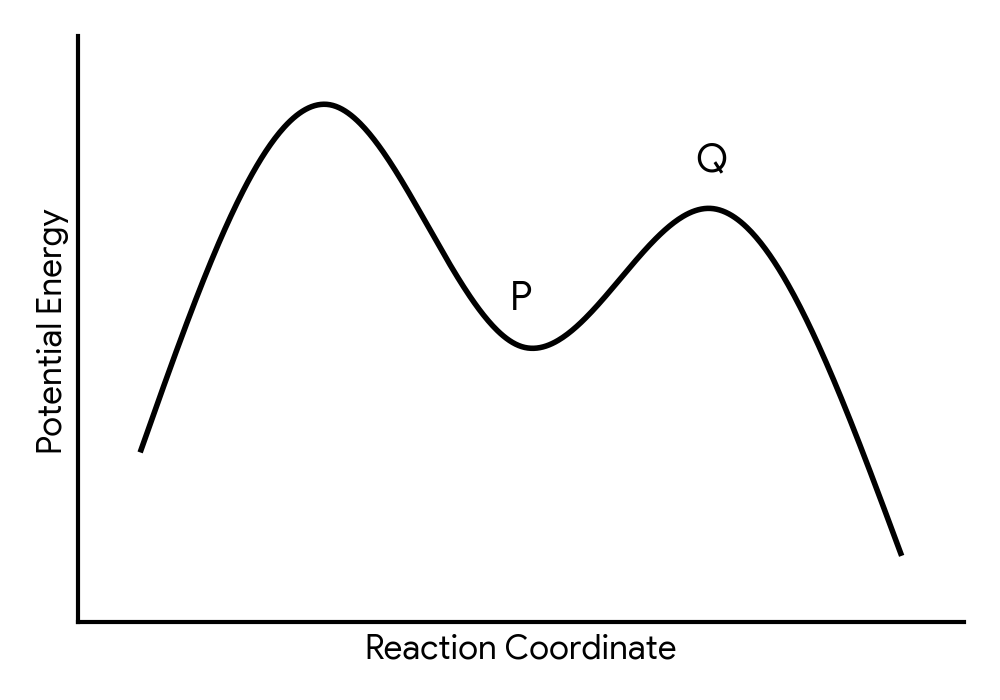
Which statement correctly identifies the species at points P and Q?
A. P is an intermediate and Q is a transition state.
B. P is a transition state and Q is an intermediate.
C. P and Q are both transition states.
D. P and Q are both intermediates.
Recall the definitions of a transition state and a reaction intermediate. A transition state is a species at the maximum of an energy barrier, while an intermediate is a species that exists in a potential energy minimum between two transition states.
Question 12
MediumPaper 1A · calculator1 markWhich elementary reaction would be expected to have the largest value for the Arrhenius pre-exponential factor, A?
A.
B.
C.
D.
The Arrhenius pre-exponential factor, A, is related to the frequency of collisions and the steric (orientation) factor. Consider which pair of reacting particles has the least specific orientation requirement for a successful collision.
Question 13
MediumPaper 1A · calculator1 markThe decomposition of a novel atmospheric pollutant, , by reaction with an atmospheric radical, , was studied at a constant temperature. The following initial rate data were collected:
What is the overall order of the reaction?
A. 1
B. 2
C. 3
D. 4
Compare experiments where the concentration of one reactant is kept constant while the other is varied to determine the order with respect to each reactant. The overall order is the sum of the individual orders.
No question on this page matches those filters. Try another difficulty or paper.
Every How fast? the rate of chemical change question, marked for you
Every answer is marked mark by mark, IB-style, and the AI tutor helps when you are stuck.
Where marks are lost
- Reaching for "human error" or "only one trial." A source of error has to be a specific step in the method, not a general apology for the result.
- Joining the dots instead of drawing a curve.
- Naming a chemical instead of the property that distinguishes it, or vice versa. Answering with the nearest fact that comes to mind rather than the fact the command term and stem jointly ask for is a recurring way to answer a question that was not, quite, the one asked.