How much? the amount of chemical change: notes and practice questions
- This topic has no additional higher level content beyond the standard level material.
- All content for Reactivity 2.1, including chemical equations, mole ratios, limiting reactants, theoretical, experimental, and percentage yields, is covered by both Standard Level and Higher Level students.
- Calculations of atom economy are also part of the common curriculum for both levels.
- The focus remains on quantifying chemical change and understanding reaction efficiency.
How it is examined
The most reliably examined subtopic in the course, in every paper. Titration calculations, limiting reactant chains and percentage yield are all standard. May 2025 HL Paper 2 TZ1 4(a) ran a three-part chain: write the equation with all state symbols [2], marked as one mark for correct products with state symbols and one for correct balancing; deduce the limiting reactant [2]; then calculate the gas volume [1]. Because state symbols were explicitly asked for in the stem, the general "ignore state symbols" rule did not apply. Percentage yield questions that give a mass and ask for the yield are 2 to 3 marks with error carried forward.
Relative atomic masses to two decimal places, and the atom economy equation. The percentage yield definition is recall, as is which reactant is limiting given moles and a ratio.
- 2.1.1 Chemical equations show the ratio of reactants and products in a reaction. Students deduce chemical equations when reactants and products are specified.
- 2.1.2 The mole ratio of an equation can be used to determine the masses and/or volumes of reactants and products, and the concentrations of reactants and products for reactions occurring in solution. Students calculate reacting masses, volumes and concentrations.
- 2.1.3 The limiting reactant determines the theoretical yield. Students identify the limiting and excess reactants from given data.
- 2.1.4 The percentage yield is calculated from the ratio of experimental yield to theoretical yield. Students solve problems involving reacting quantities, limiting and excess reactants, and theoretical, experimental and percentage yields.
Guiding questions
- How are chemical equations used to calculate reacting ratios?
Linking questions
- Reactivity 3.2 When is it useful to use half-equations?
- Structure 1.5 How does the molar volume of a gas vary with changes in temperature and pressure?
- Nature of science, Structure 1.4 In what ways does Avogadro's law help us to describe, but not explain, the behaviour of gases?
- Tool 1, Inquiry 1, 2, 3 What errors may cause the experimental yield to be i) higher and ii) lower than the theoretical yield?
- Structure 2.4, Reactivity 2.2 The atom economy and the percentage yield both give important information about the efficiency of a chemical process. What other factors should be considered in this assessment?
Practice questions
7 questions · 7 mediumQuestion 1
MediumPaper 1A · calculator1 markIn an industrial process for ammonia synthesis, of nitrogen gas was mixed with of hydrogen gas in a reaction vessel. The reaction proceeded to completion according to the following equation:
What is the volume of unreacted hydrogen gas remaining at the original conditions of temperature and pressure?
A.
B.
C.
D.
Use Gay-Lussac's Law of Combining Volumes, which states that volumes of gases react in simple whole number ratios under constant temperature and pressure. First, identify the limiting reactant by comparing the available volumes with the stoichiometric ratio.
Question 2
MediumPaper 1A · calculator1 markA student is investigating the reaction between aluminum metal and hydrochloric acid.
What are the limiting reactant and theoretical yield of hydrogen when of aluminum reacts with of hydrochloric acid?
A. Al,
B. Al,
C. HCl,
D. HCl,
First, calculate the moles of hydrogen that could be produced from each reactant, assuming it is the limiting reactant. The reactant that produces the least amount of product is the limiting reactant, and that minimum amount is the theoretical yield.
Question 3
MediumPaper 1A · calculator1 markA sample of butane, , with a volume of is collected at and . How many moles of oxygen are needed for the complete combustion of this sample of butane?
A.
B.
C.
D.
First, write a balanced chemical equation for the complete combustion of butane. Then, use the ideal gas law () to find the moles of butane. Finally, use the stoichiometric ratio from the balanced equation to determine the moles of oxygen. Remember to convert units appropriately for the ideal gas law ( in Pa, in m, in K, ).
Question 4
MediumPaper 1A · calculator1 markIn an industrial synthesis, equal volumes of nitrogen gas () and hydrogen gas () are mixed in a sealed reactor at constant temperature and pressure to produce ammonia gas ().
After the reaction reaches completion, the volume of ammonia gas produced is measured to be .
What was the initial volume, in , of nitrogen gas at the beginning of the reaction?
A.
B.
C.
D.
Consider the stoichiometry of the reaction and identify the limiting reactant when equal volumes of nitrogen and hydrogen are mixed.
Question 5
MediumPaper 1A · calculator1 markThe dotted line in the graph below represents the volume of hydrogen gas evolved when excess solid zinc is added to of hydrochloric acid.
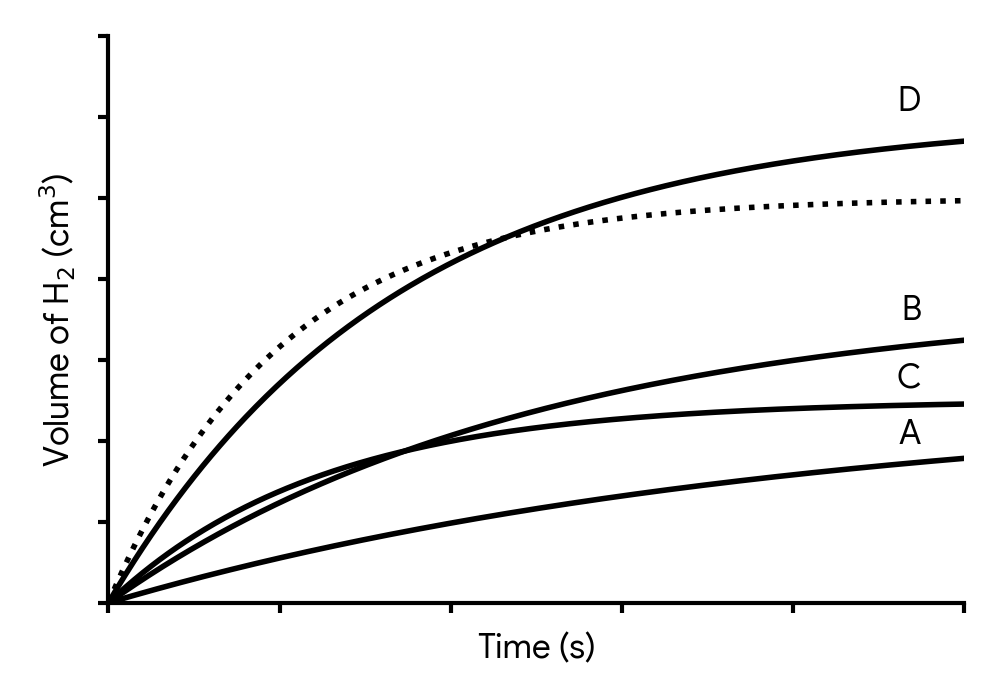
Which curve (A, B, C, or D) represents the production of hydrogen gas when excess solid zinc is added to of hydrochloric acid?
A. Curve A
B. Curve B
C. Curve C
D. Curve D
Consider how changing the concentration and volume of the limiting reactant affects both the total amount of product formed and the initial rate of reaction. The reaction is .
Question 6
MediumPaper 1A · calculator1 markA sample of a gaseous hydrocarbon, , a component of liquefied petroleum gas (LPG), undergoes complete combustion. of the hydrocarbon reacts completely to produce of gaseous products. This volume reduces to when the water vapour present condenses. All volumes are measured at the same temperature and pressure.
What is the molecular formula of the hydrocarbon?
A.
B.
C.
D.
Recall Gay-Lussac's Law of Combining Volumes. The volume of gaseous products after condensation corresponds to the carbon dioxide produced. The difference in volume before and after condensation corresponds to the water vapour produced.
Question 7
MediumPaper 1A · calculator1 markA student performs a redox titration to determine the concentration of iron(II) ions in a sample. The iron(II) ions are oxidized to iron(III) ions by dichromate(VI) ions, which are themselves reduced to chromium(III) ions.
reduced to
oxidized to
What volume, in , of is required to reach the equivalence point in the titration of of ?
A. 12.5
B. 25.0
C. 50.0
D. 150.0
First, write and balance the half-equations for the oxidation of and the reduction of in acidic solution. Then combine them to find the overall stoichiometric ratio between and . Finally, use this ratio with the given concentrations and volume to calculate the unknown volume.
No question on this page matches those filters. Try another difficulty or paper.
Every How much? the amount of chemical change question, marked for you
Every answer is marked mark by mark, IB-style, and the AI tutor helps when you are stuck.
Where marks are lost
- Reaching for "human error" or "only one trial." A source of error has to be a specific step in the method, not a general apology for the result.
- Joining the dots instead of drawing a curve.
- Naming a chemical instead of the property that distinguishes it, or vice versa. Answering with the nearest fact that comes to mind rather than the fact the command term and stem jointly ask for is a recurring way to answer a question that was not, quite, the one asked.