Functional groups: Classification of organic compounds: notes and practice questions
- This topic extends the understanding of organic functional groups to include stereoisomerism and advanced spectroscopic analysis.
- Understand the formation of dipeptides from amino acids.
- Deduce the number of isomers for compounds like dibromobenzene to support structural models.
- Describe and explain cis-trans isomerism in non-cyclic alkenes and C3/C4 cycloalkanes.
- Draw stereochemical formulas for chiral carbons and explain optical properties, enantiomers, and racemic mixtures.
- Interpret NMR spectra, including splitting patterns (singlets, doublets, triplets, quartets) for structural elucidation.
How it is examined
The densest single-mark region of Paper 2. May 2025 HL Paper 2 TZ1 ran a chain on an unknown X: state the functional group name [1], deduce the systematic IUPAC name [1], interpret its ¹H NMR spectrum [2], draw an isomer belonging to a different homologous series [1]. Separately it asked for the structural formula of cis-1-chlorobut-2-ene [1] and why the cis isomer is polar [1], and for a drawing showing optical isomerism with the chiral carbon marked with an asterisk [2]. Structure elucidation from combined spectra is the classic HL extended part at 3 to 6 marks.
Characteristic IR absorption ranges, ¹H NMR chemical shift ranges, and common MS fragment losses. That means a question asking a student to recall that a carbonyl absorbs near 1700 cm⁻¹, or that an aldehyde proton sits near 9-10 ppm, is testing nothing. What is recall: functional group names and structures, homologous series general formulas, IUPAC rules, and how to count chemical environments.
- 3.2.1 Organic compounds can be represented by different types of formulas: empirical, molecular, structural (full and condensed), stereochemical and skeletal. Students identify different formulas and interconvert molecular, skeletal and structural formulas, and construct 3D models (real or virtual).
- 3.2.2 Functional groups give characteristic physical and chemical properties to a compound. Organic compounds are divided into classes according to the functional groups present. Students identify these functional groups by name and structure: halogeno, hydroxy, carbonyl, carboxyl, alkoxy, amino, amido, ester, phenyl.
- 3.2.3 A homologous series is a family of compounds in which successive members differ by a common structural unit, typically CH₂, and each series can be described by a general formula. Students identify these homologous series: alkanes, alkenes, alkynes, halogenoalkanes, alcohols, aldehydes, ketones, carboxylic acids, ethers, amines, amides and esters.
- 3.2.4 Successive members of a homologous series show a trend in physical properties. Students describe and explain the trend in melting and boiling points.
- Stereochemical formulas are not expected to be drawn, except where specifically indicated.
- HL: nomenclature using the E-Z system will not be assessed. Use cis-trans.
Guiding questions
- How does the classification of organic molecules help us to predict their properties?
Linking questions
- Structure 2.2 What is unique about carbon that enables it to form more compounds than the sum of all the other elements' compounds? What is the influence of the carbon chain length, branching and the nature of the functional groups on intermolecular forces? What features of a molecule determine whether it is IR active or not?
- Nature of science, Structure 2.2 What are the advantages and disadvantages of different depictions of an organic compound?
- Nature of science, Tool 2 How useful are 3D models (real or virtual) to visualize the invisible?
- Nature of science, Reactivity 3.2, 3.4 How can functional group reactivity be used to determine a reaction pathway between compounds, for example converting ethene into ethanoic acid?
- Structure 2.2 (HL) How does the fact that there are only 3 isomers of dibromobenzene support the current model of benzene's structure?
- Structure 2.4 (HL) What is the nature of the reaction that occurs when two amino acids form a dipeptide?
- Reactivity 1.3 What properties of a greenhouse gas determine its "global warming potential"?
Practice questions
12 questions · 2 easy · 9 medium · 1 hardQuestion 1
EasyPaper 1A · calculator1 markWhich compound can be oxidized to produce pentan-2-one?
A. Pentan-1-ol
B. Pentan-2-ol
C. Pentanal
D. 2-methylbutan-2-ol
Consider the products formed from the oxidation of primary, secondary, and tertiary alcohols. Which class of alcohol produces a ketone upon oxidation?
Question 2
MediumPaper 2 · calculator1 markPentene, , has two straight-chain isomers. How many of these isomers produce an optically active alcohol upon hydration with steam and an acid catalyst?
A. 0
B. 1
C. 2
D. It depends on the E/Z configuration of the starting isomer.
First, draw the structures of the two straight-chain isomers of pentene. Then, for each isomer, predict the product(s) of hydration (addition of ). Remember Markovnikov's rule. Finally, examine the structure of each alcohol product to see if it contains a chiral centre.
Question 3
HardPaper 2 · calculator1 markWhich stereoisomer of butan-2,3-diol is achiral?
A. (2R,3R) -butan-2,3-diol
B. (2S,3S) -butan-2,3-diol
C. (2R,3S) -butan-2,3-diol
D. A 1:1 mixture of (2R,3R) -butan-2,3-diol and (2S,3S) -butan-2,3-diol
An achiral molecule is superimposable on its mirror image. Consider molecules with multiple chiral centres that may have an internal plane of symmetry. These are known as meso compounds.
Question 4
EasyPaper 1A · calculator1 markWhich molecule is chiral?
A.
B.
C.
D.
A chiral molecule contains at least one carbon atom that is bonded to four different atoms or groups of atoms. This carbon is known as a chiral centre or stereocentre.
Question 5
MediumPaper 2 · calculator1 markWhich compound can exist as a pair of enantiomers?
A. 3-methylhexane
B. 2,2-dimethylpentane
C. Hexan-3-one
D. Cyclohexanol
Enantiomers are non-superimposable mirror images. A molecule that has an enantiomer must be chiral. Identify the molecule that contains a chiral centre, which is a carbon atom bonded to four different atoms or groups.
Question 6
MediumPaper 2 · calculator1 markWhich spectroscopic technique(s) can be used to distinguish between the isomers propanal, , and propanone, ?
I. Infrared (IR) spectroscopy
II. H NMR spectroscopy
III. Mass spectrometry
A. I only
B. I and II only
C. II and III only
D. I, II and III
For each technique, identify a key difference in the expected spectrum for an aldehyde compared to a ketone. For IR, look for unique absorptions. For NMR, consider the number of proton environments and their splitting patterns. For mass spectrometry, think about how the molecules might break apart differently.
Question 7
MediumPaper 1A · calculator1 markA student prepares an alcohol with the molecular formula . The product is expected to be either butan-1-ol or butan-2-ol. Which technique would most clearly distinguish between these two isomers?
A. Infrared (IR) spectroscopy
B. Mass spectrometry (MS)
C. ¹H NMR spectroscopy
D. Ultraviolet-visible (UV-Vis) spectroscopy
Consider what information each spectroscopic technique provides. Which technique is most sensitive to the arrangement of hydrogen atoms in a molecule?
Question 8
MediumPaper 1A · calculator1 markWhich molecule has this low-resolution H NMR spectrum?
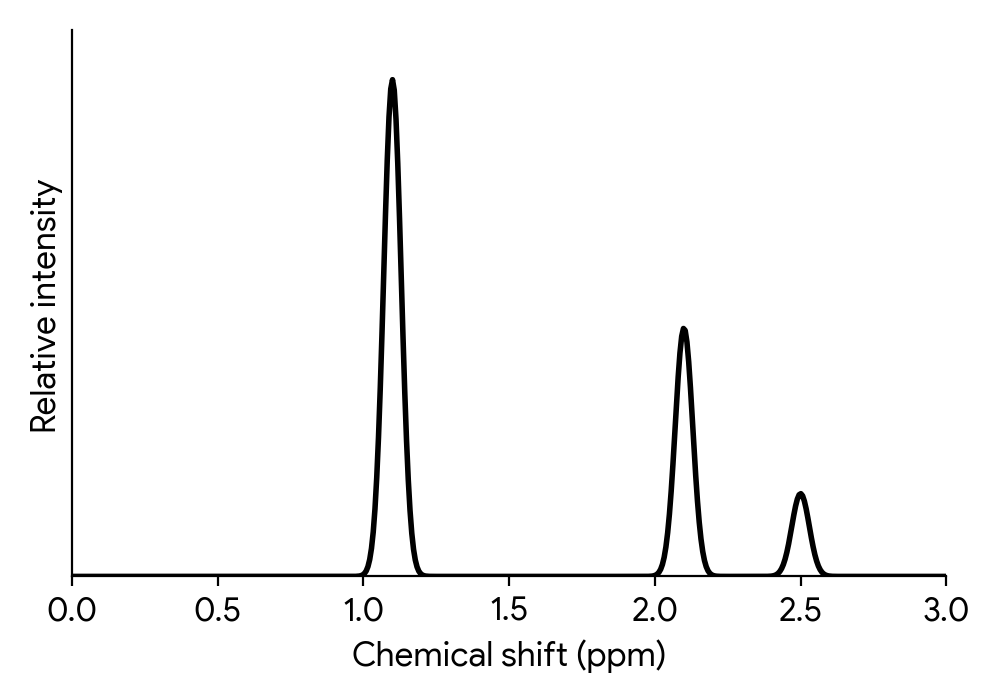
A. 3-Methylbutan-2-one
B. Ethyl ethanoate
C. Methyl propanoate
D. Butanone
Draw the structure of each molecule. Identify the different proton environments and determine the ratio of the number of protons in these environments. Match this ratio to the one given by the spectrum.
Question 9
MediumPaper 1A · calculator1 markWhat is the identity of the ester with the molecular formula , which has four peaks in its NMR spectrum with an integration ratio of ?
A. Methyl propanoate
B. Ethyl ethanoate
C. Propyl methanoate
D. Isopropyl methanoate
Consider the structure of each ester isomer. The number of peaks in a NMR spectrum corresponds to the number of different proton environments, and the integration ratio corresponds to the relative number of protons in each environment.
Question 10
MediumPaper 1A · calculator1 markWhich pair of compounds represents the correct type of isomerism?
| Isomerism Type | Compound Pair |
|---|---|
| Chain | Butan-1-ol and Butan-2-ol |
| Positional | Pentane and 2-methylbutane |
| Functional group | Propanal and Propanone |
| Cis-trans | 1,1-dichloroethene and 1,2-dichloroethene |
A. Chain: Butan-1-ol and Butan-2-ol
B. Positional: Pentane and 2-methylbutane
C. Functional group: Propanal and Propanone
D. Cis-trans: 1,1-dichloroethene and 1,2-dichloroethene
Recall the specific definitions for each type of isomerism. Chain isomers have different carbon backbones. Positional isomers have the same backbone but a functional group in a different position. Functional group isomers have the same molecular formula but different functional groups. Cis-trans isomers are stereoisomers that differ in the spatial arrangement of groups around a double bond or ring.
Question 11
MediumPaper 1A · calculator1 markWhich compounds can exhibit stereoisomerism?
I. 2-methylbutan-2-ol
II. 2-chlorobutane
III. pent-2-ene
A. I and II only
B. I and III only
C. II and III only
D. I, II and III
Consider the two main types of stereoisomerism: optical isomerism (related to chiral centres) and geometric (E/Z) isomerism (related to restricted rotation, usually around a C=C double bond). Check each molecule for the necessary structural features for each type.
Question 12
MediumPaper 1A · calculator1 markWhich is the mass spectrum of pentan-3-one?
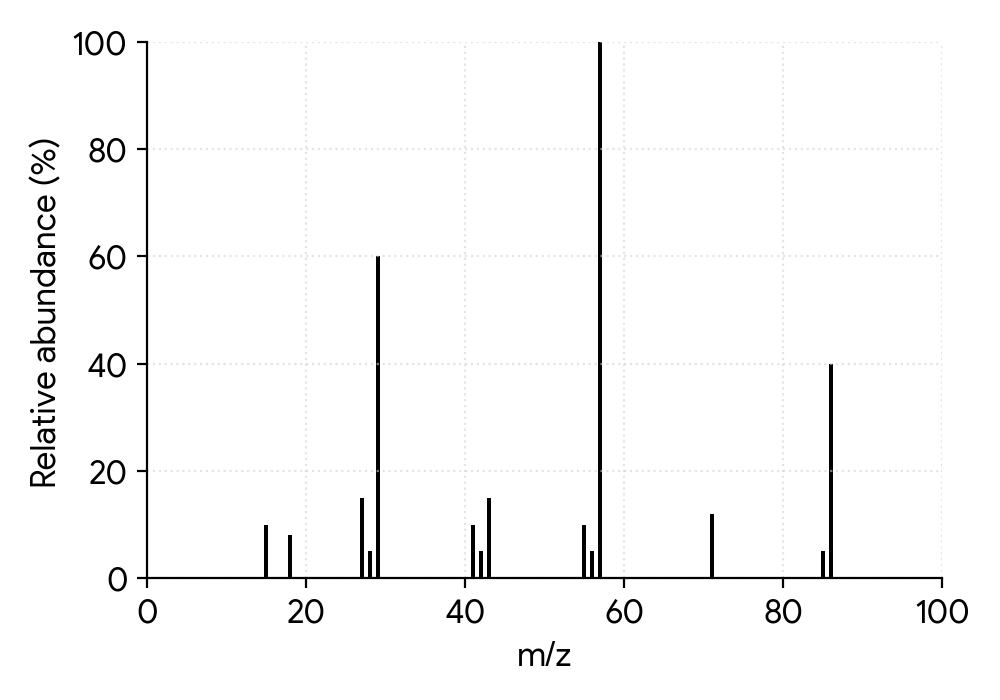
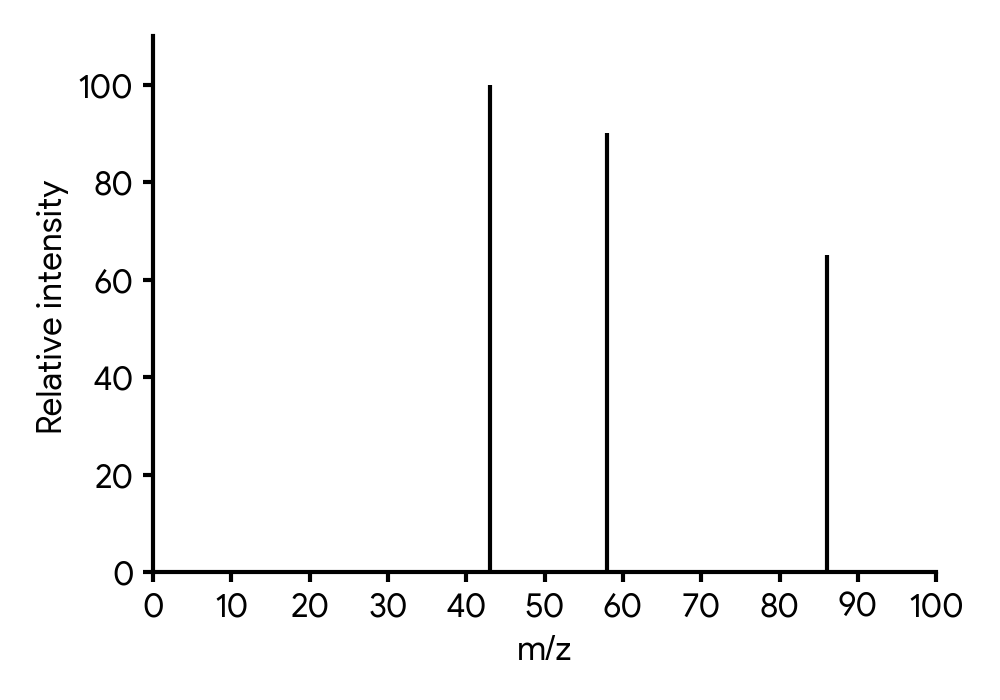
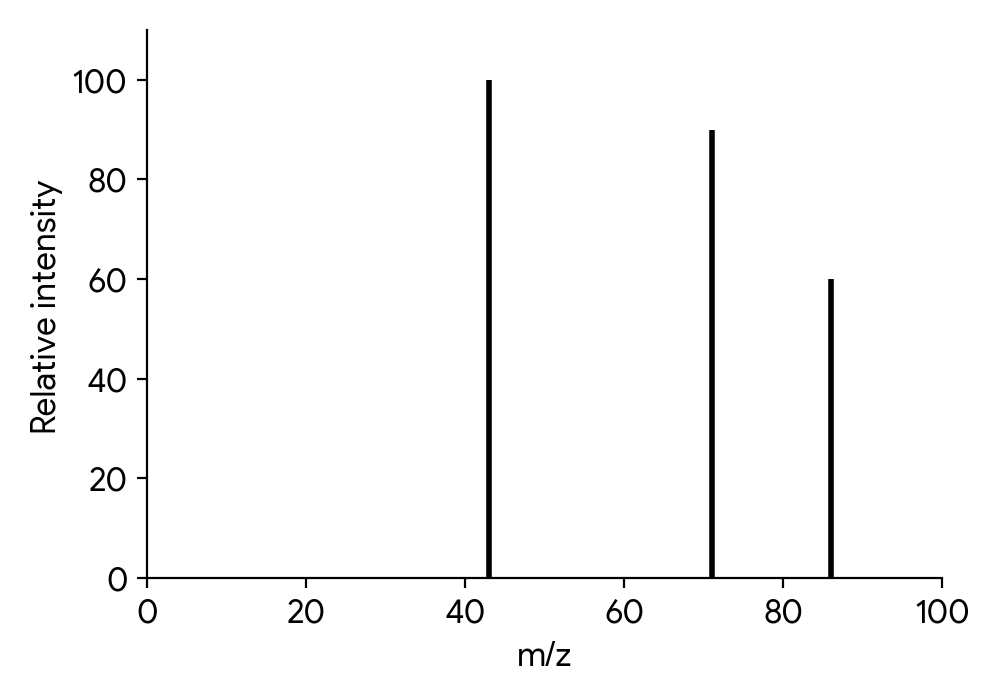
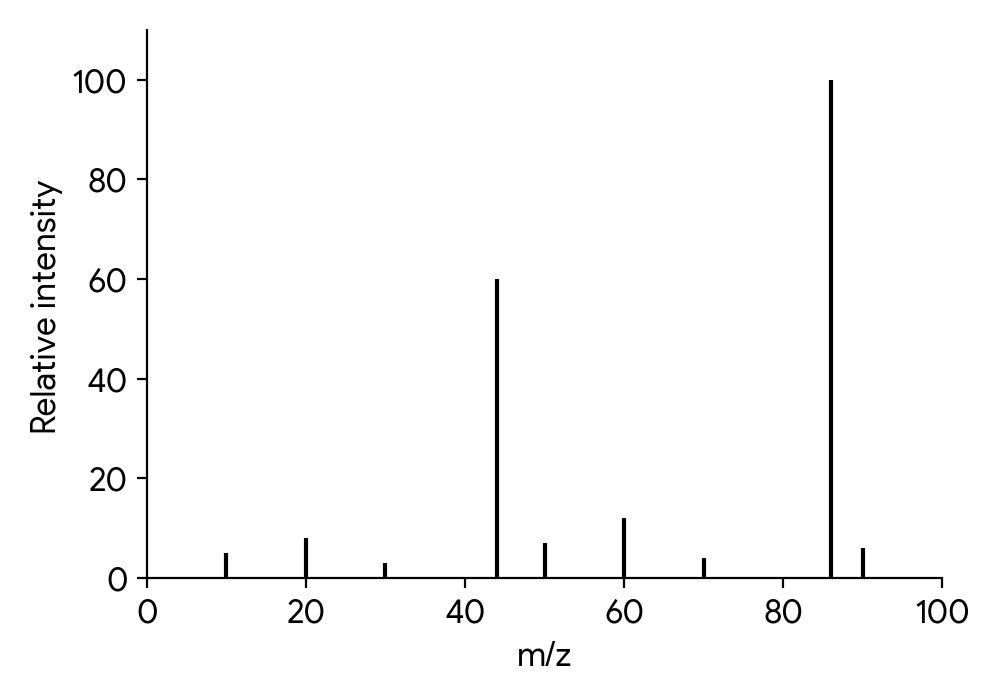
Identify the structure of pentan-3-one and calculate its molar mass to find the molecular ion peak. Then, consider the most likely fragmentation pathway for a ketone, which is alpha-cleavage on either side of the carbonyl group. Calculate the m/z values for the resulting cationic fragments.
No question on this page matches those filters. Try another difficulty or paper.
Every Functional groups: Classification of organic compounds question, marked for you
Every answer is marked mark by mark, IB-style, and the AI tutor helps when you are stuck.
Where marks are lost
- Reaching for "human error" or "only one trial." A source of error has to be a specific step in the method, not a general apology for the result.
- Joining the dots instead of drawing a curve.
- Naming a chemical instead of the property that distinguishes it, or vice versa. Answering with the nearest fact that comes to mind rather than the fact the command term and stem jointly ask for is a recurring way to answer a question that was not, quite, the one asked.