Proton transfer reactions: notes and practice questions
- This topic extends proton transfer reactions to include the pOH scale and quantitative analysis of weak acids and bases.
- The pOH scale is defined by .
- Students should interconvert between [H⁺], [OH⁻], pH, and pOH values.
- Weak acid and base strengths are quantified by , , p, and p values.
- For a conjugate acid-base pair, the relationship applies.
How it is examined
Heavily examined at both levels. pH calculations are 1 to 2 marks and the log direction is the common error. The strong versus weak distinction is a recurring 1-mark part: May 2025 HL Paper 2 TZ1 4(b)(ii) accepted "ethanoic acid weak / HCl strong" or "ethanoic acid partially ionizes / HCl fully ionizes", with "lower [H⁺]" also accepted. pH curve sketches are [3] and want the starting pH, the shape through the buffer region, and a vertical section at the correct equivalence volume and pH. Buffer questions come as a pair: describe how to make the most effective buffer [2], then explain what happens when acid or base is added [2], and the explanation marks need equations or named species, not "it neutralizes it".
The pH and pOH equations, Kw and its value at 298 K, pKa and pKb values for common weak acids and bases, and indicator pH ranges with their colours. The list of strong acids and bases is recall. Which indicator suits which titration is a deduction from the booklet's range table, not a memory item.
- 3.1.1 A Brønsted-Lowry acid is a proton donor and a Brønsted-Lowry base is a proton acceptor. Students deduce the Brønsted-Lowry acid and base in a reaction.
- 3.1.2 A pair of species differing by a single proton is called a conjugate acid-base pair. Students deduce the formula of the conjugate acid or base of any Brønsted-Lowry base or acid.
- 3.1.3 Some species can act as both Brønsted-Lowry acids and bases. Students interpret and formulate equations to show acid-base reactions of these species.
- 3.1.4 The pH scale can be used to describe the [H⁺] of a solution: `pH = −log₁₀[H⁺]`; `[H⁺] = 10^(−pH)`. Students perform calculations involving the logarithmic relationship between pH and [H⁺].
- HL: the use of quadratic equations is not expected in calculations.
- HL: salt hydrolysis examples should include NH₄⁺, RCOO⁻, CO₃²⁻ and HCO₃⁻. The acidity of hydrated transition element ions and Al³⁺(aq) is not required.
Guiding questions
- What happens when protons are transferred?
Linking questions
- Nature of science, Reactivity 3.4 Why has the definition of acid evolved over time?
- Structure 2.1 What are the conjugate acids of the polyatomic anions listed in Structure 2.1?
- Structure 3.1 What is the periodic trend in the acid-base properties of metal and non-metal oxides? Why does the release of oxides of nitrogen and sulfur into the atmosphere cause acid rain?
- Reactivity 2.3 How would you expect the equilibrium constants of strong and weak acids to compare? Why does the extent of ionization of water increase as temperature increases? (HL) Why must buffer solutions be composed of weak acid or base conjugate systems? How does Le Châtelier's principle enable us to interpret the behaviour of indicators and buffer solutions?
- Reactivity 1.1 Why does the acid strength of the hydrogen halides increase down group 17? Neutralization reactions are exothermic. How can this be explained in terms of bond enthalpies?
- Tools 1, 2, 3 What is the shape of a sketch graph of pH against [H⁺]? When are digital sensors more suitable than analogue methods? (HL) When collecting data to generate a pH curve, when should smaller volumes of titrant be added between each measurement?
- Structure 1.3, Reactivity 3.1 Why are log scales useful when discussing [H⁺] and ionization energies?
Practice questions
19 questions · 19 mediumQuestion 1
MediumPaper 2 · calculator1 markThe acid dissociation constants, , for four weak acids at 298 K are given below.
Ethanoic acid, :
Phenol, :
Carbonic acid, :
Ammonium ion, :
Which acid has the strongest conjugate base?
A. Ethanoic acid
B. Phenol
C. Carbonic acid
D. Ammonium ion
Recall the relationship between the strength of an acid and its conjugate base. A weaker acid will have a stronger conjugate base. How does the value of relate to acid strength?
Question 2
MediumPaper 2 · calculator1 markThe indicator phenolphthalein has a pH range of to . Which titrations would this indicator be suitable for?
I. A weak acid with a strong base
II. A strong acid with a weak base
III. A strong acid with a strong base
A. I only
B. III only
C. I and III only
D. I, II and III
Consider the pH at the equivalence point for each type of titration. A suitable indicator must change colour within the steep vertical portion of the titration curve, which includes the equivalence point.
Question 3
MediumPaper 2 · calculator1 markPropanoic acid () is a weak acid used in various industrial applications. What is the pH for a solution of propanoic acid if its acid dissociation constant, , is ?
A
B
C
D
For a weak acid, consider the equilibrium dissociation and use the acid dissociation constant () expression. An approximation can often be made if the acid is sufficiently weak.
Question 4
MediumPaper 2 · calculator1 markWhich of the following aqueous solutions will have a pH below 7 at 298 K?
A. Sodium cyanide
B. Lithium sulfate
C. Aluminium chloride
D. Potassium carbonate
Consider the nature of the acid and base from which each salt is formed. A salt formed from a strong acid and a weak base will hydrolyze to produce an acidic solution.
Question 5
MediumPaper 2 · calculator1 markA chemist prepares a buffer solution by mixing equal molar amounts of a weak acid, propanoic acid (), and its conjugate base, sodium propanoate (). The resulting solution has a pH of at . What is the value for propanoic acid at this temperature?
A
B
C
D
Recall the relationship between pH and pKa for a buffer solution when the concentrations of the weak acid and its conjugate base are equal. The Henderson-Hasselbalch equation is useful here.
Question 6
MediumPaper 2 · calculator1 markWhich graph correctly represents the change in pH when hydrochloric acid is added from a burette to of aqueous ammonia in a flask?
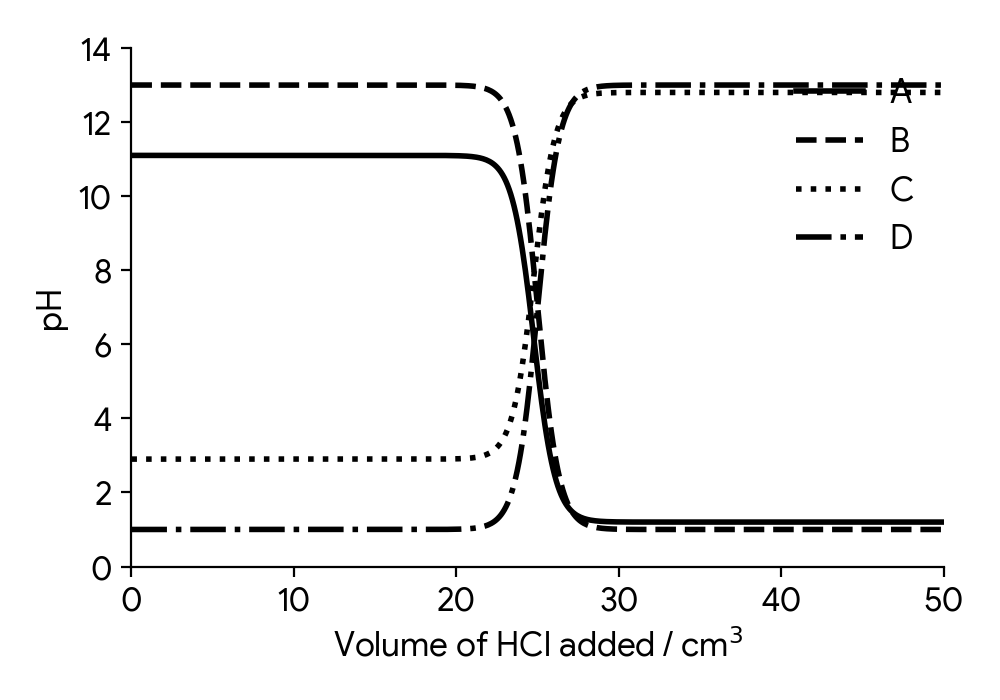
A.
B.
C.
D.
Consider the initial pH of the solution in the flask (aqueous ammonia, a weak base) and the pH at the equivalence point when a weak base is neutralized by a strong acid.
Question 7
MediumPaper 2 · calculator1 markUnder physiological conditions, the ion product constant of water () is approximately at . What is the pH of pure water at this temperature?
A
B
C
D
Recall the relationship between the ion product constant of water (), the hydrogen ion concentration (), and the pH for pure water.
Question 8
MediumPaper 2 · calculator1 markA chemist mixes of sodium hydroxide solution with of hydrochloric acid solution.
What is the pH of the resulting solution?
A
B
C
D
First, calculate the moles of acid and base. Then, determine which reactant is in excess and by how much. Finally, calculate the concentration of the excess species in the total volume and use it to find the pH.
Question 9
MediumPaper 2 · calculator1 markA student is preparing buffer solutions in the laboratory. Which of the following mixtures will result in the formation of a buffer solution?
I. of carbonic acid () and of potassium hydroxide ()
II. of methylamine () and of hydrobromic acid ()
III. of sodium carbonate () and of hydrochloric acid ()
A. I only
B. II only
C. I and II only
D. II and III only
To determine if a mixture forms a buffer, you need to check if it contains a weak acid and its conjugate base, or a weak base and its conjugate acid, in significant amounts. For each option, write the neutralization reaction and calculate the moles of all species after the reaction is complete.
Question 10
MediumPaper 1A · calculator1 markWhich aqueous solution has a pH greater than 7?
A.
B.
C.
D.
Consider the parent acid and base for each salt. The salt of a weak acid and a strong base will hydrolyze to form a basic solution.
Question 11
MediumPaper 1A · calculator1 markWhat is the best indicator to use in the titration of aqueous ethanoic acid with aqueous sodium hydroxide?
A. Methyl orange,
B. Bromocresol green,
C. Bromothymol blue,
D. Phenolphthalein,
Consider the nature of the acid and base being titrated. The salt formed at the equivalence point will hydrolyse water. Will the resulting solution be acidic, basic, or neutral? The best indicator has a value close to the pH at the equivalence point.
Question 12
MediumPaper 1A · calculator1 markA chemist is preparing various aqueous solutions for an experiment. Which of the following solutions would have a pH of approximately at ?
(Assume at and for )
A.
B.
C.
D.
Recall the definitions of strong and weak bases. For strong bases, the concentration of hydroxide ions is equal to the concentration of the base. For weak bases, you need to use the expression and consider partial dissociation. Remember the relationship between pH and pOH.
Question 13
MediumPaper 1A · calculator1 markWhat is the pH of a buffer solution prepared by mixing propanoic acid () and sodium propanoate ()?
The for propanoic acid is .
A.
B.
C.
D.
Use the Henderson-Hasselbalch equation: . Remember to correctly identify the conjugate base concentration () and the weak acid concentration ().
Question 14
MediumPaper 1A · calculator1 markWhich of these bases has the strongest conjugate acid?
Given the following values at :
A. Aniline ():
B. Hydrazine ():
C. Pyridine ():
D. Hydroxylamine ():
Recall the relationship between the strength of a base and the strength of its conjugate acid. A stronger conjugate acid corresponds to a weaker base. The strength of a base is inversely related to its value.
Question 15
MediumPaper 1A · calculator1 markWhich aqueous solution has the highest pH?
A.
B.
C.
D.
Identify the parent acid and base for each salt to determine if the resulting solution is acidic, basic, or neutral. A higher pH corresponds to a more basic solution. If multiple salts form basic solutions, compare the strengths of the conjugate bases.
Question 16
MediumPaper 1A · calculator1 markA household cleaner is found to have a of at . What is the concentration of , in , in this solution?
A.
B.
C.
D.
Recall the relationship between , , and the ion product of water, , at . Use to find , then calculate .
Question 17
MediumPaper 1A · calculator1 markWhich aqueous solution has the highest pH?
A.
B.
C.
D.
Consider which substances are acids and which are bases. Then, differentiate between strong and weak species. For strong bases, pay attention to the number of hydroxide ions produced per formula unit and the concentration.
Question 18
MediumPaper 1A · calculator1 markThe indicator bromocresol green is a weak acid, HIn, with a of 4.7. Its equilibrium in aqueous solution is shown below.
yellow blue
Which statements are correct?
I. In a solution with , the indicator will appear yellow.
II. The indicator is most effective for a titration with an equivalence point at .
III. In a solution of , the concentration of the blue form is greater than the concentration of the yellow form.
A. I and II only
B. I and III only
C. II and III only
D. I, II and III
Consider how the pH of the solution affects the position of the indicator equilibrium according to Le Chatelier's principle. Recall the relationship between the pKa of an indicator and the pH at which it changes colour. Use the Henderson-Hasselbalch equation to relate pH to the concentrations of the two coloured forms.
Question 19
MediumPaper 1A · calculator1 markWhich term cannot be used to describe the chemical behaviour of water, ?
A. Lewis acid
B. Ligand
C. Brønsted-Lowry base
D. Nucleophile
Consider the definitions of each term. A Lewis acid is an electron pair acceptor. A ligand donates an electron pair to a metal ion. A Brønsted-Lowry base is a proton acceptor. A nucleophile is an electron-rich species that attacks an electrophile. Does water have lone pairs of electrons to donate, or does it have empty orbitals to accept electron pairs?
No question on this page matches those filters. Try another difficulty or paper.
Every Proton transfer reactions question, marked for you
Every answer is marked mark by mark, IB-style, and the AI tutor helps when you are stuck.
Where marks are lost
- Reaching for "human error" or "only one trial." A source of error has to be a specific step in the method, not a general apology for the result.
- Joining the dots instead of drawing a curve.
- Naming a chemical instead of the property that distinguishes it, or vice versa. Answering with the nearest fact that comes to mind rather than the fact the command term and stem jointly ask for is a recurring way to answer a question that was not, quite, the one asked.