Counting particles by mass: the mole: notes and practice questions
- This topic covers the quantitative relationships between mass, moles, and particles, and how these are applied in chemical calculations.
- The mole (mol) is the SI unit for amount of substance, containing the Avogadro constant () elementary entities.
- Relative atomic mass () and relative formula mass () compare masses of atoms relative to .
- Molar mass () has units of ; use to interconvert mass, moles, and number of particles.
- Empirical formula shows the simplest atom ratio; molecular formula shows the actual number of atoms.
- Molar concentration () is amount of solute per volume of solution; use .
- Avogadro's law states equal volumes of gases at the same temperature and pressure contain equal numbers of molecules.
How it is examined
Everywhere. This is the highest-traffic subtopic in the course. May 2025 HL Paper 2 TZ1 4(a)(ii) asked for n(CaCO₃) and n(HCl) then which reactant was limiting, [2], with a Notes instruction not to award the second mark unless working or an answer was seen for the first. 4(a)(iii) then used the molar volume from the booklet for [1]. May 2025 HL Paper 1B TZ1 1(a) asked for the molar mass of Na₂S₂O₃ and then the mass needed for a given volume and concentration, [2], with [2] for a correct final answer. Chained mole calculations are where error carried forward matters most: a wrong Mr followed by correct method still earns the later marks.
The Avogadro constant NA. Relative atomic masses to two decimal places in the periodic table. The relationships n = m / M and n = CV. Molar volume of an ideal gas at STP. What is recall: how to build an empirical formula from percentage composition, and how to scale it to a molecular formula.
- 1.4.1 The mole (mol) is the SI unit of amount of substance. One mole contains exactly the number of elementary entities given by the Avogadro constant. Students convert the amount of substance n to the number of specified elementary entities.
- 1.4.2 Masses of atoms are compared on a scale relative to ¹²C and expressed as relative atomic mass Ar and relative formula mass Mr. Students determine Mr from Ar values.
- 1.4.3 Molar mass M has units g mol⁻¹. Students solve problems involving the relationships between number of particles, amount of substance in moles, and mass in grams, using n = m / M.
- 1.4.4 The empirical formula gives the simplest ratio of atoms of each element; the molecular formula gives the actual number of atoms of each element in a molecule. Students interconvert percentage composition by mass and empirical formula, and determine molecular formula from empirical formula and molar mass.
None for Structure 1.4.
Guiding questions
- How do we quantify matter on the atomic scale?
Linking questions
- Reactivity 2.1 How can molar masses be used with chemical equations to determine the masses of the products of a reaction?
- Tool 1 How can experimental data on mass changes in combustion reactions be used to derive empirical formulas? What are the considerations in the choice of glassware used in preparing a standard solution and a serial dilution?
- Tool 1, Inquiry 2 How can a calibration curve be used to determine the concentration of a solution?
- Nature of science, Tool 3, Structure 3.2 What is the importance of approximation in the determination of an empirical formula?
- Structure 1.5 Avogadro's law applies to ideal gases. Under what conditions might the behaviour of a real gas deviate most from an ideal gas?
Practice questions
56 questions · 19 easy · 33 medium · 4 hardQuestion 1
EasyPaper 2 · calculator9 marksA student investigates the reactions of dilute hydrochloric acid with four different substances: solid sodium carbonate (), solid copper(II) oxide (), magnesium ribbon (), and aqueous potassium hydroxide ().
(a) Write a balanced chemical equation, including state symbols, for the reaction of hydrochloric acid with solid sodium carbonate.
(b) Write a balanced chemical equation, including state symbols, for the reaction of hydrochloric acid with solid copper(II) oxide.
(c) Write a balanced chemical equation, including state symbols, for the reaction of hydrochloric acid with aqueous potassium hydroxide.
(d) (i) The reaction with magnesium ribbon is the only one of the four that does not produce water. Identify the gaseous product of this reaction.
(d) (ii) Write the balanced chemical equation, including state symbols, for the reaction between magnesium and hydrochloric acid.
(e) State the type of reaction that occurs between hydrochloric acid and potassium hydroxide.
Recall the general reaction for an acid with a metal carbonate. The products are a salt, water, and carbon dioxide. Make sure to balance the atoms on both sides and include the state symbols (s, l, g, aq).
An acid reacts with a metal oxide to form a salt and water. Identify the correct formulas for the products and balance the equation.
This is a neutralization reaction between a strong acid and a strong alkali. What are the products? Ensure the equation is balanced and has state symbols.
Recall the general reaction for a reactive metal with an acid.
The products are magnesium chloride and the gas you identified in (d)(i). Ensure the equation is balanced and has state symbols.
What is the general name for a reaction between an acid and an alkali?
Question 2
MediumPaper 2 · calculator6 marksA nitrogenous base, compound Y, extracted from a plant species, was found to have the following percentage composition by mass:
C = 60.94%
H = 15.37%
N = 23.69%
(a) Determine the empirical formula of compound Y.
(b) A solution was prepared by dissolving 1.18 g of Y in deionized water to make a 50.00 cm³ solution. A 25.00 cm³ aliquot of this solution was titrated with 0.500 mol dm⁻³ hydrochloric acid, HCl(aq). Complete neutralization required 20.00 cm³ of the HCl solution. Determine the molar mass (M) of Y.
(c) State the molecular formula of Y.
(d) Compound Y is a weak base that reacts with water according to the equation:
Y(aq) + H₂O(l) ⇌ YH⁺(aq) + OH⁻(aq)
Identify the functional group present in Y.
Start by assuming a 100 g sample of the compound. Then, convert the mass of each element to moles by dividing by its atomic mass. Finally, find the simplest whole number ratio of the moles.
First, calculate the moles of HCl that reacted. Since this is a monobasic compound, the moles of HCl will equal the moles of Y in the 25.00 cm³ sample. Then, use this to find the total moles in the original 50.00 cm³ solution and calculate the molar mass.
Calculate the mass of the empirical formula you found in part (a). Compare this to the molar mass you calculated in part (b) to find the relationship between the empirical and molecular formulas.
The compound is described as a nitrogenous base. What is the name of the functional group containing nitrogen that gives organic compounds basic properties?
Question 3
HardPaper 1B · calculator16 marksNitrogen dioxide, a pollutant from car exhausts, reacts with water in the atmosphere to form nitric acid and nitrous acid. This is a disproportionation reaction.
(a) Deduce the oxidation states of nitrogen in the reactant and products.
Reactant:
Products: ,
(b) Explain, with reference to the equilibrium, why more nitrogen dioxide gas dissolves when the reaction occurs in alkaline rainwater.
(c) The solubility of nitrogen dioxide gas in water was measured by different scientific groups. A summary of their results is shown.
| Source | Temperature / °C | Solubility of gas in 0.100 dm³ of water |
|---|---|---|
| A | 0 | 0.380 dm³ |
| B | 10 | 0.28 dm³ |
| C | 20 | 200 cm³ |
| D | 25 | 0.15 L |
| E | 30 | 0.120 dm³ |
(i) Identify a problem in comparing the data from the different sources as presented in the table.
(ii) The units of solubility are converted to mol dm⁻³. Complete the table by calculating the value for source A. Assume the atmospheric pressure is 100 kPa and the density of the resulting solution is 1.00 g cm⁻³.
(iii) Suggest an explanation for the effect of temperature on the solubility of nitrogen dioxide gas.
(d) Suggest one reason why nitrogen dioxide is considered a major air pollutant.
(e) Nitrous acid, , is a weak acid. The graph shows the percentage of nitrous acid and its conjugate base, the nitrite ion (), present at different pH values.
(GRAPH IS A STANDARD SPECIATION PLOT FOR A WEAK ACID. X-AXIS: pH from 0 to 8. Y-AXIS: Percentage from 0 to 100. A curve for HA starts at 100% and goes down, a curve for A- starts at 0% and goes up. The two curves cross at pH = 3.3, where each is at 50%.)
(i) Deduce the pH range where nitrous acid, , is the dominant nitrogen-containing species in the solution.
(ii) Determine, with reference to the graph, the of nitrous acid.
(f) Nitrous acid can react with secondary amines to form N-nitrosamines, which are potent carcinogens. An example is the reaction with dimethylamine, .
(i) Deduce a balanced chemical equation for the formation of N-nitrosodimethylamine, , from dimethylamine and nitrous acid.
(ii) The rate of N-nitrosamine formation is highly dependent on pH. The reaction rate is highest under mildly acidic conditions where there is a sufficient concentration of both the unprotonated amine and nitrous acid. State two conditions that could be maintained in an industrial process to minimize the formation of N-nitrosamines.
(g) To combat the effects of acid rain, powdered limestone () is sometimes added to lakes. Suggest two distinct reasons why this 'liming' process is effective at restoring the aquatic ecosystem.
Remember the rules for assigning oxidation states. Oxygen is usually -2 and hydrogen is usually +1. The sum of oxidation states in a neutral molecule is zero.
Alkaline conditions imply the presence of a base, like hydroxide ions (). How would a base react with the acidic products of the forward reaction? Consider Le Châtelier's principle.
Look closely at the units used for solubility in the table. Are they all consistent? What other variable that affects gas solubility might be missing?
To find the concentration in mol dm⁻³, you first need to find the moles of gas. You are given the volume of the gas, the temperature, and the pressure. The ideal gas law might be useful here.
Observe the trend in the table: as temperature increases, what happens to the volume of gas that dissolves? The dissolution of a gas in a liquid is an equilibrium process. How does temperature affect exothermic and endothermic equilibria?
Consider the direct effect of on human health or its role in forming other harmful substances in the environment.
The 'dominant' species is the one present in a higher concentration (or percentage). Find the part of the graph where the curve for is above the curve for .
The has a special significance on a speciation graph. It is the pH at which the concentrations of the weak acid and its conjugate base are equal.
The reactants are and . The products are and one other small molecule. Identify the atoms that are not part of the nitrosamine product to deduce the other product.
To minimize the formation of a product, you can either remove one of the reactants or change the conditions (like pH) to make the reaction much slower. Consider what pH would minimize the concentration of one of the key reactants, .
Think about the direct chemical effect of adding a base () to an acidified lake. Then, consider how this action might affect the equilibrium involving the atmospheric pollutant that caused the acid rain in the first place.
Question 4
EasyPaper 2 · calculator1 markA newly discovered element, 'Titanium-X' (Tx), was found in samples from a distant asteroid. Analysis of a sample of Titanium-X using mass spectrometry revealed two isotopes. The mass spectrum showed a peak at with a relative abundance of and another peak at with a relative abundance of . Determine the relative atomic mass of Titanium-X.
A
B
C
D
Recall how relative atomic mass is calculated from the isotopic masses and their relative abundances. The formula is .
Question 5
MediumPaper 1B · calculator8 marksAn experiment was conducted to investigate the effect of temperature on the rate of reaction between excess calcium carbonate chips and 100 cm³ of 0.5 mol dm⁻³ hydrochloric acid. The volume of carbon dioxide gas produced was collected in a gas syringe. The results for the reaction at 25 °C (Experiment 1), 35 °C (Experiment 2), and 45 °C (Experiment 3) are plotted on the graph below.
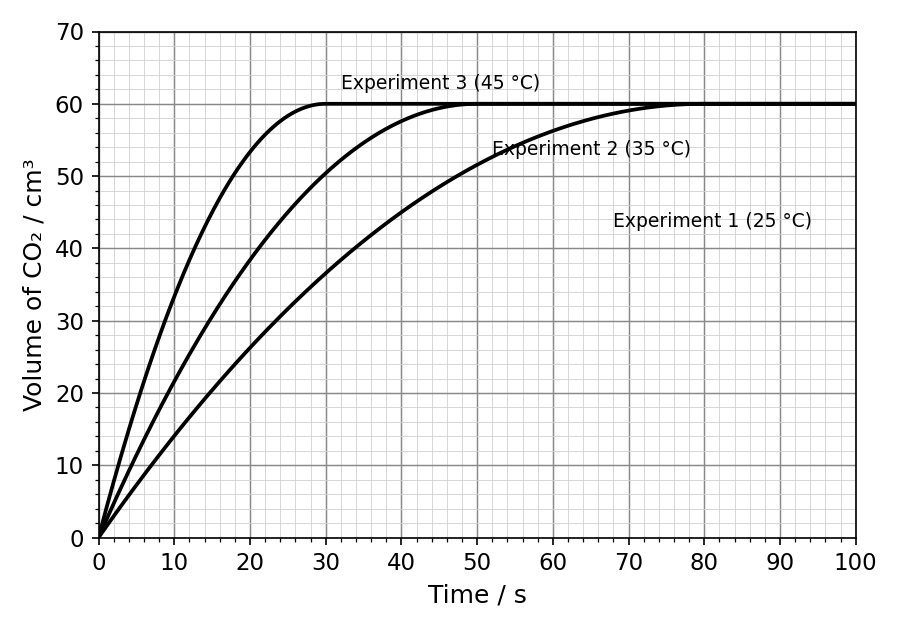
(a) By annotating the graph, determine the initial rate of reaction for Experiment 2, in cm³ s⁻¹.
(b) Estimate the time required for Experiment 1 to produce half of the total volume of CO₂.
(c) Suggest two reasons, in terms of collision theory, why the rate of reaction in Experiment 3 (45 °C) is greater than in Experiment 1 (25 °C).
(d) Calculate the percentage increase in the volume of CO₂ produced after 20 seconds when the temperature is increased from 25 °C (Experiment 1) to 45 °C (Experiment 3).
(e) The experiment was performed in a sealed flask connected to the gas syringe. Sketch a graph of the total mass of the apparatus against time for Experiment 1 and provide a reason for its shape.
To find the initial rate of reaction from a curve, you need to find the gradient of the curve at the very beginning (at time t=0). How do you calculate the gradient of a curve at a specific point?
First, identify the final volume of gas produced from the graph. Then, find half of this value on the y-axis and read the corresponding time from the curve for Experiment 1.
Think about how increasing temperature affects the movement of particles and the energy they possess. How does this relate to the requirements for a successful collision?
Read the volumes for Experiment 1 and Experiment 3 at t=20s from the graph. Then use the formula for percentage increase: ((New Value - Original Value) / Original Value) × 100%.
The apparatus consists of the flask, reactants, and the attached syringe. Consider whether any matter can enter or leave this entire system during the reaction. What law governs this?
Question 6
HardPaper 2 · calculator24 marksAntimony (Sb) and Bismuth (Bi) are elements in group 15 of the periodic table.
(a) Antimony has two stable isotopes. 57.21% of antimony atoms contain 70 neutrons and the remainder contain 72 neutrons.
(i) Deduce the nuclear symbol of the isotope of antimony containing 72 neutrons. Use section 6 of the data booklet.
(ii) Calculate, to two decimal places, the relative atomic mass of antimony.
Bismuth(III) nitrate, , is a common salt of bismuth.
(b) (i) The compound contains both ionic and covalent bonds. State which particles are joined by covalent bonds and which are joined by ionic bonds.
(ii) Distinguish between covalent and ionic bonding in terms of electron distribution.
(iii) State the enthalpy term that characterizes the strength of the bonding between the ions in an ionic solid.
(iv) Write an equation for the formation of aqueous bismuth(III) nitrate from solid bismuth(III) oxide and nitric acid.
(v) Calculate the volume, in , of nitric acid required to react completely with of solid bismuth(III) oxide.
(vi) Predict, with a reason, whether bismuth(III) oxide is expected to be primarily acidic, basic or amphoteric.
(vii) Discuss how the relative reactivity of zinc and bismuth could be established using the metals and aqueous solutions of their nitrates.
(viii) Discuss the products formed at the electrodes during the electrolysis of aqueous bismuth(III) nitrate. Use the standard electrode potential and section 24 of the data booklet.
Bismuth compounds are sometimes used in fireworks to produce special effects.
(c) (i) State the feature of the atomic emission spectrum of an element that corresponds to its first ionization energy.
(ii) Calculate the wavelength, in nm, that corresponds to the first ionization energy of bismuth. Use sections 1, 2 and 8 of the data booklet.
(iii) Explain why the first ionization energy of bismuth is lower than that of polonium (Po), in terms of nuclear charge and electron shielding.
First, find the atomic number (number of protons) for Antimony from the periodic table. The mass number is the sum of protons and neutrons. The nuclear symbol is written with the mass number as a superscript and the atomic number as a subscript to the left of the element symbol.
The relative atomic mass is the weighted average of the masses of its isotopes. You'll need the mass number and abundance of both isotopes. The abundance of the second isotope is 100% minus the abundance of the first.
Consider the structure of the polyatomic nitrate ion and how it interacts with the bismuth cation. Covalent bonds typically form between non-metal atoms, while ionic bonds form between metal cations and non-metal anions.
Think about what happens to the valence electrons in each type of bond. Are they shared or transferred?
This term refers to the enthalpy change when one mole of a solid ionic compound is formed from its gaseous ions.
Bismuth(III) oxide is a basic oxide. It will react with an acid in a neutralization reaction to form a salt and water. Remember to balance the equation and include state symbols.
First, calculate the moles of bismuth(III) oxide using its mass and molar mass. Then, use the stoichiometry from your balanced equation in (b)(iv) to find the moles of nitric acid required. Finally, use the concentration of the nitric acid to find the volume.
Consider the position of bismuth in the periodic table and the trend in metallic character down group 15. How does the acid-base character of oxides change with metallic character?
A more reactive metal can displace a less reactive metal from a solution of its salt. Describe a simple experiment to test this.
At the cathode (negative electrode), reduction occurs. Compare the standard electrode potentials for the reduction of and water. At the anode (positive electrode), oxidation occurs. Compare the oxidation of water and the nitrate ion.
Ionization corresponds to the removal of an electron, which means the electron transitions to the n=∞ energy level. What happens to the spectral lines as they approach this limit?
First, find the first ionization energy of Bismuth from the data booklet (in kJ mol⁻¹). Convert this to energy per atom (in J) using Avogadro's constant. Then use the Planck-Einstein relation () and the wave equation () to find the wavelength.
Bismuth and Polonium are in the same period. Consider how the number of protons and the location of the valence electrons change as you move from Bi to Po.
Question 7
EasyPaper 2 · calculator1 markThe relative atomic mass of bromine is . What is the standard reference for the relative atomic mass scale?
A. The mass of an atom of hydrogen-1
B. The mass of an atom of carbon-12
C. of the mass of an atom of carbon-12
D. of the mass of an atom of oxygen-16
The definition of relative atomic mass is based on a specific isotope of a particular element. Remember the fraction associated with this standard.
Question 8
MediumPaper 2 · calculator10 marksA student investigates the rate of reaction between magnesium and sulfuric acid. The reaction produces hydrogen gas.
(a) Write the balanced chemical equation, including state symbols, for the reaction between magnesium and sulfuric acid.
(b) Describe two different experimental methods to measure the rate of this reaction. For each method, state the variable that would be measured.
The student carries out the reaction using 0.50 g of magnesium and excess 1.0 mol dm⁻³ sulfuric acid. The experiment is performed twice: once with a single ribbon of magnesium and once with the same mass of magnesium powder. The results are plotted on the graph below.
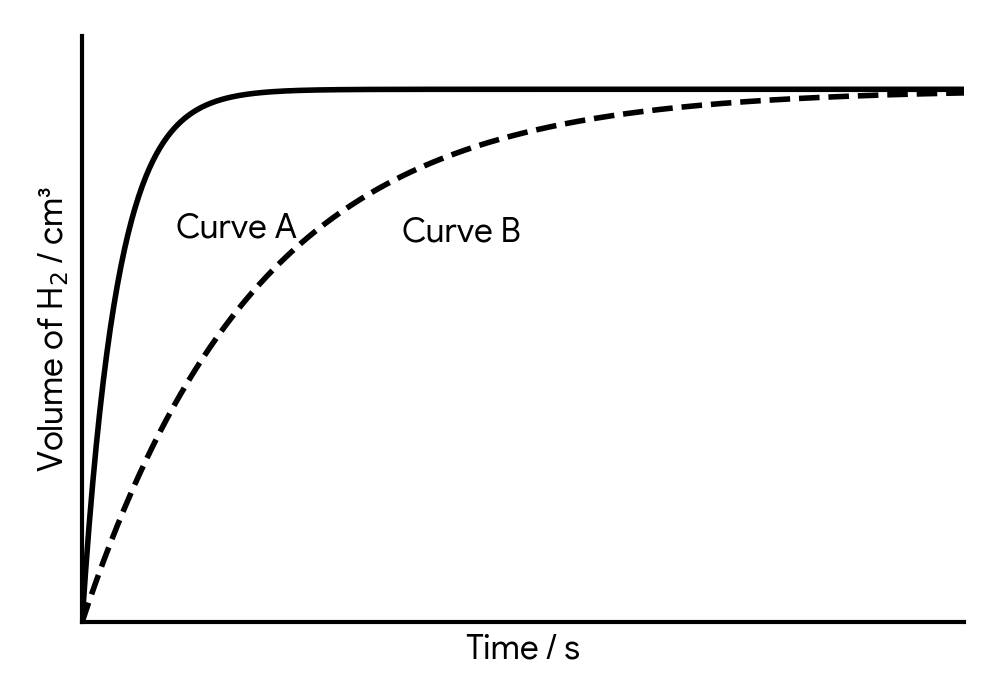
(c) (i) Identify which curve, A or B, represents the reaction with magnesium powder. Explain your answer using collision theory.
(ii) Explain why both curves reach the same final volume of hydrogen gas.
Identify the products of the reaction between a metal and an acid. Remember to include the physical state of each reactant and product at room temperature.
The reaction produces a gas and involves a solid reactant disappearing. How could you measure the change in the amount of gas over time? How could you measure the change in the total mass of the reaction system over time?
Consider how the surface area of the magnesium differs between a ribbon and a powder. How does surface area affect the rate of collisions between reactant particles?
Think about what determines the total amount of product formed in a reaction. Which reactant runs out first? Is the amount of this reactant the same in both experiments?
Question 9
HardPaper 2 · calculator23 marksA sample of chlorine consists of two isotopes, and .
(a) Contrast the sub-atomic structure of these two isotopes.
(b) (i) The sample of chlorine is analysed in a mass spectrometer, producing a spectrum for the ion. The spectrum shows three peaks at m/z values of 70, 72 and 74. Explain the origin and relative heights of these three peaks, given that the abundance of is approximately three times that of .
(ii) A more precise measurement finds the composition by mass to be: : 75.76%, : 24.24%. Calculate the relative atomic mass of chlorine from this sample, giving your answer to two decimal places. (Use isotopic masses of 35.0 and 37.0 for this calculation).
Magnesium chloride, , and manganese(II) chloride, , are two ionic compounds.
(c) (i) Deduce the type of bonding in magnesium chloride, , using electronegativity values from section 9 of the data booklet.
(ii) Determine the lattice enthalpy of magnesium chloride, assuming the bonding is purely ionic. Use sections 9, 10 and 12 of the data booklet and the following data:
Enthalpy of formation of magnesium chloride =
(iii) Explain, with reference to electron configurations, why the ionic radii of , and are different. Use section 10 of the data booklet.
(iv) Predict, with a reason, which has the stronger ionic bonding, manganese(II) chloride, , or magnesium chloride.
Magnesium chloride is white, but manganese(II) chloride is pale pink.
(d) (i) State the condensed electron configuration of a manganese atom.
(ii) State the reason, in terms of electron configuration, why manganese(II) chloride is coloured.
(iii) Manganese(II) chloride absorbs light with a wavelength of approximately 530 nm. Describe why this is consistent with the observed colour of the compound. Use sections 2 and 15 of the data booklet.
A copper key is to be electroplated with manganese using an aqueous solution of manganese(II) chloride as the electrolyte.
(e) (i) Deduce the half-equations for the reactions occurring at the anode (made of pure manganese) and the cathode (the copper key).
(ii) Deduce a balanced chemical equation for the reaction of fluorine gas with the aqueous chloride ions in the electrolyte.
Isotopes of an element have the same number of protons but a different number of another sub-atomic particle. What is this particle and how does its number differ between and ?
The peaks correspond to different combinations of the two chlorine isotopes in a diatomic molecule. The height of each peak is related to the probability of that specific combination occurring. Consider the relative abundances of the isotopes.
The relative atomic mass is the weighted average of the isotopic masses. Multiply each isotopic mass by its fractional abundance and sum the results.
Find the electronegativity values for magnesium and chlorine. The difference in their electronegativity values will indicate the type of bonding.
Construct a Born-Haber cycle for the formation of from and . Use Hess's Law to find the unknown lattice enthalpy. Remember to account for the stoichiometry, especially for chlorine.
Compare the number of electron shells and the nuclear charge (number of protons) for each ion.
The strength of ionic bonding depends on the charge of the ions and the distance between them (ionic radii). Compare these factors for and .
Manganese is in the first row of the d-block. Remember the filling order of the 4s and 3d sub-levels.
The colour of transition metal compounds is related to the electronic structure of the transition metal ion. What is special about the d-sublevel in coloured ions?
The colour we see is the complementary colour to the one that is absorbed. Use the colour wheel in the data booklet to find the complementary colour of the absorbed light.
In electroplating, the object to be plated is the cathode, and the metal used for plating is the anode. Oxidation occurs at the anode and reduction occurs at the cathode.
Consider the relative oxidizing strengths of the halogens. A more reactive halogen will displace a less reactive halide from its salt solution.
Question 10
EasyPaper 2 · calculator1 markA sample of ethanol () contains oxygen atoms. How many moles of ethanol are present in the sample?
A
B
C
D
Recall Avogadro's constant and the number of oxygen atoms in one molecule of ethanol.
Question 11
MediumPaper 1A · calculator1 markA new organic compound, isolated from a rare plant species, was analyzed to determine its elemental composition by mass. The analysis showed the following percentages:
Carbon (C) =
Hydrogen (H) =
Oxygen (O) =
What is the empirical formula of this compound?
(Relative atomic masses: C = , H = , O = )
A.
B.
C.
D.
Assume a 100 g sample of the compound. Convert the mass percentages to grams, then to moles using the given relative atomic masses. Divide all mole values by the smallest number of moles to find the simplest whole-number ratio of atoms.
Question 12
HardPaper 2 · calculator16 marksStrontium is an alkaline earth metal in group 2 of the periodic table, used to produce the red colour in fireworks.
(a) In a sample of strontium, 10.0% of the atoms have a mass number of 86 and the remainder have a mass number of 88.
(i) Deduce the nuclear symbol of the isotope of strontium with mass number 86. Use section 6 of the data booklet.
(ii) Calculate, to two decimal places, the relative atomic mass of this sample of strontium.
(iii) Explain why the first ionization energy of strontium is greater than that of rubidium.
(b) Strontium nitrate has the formula .
(i) The compound contains both ionic and covalent bonds. State which particles are joined by covalent bonds and which are joined by ionic bonds.
(ii) Contrast covalent and ionic bonds in terms of how the valence electrons are involved.
(iii) Write a balanced chemical equation for the formation of strontium nitrate solution from the reaction of solid strontium hydroxide with nitric acid.
(iv) Calculate the volume, in , of nitric acid required to react completely with of solid strontium hydroxide.
(v) Predict, with a reason, whether strontium oxide is acidic, basic or amphoteric.
(vi) Describe an experiment to establish the relative reactivity of strontium and zinc using the metals and aqueous solutions of their nitrates.
The nuclear symbol shows the mass number as a superscript and the atomic number as a subscript. Find the atomic number of strontium from the data booklet.
The relative atomic mass is the weighted average of the masses of the isotopes. Use the formula: .
Consider the number of protons (nuclear charge) and the principal energy level of the valence electrons for both strontium and rubidium.
Identify the metal cation and the polyatomic anion. What type of bond holds them together? What type of bonds exist within the polyatomic anion?
Think about what happens to the outermost electrons in each type of bonding: are they given away, taken, or shared?
This is a neutralization reaction between a base (metal hydroxide) and an acid. The products are a salt and water. Remember to balance the equation and include state symbols.
First, calculate the moles of strontium hydroxide from its mass. Then, use the stoichiometry from your balanced equation in (b)(iii) to find the moles of nitric acid. Finally, use the concentration of the acid to find the required volume.
Consider strontium's position in the periodic table. Is it a metal or a non-metal? What is the general trend in the acid-base character of oxides for metals in its group?
A reactivity series is determined by displacement reactions. Think about what would happen if you place the more reactive metal into a solution containing the ions of the less reactive metal.
Question 13
EasyPaper 2 · calculator1 markA student in a chemistry laboratory needs to prepare a more dilute solution of hydrochloric acid. They start with of a HCl solution.
Calculate the volume of distilled water that must be added to dilute this solution to a final concentration of .
A
B
C
D
Recall the dilution formula . Remember that the question asks for the volume of water added, not the final total volume.
Question 14
MediumPaper 2 · calculator1 markA student combusts of an unknown hydrocarbon completely in oxygen. The combustion produces of carbon dioxide and of water. What is the molecular formula for the hydrocarbon?
A
B
C
D
First, calculate the moles of carbon atoms from the mass of carbon dioxide and the moles of hydrogen atoms from the mass of water. Remember that each water molecule contains two hydrogen atoms. Then, use the given moles of the hydrocarbon to find the ratio of carbon to hydrogen atoms in the molecular formula.
Question 15
EasyPaper 2 · calculator1 markThe complete combustion of propane gas can be represented by the following balanced chemical equation:
If of propane burn completely in excess oxygen, what volume of carbon dioxide gas is formed at the same temperature and pressure?
A
B
C
D
Recall Gay-Lussac's Law of Combining Volumes, which states that for gaseous reactants and products at constant temperature and pressure, the ratio of their volumes is the same as the ratio of their stoichiometric coefficients in the balanced chemical equation.
Question 16
MediumPaper 2 · calculator1 markThe complete combustion of propane gas () with oxygen () occurs according to the following balanced equation:
In a laboratory experiment, of propane gas is mixed with of oxygen gas in a sealed container. Assuming the reaction goes to completion and the temperature and pressure remain constant throughout, how much carbon dioxide is formed?
A
B
C
D
Recall Avogadro's law, which states that equal volumes of all gases, at the same temperature and pressure, have the same number of molecules. Therefore, volume ratios are equivalent to mole ratios. Identify the limiting reactant first.
Question 17
EasyPaper 2 · calculator1 markA laboratory technician needs to prepare a diluted solution of hydrochloric acid for an experiment. They take of a stock solution of and dilute it with distilled water to a final volume of in a volumetric flask. What is the new concentration of the diluted solution?
A
B
C
D
Recall the dilution formula . Ensure all volumes are in consistent units.
Question 18
MediumPaper 2 · calculator1 markGlucose () is a vital sugar molecule that provides energy for living organisms.
(a) Determine the mass in kg for one molecule of glucose ().
A
B
C
D
First, calculate the molar mass of glucose. Then, use Avogadro's constant to find the mass of a single molecule in grams. Finally, convert this mass to kilograms.
Question 19
EasyPaper 2 · calculator1 markA laboratory technician is preparing various reagents for an experiment. To minimize waste, they need to identify the sample with the smallest mass.
Which of the following samples has the least mass?
A. of
B. of
C. of
D. of
To determine the mass of each sample, you need to calculate its molar mass first. Use the periodic table to find the atomic masses of the elements involved. Then, multiply the molar mass by the number of moles given for each option.
Question 20
MediumPaper 2 · calculator1 markWhich sample contains the greatest number of oxygen atoms?
A of
B of
C of
D of
For each option, calculate the total number of oxygen atoms. Remember to account for the number of oxygen atoms in each molecule or formula unit and use Avogadro's constant. For option C, first convert mass to moles using the molar mass.
No question on this page matches those filters. Try another difficulty or paper.
36 more Counting particles by mass: the mole questions in the app
Every answer is marked mark by mark, IB-style, and the AI tutor helps when you are stuck.
Where marks are lost
- Reaching for "human error" or "only one trial." A source of error has to be a specific step in the method, not a general apology for the result.
- Joining the dots instead of drawing a curve.
- Naming a chemical instead of the property that distinguishes it, or vice versa. Answering with the nearest fact that comes to mind rather than the fact the command term and stem jointly ask for is a recurring way to answer a question that was not, quite, the one asked.