The nuclear atom: notes and practice questions
- This topic introduces the nuclear atom model, including its subatomic particles and their arrangement.
- Atoms consist of a dense, positively charged nucleus (protons and neutrons) and negatively charged electrons occupying space outside the nucleus.
- Use the nuclear symbol to deduce the number of protons, neutrons, and electrons in atoms and ions.
- Isotopes are atoms of the same element with different numbers of neutrons.
- Perform calculations involving non-integer relative atomic masses and isotopic abundance.
- Interpret mass spectra to determine the identity and relative abundance of isotopes.
How it is examined
Paper 1A carries the subatomic-particle counting. Weighted-average Ar calculations from isotopic abundance are standard 2-mark Paper 2 parts. At HL the mass spectrum version gives a bar chart of m/z against relative abundance and asks for Ar, still 2 marks. A question asking a student to recall the mass of a proton in kg is a bad question: the booklet supplies it.
Actual masses and charges of the proton, neutron and electron. Relative atomic masses to two decimal places in the periodic table. The relative values (proton and neutron 1, electron negligible; charges +1, 0, -1) are recall.
- 1.2.1 Atoms contain a positively charged, dense nucleus of protons and neutrons (nucleons). Negatively charged electrons occupy the space outside the nucleus. Students use the nuclear symbol (mass number A upper left, atomic number Z lower left, element symbol X) to deduce the number of protons, neutrons and electrons in atoms and ions.
- 1.2.2 Isotopes are atoms of the same element with different numbers of neutrons. Students perform calculations involving non-integer relative atomic masses and isotopic abundance from given data.
The operational details of the mass spectrometer will not be assessed (HL).
1.2.3 Mass spectra are used to determine relative atomic masses of elements from their isotopic composition. Students interpret mass spectra in terms of identity and relative abundance of isotopes.
Guiding questions
- How do the nuclei of atoms differ?
Linking questions
- Structure 1.3 What determines the different chemical properties of atoms?
- Structure 3.1 How does the atomic number relate to the position of an element in the periodic table?
- Nature of science, Reactivity 3.4 How can isotope tracers provide evidence for a reaction mechanism?
- Structure 3.2 (HL) How does the fragmentation pattern of a compound in the mass spectrometer help in the determination of its structure?
Practice questions
29 questions · 15 easy · 11 medium · 3 hardQuestion 1
EasyPaper 2 · calculator1 markWhat is the number of neutrons in an atom of the isotope Cadmium-114 ()?
A
B
C
D
Recall that the mass number (A) of an atom is the sum of its protons and neutrons, and the atomic number (Z) is the number of protons. The number of neutrons can be found by subtracting the atomic number from the mass number.
Question 2
MediumPaper 1A · calculator1 markWhich pair of species has the same number of electrons in the outermost principal energy level?
The letters do not represent symbols of elements.
A. P and Q
B. Q and S
C. P and R
D. R and S
First, determine the total number of electrons for each species by considering its atomic number (the subscript) and its charge (the superscript). Then, write out the full electron configuration for each species to identify the outermost principal energy level and count the electrons within it.
Question 3
HardPaper 2 · calculator24 marksAntimony (Sb) and Bismuth (Bi) are elements in group 15 of the periodic table.
(a) Antimony has two stable isotopes. 57.21% of antimony atoms contain 70 neutrons and the remainder contain 72 neutrons.
(i) Deduce the nuclear symbol of the isotope of antimony containing 72 neutrons. Use section 6 of the data booklet.
(ii) Calculate, to two decimal places, the relative atomic mass of antimony.
Bismuth(III) nitrate, , is a common salt of bismuth.
(b) (i) The compound contains both ionic and covalent bonds. State which particles are joined by covalent bonds and which are joined by ionic bonds.
(ii) Distinguish between covalent and ionic bonding in terms of electron distribution.
(iii) State the enthalpy term that characterizes the strength of the bonding between the ions in an ionic solid.
(iv) Write an equation for the formation of aqueous bismuth(III) nitrate from solid bismuth(III) oxide and nitric acid.
(v) Calculate the volume, in , of nitric acid required to react completely with of solid bismuth(III) oxide.
(vi) Predict, with a reason, whether bismuth(III) oxide is expected to be primarily acidic, basic or amphoteric.
(vii) Discuss how the relative reactivity of zinc and bismuth could be established using the metals and aqueous solutions of their nitrates.
(viii) Discuss the products formed at the electrodes during the electrolysis of aqueous bismuth(III) nitrate. Use the standard electrode potential and section 24 of the data booklet.
Bismuth compounds are sometimes used in fireworks to produce special effects.
(c) (i) State the feature of the atomic emission spectrum of an element that corresponds to its first ionization energy.
(ii) Calculate the wavelength, in nm, that corresponds to the first ionization energy of bismuth. Use sections 1, 2 and 8 of the data booklet.
(iii) Explain why the first ionization energy of bismuth is lower than that of polonium (Po), in terms of nuclear charge and electron shielding.
First, find the atomic number (number of protons) for Antimony from the periodic table. The mass number is the sum of protons and neutrons. The nuclear symbol is written with the mass number as a superscript and the atomic number as a subscript to the left of the element symbol.
The relative atomic mass is the weighted average of the masses of its isotopes. You'll need the mass number and abundance of both isotopes. The abundance of the second isotope is 100% minus the abundance of the first.
Consider the structure of the polyatomic nitrate ion and how it interacts with the bismuth cation. Covalent bonds typically form between non-metal atoms, while ionic bonds form between metal cations and non-metal anions.
Think about what happens to the valence electrons in each type of bond. Are they shared or transferred?
This term refers to the enthalpy change when one mole of a solid ionic compound is formed from its gaseous ions.
Bismuth(III) oxide is a basic oxide. It will react with an acid in a neutralization reaction to form a salt and water. Remember to balance the equation and include state symbols.
First, calculate the moles of bismuth(III) oxide using its mass and molar mass. Then, use the stoichiometry from your balanced equation in (b)(iv) to find the moles of nitric acid required. Finally, use the concentration of the nitric acid to find the volume.
Consider the position of bismuth in the periodic table and the trend in metallic character down group 15. How does the acid-base character of oxides change with metallic character?
A more reactive metal can displace a less reactive metal from a solution of its salt. Describe a simple experiment to test this.
At the cathode (negative electrode), reduction occurs. Compare the standard electrode potentials for the reduction of and water. At the anode (positive electrode), oxidation occurs. Compare the oxidation of water and the nitrate ion.
Ionization corresponds to the removal of an electron, which means the electron transitions to the n=∞ energy level. What happens to the spectral lines as they approach this limit?
First, find the first ionization energy of Bismuth from the data booklet (in kJ mol⁻¹). Convert this to energy per atom (in J) using Avogadro's constant. Then use the Planck-Einstein relation () and the wave equation () to find the wavelength.
Bismuth and Polonium are in the same period. Consider how the number of protons and the location of the valence electrons change as you move from Bi to Po.
Question 4
EasyPaper 2 · calculator1 markThe table below shows the number of subatomic particles for four different species.
| Species | Number of protons | Number of neutrons | Number of electrons |
|---|---|---|---|
| P | 12 | 13 | 10 |
| Q | 12 | 12 | 12 |
| R | 10 | 10 | 10 |
| S | 11 | 13 | 10 |
Which two species are isotopes of the same element?
A. P and Q
B. P and S
C. Q and R
D. R and S
Recall the definition of isotopes. What do isotopes of an element have in common, and what is different about them in terms of their subatomic particles?
Question 5
MediumPaper 1A · calculator1 markWhich property is the same for tetrachloromethane, , containing only the isotope and tetrachloromethane containing only the isotope?
A. Molar mass
B. Rate of diffusion in the gaseous state
C. Polarity of the carbon-chlorine bond
D. Frequency of the C-Cl bond vibration
Isotopes of an element have the same number of protons and electrons but a different number of neutrons. Consider how this affects chemical properties (related to electrons) versus physical properties (related to mass).
Question 6
HardPaper 2 · calculator23 marksA sample of chlorine consists of two isotopes, and .
(a) Contrast the sub-atomic structure of these two isotopes.
(b) (i) The sample of chlorine is analysed in a mass spectrometer, producing a spectrum for the ion. The spectrum shows three peaks at m/z values of 70, 72 and 74. Explain the origin and relative heights of these three peaks, given that the abundance of is approximately three times that of .
(ii) A more precise measurement finds the composition by mass to be: : 75.76%, : 24.24%. Calculate the relative atomic mass of chlorine from this sample, giving your answer to two decimal places. (Use isotopic masses of 35.0 and 37.0 for this calculation).
Magnesium chloride, , and manganese(II) chloride, , are two ionic compounds.
(c) (i) Deduce the type of bonding in magnesium chloride, , using electronegativity values from section 9 of the data booklet.
(ii) Determine the lattice enthalpy of magnesium chloride, assuming the bonding is purely ionic. Use sections 9, 10 and 12 of the data booklet and the following data:
Enthalpy of formation of magnesium chloride =
(iii) Explain, with reference to electron configurations, why the ionic radii of , and are different. Use section 10 of the data booklet.
(iv) Predict, with a reason, which has the stronger ionic bonding, manganese(II) chloride, , or magnesium chloride.
Magnesium chloride is white, but manganese(II) chloride is pale pink.
(d) (i) State the condensed electron configuration of a manganese atom.
(ii) State the reason, in terms of electron configuration, why manganese(II) chloride is coloured.
(iii) Manganese(II) chloride absorbs light with a wavelength of approximately 530 nm. Describe why this is consistent with the observed colour of the compound. Use sections 2 and 15 of the data booklet.
A copper key is to be electroplated with manganese using an aqueous solution of manganese(II) chloride as the electrolyte.
(e) (i) Deduce the half-equations for the reactions occurring at the anode (made of pure manganese) and the cathode (the copper key).
(ii) Deduce a balanced chemical equation for the reaction of fluorine gas with the aqueous chloride ions in the electrolyte.
Isotopes of an element have the same number of protons but a different number of another sub-atomic particle. What is this particle and how does its number differ between and ?
The peaks correspond to different combinations of the two chlorine isotopes in a diatomic molecule. The height of each peak is related to the probability of that specific combination occurring. Consider the relative abundances of the isotopes.
The relative atomic mass is the weighted average of the isotopic masses. Multiply each isotopic mass by its fractional abundance and sum the results.
Find the electronegativity values for magnesium and chlorine. The difference in their electronegativity values will indicate the type of bonding.
Construct a Born-Haber cycle for the formation of from and . Use Hess's Law to find the unknown lattice enthalpy. Remember to account for the stoichiometry, especially for chlorine.
Compare the number of electron shells and the nuclear charge (number of protons) for each ion.
The strength of ionic bonding depends on the charge of the ions and the distance between them (ionic radii). Compare these factors for and .
Manganese is in the first row of the d-block. Remember the filling order of the 4s and 3d sub-levels.
The colour of transition metal compounds is related to the electronic structure of the transition metal ion. What is special about the d-sublevel in coloured ions?
The colour we see is the complementary colour to the one that is absorbed. Use the colour wheel in the data booklet to find the complementary colour of the absorbed light.
In electroplating, the object to be plated is the cathode, and the metal used for plating is the anode. Oxidation occurs at the anode and reduction occurs at the cathode.
Consider the relative oxidizing strengths of the halogens. A more reactive halogen will displace a less reactive halide from its salt solution.
Question 7
EasyPaper 2 · calculator1 markThe relative atomic mass of bromine is . What is the standard reference for the relative atomic mass scale?
A. The mass of an atom of hydrogen-1
B. The mass of an atom of carbon-12
C. of the mass of an atom of carbon-12
D. of the mass of an atom of oxygen-16
The definition of relative atomic mass is based on a specific isotope of a particular element. Remember the fraction associated with this standard.
Question 8
MediumPaper 2 · calculator1 markBoron has two naturally occurring isotopes, and . The relative atomic mass of boron is . The isotopic mass of is amu and the isotopic mass of is amu. What are the natural abundances of these two isotopes?
A and
B and
C and
D and
Let be the fractional abundance of one isotope. The fractional abundance of the other isotope will be . Set up an equation using the relative atomic mass and the isotopic masses.
Question 9
HardPaper 2 · calculator16 marksStrontium is an alkaline earth metal in group 2 of the periodic table, used to produce the red colour in fireworks.
(a) In a sample of strontium, 10.0% of the atoms have a mass number of 86 and the remainder have a mass number of 88.
(i) Deduce the nuclear symbol of the isotope of strontium with mass number 86. Use section 6 of the data booklet.
(ii) Calculate, to two decimal places, the relative atomic mass of this sample of strontium.
(iii) Explain why the first ionization energy of strontium is greater than that of rubidium.
(b) Strontium nitrate has the formula .
(i) The compound contains both ionic and covalent bonds. State which particles are joined by covalent bonds and which are joined by ionic bonds.
(ii) Contrast covalent and ionic bonds in terms of how the valence electrons are involved.
(iii) Write a balanced chemical equation for the formation of strontium nitrate solution from the reaction of solid strontium hydroxide with nitric acid.
(iv) Calculate the volume, in , of nitric acid required to react completely with of solid strontium hydroxide.
(v) Predict, with a reason, whether strontium oxide is acidic, basic or amphoteric.
(vi) Describe an experiment to establish the relative reactivity of strontium and zinc using the metals and aqueous solutions of their nitrates.
The nuclear symbol shows the mass number as a superscript and the atomic number as a subscript. Find the atomic number of strontium from the data booklet.
The relative atomic mass is the weighted average of the masses of the isotopes. Use the formula: .
Consider the number of protons (nuclear charge) and the principal energy level of the valence electrons for both strontium and rubidium.
Identify the metal cation and the polyatomic anion. What type of bond holds them together? What type of bonds exist within the polyatomic anion?
Think about what happens to the outermost electrons in each type of bonding: are they given away, taken, or shared?
This is a neutralization reaction between a base (metal hydroxide) and an acid. The products are a salt and water. Remember to balance the equation and include state symbols.
First, calculate the moles of strontium hydroxide from its mass. Then, use the stoichiometry from your balanced equation in (b)(iii) to find the moles of nitric acid. Finally, use the concentration of the acid to find the required volume.
Consider strontium's position in the periodic table. Is it a metal or a non-metal? What is the general trend in the acid-base character of oxides for metals in its group?
A reactivity series is determined by displacement reactions. Think about what would happen if you place the more reactive metal into a solution containing the ions of the less reactive metal.
Question 10
EasyPaper 2 · calculator1 markChlorine has two common isotopes, and . Which statements about these isotopes are correct?
I. They have the same number of electrons in a neutral atom.
II. They have different numbers of neutrons.
III. They have different physical properties.
A. I and II only
B. I and III only
C. II and III only
D. I, II and III
Recall the definition of isotopes in terms of subatomic particles. Consider how the number of protons, neutrons, and electrons affects the chemical and physical properties of an atom.
Question 11
MediumPaper 2 · calculator1 markCopper has two naturally occurring isotopes: and . The natural abundance of is and the natural abundance of is . What is the relative atomic mass of copper?
A
B
C
D
The relative atomic mass is the weighted average of the masses of the isotopes, taking into account their natural abundances. Ensure the abundances are converted to decimal form before calculation.
Question 12
EasyPaper 2 · calculator1 markThe table shows the composition of four different species.
| Species | Nucleon number | Number of protons | Number of electrons |
|---|---|---|---|
| P | |||
| Q | |||
| R | |||
| S |
Which species are positive ions?
A. P and Q
B. Q and R
C. R and S
D. P and S
A positive ion, or cation, has more protons than electrons. Compare the number of protons and electrons for each species listed in the table.
Question 13
MediumPaper 1A · calculator1 markMagnesium has three naturally occurring isotopes. A sample of magnesium was analyzed using mass spectrometry, revealing the following isotopic abundances:
Mg:
Mg:
Mg:
What is the relative atomic mass of this sample of magnesium?
A.
B.
C.
D.
The relative atomic mass is the weighted average of the masses of the isotopes, taking into account their relative abundances. Remember to convert percentages to decimal fractions before multiplying.
Question 14
EasyPaper 2 · calculator1 markWhich of the following isotopes contains the greatest number of neutrons?
A.
B.
C.
D.
Recall that the number of neutrons in an atom is calculated by subtracting the atomic number (Z) from the mass number (A).
Question 15
MediumPaper 1A · calculator1 markBromine is a diatomic molecule. A sample of bromine contains the isotopes and in approximately equal abundance.
Which graph shows the mass spectrum of this sample of bromine?
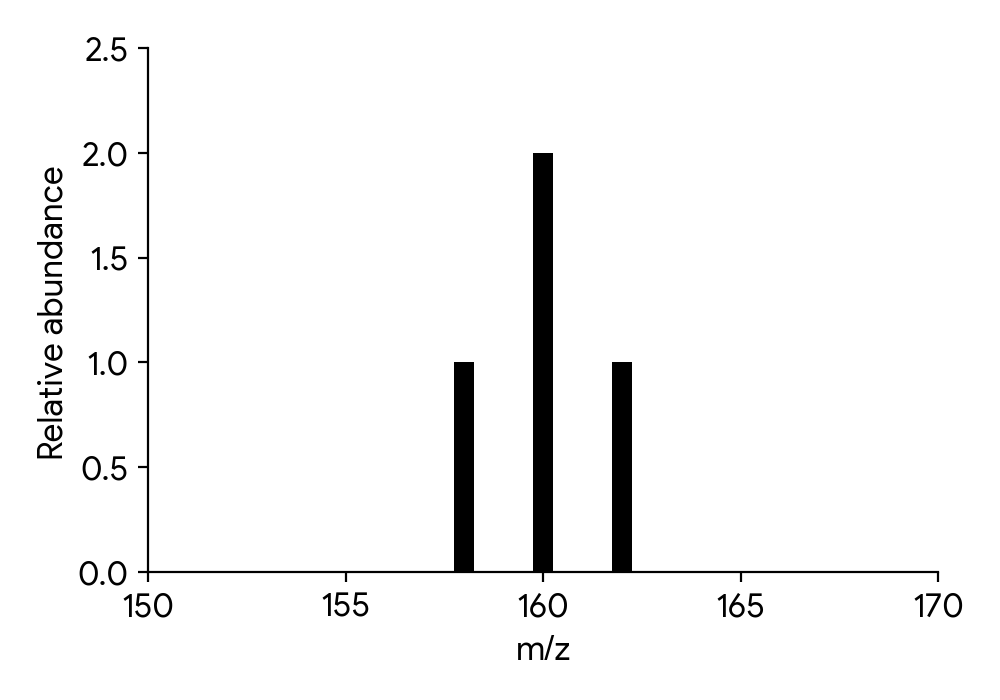
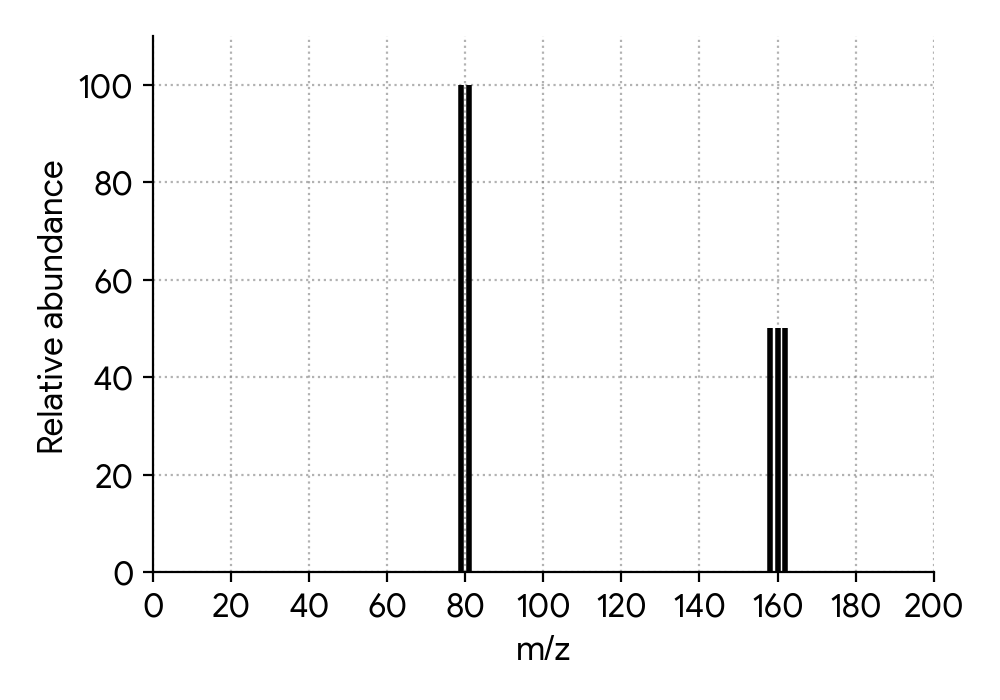
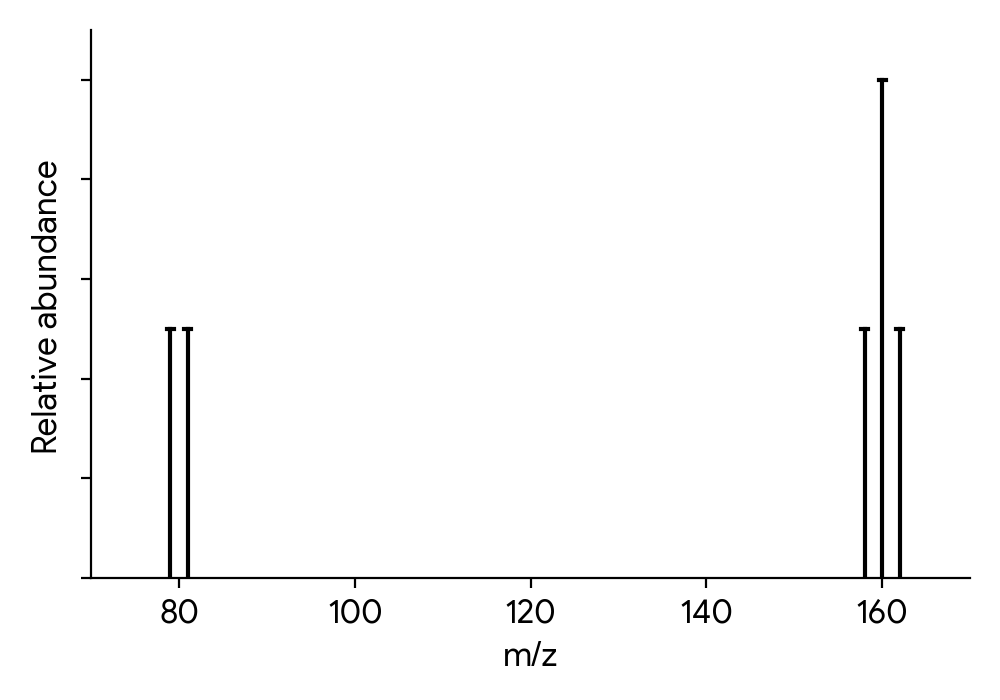
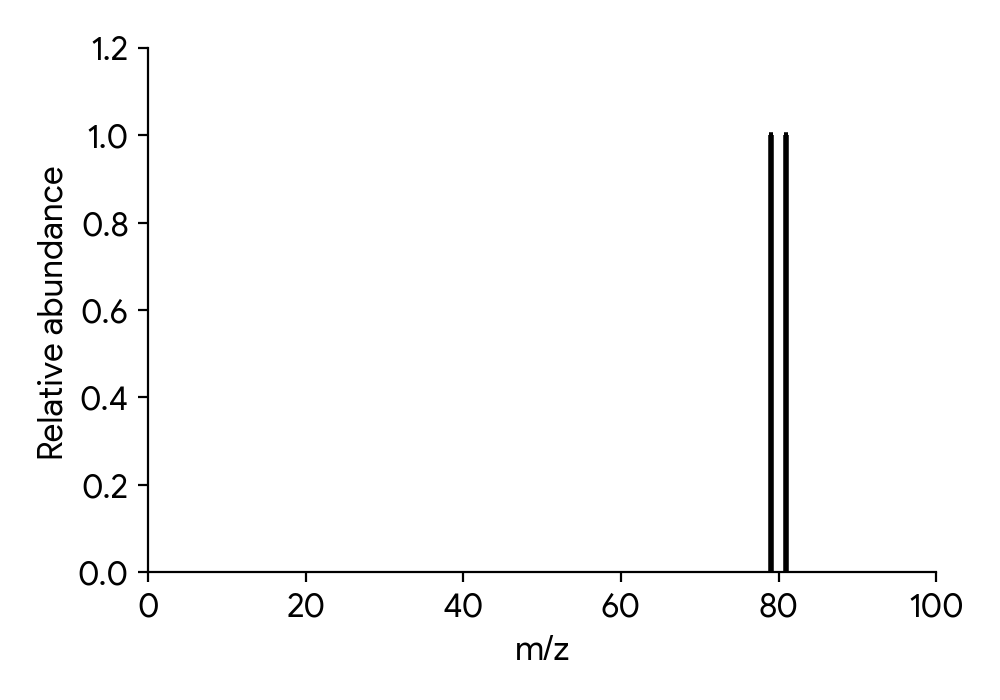
Consider both the atomic ions () and the molecular ions () that will be formed in the mass spectrometer. Remember to account for all possible combinations of the two isotopes in the diatomic molecule and their relative probabilities.
Question 16
EasyPaper 2 · calculator1 markAn atom of a certain element has protons and neutrons. Which of the following correctly represents the nuclear symbol for this atom?
A
B
C
D
Remember that the atomic number () represents the number of protons, and the mass number () represents the total number of protons and neutrons in the nucleus.
Question 17
MediumPaper 1A · calculator1 markWhich of the following species have the same number of outer electrons? The letters do not represent symbols of elements.
A. M and P
B. N and Q
C. M and N
D. P and Q
For each species, first determine the atomic number (number of protons) from the subscript. Then, calculate the total number of electrons by considering the charge on the ion. Finally, write out the electron configuration for each species to find the number of electrons in the outermost energy level.
Question 18
EasyPaper 2 · calculator1 markWhich of the following species contains more protons than neutrons?
A.
B.
C.
D.
Recall that the atomic number (Z) represents the number of protons, and the mass number (A) represents the sum of protons and neutrons. The number of neutrons can be calculated as .
Question 19
MediumPaper 1A · calculator1 markWhich property is the same for a sample of tetrachloromethane, , containing only the isotope and a sample containing only the isotope?
A. Boiling point
B. Polarity of the C–Cl bond
C. Rate of effusion
D. Molar mass
Isotopes of an element have the same number of protons and electrons but a different number of neutrons. Consider which properties are determined by the mass of the atom versus its electronic configuration.
Question 20
EasyPaper 2 · calculator1 markWhich of the following species has more electrons than neutrons?
A.
B.
C.
D.
Recall how to determine the number of protons, neutrons, and electrons from the atomic number, mass number, and charge of an ion. Protons = atomic number. Neutrons = mass number - atomic number. Electrons = atomic number - charge.
No question on this page matches those filters. Try another difficulty or paper.
9 more The nuclear atom questions in the app
Every answer is marked mark by mark, IB-style, and the AI tutor helps when you are stuck.
Where marks are lost
- Reaching for "human error" or "only one trial." A source of error has to be a specific step in the method, not a general apology for the result.
- Joining the dots instead of drawing a curve.
- Naming a chemical instead of the property that distinguishes it, or vice versa. Answering with the nearest fact that comes to mind rather than the fact the command term and stem jointly ask for is a recurring way to answer a question that was not, quite, the one asked.