Electron sharing reactions: notes and practice questions
- This topic covers no additional higher level content beyond the standard level material for electron sharing reactions, as explicitly stated in the IB Chemistry guide.
How it is examined
Two hours of teaching, so a small share of marks, but it is examined every session because it is easy to write clean marking points for. The standard shape is "State the equation for the initiation step" [1], "State two propagation steps" [2], "State an equation for a termination step" [1]. Radical dots are part of the mark: an equation written without them can be refused. The "why a mixture of products" answer wants further substitution, not just "many reactions happen".
Average bond enthalpies, which support the "why does UV break Cl-Cl and not C-H" reasoning. The radical dot notation and the three stage names are recall.
- 3.3.1 A radical is a molecular entity that has an unpaired electron. Radicals are highly reactive. Students identify and represent radicals, for example `·CH₃` and `Cl·`.
- 3.3.2 Radicals are produced by homolytic fission, for example of halogens, in the presence of ultraviolet (UV) light or heat. Students explain, including with equations, the homolytic fission of halogens, known as the initiation step in a chain reaction.
- 3.3.3 Radicals take part in substitution reactions with alkanes, producing a mixture of products. Students explain, using equations, the propagation and termination steps in the reactions between alkanes and halogens.
Guiding questions
- What happens when a species possesses an unpaired electron?
Linking questions
- Structure 2.1 How is it possible for a radical to be an atom, a molecule, a cation or an anion? Consider examples of each type.
- Structure 2.2 What is the reverse process of homolytic fission? Chlorine radicals released from CFCs are able to break down ozone, O₃, but not oxygen, O₂, in the stratosphere. What does this suggest about the relative strengths of bonds in the two allotropes?
- Reactivity 1.2 Why do chlorofluorocarbons (CFCs) in the atmosphere break down to release chlorine radicals but typically not fluorine radicals?
- Reactivity 2.2 Why are alkanes described as kinetically stable but thermodynamically unstable?
Practice questions
12 questions · 3 easy · 9 mediumQuestion 1
EasyPaper 1A · calculator1 markWhich species acts as the electrophile during the nitration of benzene using a nitrating mixture of concentrated nitric acid and concentrated sulfuric acid?
A.
B.
C.
D.
The nitrating mixture contains two strong acids. Consider how they might react with each other to generate a highly reactive species capable of attacking the electron-rich benzene ring.
Question 2
MediumPaper 1A · calculator1 markWhich change represents reduction of the functional group?
A.
B.
C.
D.
Reduction in organic chemistry often involves an increase in the number of C-H bonds or a decrease in the number of C-O bonds. Examine the change in the functional group for each option.
Question 3
EasyPaper 1A · calculator1 markWhat is the role of ammonia in the reaction of 2-bromobutane with excess ethanolic ammonia?
A. Electrophile and Lewis acid
B. Nucleophile and Lewis acid
C. Electrophile and Lewis base
D. Nucleophile and Lewis base
Consider the definitions of a nucleophile and a Lewis base. Does ammonia possess a lone pair of electrons that it can donate? Is it attracted to a region of positive charge (a nucleus)?
Question 4
MediumPaper 1A · calculator1 markWhich species acts as the electrophile in the Friedel-Crafts acylation of benzene with ethanoyl chloride in the presence of a Lewis acid catalyst?
A.
B.
C.
D.
The electrophile is the species that directly attacks the electron-rich benzene ring. Consider how the Lewis acid catalyst interacts with the ethanoyl chloride to generate a highly reactive, electron-deficient species.
Question 5
EasyPaper 1A · calculator1 markWhich compound can be oxidized to produce pentan-2-one?
A. Pentan-1-ol
B. Pentan-2-ol
C. Pentanal
D. 2-methylbutan-2-ol
Consider the products formed from the oxidation of primary, secondary, and tertiary alcohols. Which class of alcohol produces a ketone upon oxidation?
Question 6
MediumPaper 1A · calculator1 markWhich process has the smallest activation energy?
A.
B.
C.
D.
Consider what activation energy represents. Processes that involve breaking stable bonds or removing electrons require a significant energy input to overcome existing forces. Conversely, what can be said about the energy barrier for two highly reactive species, like free radicals, combining to form a stable molecule?
Question 7
MediumPaper 1A · calculator1 markWhich statement is correct for an reaction of a chiral haloalkane?
A. The rate is proportional to the concentration of the nucleophile.
B. The reaction occurs in a single concerted step.
C. A racemic mixture is formed.
D. The reaction is favoured by polar aprotic solvents.
Recall the characteristics of an mechanism. Think about the rate-determining step, the intermediate species, and how this intermediate affects the stereochemistry of the product.
Question 8
MediumPaper 1A · calculator1 markWhat is the major product formed when 2-methylpropene, , is hydrated with steam in the presence of an acid catalyst?
A.
B.
C.
D.
This is an electrophilic addition reaction. Recall Markovnikov's rule, which is based on the stability of the carbocation intermediate. Which of the two carbon atoms in the double bond will form a more stable carbocation upon protonation?
Question 9
MediumPaper 1A · calculator1 markThe hydrolysis of 2-chloro-2-methylpropane, , proceeds via a two-step mechanism. The energy profile for this reaction is shown below.
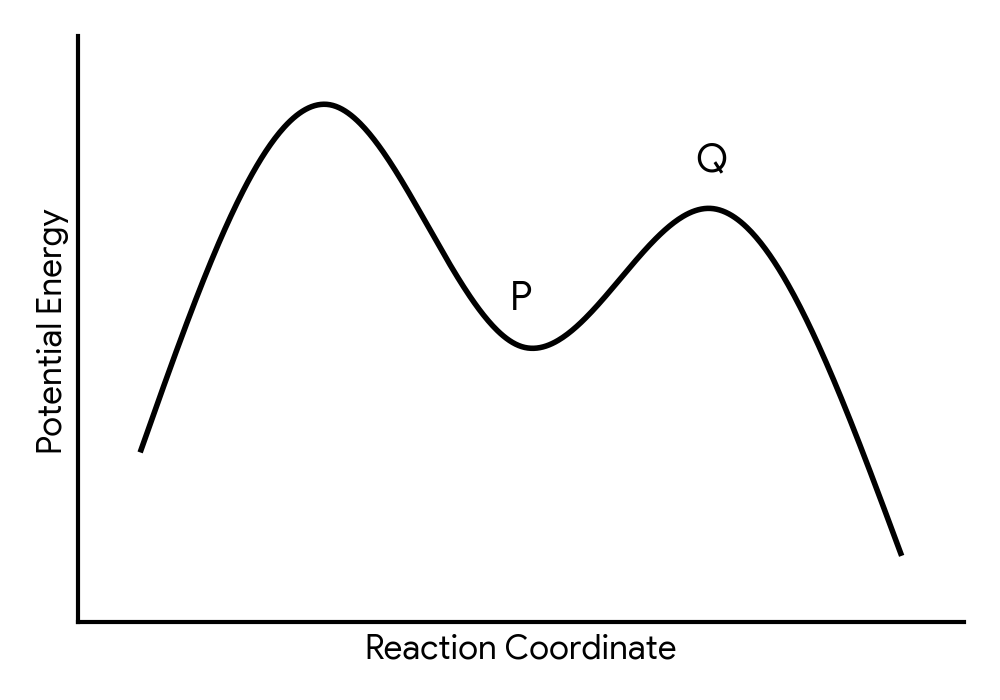
Which statement correctly identifies the species at points P and Q?
A. P is an intermediate and Q is a transition state.
B. P is a transition state and Q is an intermediate.
C. P and Q are both transition states.
D. P and Q are both intermediates.
Recall the definitions of a transition state and a reaction intermediate. A transition state is a species at the maximum of an energy barrier, while an intermediate is a species that exists in a potential energy minimum between two transition states.
Question 10
MediumPaper 1A · calculator1 markWhich statements explain the following observations for the free-radical substitution of methane with chlorine in the presence of UV light?
| The initiation step is the homolytic fission of rather than . | A small amount of UV light can initiate the reaction of a large number of methane molecules. |
|---|---|
| A. The C-H bond is weaker than the Cl-Cl bond. | The chlorine radical is consumed in the termination step. |
| B. The Cl-Cl bond is weaker than the C-H bond. | The chlorine radical is consumed in the termination step. |
| C. The C-H bond is weaker than the Cl-Cl bond. | The chlorine radical is regenerated in a propagation step. |
| D. The Cl-Cl bond is weaker than the C-H bond. | The chlorine radical is regenerated in a propagation step. |
Consider the energy required to break bonds in the initiation step. Then, think about the role of the radical in the propagation and termination steps of a chain reaction.
Question 11
MediumPaper 1A · calculator1 markWhich haloalkane will undergo hydrolysis at the fastest rate?
A. 1-chlorobutane
B. 1-fluorobutane
C. 1-iodobutane
D. 1-bromobutane
Consider the strength of the carbon-halogen bond and the stability of the resulting halide ion. A better leaving group is a weaker base and forms a weaker bond with carbon.
Question 12
MediumPaper 1A · calculator1 markWhich statement is correct for the reaction of 2-bromo-2-methylpropane with dilute aqueous sodium hydroxide?
A. The reaction follows an mechanism.
B. The rate of reaction is proportional to the concentration of hydroxide ions.
C. A tertiary carbocation is formed as an intermediate.
D. The carbon–bromine bond breaks by homolytic fission.
Consider the structure of the haloalkane. Is it primary, secondary, or tertiary? What reaction mechanism does this type of haloalkane favour in nucleophilic substitution?
No question on this page matches those filters. Try another difficulty or paper.
Every Electron sharing reactions question, marked for you
Every answer is marked mark by mark, IB-style, and the AI tutor helps when you are stuck.
Where marks are lost
- Reaching for "human error" or "only one trial." A source of error has to be a specific step in the method, not a general apology for the result.
- Joining the dots instead of drawing a curve.
- Naming a chemical instead of the property that distinguishes it, or vice versa. Answering with the nearest fact that comes to mind rather than the fact the command term and stem jointly ask for is a recurring way to answer a question that was not, quite, the one asked.