How much? the amount of chemical change: notes and practice questions
- This topic covers using chemical equations to quantify the amount of chemical change.
- Chemical equations show the mole ratio of reactants and products, including state symbols.
- Mole ratios are used to calculate reacting masses, volumes, and concentrations of solutions.
- The limiting reactant determines the theoretical yield of a reaction.
- Percentage yield is calculated as .
- Atom economy is a measure of the efficiency of a reaction, calculated from stoichiometry.
How it is examined
The most reliably examined subtopic in the course, in every paper. Titration calculations, limiting reactant chains and percentage yield are all standard. May 2025 HL Paper 2 TZ1 4(a) ran a three-part chain: write the equation with all state symbols [2], marked as one mark for correct products with state symbols and one for correct balancing; deduce the limiting reactant [2]; then calculate the gas volume [1]. Because state symbols were explicitly asked for in the stem, the general "ignore state symbols" rule did not apply. Percentage yield questions that give a mass and ask for the yield are 2 to 3 marks with error carried forward.
Relative atomic masses to two decimal places, and the atom economy equation. The percentage yield definition is recall, as is which reactant is limiting given moles and a ratio.
- 2.1.1 Chemical equations show the ratio of reactants and products in a reaction. Students deduce chemical equations when reactants and products are specified.
- 2.1.2 The mole ratio of an equation can be used to determine the masses and/or volumes of reactants and products, and the concentrations of reactants and products for reactions occurring in solution. Students calculate reacting masses, volumes and concentrations.
- 2.1.3 The limiting reactant determines the theoretical yield. Students identify the limiting and excess reactants from given data.
- 2.1.4 The percentage yield is calculated from the ratio of experimental yield to theoretical yield. Students solve problems involving reacting quantities, limiting and excess reactants, and theoretical, experimental and percentage yields.
None for Reactivity 2.1.
Guiding questions
- How are chemical equations used to calculate reacting ratios?
Linking questions
- Reactivity 3.2 When is it useful to use half-equations?
- Structure 1.5 How does the molar volume of a gas vary with changes in temperature and pressure?
- Nature of science, Structure 1.4 In what ways does Avogadro's law help us to describe, but not explain, the behaviour of gases?
- Tool 1, Inquiry 1, 2, 3 What errors may cause the experimental yield to be i) higher and ii) lower than the theoretical yield?
- Structure 2.4, Reactivity 2.2 The atom economy and the percentage yield both give important information about the efficiency of a chemical process. What other factors should be considered in this assessment?
Practice questions
35 questions · 7 easy · 26 medium · 2 hardQuestion 1
EasyPaper 2 · calculator1 markDuring the complete combustion of propane, , of carbon dioxide were produced. How many moles of oxygen were consumed in the reaction?
A.
B.
C.
D.
Use the stoichiometric coefficients from the balanced chemical equation to establish the mole ratio between carbon dioxide and oxygen.
Question 2
MediumPaper 2 · calculator6 marksA nitrogenous base, compound Y, extracted from a plant species, was found to have the following percentage composition by mass:
C = 60.94%
H = 15.37%
N = 23.69%
(a) Determine the empirical formula of compound Y.
(b) A solution was prepared by dissolving 1.18 g of Y in deionized water to make a 50.00 cm³ solution. A 25.00 cm³ aliquot of this solution was titrated with 0.500 mol dm⁻³ hydrochloric acid, HCl(aq). Complete neutralization required 20.00 cm³ of the HCl solution. Determine the molar mass (M) of Y.
(c) State the molecular formula of Y.
(d) Compound Y is a weak base that reacts with water according to the equation:
Y(aq) + H₂O(l) ⇌ YH⁺(aq) + OH⁻(aq)
Identify the functional group present in Y.
Start by assuming a 100 g sample of the compound. Then, convert the mass of each element to moles by dividing by its atomic mass. Finally, find the simplest whole number ratio of the moles.
First, calculate the moles of HCl that reacted. Since this is a monobasic compound, the moles of HCl will equal the moles of Y in the 25.00 cm³ sample. Then, use this to find the total moles in the original 50.00 cm³ solution and calculate the molar mass.
Calculate the mass of the empirical formula you found in part (a). Compare this to the molar mass you calculated in part (b) to find the relationship between the empirical and molecular formulas.
The compound is described as a nitrogenous base. What is the name of the functional group containing nitrogen that gives organic compounds basic properties?
Question 3
HardPaper 2 · calculator12 marksA student investigated the effectiveness of three different brands of antacid tablets (Brand A, Brand B, and Brand C) in neutralizing hydrochloric acid, which simulates stomach acid. The active ingredient in all three brands is calcium carbonate, .
The following procedure was used for each brand:
1. One tablet was crushed using a mortar and pestle.
2. The crushed tablet was transferred to a conical flask containing of HCl(aq). This is an excess of acid.
3. The mixture was stirred for a fixed time until the reaction appeared complete.
4. The resulting solution was titrated with NaOH(aq) using a suitable indicator.
5. The experiment was repeated three times for each brand.
(a) State the independent and dependent variables for this investigation.
(b) Suggest two experimental conditions, other than the volumes and concentrations of the acid and alkali, that must be controlled to ensure a fair comparison between the brands.
(c) Suggest a reason for crushing the tablet before adding it to the acid.
The average results for the titrations are shown in the table.
| Brand of Antacid | Average volume of NaOH added / |
|---|---|
| A | 28.55 |
| B | 21.10 |
| C | 29.20 |
(d) Based on the data, deduce which brand of antacid is the most effective, giving a reason.
(e) Calculate the amount, in mol, of HCl neutralized by one tablet of Brand B.
(f) The manufacturer of Brand A claims their tablet contains of calcium carbonate, . Determine if the student's results for Brand A support this claim. The equation for the reaction is: .
The independent variable is the one the experimenter chooses to change. The dependent variable is the one that is measured in response to this change.
Consider factors that could influence the rate or extent of the reaction between the solid tablet and the acid.
Think about the factors that affect the rate of a chemical reaction involving a solid reactant.
The most effective antacid neutralizes the most acid. This means less acid will be left over to react with the NaOH in the back-titration.
This is a back-titration calculation. First, find the initial moles of HCl. Then, find the moles of NaOH used to titrate the excess HCl. The difference will be the moles of HCl that reacted with the antacid.
Use the data for Brand A to find the moles of HCl it neutralized. Then use the reaction stoichiometry to find the corresponding moles, and then mass, of . Compare this experimental mass to the manufacturer's claim.
Question 4
EasyPaper 2 · calculator1 markDuring a laboratory exercise on energy content in fuels, a student investigates the complete combustion of liquid pentane, . The reaction produces gaseous carbon dioxide and liquid water.
Which of the following represents the sum of all coefficients when the chemical equation for the complete combustion of pentane is balanced using the smallest whole numbers?
A. 19
B. 20
C. 21
D. 22
First, write the unbalanced chemical equation for the complete combustion of pentane. Then, balance the atoms of carbon, hydrogen, and oxygen in that order, ensuring all coefficients are the smallest possible whole numbers. Finally, sum all the coefficients.
Question 5
MediumPaper 2 · calculator12 marksSolid rocket boosters are used to provide large amounts of thrust for spacecraft launches. A common oxidizer used in these boosters is ammonium nitrate, .
(a) When ignited, ammonium nitrate decomposes to produce nitrogen gas, oxygen gas, and water vapour. Deduce the balanced chemical equation for this decomposition, including state symbols.
(b) Calculate the total number of moles of gas produced from the complete decomposition of 100.0 g of ammonium nitrate.
(c) The gaseous products are ejected at a temperature of 800 °C. Calculate the total volume, in , that these gases would occupy at a pressure of 1.01 × 10⁵ Pa.
(d) Explain why water vapour deviates more from ideal gas behaviour than oxygen gas does, especially at lower temperatures and higher pressures.
(e) Some advanced propellants use ammonium perchlorate, , which produces toxic chlorine gas, , upon decomposition. Suggest, including a relevant equation, one reason why the release of chlorine gas into the atmosphere is an environmental concern.
Start by writing the formulas for the reactant (ammonium nitrate) and the products (nitrogen, oxygen, water). Then, adjust the stoichiometric coefficients to ensure the number of atoms of each element is the same on both sides of the equation. Remember that nitrogen and oxygen are diatomic gases.
First, calculate the molar mass of ammonium nitrate. Then, use this to find the number of moles in 100.0 g. Finally, use the mole ratio from your balanced equation in part (a) to find the total moles of all gaseous products.
You will need to use the ideal gas law, PV = nRT. Make sure all your variables are in the correct SI units before you substitute them into the equation. Remember to convert the temperature from Celsius to Kelvin.
Consider the types of intermolecular forces present in water molecules and in oxygen molecules. How does the strength of these forces relate to the assumptions made about ideal gases?
Think about how chlorine gas might react with other common substances in the environment, such as water. What kind of products would be formed and why would they be a concern?
Question 6
HardPaper 2 · calculator24 marksAntimony (Sb) and Bismuth (Bi) are elements in group 15 of the periodic table.
(a) Antimony has two stable isotopes. 57.21% of antimony atoms contain 70 neutrons and the remainder contain 72 neutrons.
(i) Deduce the nuclear symbol of the isotope of antimony containing 72 neutrons. Use section 6 of the data booklet.
(ii) Calculate, to two decimal places, the relative atomic mass of antimony.
Bismuth(III) nitrate, , is a common salt of bismuth.
(b) (i) The compound contains both ionic and covalent bonds. State which particles are joined by covalent bonds and which are joined by ionic bonds.
(ii) Distinguish between covalent and ionic bonding in terms of electron distribution.
(iii) State the enthalpy term that characterizes the strength of the bonding between the ions in an ionic solid.
(iv) Write an equation for the formation of aqueous bismuth(III) nitrate from solid bismuth(III) oxide and nitric acid.
(v) Calculate the volume, in , of nitric acid required to react completely with of solid bismuth(III) oxide.
(vi) Predict, with a reason, whether bismuth(III) oxide is expected to be primarily acidic, basic or amphoteric.
(vii) Discuss how the relative reactivity of zinc and bismuth could be established using the metals and aqueous solutions of their nitrates.
(viii) Discuss the products formed at the electrodes during the electrolysis of aqueous bismuth(III) nitrate. Use the standard electrode potential and section 24 of the data booklet.
Bismuth compounds are sometimes used in fireworks to produce special effects.
(c) (i) State the feature of the atomic emission spectrum of an element that corresponds to its first ionization energy.
(ii) Calculate the wavelength, in nm, that corresponds to the first ionization energy of bismuth. Use sections 1, 2 and 8 of the data booklet.
(iii) Explain why the first ionization energy of bismuth is lower than that of polonium (Po), in terms of nuclear charge and electron shielding.
First, find the atomic number (number of protons) for Antimony from the periodic table. The mass number is the sum of protons and neutrons. The nuclear symbol is written with the mass number as a superscript and the atomic number as a subscript to the left of the element symbol.
The relative atomic mass is the weighted average of the masses of its isotopes. You'll need the mass number and abundance of both isotopes. The abundance of the second isotope is 100% minus the abundance of the first.
Consider the structure of the polyatomic nitrate ion and how it interacts with the bismuth cation. Covalent bonds typically form between non-metal atoms, while ionic bonds form between metal cations and non-metal anions.
Think about what happens to the valence electrons in each type of bond. Are they shared or transferred?
This term refers to the enthalpy change when one mole of a solid ionic compound is formed from its gaseous ions.
Bismuth(III) oxide is a basic oxide. It will react with an acid in a neutralization reaction to form a salt and water. Remember to balance the equation and include state symbols.
First, calculate the moles of bismuth(III) oxide using its mass and molar mass. Then, use the stoichiometry from your balanced equation in (b)(iv) to find the moles of nitric acid required. Finally, use the concentration of the nitric acid to find the volume.
Consider the position of bismuth in the periodic table and the trend in metallic character down group 15. How does the acid-base character of oxides change with metallic character?
A more reactive metal can displace a less reactive metal from a solution of its salt. Describe a simple experiment to test this.
At the cathode (negative electrode), reduction occurs. Compare the standard electrode potentials for the reduction of and water. At the anode (positive electrode), oxidation occurs. Compare the oxidation of water and the nitrate ion.
Ionization corresponds to the removal of an electron, which means the electron transitions to the n=∞ energy level. What happens to the spectral lines as they approach this limit?
First, find the first ionization energy of Bismuth from the data booklet (in kJ mol⁻¹). Convert this to energy per atom (in J) using Avogadro's constant. Then use the Planck-Einstein relation () and the wave equation () to find the wavelength.
Bismuth and Polonium are in the same period. Consider how the number of protons and the location of the valence electrons change as you move from Bi to Po.
Question 7
EasyPaper 2 · calculator1 markA student is preparing oxygen gas in the laboratory by heating potassium chlorate (). The balanced chemical equation for the decomposition is given below:
If of potassium chlorate () is completely decomposed, how many moles of oxygen gas () will be produced?
Molar mass of
Molar mass of
Molar mass of
A.
B.
C.
D.
First, calculate the molar mass of potassium chlorate (). Then, determine the number of moles of from the given mass. Finally, use the stoichiometric ratio from the balanced equation to find the moles of produced.
Question 8
MediumPaper 2 · calculator1 markDuring a laboratory experiment, of propane () is completely combusted in a plentiful supply of oxygen. The balanced chemical equation for this reaction is:
What mass of oxygen is consumed in this reaction?
A.
B.
C.
D.
First, calculate the moles of propane. Then, use the stoichiometric ratio from the balanced equation to find the moles of oxygen required. Finally, convert moles of oxygen to mass using its molar mass.
Question 9
EasyPaper 1A · calculator1 markWhich synthesis has an atom economy of 100%?
A.
B.
C.
D.
Atom economy is calculated as (molar mass of desired product / total molar mass of all reactants) x 100%. A reaction with 100% atom economy is one where all the atoms of the reactants are converted into the desired product, with no other products formed. Look for an addition reaction.
Question 10
MediumPaper 2 · calculator1 markNitrogen gas and hydrogen gas react in a sealed container at constant temperature and pressure to produce ammonia gas, according to the following balanced chemical equation:
If of is mixed with of , what is the maximum volume of that can be produced?
A.
B.
C.
D.
E.
Remember that for reactions involving gases at constant temperature and pressure, the ratio of reacting volumes is the same as the ratio of moles (stoichiometric coefficients). Identify the limiting reactant first.
Question 11
EasyPaper 1A · calculator1 markThe Haber process involves the reaction between nitrogen and hydrogen to produce ammonia:
Which volume of ammonia gas, in , will be produced when of hydrogen gas reacts completely with an excess of nitrogen gas under the same conditions of temperature and pressure?
A.
B.
C.
D.
Recall Gay-Lussac's Law of Combining Volumes, which states that when gases react, they do so in volumes that bear a simple whole-number ratio to one another, and to the volumes of any gaseous products, provided all volumes are measured at the same temperature and pressure. Use the stoichiometric coefficients from the balanced chemical equation to determine the volume ratio.
Question 12
MediumPaper 2 · calculator1 markButan-1-ol is a biofuel that can be combusted to release energy. (a) When the equation for the complete combustion of butan-1-ol is balanced with the smallest whole number coefficients, what is the sum of all coefficients?
A. 15
B. 16
C. 17
D. 18
Start by balancing carbon atoms, then hydrogen atoms, and finally oxygen atoms. If you obtain fractional coefficients, multiply all coefficients by the smallest integer that converts them into whole numbers.
Question 13
EasyPaper 1A · calculator1 markWhich process for producing a halogenoalkane has an atom economy of 100%?
A.
B.
C.
D.
Consider the definition of atom economy. A reaction with 100% atom economy converts all reactant atoms into the desired product, with no waste products. Examine the products of each reaction.
Question 14
MediumPaper 2 · calculator1 markA chemist is analyzing a sample of a liquid fertilizer to determine its phosphoric acid content. A aliquot of sodium hydroxide solution is required to completely neutralize a sample of the fertilizer containing phosphoric acid. If the phosphoric acid in the fertilizer has a concentration of , what volume of the phosphoric acid solution was neutralized?
A.
B.
C.
D.
First, write a balanced chemical equation for the neutralization reaction between sodium hydroxide and phosphoric acid. Then, calculate the moles of sodium hydroxide used. Use the stoichiometric ratio from the balanced equation to find the moles of phosphoric acid, and finally, calculate the volume of phosphoric acid.
Question 15
EasyPaper 1A · calculator1 markPropane, , is a common fuel used in gas grills. When propane undergoes complete combustion in sufficient oxygen, carbon dioxide and water vapour are produced.
Which volume of propane gas, in , is required to produce of carbon dioxide gas when completely combusted in oxygen, assuming all volumes are measured at the same temperature and pressure?
A.
B.
C.
D.
Recall Avogadro's Law, which states that equal volumes of all gases, at the same temperature and pressure, have the same number of molecules. This means that for gaseous reactants and products, the ratio of their volumes is the same as the ratio of their stoichiometric coefficients in the balanced chemical equation.
Question 16
MediumPaper 2 · calculator1 markAluminum metal reacts vigorously with iodine to form aluminum iodide. The balanced chemical equation for this reaction is:
If of aluminum and of iodine are mixed, which reactant is the limiting reactant?
A. Aluminum
B. Iodine
C. Aluminum iodide
D. Neither, both are in stoichiometric amounts.
Calculate the moles of each reactant using their molar masses. Then, compare the mole ratio of the reactants to their stoichiometric coefficients in the balanced equation to identify the limiting reactant.
Question 17
MediumPaper 2 · calculator1 markA student performs a titration to determine the concentration of an unknown potassium hydroxide () solution. They use of oxalic acid () solution. The titration requires of the solution to reach the equivalence point. The balanced chemical equation for the reaction is:
What is the molarity of the solution?
A.
B.
C.
D.
First, calculate the moles of oxalic acid. Then, use the stoichiometric ratio from the balanced equation to find the moles of potassium hydroxide. Finally, calculate the concentration of potassium hydroxide.
Question 18
MediumPaper 2 · calculator10 marksA student investigates the rate of reaction between magnesium and sulfuric acid. The reaction produces hydrogen gas.
(a) Write the balanced chemical equation, including state symbols, for the reaction between magnesium and sulfuric acid.
(b) Describe two different experimental methods to measure the rate of this reaction. For each method, state the variable that would be measured.
The student carries out the reaction using 0.50 g of magnesium and excess 1.0 mol dm⁻³ sulfuric acid. The experiment is performed twice: once with a single ribbon of magnesium and once with the same mass of magnesium powder. The results are plotted on the graph below.
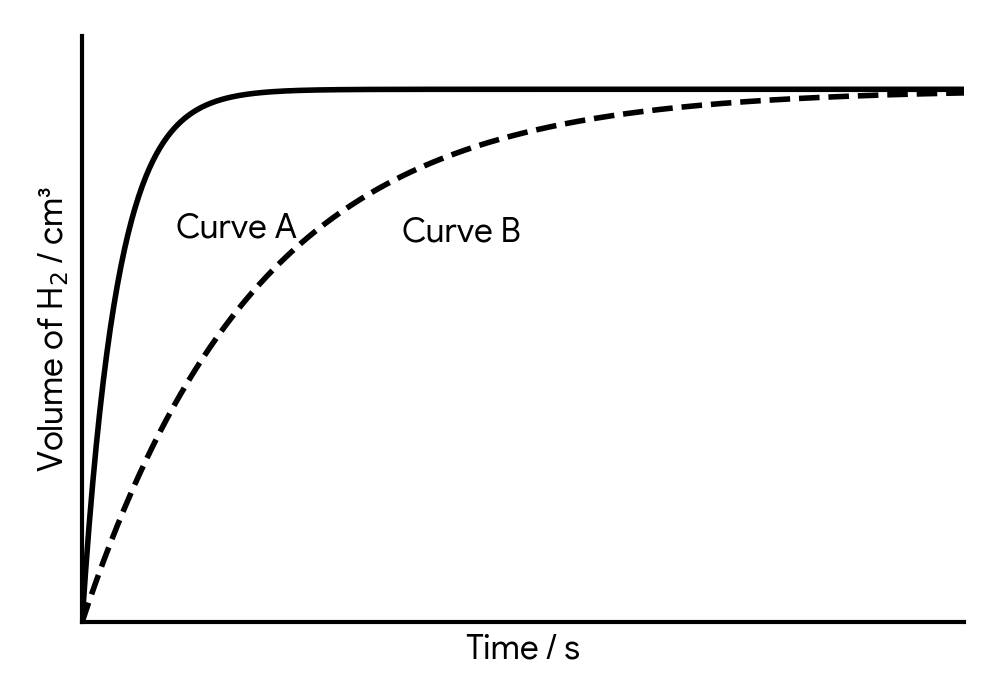
(c) (i) Identify which curve, A or B, represents the reaction with magnesium powder. Explain your answer using collision theory.
(ii) Explain why both curves reach the same final volume of hydrogen gas.
Identify the products of the reaction between a metal and an acid. Remember to include the physical state of each reactant and product at room temperature.
The reaction produces a gas and involves a solid reactant disappearing. How could you measure the change in the amount of gas over time? How could you measure the change in the total mass of the reaction system over time?
Consider how the surface area of the magnesium differs between a ribbon and a powder. How does surface area affect the rate of collisions between reactant particles?
Think about what determines the total amount of product formed in a reaction. Which reactant runs out first? Is the amount of this reactant the same in both experiments?
Question 19
MediumPaper 1A · calculator1 markA student investigates the thermal decomposition of calcium carbonate. What is the volume of carbon dioxide, in , produced at STP when of calcium carbonate undergoes complete thermal decomposition?
Molar volume of an ideal gas at STP is
A.
B.
C.
D.
First, calculate the molar mass of calcium carbonate. Then, determine the moles of calcium carbonate from the given mass. Use the stoichiometry of the balanced equation to find the moles of carbon dioxide produced. Finally, use the molar volume at STP to calculate the volume of carbon dioxide in and convert it to .
Question 20
MediumPaper 1A · calculator1 markA sample of butane gas, , was completely combusted in of oxygen gas, , at constant temperature and pressure.
The reaction is represented by the following equation:
What is the volume of unreacted oxygen gas remaining at the original conditions?
A.
B.
C.
D.
According to Gay-Lussac's Law of combining volumes, the ratio of volumes of gaseous reactants and products is the same as the ratio of their stoichiometric coefficients in the balanced chemical equation, provided temperature and pressure are constant. First, identify the limiting reactant.
No question on this page matches those filters. Try another difficulty or paper.
15 more How much? the amount of chemical change questions in the app
Every answer is marked mark by mark, IB-style, and the AI tutor helps when you are stuck.
Where marks are lost
- Reaching for "human error" or "only one trial." A source of error has to be a specific step in the method, not a general apology for the result.
- Joining the dots instead of drawing a curve.
- Naming a chemical instead of the property that distinguishes it, or vice versa. Answering with the nearest fact that comes to mind rather than the fact the command term and stem jointly ask for is a recurring way to answer a question that was not, quite, the one asked.