Nucleic Acids: notes and practice questions
- This topic covers the molecular structure of nucleic acids, DNA and RNA, and their fundamental roles in storing and transmitting genetic information.
- Nucleotides, the monomers of nucleic acids, consist of a phosphate group, a pentose sugar (deoxyribose in DNA, ribose in RNA), and a nitrogenous base.
- DNA forms a double helix with two antiparallel sugar-phosphate backbones, where complementary base pairs (adenine with thymine, guanine with cytosine) are linked by hydrogen bonds.
- RNA is typically a single-stranded polymer of nucleotides, differing from DNA by having uracil instead of thymine and ribose instead of deoxyribose.
- Complementary base pairing is essential for accurate DNA replication and gene expression.
- The genetic code's conservation across life forms provides evidence for universal common ancestry.
How it is examined
A heavy drawing and labelling topic. Paper 2 asks for nucleotide and RNA diagrams, and for state or outline of DNA/RNA differences. Hershey-Chase and Chargaff turn up at HL as data-interpretation stems in Paper 1B or as explain how the results support items in Paper 2. Watch the base-pair rule: writing "A pairs with T" with no mention of hydrogen bonding often costs the second mark.
- A1.2.1 DNA is the genetic material of all living organisms. Some viruses use RNA, but viruses are not considered living.
- A1.2.2 Components of a nucleotide. In diagrams, use circles for phosphates, pentagons for pentose sugars and rectangles for bases, in the relative positions the guide shows.
- A1.2.3 Sugar-phosphate bonding and the sugar-phosphate backbone. Covalent bonding makes a continuous chain in each strand and a strong backbone.
- A1.2.4 The bases in each nucleic acid as the basis of a code. Students should know the names of the nitrogenous bases.
Students are not required to memorize specific examples for A1.2.10.
- A1.2.11 Directionality of RNA and DNA, including 5' to 3' linkages in the backbone and what that means for replication, transcription and translation.
- A1.2.12 Purine-to-pyrimidine bonding as part of helix stability. A-T and C-G pairs are the same length, so the helix has the same three-dimensional structure whatever the base sequence.
- A1.2.13 Structure of a nucleosome: DNA wrapped around a core of eight histone proteins, held by an additional histone attached to linker DNA. Application of skills: students are required to use molecular visualization software to study the protein-DNA association in a nucleosome.
- A1.2.14 Evidence from the Hershey-Chase experiment for DNA as the genetic material, and how the results support that conclusion. NOS: technological developments open new experiments, here radioisotopes.
Guiding questions
- How does the structure of nucleic acids allow hereditary information to be stored?
- How does the structure of DNA facilitate accurate replication?
Linking questions
- What makes RNA more likely to have been the first genetic material, rather than DNA?
- How can polymerization result in emergent properties?
Practice questions
13 questions · 3 easy · 8 medium · 2 hardQuestion 1
EasyPaper 1A · calculator1 markWhich row correctly identifies structural features of DNA and RNA?
| Pentose sugar in DNA | Nitrogenous base in DNA but not RNA | Typical strand structure of RNA | |
|---|---|---|---|
| A. | Ribose | Uracil | Double-stranded |
| B. | Deoxyribose | Thymine | Single-stranded |
| C. | Deoxyribose | Uracil | Single-stranded |
| D. | Ribose | Thymine | Double-stranded |
Consider the three structural differences between DNA and RNA: the specific pentose sugar in each nucleotide, which nitrogenous base is unique to DNA versus RNA, and the number of strands typical for each molecule.
Question 2
MediumPaper 2 · calculator4 marksDescribe the structure of the DNA double helix and how it allows for the storage of genetic information.
Recall the components and bonding of the two strands in a DNA molecule (including the backbone and base pairing), and explain how the arrangement of nitrogenous bases provides an enormous capacity to store information.
Question 3
HardPaper 2 · calculator3 marksDuring the cell cycle, a cell must replicate its DNA prior to cell division to maintain genetic fidelity.
(a) State the two complementary base pairs that form in a DNA molecule.
(b) Explain how complementary base pairing and hydrogen bonding facilitate accurate DNA replication.
Recall which nitrogenous bases specifically pair together across the two strands of double-stranded DNA.
Think about how each original strand acts as a template, how specific bases align and bind to one another via hydrogen bonds, and the consequence for the nucleotide sequence of the newly formed strand.
Question 4
EasyPaper 1A · calculator1 markWhich statement correctly describes RNA?
A. It contains the pentose sugar deoxyribose.
B. It contains the nitrogenous base uracil instead of thymine.
C. It typically consists of two antiparallel strands.
D. Its sugar-phosphate backbone is held together by hydrogen bonds.
Recall the three main structural differences between DNA and RNA: the identity of the pentose sugar, the set of nitrogenous bases used, and the typical number of strands.
Question 5
MediumPaper 2 · calculator4 marksAll living organisms store their hereditary instructions in deoxyribonucleic acid (DNA).
Describe the structure of the DNA double helix and how this structure allows it to store limitless genetic information.
Think about the three main components of a DNA strand, how two strands interact and orient relative to each other, and how the four nitrogenous bases can be arranged along a strand of any length.
Question 6
HardPaper 2 · calculator3 marksBefore a somatic cell undergoes division, its double-stranded DNA must replicate to ensure that both daughter cells receive complete and accurate genetic instructions.
(a) Outline why the two strands of a DNA molecule can separate during replication without breaking the sugar-phosphate backbone.
(b) Explain how complementary base pairing and hydrogen bonding maintain genetic fidelity during DNA replication.
Consider the relative strengths of the bonds holding the two strands together down the center versus the bonds linking nucleotides along each strand.
Focus on the role of each original strand as a template, the specificity of base pairing (which base pairs with which), and how hydrogen bonding ensures that only the correct complementary nucleotides are joined into the new strand.
Question 7
EasyPaper 1A · calculator1 markWhich structural feature of DNA is essential for the accurate replication of genetic information?
A. The covalent bonds linking the sugar-phosphate backbone
B. The antiparallel orientation of the two polynucleotide strands
C. The specific hydrogen bonding between complementary bases
D. The presence of deoxyribose instead of ribose
Consider which part of the DNA molecule acts as a template and how the correct new nucleotides are selected and attached during the copying process.
Question 8
MediumPaper 1A · calculator1 markWhich statement correctly describes the structure of the sugar-phosphate backbone in a single strand of DNA?
A. Covalent bonds link the phosphate group of one nucleotide to the pentose sugar of the adjacent nucleotide.
B. Hydrogen bonds link adjacent pentose sugars directly to each other.
C. Covalent bonds link complementary nitrogenous bases along the length of the strand.
D. Hydrogen bonds link the phosphate group of one nucleotide to the pentose sugar of the adjacent nucleotide.
Think about the two distinct types of bonds found in DNA: one provides high structural strength along each individual strand, whereas the other joins complementary base pairs across opposing strands. Identify which components make up the outer chain.
Question 9
MediumPaper 1A · calculator1 markWhich row correctly identifies the components of the DNA backbone, the bonds linking those components within a strand, and the bonds linking complementary base pairs between strands?
| Components of the backbone | Bonds within the backbone | Bonds between complementary base pairs | |
|---|---|---|---|
| A. | Pentose sugars and phosphate groups | Covalent | Hydrogen |
| B. | Pentose sugars and phosphate groups | Hydrogen | Covalent |
| C. | Pentose sugars and nitrogenous bases | Covalent | Hydrogen |
| D. | Pentose sugars and nitrogenous bases | Hydrogen | Covalent |
Think about which parts of the nucleotide make up the continuous outer 'rail' of a DNA strand versus the central 'rungs'. Then, consider whether a permanent polymer chain requires strong covalent bonds or weaker hydrogen bonds.
Question 10
MediumPaper 2 · calculator3 marksBiochemists isolated two nucleic acid samples from a culture of eukaryotic cells: Sample A was extracted from the nucleus as the cell's chromosomal genetic material, and Sample B was extracted from the cytoplasm as mRNA transcripts.
(a) Distinguish between the nucleic acids in Sample A (DNA) and Sample B (RNA) based on their pentose sugars and nitrogenous bases.
(b) State the difference in the number of strands between DNA and RNA under typical cellular conditions.
Consider the names of the two nucleic acids to identify their five-carbon sugars, and recall which specific pyrimidine base is present only in RNA versus DNA.
Think about the helix structure formed by the two backbones in DNA compared to a transcript molecule.
Question 11
MediumPaper 2 · calculator3 marksA team of microbiologists isolated an unknown nucleic acid from a newly discovered single-celled organism inhabiting an Antarctic subglacial lake. Laboratory tests were conducted to determine whether the isolated polymer was DNA or RNA.
(a) Distinguish between DNA and RNA in terms of their nitrogenous base composition and the number of nucleotide strands.
(b) Identify the pentose sugar found in DNA and the pentose sugar found in RNA.
Consider which pyrimidine base is unique to DNA compared to RNA, and compare the number of nucleotide chains that compose each molecule.
Recall the full names of DNA and RNA; the prefix of each name reveals the specific five-carbon sugar present in its nucleotides.
Question 12
MediumPaper 2 · calculator7 marksThe diagram shows part of a DNA molecule undergoing replication.
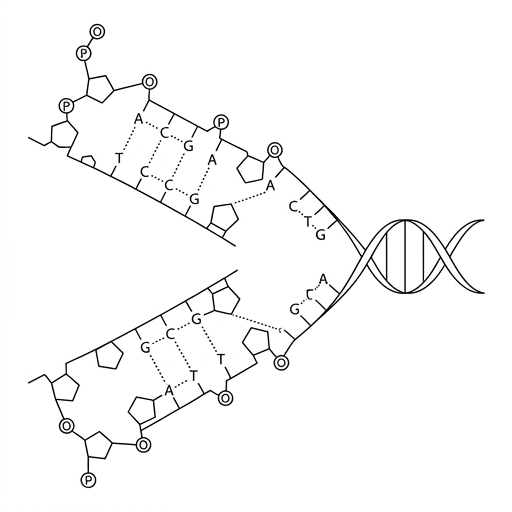
Identify two different types of chemical bonds shown in the DNA molecule.
(b) Explain the process of semi-conservative replication of DNA.
(c) Distinguish between the chromosomal DNA of prokaryotes and eukaryotes.
Look at the bonds that hold the two strands together, and the bonds that form the backbone of each individual strand.
Describe the key steps starting from the unwinding of the DNA double helix. Mention the roles of key enzymes and the principle of complementary base pairing. What does 'semi-conservative' mean in terms of the final product?
Think about the shape of the main chromosome, its location within the cell, and whether it is associated with any proteins.
Question 13
MediumPaper 2 · calculator4 marksThe diagram shows a simplified prokaryotic cell and a eukaryotic animal cell.
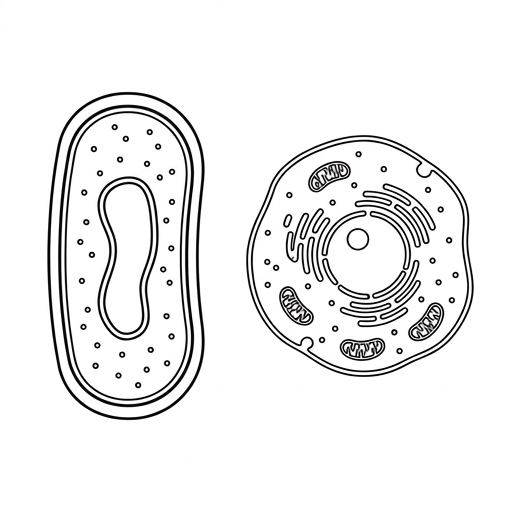
(a) State two structures that are present in both the prokaryotic cell and the eukaryotic animal cell.
(b) (i) State one membrane-bound organelle present in the eukaryotic cell but absent in the prokaryotic cell.
(b) (ii) State one difference, other than location, between the DNA of the prokaryotic cell and the DNA of the eukaryotic cell.
Look for components that are fundamental to any cell's basic function and boundary, regardless of its complexity.
Think about the key feature that defines a eukaryotic cell, which is the presence of internal compartments.
Consider the shape of the DNA molecule and what it is associated with inside the cell.
No question on this page matches those filters. Try another difficulty or paper.
Every Nucleic Acids question, marked for you
Every answer is marked mark by mark, IB-style, and the AI tutor helps when you are stuck.
Where marks are lost
- Command terms are consistently under-read. Students answer describe when the question said explain, so they give an account with no reasons and cap at half marks. The reverse also happens on outline, where a student writes an essay for a 2-mark summary and runs out of time.