DNA Replication: notes and practice questions
- This topic covers the process of DNA replication, its semi-conservative nature, and its applications in biotechnology.
- DNA replication produces exact copies of DNA with identical base sequences, essential for reproduction, growth, and tissue replacement.
- It is semi-conservative, meaning each new DNA molecule has one original strand and one newly synthesized strand, due to complementary base pairing.
- Helicase unwinds the DNA double helix and breaks hydrogen bonds, while DNA polymerase synthesizes new strands.
- Polymerase chain reaction (PCR) amplifies DNA using primers, temperature changes, and Taq polymerase.
- Gel electrophoresis separates DNA fragments based on size.
- Applications include DNA profiling for paternity and forensic investigations.
How it is examined
PCR appears as an outline the stages item, and the mark scheme wants denaturation, annealing of primers and extension by Taq polymerase with their temperature ranges. Gel electrophoresis questions ask why fragments separate, and the mark is for smaller fragments moving further because DNA is negatively charged and moves towards the anode. DNA profile images appear in Paper 1B as deduce items on paternity or forensic matches.
- D1.1.1 DNA replication as production of exact copies of DNA with identical base sequences, required for reproduction and for growth and tissue replacement in multicellular organisms.
- D1.1.2 Semi-conservative nature of DNA replication and the role of complementary base pairing, and how these allow a high degree of accuracy in copying base sequences.
- D1.1.3 Role of helicase and DNA polymerase, limited to helicase unwinding and breaking hydrogen bonds between DNA strands, and the general role of DNA polymerase.
- D1.1.4 Polymerase chain reaction and gel electrophoresis as tools for amplifying and separating DNA. Students should understand the use of primers, temperature changes and Taq polymerase in PCR, and the basis of separation of DNA fragments in gel electrophoresis.
- D1.1.6 Directionality of DNA polymerases. Students should understand the difference between the 5' and 3' terminals of strands of nucleotides, and that DNA polymerases add the 5' of a nucleotide to the 3' end of a strand.
- D1.1.7 Differences between replication on the leading strand and the lagging strand, including "continuous", "discontinuous" and "Okazaki fragments". Replication has to be initiated with RNA primer only once on the leading strand but repeatedly on the lagging strand.
- D1.1.8 Functions of DNA primase, DNA polymerase I, DNA polymerase III and DNA ligase in replication, limited to the prokaryotic system.
- D1.1.9 DNA proofreading, limited to the action of DNA polymerase III in removing any nucleotide from the 3' terminal with a mismatched base, followed by replacement with a correctly matched nucleotide.
Guiding questions
- How is new DNA produced?
- How has knowledge of DNA replication enabled applications in biotechnology?
Linking questions
- How is genetic continuity ensured between generations?
- What biological mechanisms rely on directionality?
Practice questions
8 questions · 1 easy · 6 medium · 1 hardQuestion 1
EasyPaper 1A · calculator1 markWhich row correctly describes the actions of helicase and DNA polymerase during DNA replication?
| Helicase | DNA polymerase | |
|---|---|---|
| A. | Breaks hydrogen bonds between nitrogenous bases | Forms covalent bonds between nucleotides |
| B. | Breaks covalent bonds between nucleotides | Forms hydrogen bonds between nitrogenous bases |
| C. | Breaks hydrogen bonds between nitrogenous bases | Breaks covalent bonds between nucleotides |
| D. | Forms covalent bonds between nucleotides | Forms hydrogen bonds between nitrogenous bases |
Recall which enzyme is responsible for separating the two strands of the double helix and which one is responsible for linking new monomers together to build the sugar-phosphate backbone.
Question 2
MediumPaper 1A · calculator1 markA researcher discovers a compound that specifically inhibits the activity of DNA ligase. If this compound is added to a culture of replicating cells, what would be the expected outcome?
A. Replication forks would not form because the DNA helix could not be unwound.
B. The lagging strand would be composed of unjoined Okazaki fragments.
C. RNA primers would not be synthesized on the template strands.
D. The leading strand would not be synthesized.
Recall the specific roles of the different enzymes in DNA replication. Think about how the leading and lagging strands are synthesized differently and which enzyme is responsible for joining the pieces of the lagging strand.
Question 3
HardPaper 1B · calculator10 marks(a.i) Escherichia coli (E. coli) bacteria were grown for many generations in a medium containing heavy nitrogen () and then transferred to a medium containing only light nitrogen (). DNA was extracted at , , , and , and separated by density gradient centrifugation. The denser the DNA, the further it moves towards the bottom of the centrifuge tube. The graph shows the amount of DNA at each position in the tube, measured by UV absorbance.
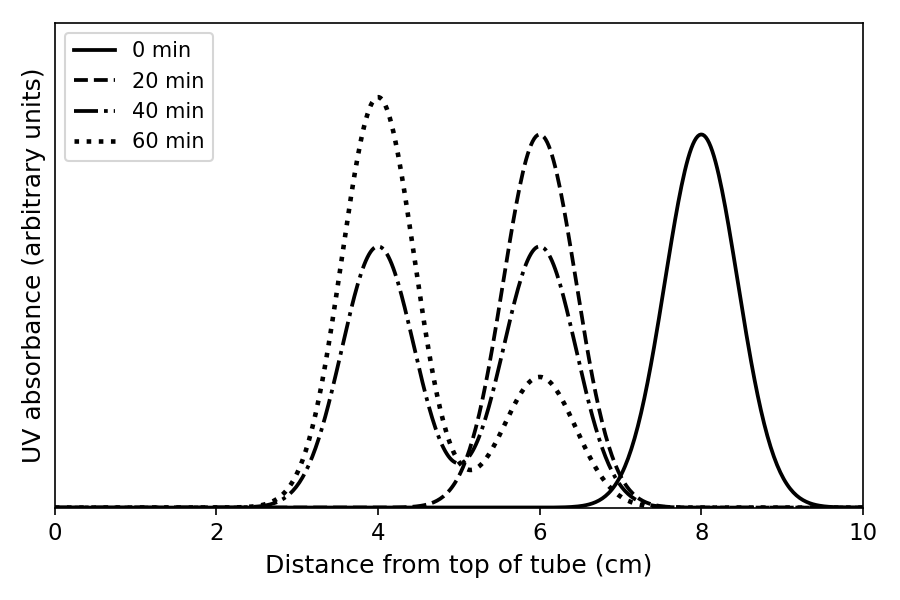
State whether the DNA at from the top of the tube was high density or low density.
(a.ii) Suggest reasons for the DNA forming a single band at after .
(a.iii) Deduce the name of the enzyme that synthesizes the new DNA strands.
(b.i) Distinguish between the and results.
(b.ii) Explain the results at by the activity of helicase and DNA polymerase.
Look at the axis labels and the description in the text. Does a larger distance from the top of the tube mean the DNA is denser or less dense?
Think about the Meselson-Stahl experiment and what happens to the two strands of the original DNA molecule during the first round of replication in the new medium.
Which enzyme is responsible for adding free nucleotides to form a new complementary DNA strand?
Compare the heights of the peaks at and for both time points. What does the area under the curve represent in terms of total DNA?
Describe the specific roles of the two main replication enzymes and how they act on the intermediate DNA molecules that were present at the 20-minute mark.
Question 4
MediumPaper 2 · calculator7 marksThe diagram shows part of a DNA molecule undergoing replication.
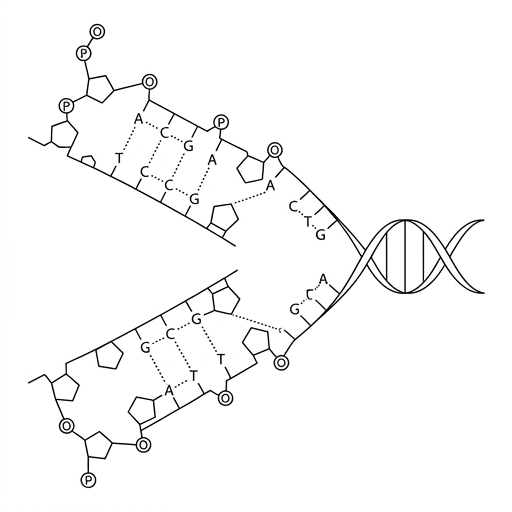
Identify two different types of chemical bonds shown in the DNA molecule.
(b) Explain the process of semi-conservative replication of DNA.
(c) Distinguish between the chromosomal DNA of prokaryotes and eukaryotes.
Look at the bonds that hold the two strands together, and the bonds that form the backbone of each individual strand.
Describe the key steps starting from the unwinding of the DNA double helix. Mention the roles of key enzymes and the principle of complementary base pairing. What does 'semi-conservative' mean in terms of the final product?
Think about the shape of the main chromosome, its location within the cell, and whether it is associated with any proteins.
Question 5
MediumPaper 1A · calculator1 markThe polymerase chain reaction (PCR) involves repeated cycles of heating and cooling to amplify a specific DNA sequence. What is the purpose of the initial high-temperature step (around 95 °C) in a PCR cycle?
A. To allow the primers to bind to the single-stranded DNA template.
B. To allow Taq polymerase to synthesize new DNA strands.
C. To break the hydrogen bonds between the two strands of the DNA template.
D. To join the newly synthesized DNA fragments into a continuous strand.
Think about the structure of a DNA double helix and what must happen before it can be copied. What kind of bonds hold the two strands together, and how are they affected by heat?
Question 6
MediumPaper 2 · calculator5 marks(a) The polymerase chain reaction (PCR) is widely used in biotechnology to amplify small samples of DNA, such as those found at a crime scene. The process relies on principles similar to cellular DNA replication.
Explain the role of complementary base pairing in the semi-conservative replication of DNA.
(b.i) Outline the role of helicase in cellular DNA replication.
(b.ii) State how the separation of DNA strands is achieved during the polymerase chain reaction (PCR).
Think about the specific rules for how bases pair up and how this helps create an exact copy using the original strand as a guide.
What does helicase do to the DNA double helix to prepare it for copying?
PCR does not use helicase. What physical condition is changed in the thermal cycler to separate the strands?
Question 7
MediumPaper 2 · calculator10 marksThe diagram shows the DNA profiles of three wolves from a pack. Two of the wolves are the parents and one is their offspring.
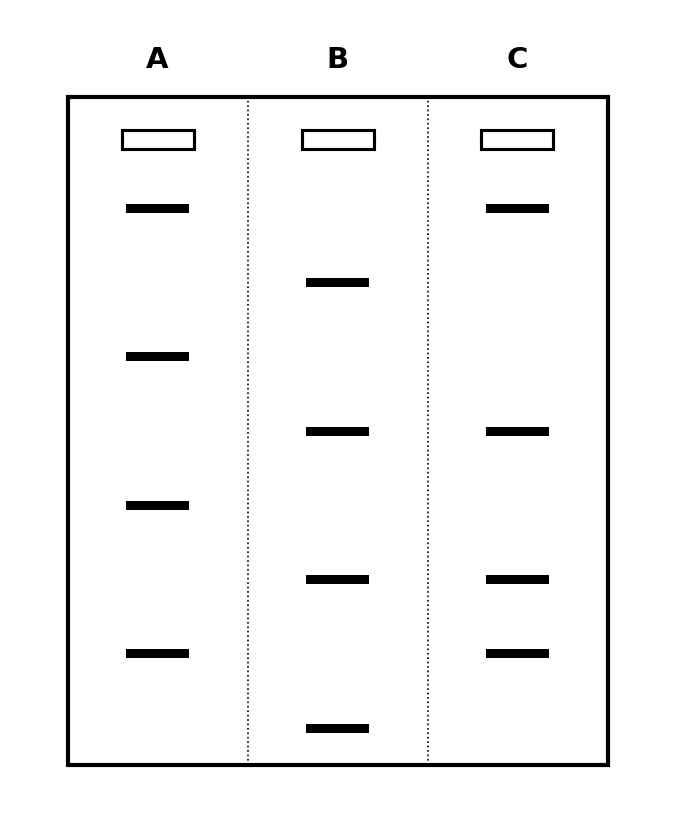
(a) Explain how DNA profiling can be used to establish genetic relationships between animals.
(b) Deduce, giving reasons, which profile belongs to the offspring.
Think about the two main laboratory techniques used to copy the DNA and then separate the fragments to create a visible pattern. Why do the fragments separate, and how do the bands relate to inheritance?
An offspring inherits half of its DNA from each parent. Look for the profile that is a complete mixture of the other two.
Question 8
MediumPaper 1A · calculator1 markA cell containing a single DNA double helix, in which both strands are radioactively labelled, is placed in a medium containing only unlabelled nucleotides. The cell divides twice to produce four cells, each containing one DNA double helix.
How many of these four DNA molecules will contain at least one radioactively labelled strand?
A.
B.
C.
D.
Remember that DNA replication is semi-conservative. Trace the original two labelled strands through two rounds of replication.
No question on this page matches those filters. Try another difficulty or paper.
Every DNA Replication question, marked for you
Every answer is marked mark by mark, IB-style, and the AI tutor helps when you are stuck.
Where marks are lost
- Command terms are consistently under-read. Students answer describe when the question said explain, so they give an account with no reasons and cap at half marks. The reverse also happens on outline, where a student writes an essay for a 2-mark summary and runs out of time.