Reproduction: notes and practice questions
- This topic covers the mechanisms and processes of reproduction in living organisms, focusing on both sexual and asexual strategies.
- Asexual reproduction produces genetically identical offspring, while sexual reproduction generates variation through meiosis and gamete fusion.
- Human reproduction involves male and female reproductive systems, with hormonal regulation of ovarian and uterine cycles by oestradiol, progesterone, LH, and FSH.
- Fertilization in humans includes sperm-egg membrane fusion and the formation of a diploid zygote.
- Sexual reproduction in flowering plants involves gamete production, pollination, fertilization, and subsequent seed dispersal and germination.
- Cross-pollination is promoted by various mechanisms to increase genetic diversity.
How it is examined
The menstrual cycle is the highest-tariff item here and a regular Paper 2 extended response. The mark scheme wants each hormone, its source, its target and its feedback direction, and the LH surge triggered by high oestradiol through positive feedback is the point most often missed. Flower and reproductive system diagrams are drawn items marked on structure names plus functions. At HL, the progesterone-to-oxytocin switch at childbirth is a set-piece positive feedback question.
- D3.1.1 Differences between sexual and asexual reproduction, including these relative advantages: asexual reproduction produces genetically identical offspring from individuals already adapted to an existing environment; sexual reproduction produces offspring with new gene combinations and so the variation needed for adaptation to a changed environment.
- D3.1.2 Role of meiosis and fusion of gametes in the sexual life cycle. Meiosis breaks up parental combinations of alleles and fusion of gametes produces new combinations. Fusion of gametes is also known as fertilization.
- D3.1.3 Differences between male and female sexes in sexual reproduction. The prime difference is that the male gamete travels to the female gamete, so it is smaller with less food reserves than the egg, and from this follow differences in gamete numbers and in reproductive strategies.
- D3.1.4 Anatomy of the human male and female reproductive systems. Students should be able to draw diagrams of the male-typical and female-typical systems and annotate them with names of structures and functions.
- D3.1.13 Control of the developmental changes of puberty by gonadotropin-releasing hormone and steroid sex hormones, limited to increased release of GnRH by the hypothalamus in childhood triggering increased LH and FSH release, with increased sex hormone production ultimately leading to the changes associated with puberty.
- D3.1.14 Spermatogenesis and oogenesis in humans, including mitosis, cell growth, two divisions of meiosis and differentiation, and how gametogenesis results in different numbers of sperm and eggs and different amounts of cytoplasm.
- D3.1.15 Mechanisms to prevent polyspermy. The acrosome reaction allows a sperm to penetrate the zona pellucida and the cortical reaction prevents other sperm from passing through.
- D3.1.16 Development of a blastocyst and implantation in the endometrium.
Guiding questions
- How does asexual or sexual reproduction exemplify themes of change or continuity?
- What changes within organisms are required for reproduction?
Linking questions
- How can interspecific relationships assist in the reproductive strategies of living organisms?
- What are the roles of barriers in living systems?
Practice questions
12 questions · 3 easy · 8 medium · 1 hardQuestion 1
EasyPaper 2 · calculator10 marksOrganisms can reproduce using sexual or asexual strategies.
(a) Explain whether the propagation of a cassava plant by planting stem cuttings is sexual or asexual reproduction.
(b) Explain whether in vitro fertilization (IVF) in humans is sexual or asexual reproduction.
(c) Explain whether a single Amoeba dividing into two cells by mitosis is sexual or asexual reproduction.
(d) Explain whether the production of seeds in a flowering plant following cross-pollination is sexual or asexual reproduction.
(e) Explain whether the artificial insemination of a female sheep using semen collected from a ram is sexual or asexual reproduction.
Consider how many parents are involved and whether gametes (sex cells) are fusing.
Think about what is being combined in the glass dish during the IVF procedure.
Recall the purpose and outcome of mitosis in unicellular organisms.
Consider what pollen contains and what it must fuse with to form a seed.
Focus on the biological cells involved in the process, regardless of how they are introduced.
Question 2
MediumPaper 1A · calculator1 markThe process of childbirth involves a positive feedback loop. Stretching of the cervix sends signals to the hypothalamus, which then stimulates the posterior pituitary to release a hormone. This hormone increases the strength of uterine contractions, leading to further stretching of the cervix. Which hormone is central to this process?
A. Progesterone
B. Oxytocin
C. Luteinizing hormone (LH)
D. Prolactin
Consider the roles of different hormones in the later stages of pregnancy and during labour. Which one is known for stimulating contractions? Think about what 'positive feedback' means in this context – the output of the system enhances the original stimulus.
Question 3
HardPaper 2 · calculator15 marksSexual reproduction in flowering plants involves the production of gametes by meiosis, followed by pollination and fertilization.
Outline the events that occur during prophase I of meiosis.
Describe the process of fertilization in flowering plants.
Explain how meiosis and sexual reproduction promote genetic variation in a population.
Think about what happens to the chromosomes before they align at the equator. How do homologous chromosomes interact?
Trace the path of the male gamete from the moment a pollen grain lands on the flower until it reaches the egg.
Consider the two main sources of variation during meiosis, and what happens when gametes from two different individuals combine.
Question 4
EasyPaper 1A · calculator1 markWhich of the following adaptations in a flowering plant is most likely to promote cross-pollination?
A. The maturation of anthers and stigmas at different times
B. The positioning of anthers directly above the stigma
C. The maturation of anthers and stigmas at the same time
D. The production of flowers that remain closed until fertilization occurs
Consider which of these options would prevent a flower's own pollen from successfully landing on and fertilizing its own stigma.
Question 5
MediumPaper 1A · calculator1 markWhich of the following events are required to trigger ovulation in the human menstrual cycle?
I. Positive feedback of estrogen on the hypothalamus and anterior pituitary
II. A surge in luteinizing hormone (LH) secretion
III. High levels of progesterone secretion from the corpus luteum
A. I only
B. I and II only
C. II and III only
D. I, II and III
Think about the sequence of hormonal changes during the follicular phase leading up to day 14 of the cycle. Which hormone peaks just before ovulation, and what causes this peak?
Question 6
EasyPaper 1A · calculator1 markA researcher observes different types of cell division under a microscope. In one instance, they note that the cytoplasm is divided unequally, resulting in one large cell and one much smaller daughter cell.
Which process is the researcher observing?
A. Yeast undergoing budding
B. Escherichia coli undergoing binary fission
C. B-lymphocytes undergoing clonal expansion
D. A human zygote undergoing cleavage
Think about which form of asexual reproduction produces a smaller outgrowth from the parent cell rather than splitting the cell perfectly in half.
Question 7
MediumPaper 1A · calculator1 markWhat is the primary role of Luteinizing Hormone (LH) in the ovarian cycle?
A. It stimulates the final maturation of the follicle and triggers ovulation.
B. It causes the degeneration of the corpus luteum.
C. It stimulates the development of multiple primary follicles.
D. It directly causes the thickening of the endometrium.
Consider the event that occurs around day 14 of the menstrual cycle. Which hormone surges to cause this event?
Question 8
MediumPaper 1A · calculator1 markThe diagram shows a cross-section of a flower after pollination.
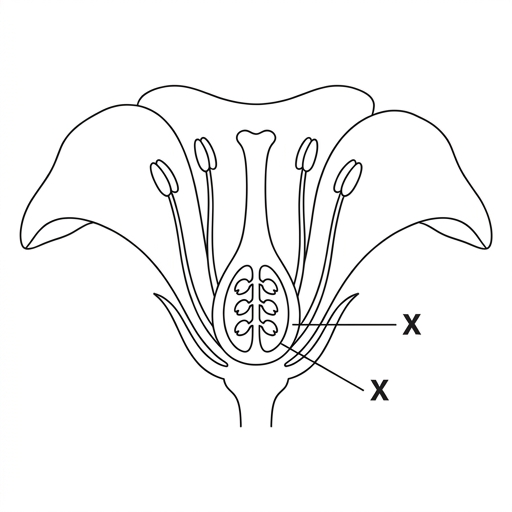
What is the fate of structure X and its contents after fertilization?
A. Structure X develops into the seed and its contents develop into the fruit.
B. Structure X develops into the fruit and its contents develop into the seeds.
C. Both structure X and its contents develop into the seed.
D. Both structure X and its contents develop into the fruit.
Recall the botanical definitions of a fruit and a seed. Which part of the flower develops into which structure?
Question 9
MediumPaper 2 · calculator4 marks(a) The volume of a human ovum is approximately and the volume of a human sperm cell is approximately . Calculate the ratio of the volume of the ovum to the volume of the sperm cell.
(b) Suggest reasons for the large difference in volume between the ovum and the sperm cell.
Divide the volume of the ovum by the volume of the sperm cell to find how many times larger it is.
Consider the different functions of the two gametes during and immediately after fertilization.
Question 10
MediumPaper 2 · calculator10 marksHumans reproduce sexually, relying on different types of cell division for growth and reproduction.
(a) Compare the outcomes of mitosis and meiosis in human reproduction.
(b) Distinguish between human male and female gametes.
(c) Explain the events that occur during human fertilization after a sperm reaches the egg.
(d) Explain the role of progesterone in the human menstrual cycle.
Think about the number of cells produced, their genetic composition, and their specific roles in the human life cycle.
Focus on differences in size, mobility, numbers produced, and specific structural features like the acrosome or cortical granules.
Describe what happens when the membranes fuse, how the egg prevents other sperm from entering, and what happens to the nuclei.
Consider where progesterone is produced after ovulation and its effects on the uterine lining and pituitary hormones.
Question 11
MediumPaper 1A · calculator1 markWhich event occurs during the process of fertilization in humans?
A. The plasma membranes of the sperm and the egg fuse together.
B. The secondary oocyte completes meiosis I.
C. The zygote receives an equal number of mitochondria from both gametes.
D. The genetic material of the sperm and egg replicates immediately before fusion.
Consider what physical boundary must be crossed for the genetic material of the sperm to enter the egg, and recall which type of cell division is completed upon fertilization.
Question 12
MediumPaper 1A · calculator1 markIn the foxglove plant (Digitalis purpurea), the anthers release their pollen before the stigma of the same flower becomes receptive. What is the primary evolutionary advantage of this mechanism?
A. It guarantees fertilization if cross-pollination fails.
B. It increases genetic variation among the offspring.
C. It decreases the rate of mutation in the gametes.
D. It reduces the energy required for pollen production.
Consider what happens if a flower's pollen cannot fertilize its own stigma. Where must the pollen go, and what effect does this have on the genetics of the next generation?
No question on this page matches those filters. Try another difficulty or paper.
Every Reproduction question, marked for you
Every answer is marked mark by mark, IB-style, and the AI tutor helps when you are stuck.
Where marks are lost
- Command terms are consistently under-read. Students answer describe when the question said explain, so they give an account with no reasons and cap at half marks. The reverse also happens on outline, where a student writes an essay for a 2-mark summary and runs out of time.
- compare and contrast answers give only similarities, or only differences.