Cell Specialization: notes and practice questions
- This topic covers how unspecialized cells develop into specialized cells through differentiation and the properties of stem cells.
- Unspecialized cells are produced after fertilization and differentiate based on gene expression in early embryos.
- Stem cells can divide endlessly and differentiate into various cell types.
- Totipotent cells (early embryo) can form any cell type, pluripotent (later embryo) can form many, and multipotent (adult) are more restricted.
- Cell size is a specialization aspect, with the surface area-to-volume ratio influencing material exchange efficiency.
How it is examined
Surface area-to-volume ratio is a calculation item that appears in Paper 1B as well as Paper 2, and the answer needs the ratio itself, not just the two numbers. The totipotent/pluripotent/multipotent distinction is a common distinguish item, and mixing up "can become any cell type" with "can become any cell type plus placental tissue" is the usual error.
- B2.3.1 Production of unspecialized cells after fertilization and their development into specialized cells by differentiation, including the impact of gradients on gene expression in an early-stage embryo.
- B2.3.2 Properties of stem cells, limited to the capacity to divide endlessly and to differentiate along different pathways.
- B2.3.3 Location and function of stem cell niches in adult humans, limited to two example locations, with bone marrow and hair follicles as suitable examples, and the understanding that a niche can maintain cells or promote their proliferation and differentiation.
- B2.3.4 Differences between totipotent, pluripotent and multipotent stem cells. Cells in early-stage animal embryos are totipotent but soon become pluripotent; adult tissue stem cells such as bone marrow are multipotent.
Stem cell properties are limited to endless division plus differentiation, so therapeutic-use detail is not required here.
- B2.3.7 Adaptations to increase surface area-to-volume ratios: flattening of cells, microvilli and invagination, with erythrocytes and proximal convoluted tubule cells in the nephron as the examples.
- B2.3.8 Adaptations of type I and type II pneumocytes in alveoli, limited to extreme thinness reducing diffusion distance in type I, and many secretory vesicles (lamellar bodies) discharging surfactant into the alveolar lumen in type II. Alveolar epithelium shows a tissue with more than one cell type.
- B2.3.9 Adaptations of cardiac muscle cells and striated muscle fibres, including contractile myofibrils in both, plus branching (branched or unbranched), length and number of nuclei, and a discussion of whether a striated muscle fibre is a cell.
- B2.3.10 Adaptations of sperm and egg cells, limited to gametes in humans.
Guiding questions
- What are the roles of stem cells in multicellular organisms?
- How are differentiated cells adapted to their specialized functions?
Linking questions
- What are the advantages of small size and large size in biological systems?
- How do cells become differentiated?
Practice questions
9 questions · 2 easy · 7 mediumQuestion 1
EasyPaper 1A · calculator1 markHematopoietic stem cells in the bone marrow can divide and differentiate into red blood cells, white blood cells, and platelets, but cannot form muscle or nerve cells. Which term best describes these stem cells?
A. Totipotent
B. Pluripotent
C. Multipotent
D. Unipotent
Consider which type of stem cell is found in adult tissues and has a restricted capacity to differentiate into only a few closely related cell types.
Question 2
MediumPaper 1A · calculator1 markA researcher isolates cells from the inner cell mass of a human blastocyst. These cells are cultured in vitro and demonstrate the ability to differentiate into various specialized cell types, including neurons, muscle cells, and blood cells, but not into placental tissue. Which term best describes the potency of these stem cells?
A. Totipotent
B. Pluripotent
C. Multipotent
D. Unipotent
Consider the definition of each type of stem cell potency and what tissues they are capable of forming. Specifically, think about the distinction between forming all cell types of an organism versus also forming extraembryonic tissues.
Question 3
EasyPaper 1A · calculator1 markWhich is a correct description of the potency of stem cells?
A. Stem cells in the early embryo are multipotent.
B. Stem cells in the later embryo are pluripotent.
C. Stem cells in adult bone marrow are totipotent.
D. Stem cells in adult skin are pluripotent.
Recall the hierarchy of stem cell potency from the earliest stage of development to adulthood. Which type of stem cell has the most restricted differentiation potential?
Question 4
MediumPaper 2 · calculator5 marksThe image shows a transmission electron micrograph (TEM) of a chloroplast.
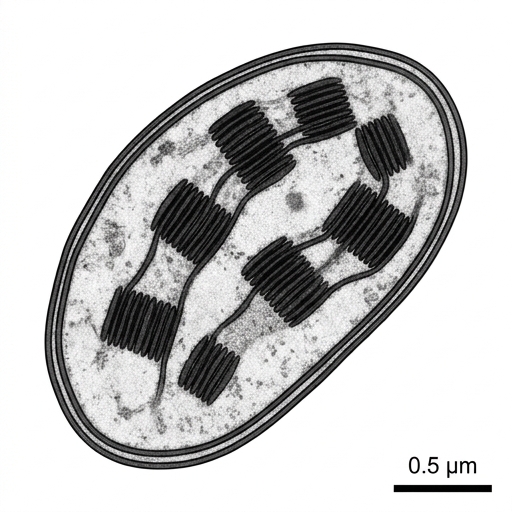
(a)
(i) Name a type of cell in a flowering plant that does not contain chloroplasts.
(a) (ii) State two products of the overall process of photosynthesis.
(b) Chloroplasts contain their own circular DNA and 70S ribosomes. Explain how these features provide evidence for the endosymbiotic theory.
Consider the different parts of a plant. Which parts are not exposed to sunlight and therefore have no need for photosynthesis?
Recall the word equation for photosynthesis. The products are the substances that are created during the reaction.
Compare the features mentioned (circular DNA, 70S ribosomes) with the features of prokaryotic and eukaryotic cells. What does the term 'endosymbiosis' imply about the origin of this organelle?
Question 5
MediumPaper 1B · calculator10 marks(a) The table shows the areas of different membranes () in a plasma cell (an antibody-secreting B lymphocyte).
| Membrane | Area / |
|---|---|
| Rough endoplasmic reticulum | 18 000 |
| Smooth endoplasmic reticulum | 150 |
| Outer mitochondrial membrane | 1 200 |
| Inner mitochondrial membrane | 6 500 |
| Plasma membrane | 864 |
| Golgi apparatus | 1 800 |
| Nucleus | 300 |
Calculate the volume of the plasma cell, assuming it is cubic.
(b) Explain the difference in area of the inner and outer mitochondrial membranes.
(c) Justify the conclusion that the plasma cell is highly specialized for protein secretion.
(d) Comment on the area of the smooth endoplasmic reticulum in the plasma cell.
Remember that a cube has 6 identical square faces. First find the area of one face using the plasma membrane area, then find the side length, and finally calculate the volume.
Think about the structure of the inner mitochondrial membrane and the specific biochemical processes that occur there.
Look at the areas of the organelles involved in the synthesis, modification, and packaging of proteins.
Compare the area of the smooth ER to the rough ER, and consider the specific functions of the smooth ER that might not be needed in a plasma cell.
Question 6
MediumPaper 2 · calculator4 marks(a) The volume of a human ovum is approximately and the volume of a human sperm cell is approximately . Calculate the ratio of the volume of the ovum to the volume of the sperm cell.
(b) Suggest reasons for the large difference in volume between the ovum and the sperm cell.
Divide the volume of the ovum by the volume of the sperm cell to find how many times larger it is.
Consider the different functions of the two gametes during and immediately after fertilization.
Question 7
MediumPaper 2 · calculator10 marksThe table shows the percentage composition by volume of three types of mammalian cell. Cytoplasm volumes do not include membrane-bound organelles. Macrophages engulf and digest bacterial pathogens. Pancreatic acinar cells synthesize and secrete digestive enzymes. Cardiac muscle cells contract continuously to pump blood.
| Component | Pancreatic acinar (%) | Cardiac muscle (%) | Macrophage (%) |
|---|---|---|---|
| Cytoplasm | 42.1 | 51.5 | 61.2 |
| Nucleus | 8.4 | 4.2 | 11.5 |
| Mitochondria | 7.8 | 36.4 | 4.9 |
| Rough ER | 26.5 | 1.5 | 4.2 |
| Lysosomes | 1.2 | 0.8 | 14.6 |
Suggest reasons for the differences in the volume of mitochondria across the three cell types.
Suggest reasons for the differences in the volume of rough endoplasmic reticulum (rER) across the three cell types.
Suggest reasons for the differences in the volume of lysosomes across the three cell types.
The total percentages for each cell type are lower than 100%. Deduce the reason for this.
Think about the specific energy requirements of each cell type based on their functions described in the text.
Relate the function of the rough ER to the specific products made by pancreatic acinar cells.
Consider what lysosomes contain and how that relates to the function of a macrophage.
Are there any other structures inside a eukaryotic cell that take up space but are not listed in the table?
Question 8
MediumPaper 1A · calculator1 markAs cells differentiate, their size and shape become specialized for their function. Which of the following cells has the lowest surface area-to-volume ratio?
A. Egg cell
B. Red blood cell
C. Sperm cell
D. White blood cell
Remember that as a cell's volume increases, its surface area-to-volume ratio decreases. Which of these cells is the largest?
Question 9
MediumPaper 1A · calculator1 markWhat is the effect of chemical signalling gradients on unspecialized cells in an early embryo?
A. They trigger the cells to differentiate by altering gene expression.
B. They cause the cells to undergo meiosis to form gametes.
C. They stimulate the cells to replicate their DNA without dividing.
D. They induce the cells to eliminate unnecessary chromosomes.
Think about how a single fertilized egg can give rise to many different types of tissues, even though all the cells contain the same DNA.
No question on this page matches those filters. Try another difficulty or paper.
Every Cell Specialization question, marked for you
Every answer is marked mark by mark, IB-style, and the AI tutor helps when you are stuck.
Where marks are lost
- Command terms are consistently under-read. Students answer describe when the question said explain, so they give an account with no reasons and cap at half marks. The reverse also happens on outline, where a student writes an essay for a 2-mark summary and runs out of time.