Neural Signalling: notes and practice questions
- This topic covers neuron structure, electrical signal generation and propagation, and synaptic transmission.
- Neurons transmit electrical impulses along axons and dendrites.
- A negative resting potential is maintained by ATP-driven sodium-potassium pumps.
- Nerve impulses are action potentials, involving movement of positively charged ions.
- Impulse speed varies with axon diameter and myelination.
- Chemical synapses transmit signals unidirectionally between neurons or to effector cells.
- Neurotransmitters released from the presynaptic membrane bind to postsynaptic receptors, generating a potential.
How it is examined
Oscilloscope trace reading is an HL Paper 1B staple: identify the resting potential in mV, identify the point where sodium channels open, calculate impulses per second. Synaptic transmission is a sequenced outline worth 3 to 5 marks and the mark scheme runs in order, so a jumbled answer still scores if each step is present but a missing step (calcium influx, vesicle fusion, diffusion, receptor binding) loses its own mark. The resting potential explanation needs three sodium out to two potassium in to reach the "negative inside" mark cleanly.
- C2.2.1 Neurons as cells within the nervous system that carry electrical impulses. Cytoplasm and a nucleus form the cell body, with elongated nerve fibres of varying length projecting from it. An axon is a long single fibre; dendrites are multiple shorter fibres. Impulses are conducted along these fibres.
- C2.2.2 Generation of the resting potential by pumping to establish and maintain concentration gradients of sodium and potassium ions. Energy from ATP drives the pumping of sodium and potassium in opposite directions across the plasma membrane. Students should understand membrane polarization, membrane potential, and the reasons the resting potential is negative.
- C2.2.3 Nerve impulses as action potentials propagated along nerve fibres. A nerve impulse is electrical because it involves movement of positively charged ions.
- C2.2.4 Variation in the speed of nerve impulses. Compare transmission speed in giant axons of squid with smaller non-myelinated fibres, and myelinated with non-myelinated fibres. Application of skills: describe negative and positive correlations, apply correlation coefficients to determine the strength of a correlation, and apply the coefficient of determination (R squared) to evaluate how far variation in the independent variable explains variation in the dependent variable. Conduction speed is negatively correlated with animal size and positively correlated with axon diameter.
- C2.2.8 Depolarization and repolarization during action potentials, including the action of voltage-gated sodium and potassium channels and the need for a threshold potential to be reached for sodium channels to open.
- C2.2.9 Propagation of an action potential along a nerve fibre as a result of local currents. Diffusion of sodium ions both inside and outside the axon can cause the threshold potential to be reached.
- C2.2.10 Oscilloscope traces showing resting potentials and action potentials. Application of skills: interpret the trace in relation to cellular events, and measure the number of impulses per second.
- C2.2.11 Saltatory conduction in myelinated fibres to achieve faster impulses. Ion pumps and channels are clustered at nodes of Ranvier and an action potential is propagated from node to node.
Guiding questions
- How are electrical signals generated and moved within neurons?
- How can neurons interact with other cells?
Linking questions
- In what ways are biological systems regulated?
- How is the structure of specialized cells related to function?
Practice questions
7 questions · 1 easy · 4 medium · 2 hardQuestion 1
EasyPaper 1A · calculator1 markThe table shows the characteristics of four different axons. Which axon would transmit an action potential at the greatest velocity?
| Axon | Axon diameter / | Myelin sheath |
|---|---|---|
| A | 2 | Absent |
| B | 2 | Present |
| C | 20 | Absent |
| D | 20 | Present |
A. Axon A
B. Axon B
C. Axon C
D. Axon D
Consider the two main factors that increase the speed of a nerve impulse: the physical width of the axon and whether the impulse can jump between nodes.
Question 2
MediumPaper 1A · calculator1 markOrganophosphate pesticides are potent neurotoxins that irreversibly inhibit the enzyme acetylcholinesterase. What is the direct consequence of this inhibition at a cholinergic synapse?
A. Acetylcholine is not released from the presynaptic neuron.
B. The resting potential of the postsynaptic neuron cannot be established.
C. Acetylcholine remains in the synaptic cleft, causing continuous stimulation of the postsynaptic neuron.
D. Voltage-gated sodium channels on the postsynaptic membrane are permanently blocked.
Consider the normal function of acetylcholinesterase at a synapse. What process does it catalyse? If this enzyme is inhibited, what substance will accumulate in the synaptic cleft and what effect will this have?
Question 3
HardPaper 2 · calculator15 marksThe transmission of nerve impulses involves the coordinated movement of ions across and along the neuron membrane.
(a) Outline how active transport establishes and maintains the resting potential of a neuron.
(b) Describe the role of myelin in the propagation of a nerve impulse.
(c) Explain how facilitated diffusion and simple diffusion contribute to the generation and propagation of an action potential.
Think about the specific membrane protein that uses ATP to move ions when the neuron is not transmitting a signal, and how many of each ion it moves.
Consider how the myelin sheath affects the permeability of the axon membrane and where the action potentials are forced to occur.
Break down the action potential into depolarization and repolarization for facilitated diffusion, and then consider how the signal moves down the axon for simple diffusion.
Question 4
MediumPaper 1A · calculator1 markThe diagram shows the changes in membrane potential during an action potential. What causes the membrane potential to begin to decrease after reaching the peak at R?
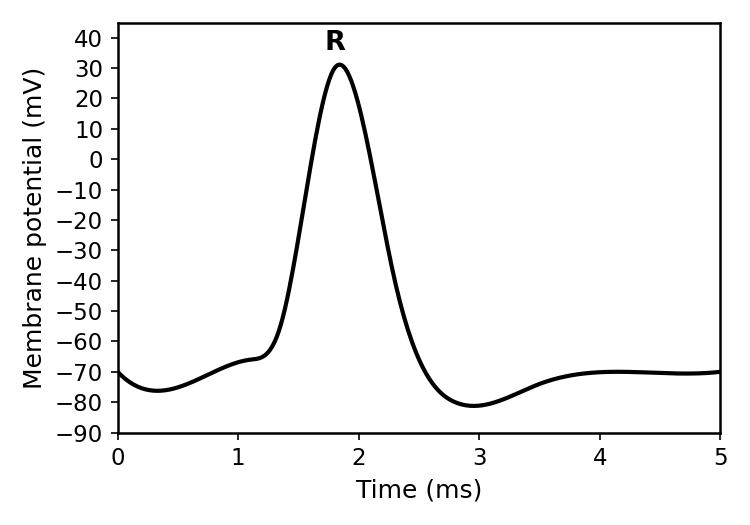
A. Opening of voltage-gated Na channels.
B. Closing of voltage-gated K channels.
C. Inactivation of voltage-gated Na channels and opening of voltage-gated K channels.
D. Activity of the Na/K pump.
Consider the movement of ions that would make the inside of the neuron more negative relative to the outside. Which ion channels are responsible for repolarization?
Question 5
HardPaper 2 · calculator13 marks(a) The graph shows oscilloscope traces for a sensory neuron (presynaptic) and a relay neuron (postsynaptic) in a spinal cord reflex arc. Both neurons have a resting potential of .
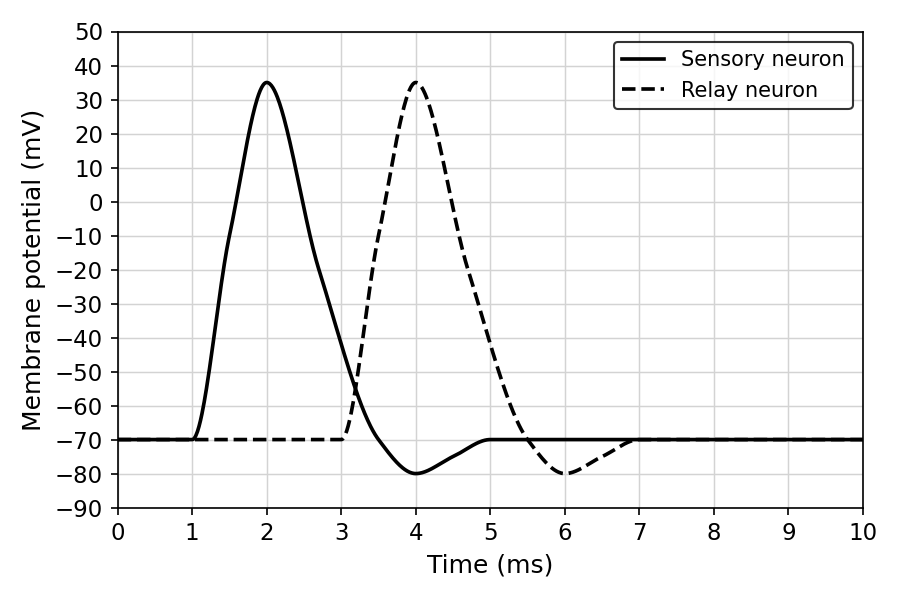
Calculate the total change in membrane potential during the depolarization phase of the sensory neuron.
(b) Estimate the time taken for repolarization to occur in the sensory neuron, from the peak of the action potential until it first returns to the resting potential.
(c) Identify the state of the voltage-gated sodium and potassium channels in the sensory neuron at .
(d) Calculate the synaptic delay between the start of depolarization in the sensory neuron and the start of depolarization in the relay neuron.
(e) Explain the sequence of events occurring at the synapse that accounts for this delay.
(f) In a separate trial, the relay neuron trace shows a small depolarization to , but no action potential is generated. Deduce the meaning of the "all-or-nothing" principle using this information.
(g) Suggest two reasons why the relay neuron might only reach in this trial.
Think about the difference between the peak voltage and the resting voltage.
Repolarization is the falling phase of the action potential. Look at when it starts to fall and when it hits the resting potential line again.
At 1.5 ms, the membrane potential is increasing (depolarizing). Which ions are moving to cause this?
Find the time difference between the start of the first action potential and the start of the second.
What physical and chemical processes must happen between the arrival of an impulse at the presynaptic terminal and the generation of a new impulse in the postsynaptic neuron?
Consider what happens when a stimulus is too weak versus when it is strong enough.
Think about factors that could reduce the amount of excitatory signal reaching or acting on the postsynaptic membrane.
Question 6
MediumPaper 1A · calculator1 markThe table shows the conduction velocity of electrical impulses in four different nerve fibres.
| Nerve fibre | Myelin sheath | Conduction velocity / |
|---|---|---|
| W | Absent | 1.5 |
| X | Absent | 25.0 |
| Y | Present | 15.0 |
| Z | Present | 120.0 |
Which hypothesis best explains why the conduction velocity is higher in nerve fibre X than in nerve fibre W?
A. Nerve fibre X has a larger axon diameter.
B. Nerve fibre X has a shorter overall length.
C. Nerve fibre X has more nodes of Ranvier.
D. Nerve fibre X produces larger action potentials.
Consider the two main factors that affect the speed of a nerve impulse. If myelination is the same for both fibres, what other structural feature could cause the difference?
Question 7
MediumPaper 1A · calculator1 markThe table shows the characteristics of four different axons. Which axon would conduct an action potential at the greatest speed?
| Axon | Diameter / | Myelin sheath |
|---|---|---|
| A | 2 | Absent |
| B | 2 | Present |
| C | 20 | Absent |
| D | 20 | Present |
A. Axon A
B. Axon B
C. Axon C
D. Axon D
Consider how the myelin sheath affects the way an action potential travels, and how the width of a tube affects the resistance to fluid flow, which is analogous to electrical current in an axon.
No question on this page matches those filters. Try another difficulty or paper.
Every Neural Signalling question, marked for you
Every answer is marked mark by mark, IB-style, and the AI tutor helps when you are stuck.
Where marks are lost
- Command terms are consistently under-read. Students answer describe when the question said explain, so they give an account with no reasons and cap at half marks. The reverse also happens on outline, where a student writes an essay for a 2-mark summary and runs out of time.