Membranes and Membrane Transport: notes and practice questions
- This topic covers the structure of biological membranes and the mechanisms by which substances are transported across them.
- Cell membranes are lipid bilayers formed by amphipathic phospholipids.
- The hydrophobic core acts as a barrier to large, hydrophilic, and charged particles.
- Small, non-polar molecules like and cross by simple diffusion.
- Water moves by osmosis, often facilitated by aquaporins.
- Membrane proteins include integral and peripheral types, facilitating transport and recognition.
- Channel proteins enable facilitated diffusion; pump proteins use ATP for active transport against gradients.
- The fluid mosaic model describes the membrane structure.
How it is examined
The fluid mosaic drawing is a recurring Paper 2 item worth 3 to 4 marks. Compare and contrast between simple diffusion, facilitated diffusion and active transport is a set piece and the mark scheme usually runs as a table, so a student answering in prose still needs both sides of each comparison. HL sodium-potassium pump questions want the 3 Na out / 2 K in stoichiometry when membrane potential is the point.
- B2.1.1 Lipid bilayers as the basis of cell membranes. Phospholipids and other amphipathic lipids naturally form continuous sheet-like bilayers in water.
- B2.1.2 Lipid bilayers as barriers. The hydrophobic hydrocarbon core has low permeability to large molecules and to hydrophilic particles including ions and polar molecules, so membranes are effective barriers between aqueous solutions.
- B2.1.3 Simple diffusion across membranes, using oxygen and carbon dioxide moving between phospholipids as the example.
- B2.1.4 Integral and peripheral proteins in membranes. Membrane proteins have diverse structures, locations and functions. Integral proteins are embedded in one or both lipid layers; peripheral proteins are attached to one surface.
- B2.1.11 Relationship between fatty acid composition of lipid bilayers and their fluidity. Unsaturated fatty acids have lower melting points so membranes stay fluid and flexible; saturated fatty acids have higher melting points and make membranes stronger at higher temperatures. Be familiar with an example of membrane composition adapted to habitat.
- B2.1.12 Cholesterol and membrane fluidity in animal cells: the position of cholesterol in the membrane, and its role as a modulator of fluidity, stabilizing at higher temperatures and preventing stiffening at lower ones.
- B2.1.13 Membrane fluidity and the fusion and formation of vesicles, including the terms "endocytosis" and "exocytosis" with examples of each.
- B2.1.14 Gated ion channels in neurons. Nicotinic acetylcholine receptors are the named neurotransmitter-gated channel; sodium and potassium channels are the named voltage-gated ones.
Guiding questions
- How do molecules of lipid and protein assemble into biological membranes?
- What determines whether a substance can pass through a biological membrane?
Linking questions
- What processes depend on active transport in biological systems?
- What are the roles of cell membranes in the interaction of a cell with its environment?
Practice questions
11 questions · 1 easy · 6 medium · 4 hardQuestion 1
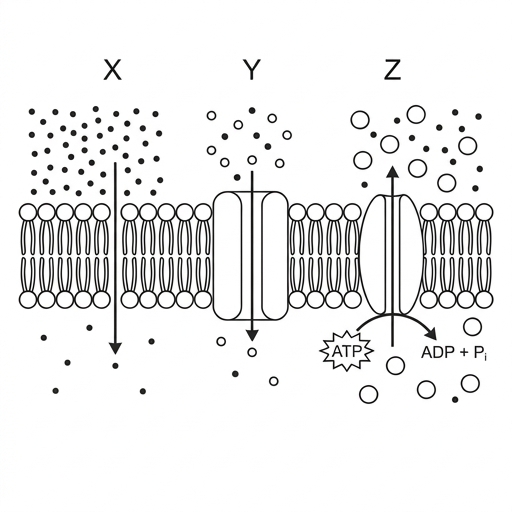
EasyPaper 1A · calculator1 markThe diagram shows three processes by which substances cross a plasma membrane. Which process is active transport?
A. X
B. Y
C. Z
D. Y and Z
Active transport moves substances against their concentration gradient and requires energy, usually from ATP. Examine each process for these two characteristics.
Question 2
MediumPaper 2 · calculator4 marksThe diagram shows the structure of a phospholipid, a key component of cell membranes.
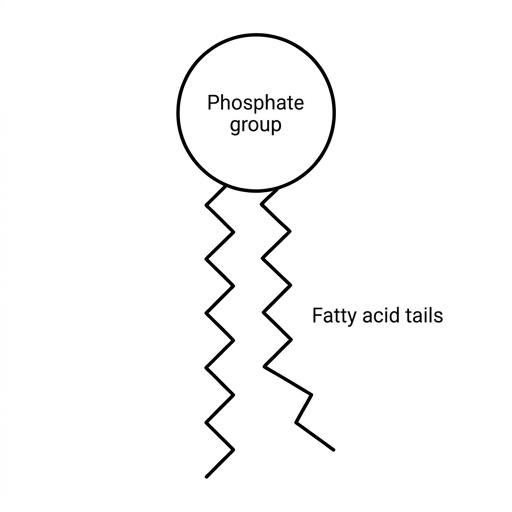
(a) State the term that describes molecules, such as phospholipids, which have both hydrophilic and hydrophobic regions.
(b) Explain how the properties of phospholipids contribute to the structure and function of the cell membrane.
Think about the word that describes having two opposing properties, in this case, an attraction to water and a repulsion from water.
Consider how the hydrophilic heads and hydrophobic tails arrange themselves in an aqueous environment and what kind of barrier this arrangement creates.
Question 3
HardPaper 2 · calculator15 marks(a) Outline the processes and conditions required for the spontaneous origin of cells on early Earth.
(b) Describe the advantages of compartmentalization in eukaryotic cells.
(c) Explain how the structure of proteins allows them to perform diverse functions in cell membranes and metabolism.
Think about the atmosphere of early Earth and the steps needed to go from simple molecules to a fully functioning cell, including the Miller-Urey experiment.
Consider why it is beneficial for a cell to have membrane-bound organelles rather than having all its enzymes and substrates mixed together in the cytoplasm.
Link the sequence and properties of amino acids (like hydrophobic/hydrophilic R-groups) to the 3D shape of proteins, and then explain how this shape allows them to act as membrane transporters and metabolic enzymes.
Question 4
MediumPaper 2 · calculator10 marks(a) Triglycerides are the main component of adipose tissue in mammals. They are non-polar molecules and are therefore hydrophobic.
Explain the chemical reasons why non-polar molecules are hydrophobic.
(b.i) Outline how the hydrophobic nature of triglycerides makes them well-suited for long-term energy storage in animals.
(b.ii) Steroid hormones, such as oestradiol, are lipids.
State how the hydrophobic nature of oestradiol allows it to enter a target cell.
(c) Explain how the amphipathic properties of phospholipids lead to the formation of a stable cell membrane.
Think about the types of bonds water forms with itself and why it cannot form these bonds with non-polar molecules.
Consider how water affects the mass and volume of stored molecules, and how it affects osmosis.
Think about the structure of the cell membrane and how non-polar molecules cross it.
Define amphipathic and describe how the different parts of the phospholipid interact with water.
Question 5
HardPaper 2 · calculator15 marksEukaryotic cells are characterized by the presence of membrane-bound organelles, which compartmentalize various biochemical processes.
(a) Compare and contrast the structure of chloroplasts and mitochondria.
(b) Describe the advantages of compartmentalization in eukaryotic cells.
(c) Explain the role of compartmentalization in the synthesis, modification, and transport of proteins destined for secretion.
Think about the membranes, genetic material, and internal structures of both organelles. Remember to provide both similarities and differences.
Consider how having separate 'rooms' in a cell might help with efficiency, optimal conditions, and protecting the cell from its own enzymes.
Trace the pathway of a protein from the DNA code in the nucleus to its release outside the cell. Mention the specific organelles and vesicles involved.
Question 6
MediumPaper 2 · calculator5 marks(a) Arctic reindeer (Rangifer tarandus) experience extreme temperature fluctuations in their extremities. The plasma membranes in the cells of their lower legs contain a high proportion of cholesterol, which is a type of steroid.
Outline the structural characteristics of steroid molecules.
(b) Explain how the presence of cholesterol helps maintain the physical properties of the cell membranes in the reindeer's extremities across a wide range of temperatures.
Think about the number and shape of the carbon rings that make up the core structure of molecules like cholesterol and testosterone.
Consider how cholesterol interacts with phospholipid tails when the environment is very cold versus when it is warm.
Question 7
HardPaper 2 · calculator10 marksThe movement of water across the plasma membrane is a fundamental process in both plant and animal cells.
Explain how the net movement of water across a cell membrane is driven by differences in solute concentration.
Describe the role of aquaporins in facilitating the movement of water across the plasma membrane.
Explain how pressure potential affects the movement of water into a plant cell.
Think about the terms hypotonic and hypertonic, and how solutes interact with water molecules to affect their ability to move freely.
Consider the structure of the phospholipid bilayer and why water might need a specialized protein to cross it rapidly.
What happens when a plant cell takes in water and expands against its cell wall? How does this physical pressure change the overall water potential?
Question 8
MediumPaper 1A · calculator1 markA cell maintains a higher concentration of a specific ion inside its cytoplasm compared to the surrounding extracellular fluid. The cell continues to absorb this ion from the fluid. Which membrane component is directly responsible for this absorption?
A. Cholesterol
B. Channel protein
C. Pump protein
D. Glycoprotein
Consider the direction of movement relative to the concentration gradient. What type of transport moves substances from a lower to a higher concentration, and which protein facilitates it?
Question 9
HardPaper 2 · calculator15 marksThe transmission of nerve impulses involves the coordinated movement of ions across and along the neuron membrane.
(a) Outline how active transport establishes and maintains the resting potential of a neuron.
(b) Describe the role of myelin in the propagation of a nerve impulse.
(c) Explain how facilitated diffusion and simple diffusion contribute to the generation and propagation of an action potential.
Think about the specific membrane protein that uses ATP to move ions when the neuron is not transmitting a signal, and how many of each ion it moves.
Consider how the myelin sheath affects the permeability of the axon membrane and where the action potentials are forced to occur.
Break down the action potential into depolarization and repolarization for facilitated diffusion, and then consider how the signal moves down the axon for simple diffusion.
Question 10
MediumPaper 1A · calculator1 markWhich molecule is correctly paired with the component of the cell membrane that allows it to pass through?
| Molecule | Component of the cell membrane | |
|---|---|---|
| A. | cellulose | channel protein |
| B. | potassium ions | phospholipid bilayer |
| C. | oxygen | phospholipid bilayer |
| D. | water | pump protein |
Consider the size, polarity, and charge of each molecule to determine if it can pass through the hydrophobic core of the membrane or if it requires a specific transport protein.
Question 11
MediumPaper 1A · calculator1 markThe table shows the concentrations of two ions in soil water and inside a plant root hair cell.
| Ion | Concentration in soil water / | Concentration in root hair cell / |
|---|---|---|
| Nitrate | 1.5 | 38.0 |
| Magnesium | 0.8 | 14.5 |
Which mechanism is responsible for the uptake of these ions from the soil water into the root hair cell?
A. Active transport using a pump protein
B. Facilitated diffusion using a channel protein
C. Simple diffusion through the phospholipid bilayer
D. Osmosis using an aquaporin
Compare the concentrations of the ions inside and outside the cell. Are the ions moving down or against their concentration gradient?
No question on this page matches those filters. Try another difficulty or paper.
Every Membranes and Membrane Transport question, marked for you
Every answer is marked mark by mark, IB-style, and the AI tutor helps when you are stuck.
Where marks are lost
- Command terms are consistently under-read. Students answer describe when the question said explain, so they give an account with no reasons and cap at half marks. The reverse also happens on outline, where a student writes an essay for a 2-mark summary and runs out of time.
- compare and contrast answers give only similarities, or only differences.