Chemical Signalling: notes and practice questions
- This topic covers how cells receive and respond to chemical signals, focusing on the mechanisms of signal transduction and the diversity of signalling molecules and receptors.
- Receptors are proteins with specific binding sites for signalling chemicals, called ligands.
- Signalling chemicals include hormones, neurotransmitters, cytokines, and calcium ions, with varied chemical structures.
- Receptors can be transmembrane (for hydrophilic ligands) or intracellular (for hydrophobic ligands, affecting gene expression).
- Ligand binding initiates signal transduction pathways within the cell.
- Examples include acetylcholine receptors (ion channels), epinephrine receptors (G proteins, cAMP), insulin receptors (tyrosine kinase), and steroid hormone receptors.
- Cell signalling pathways are regulated by positive and negative feedback.
How it is examined
HL Paper 1A tests the receptor-type distinctions, and HL Paper 2 asks outline or explain of one named pathway, usually adrenaline via cAMP or insulin via tyrosine kinase. The mark that students miss is the reason steroid hormones use intracellular receptors at all, which is that they are non-polar and cross the membrane. The word "ligand" is expected, but the mark scheme normally accepts "signalling chemical".
There is no SL content in C2.1. The whole subtopic is HL.
Do not set this topic for SL students.
Guiding questions
- How do cells distinguish between the many different signals that they receive?
- What interactions occur inside animal cells in response to chemical signals?
Linking questions
- What patterns exist in communication in biological systems?
- In what ways is negative feedback evident at all levels of biological organization?
Practice questions
6 questions · 4 medium · 2 hardQuestion 1
MediumPaper 1A · calculator1 markThe process of childbirth involves a positive feedback loop. Stretching of the cervix sends signals to the hypothalamus, which then stimulates the posterior pituitary to release a hormone. This hormone increases the strength of uterine contractions, leading to further stretching of the cervix. Which hormone is central to this process?
A. Progesterone
B. Oxytocin
C. Luteinizing hormone (LH)
D. Prolactin
Consider the roles of different hormones in the later stages of pregnancy and during labour. Which one is known for stimulating contractions? Think about what 'positive feedback' means in this context – the output of the system enhances the original stimulus.
Question 2
HardPaper 2 · calculator15 marksGene expression and protein function are highly regulated processes that allow cells to respond to their environment and maintain homeostasis.
(a) Outline how gene expression can be regulated at the stages of transcription and translation.
(b) Explain the mechanism by which a steroid hormone, such as oestradiol, initiates gene expression.
(c) Explain how the activity of cellular proteins, such as enzymes and receptors, can be controlled or inhibited after they have been synthesized.
Think about what can bind to DNA to stop transcription, how epigenetic tags affect DNA coiling, and what happens to mRNA to prevent it from being translated.
Consider the chemical nature of steroid hormones. How do they enter the cell, what do they bind to inside, and how does this complex interact with DNA?
Discuss how ligands activate proteins, and describe the three main types of enzyme inhibition (competitive, non-competitive/feedback, and mechanism-based), providing a named example for each.
Question 3
MediumPaper 2 · calculator10 marks(a) Triglycerides are the main component of adipose tissue in mammals. They are non-polar molecules and are therefore hydrophobic.
Explain the chemical reasons why non-polar molecules are hydrophobic.
(b.i) Outline how the hydrophobic nature of triglycerides makes them well-suited for long-term energy storage in animals.
(b.ii) Steroid hormones, such as oestradiol, are lipids.
State how the hydrophobic nature of oestradiol allows it to enter a target cell.
(c) Explain how the amphipathic properties of phospholipids lead to the formation of a stable cell membrane.
Think about the types of bonds water forms with itself and why it cannot form these bonds with non-polar molecules.
Consider how water affects the mass and volume of stored molecules, and how it affects osmosis.
Think about the structure of the cell membrane and how non-polar molecules cross it.
Define amphipathic and describe how the different parts of the phospholipid interact with water.
Question 4
HardPaper 2 · calculator10 marks(HL only)
Outline how a steroid hormone initiates a response in a target cell.
Outline the mechanism of signal transduction when epinephrine binds to its receptor.
Explain the role of epinephrine in preparing the body for vigorous activity.
Think about the chemical properties of steroid hormones and where their receptors are located.
Epinephrine cannot enter the cell. What type of receptor does it bind to, and what second messenger is produced?
Consider the 'fight or flight' response and how different body systems (like the heart, lungs, and liver) are integrated to support muscle action.
Question 5
MediumPaper 2 · calculator10 marksCells receive and respond to chemical signals through various types of receptors. Epinephrine (adrenaline) is a hormone that binds to a G protein-coupled receptor on the surface of target cells.
Describe the events that occur at the plasma membrane to activate this signalling pathway.
Insulin regulates blood glucose levels by binding to a different type of transmembrane receptor.
Outline the mechanism by which the insulin receptor transmits a signal into the cytoplasm.
Think about the structure of a G protein, the nucleotides involved (GDP and GTP), and what happens to the subunits when the receptor is activated.
Consider the specific type of receptor insulin binds to (a kinase) and how the intracellular tails of the receptor interact with each other upon binding.
Question 6
MediumPaper 1B · calculator10 marksThe graph shows the intracellular concentration of cyclic AMP (cAMP) in liver cells when exposed to different concentrations of the hormone epinephrine.
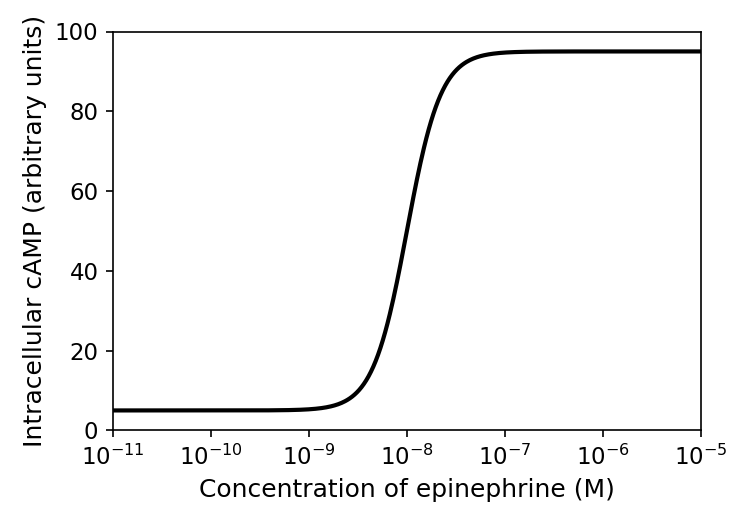
(a) State the type of scale used on the x-axis of the graph.
(b) Describe the trend shown by the graph.
(c) Explain how the binding of epinephrine to its receptor leads to the production of cAMP.
(d) (i) State the location of the epinephrine receptor in a liver cell.
(ii) Explain the advantages of the signal transduction pathway initiated by epinephrine.
Look at the intervals between the major tick marks on the x-axis. Do they increase by a constant amount (addition) or by a constant factor (multiplication)?
Break the graph into three sections: low concentrations, medium concentrations, and high concentrations. State what happens to cAMP in each section, including the specific epinephrine concentrations where the trend changes.
Recall the specific type of receptor epinephrine binds to and the intermediate molecules involved in producing cAMP from ATP.
Consider the chemical properties of epinephrine. Is it a hydrophilic or hydrophobic ligand, and where must its receptor be located as a result?
Think about how a single hormone molecule binding to the outside of the cell can cause a massive and rapid change in the cell's metabolism.
No question on this page matches those filters. Try another difficulty or paper.
Every Chemical Signalling question, marked for you
Every answer is marked mark by mark, IB-style, and the AI tutor helps when you are stuck.
Where marks are lost
- Command terms are consistently under-read. Students answer describe when the question said explain, so they give an account with no reasons and cap at half marks. The reverse also happens on outline, where a student writes an essay for a 2-mark summary and runs out of time.