Populations and Communities: notes and practice questions
- This topic covers populations as interacting groups of the same species and communities as all interacting organisms in an ecosystem.
- Population size can be estimated using random quadrat sampling for sessile organisms or capture-mark-release-recapture for motile organisms.
- The Lincoln index formula for population size estimate is .
- Carrying capacity is the maximum population size an environment can sustain, limited by resources.
- Population growth curves include exponential growth and sigmoid curves, often reaching carrying capacity.
- Interspecific relationships include herbivory, predation, interspecific competition, mutualism, parasitism, and pathogenicity.
- The chi-squared test can be applied to data on species association to test for interspecific competition.
How it is examined
The heaviest calculation topic in the syllabus. Lincoln index and chi-squared items land in Paper 1B and in Paper 2 data questions, and both need working. Chi-squared answers must state degrees of freedom, compare the calculated value against the critical value, and then state a conclusion about the null hypothesis, which is three separate marks. Population growth curve questions ask explain the shape of each phase and want the limiting factor named for the plateau.
- C4.1.1 Populations as interacting groups of organisms of the same species living in an area. Members of a population normally breed, and reproductive isolation is used to distinguish one population of a species from another.
- C4.1.2 Estimation of population size by random sampling, the reasons for estimating rather than counting every individual, and the need for randomness. NOS: random sampling inevitably results in sampling error, the difference between the estimate and the true size.
- C4.1.3 Random quadrat sampling to estimate population size for sessile organisms. Both sessile animals and plants are suitable. Application of skills: understand what the standard deviation of a mean indicates. The standard deviation of the mean number of individuals per quadrat gives a measure of variation and of how evenly the population is spread.
- C4.1.4 Capture-mark-release-recapture and the Lincoln index to estimate population size for motile organisms. Application of skills: use the Lincoln index. > Population size estimate = M × (N / R), where M is the number of individuals caught > and marked initially, N is the total number of individuals recaptured and R is the > number of marked individuals recaptured. Students should understand the assumptions made when using this method.
Guiding questions
- How do interactions between organisms regulate sizes of populations in a community?
- What interactions within a community make its populations interdependent?
Linking questions
- What are the benefits of models in studying biology?
- What factors can limit capacity in biological systems?
Practice questions
13 questions · 5 easy · 7 medium · 1 hardQuestion 1
EasyPaper 1A · calculator1 markWhat is the definition of a community in ecology?
A. All the organisms of a single species living in the same area at the same time.
B. All the organisms of different species living and interacting in the same area.
C. A group of organisms and the abiotic environment with which they interact.
D. The specific role an organism plays within its environment.
Consider the hierarchy of ecological organization. Start with an individual, then a population, then a community, and finally an ecosystem. Where does 'community' fit, and what does it include?
Question 2
MediumPaper 1A · calculator1 markThe classic experiments by G.F. Gause involved growing two species of protists, Paramecium aurelia and Paramecium caudatum, in laboratory cultures. When grown in separate flasks with a constant supply of bacteria for food, both populations grew to a stable carrying capacity. However, when grown together in the same flask, the population of P. caudatum was driven to extinction. What can be concluded from these results?
I. The fundamental niches of the two species overlap.
II. The realized niche of P. caudatum in the mixed culture was zero.
III. The two species exhibited resource partitioning.
A. I only
B. I and II only
C. II and III only
D. I, II and III
Consider the definitions of fundamental niche, realized niche, competitive exclusion, and resource partitioning. How does the outcome of the experiment (extinction of one species) relate to these concepts?
Question 3
HardPaper 2 · calculator15 marks(a) Distinguish between a fundamental niche and a realized niche.
(b) Compare and contrast the relationships of mutualism and parasitism.
(c) Explain how the carrying capacity of an environment is determined by limiting factors and species interactions.
Think about the difference between where a species could live based on its physical tolerances, versus where it actually lives due to competition.
Identify what both relationships have in common regarding the species involved, and then contrast how each species is affected (positively or negatively).
Consider both the physical resources a population needs to grow and the biological interactions (like predators or diseases) that keep a population from growing indefinitely.
Question 4
EasyPaper 1A · calculator1 markEcologists used the capture-mark-release-recapture method to estimate the population size of common woodlice (Oniscus asellus) in a woodland. The Lincoln index formula (Population size estimate = M × N/R) was used. The table shows the data collected.
| Data collected | Number of woodlice |
|---|---|
| Individuals captured and marked initially (M) | 80 |
| Total individuals recaptured in second sample (N) | 120 |
| Marked individuals recaptured (R) | 15 |
What is the estimated size of the woodlouse population?
A. 185
B. 200
C. 640
D. 960
Identify the values for M, N, and R from the table. Substitute these values into the provided Lincoln index formula and perform the calculation to find the population size estimate.
Question 5
MediumPaper 1A · calculator1 markA large area of temperate forest is destroyed by a wildfire, leaving the soil intact. Which sequence of events correctly describes the process of secondary succession that follows?
A. Pioneer species colonize bare rock → soil formation → climax community established.
B. Grasses and annual plants grow → shrubs appear → fast-growing trees → slow-growing hardwood trees.
C. The climax community is immediately re-established from the soil seed bank.
D. Lichens and mosses colonize the burnt ground → soil depth increases → grasses and weeds grow.
Consider the key difference between primary and secondary succession. What is the condition of the environment immediately after the wildfire described in the question?
Question 6
EasyPaper 2 · calculator5 marks(a) State the biological term for all the interacting organisms in an ecosystem.
(b) State the biological term for the splitting of a pre-existing species into two or more new species.
(c) State the biological term for a group of organisms that have evolved from a common ancestor.
(d) State the biological term for the accumulation of carbon compounds in biomass by autotrophs.
(e) State the biological term for the maximum population size an environment can sustain.
Think about the level of ecological organization that includes multiple different species living together, but does not include the abiotic factors.
What is the evolutionary process that increases biodiversity by creating new distinct lineages?
This term is used in phylogenetic classification to describe a complete branch on an evolutionary tree.
This represents the energy captured by plants that is converted into organic matter.
This limit is determined by the availability of resources such as food, water, and space in the environment.
Question 7
MediumPaper 2 · calculator5 marksThe clownfish (Amphiprioninae) is a genus of fish that lives in a close relationship with sea anemones. The sea anemone has stinging tentacles that are lethal to most other fish, but the clownfish is able to live among them without being harmed.
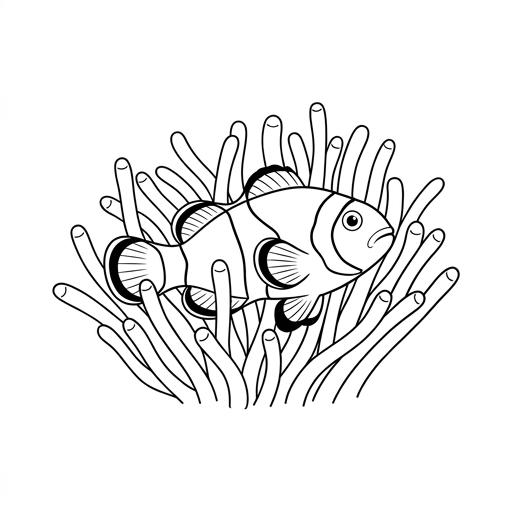
(a) Explain the type of ecological relationship between the clownfish and the sea anemone.
(b) State one adaptation of the clownfish that allows it to live unharmed among the anemone's tentacles.
(c) The relationship with the sea anemone is a key part of the clownfish's realized niche. Distinguish between a fundamental niche and a realized niche.
Consider how each organism is affected by the interaction. Does one benefit? Do both benefit? Does one suffer harm?
Think about what prevents the anemone's stinging cells from affecting the clownfish.
One term refers to the potential role of a species, while the other refers to its actual role. What factors cause the difference between the two?
Question 8
EasyPaper 1A · calculator1 markA researcher is investigating the factors that determine the distribution of a plant species in a woodland ecosystem. Which of the following is an abiotic factor that the researcher might measure?
A. The grazing of the plants by a population of deer
B. The light intensity reaching the forest floor
C. The infection of the plants by a pathogenic fungus
D. The competition for space with a different plant species
Recall the difference between living (biotic) and non-living (abiotic) components of an ecosystem.
Question 9
MediumPaper 1B · calculator6 marksAn ecologist investigated the distribution of two plant species, heather (Calluna vulgaris) and bracken (Pteridium aquilinum), on a moorland. They recorded the presence or absence of each species in randomly placed quadrats.
The results are shown in the contingency table.
| P. aquilinum present | P. aquilinum absent | |
|---|---|---|
| _C. vulgaris_ present | ||
| _C. vulgaris_ absent |
(a) State the null hypothesis for this chi-squared test.
(b) Calculate the expected frequency of quadrats containing both C. vulgaris and P. aquilinum.
(c) The calculated chi-squared value for this data is . The critical value at a significance level is . Deduce the conclusion that can be drawn from this statistical test.
(d) The data shows that the two species are found together less often than expected by chance. Suggest one biological reason for this negative association.
What are we assuming about the relationship between the two species before we perform the statistical test?
The formula for expected frequency is (row total column total) grand total.
Compare the calculated value to the critical value. If the calculated value is higher, what does that mean for the null hypothesis?
Why might two plant species struggle to grow in the exact same location?
Question 10
EasyPaper 1A · calculator1 markThe larvae of the monarch butterfly (Danaus plexippus) feed exclusively on the leaves of milkweed plants. What is the type of interspecific relationship between the butterfly larvae and the milkweed plants?
A. Predation
B. Parasitism
C. Mutualism
D. Herbivory
Consider whether the organism being consumed is a plant or an animal, and whether both organisms benefit from the interaction.
Question 11
MediumPaper 1A · calculator1 markTwo species of barnacle, Chthamalus and Balanus, inhabit the same rocky shore. Balanus grows rapidly and physically dislodges Chthamalus from the lower intertidal zone, restricting Chthamalus to the upper intertidal zone.
What type of interspecific relationship is demonstrated by this interaction?
A. Interspecific competition
B. Predation
C. Parasitism
D. Mutualism
Consider what resource the two species are interacting over, and whether either species is consuming or living inside the other.
Question 12
MediumPaper 1A · calculator1 markBlack walnut trees (Juglans nigra) secrete a chemical called juglone from their roots into the surrounding soil. Juglone inhibits the germination and growth of many other plant species nearby, reducing the number of plants sharing the same water and soil nutrients.
What type of interspecific relationship does this describe?
A. Interspecific competition
B. Pathogenicity
C. Parasitism
D. Herbivory
Consider why the tree might benefit from preventing other plants from growing nearby. What are they both trying to obtain from the soil?
Question 13
MediumPaper 1A · calculator1 markOn the rocky shores of Scotland, two species of barnacles, Chthamalus stellatus and Balanus balanoides, occupy different zones. Chthamalus is typically found in the upper intertidal zone, while Balanus is found in the lower intertidal zone. When Balanus was experimentally removed from the lower zone, Chthamalus was able to colonize and thrive in this area. However, Balanus could not survive in the upper zone, even when Chthamalus was removed, due to excessive desiccation (drying out).
What can be concluded from these observations?
I. The fundamental niche of Chthamalus is larger than its realized niche.
II. The distribution of Balanus is limited by an abiotic factor.
III. The two species are in a mutualistic relationship.
A. I only
B. I and II only
C. II and III only
D. I, II and III
Consider the definitions of fundamental and realized niches. The fundamental niche is where a species could live without competition, while the realized niche is where it does live. Also, consider what limits the distribution of each species – is it another species (biotic) or a physical factor (abiotic)?
No question on this page matches those filters. Try another difficulty or paper.
Every Populations and Communities question, marked for you
Every answer is marked mark by mark, IB-style, and the AI tutor helps when you are stuck.
Where marks are lost
- Command terms are consistently under-read. Students answer describe when the question said explain, so they give an account with no reasons and cap at half marks. The reverse also happens on outline, where a student writes an essay for a 2-mark summary and runs out of time.
- compare and contrast answers give only similarities, or only differences.