Enzymes and Metabolism: notes and practice questions
- This topic covers the role of enzymes as biological catalysts in metabolic pathways and the factors affecting their activity.
- Enzymes are globular proteins with specific active sites that bind to substrates via the induced-fit model.
- They increase reaction rates by lowering the activation energy of chemical reactions.
- Metabolism involves anabolic reactions (synthesis, e.g., protein synthesis) and catabolic reactions (breakdown, e.g., digestion).
- Enzyme activity is significantly affected by temperature, pH, and substrate concentration.
- Extreme temperatures or pH can cause denaturation, altering the active site and reducing enzyme function.
- Skills include interpreting graphs of enzyme activity and determining reaction rates.
How it is examined
Graph interpretation carries this topic. Paper 1B has used enzyme rate data for calculate the rate, describe the trend and suggest a reason. Rate calculations need units. The classic Paper 2 item is explain the effect of temperature on the rate of an enzyme-catalysed reaction, where the mark scheme wants both halves: increasing kinetic energy and more collisions below the optimum, then denaturation and loss of active-site shape above it. Writing "the enzyme dies" scores nothing.
- C1.1.1 Enzymes as catalysts, and the benefit of increasing rates of reaction in cells.
- C1.1.2 Role of enzymes in metabolism. Metabolism is the complex network of interdependent and interacting chemical reactions in living organisms. Because of enzyme specificity many different enzymes are needed, and control over metabolism can be exerted through them.
- C1.1.3 Anabolic and catabolic reactions. Anabolism includes forming macromolecules from monomers by condensation, so protein synthesis, glycogen formation and photosynthesis. Catabolism includes hydrolysis of macromolecules into monomers in digestion and oxidation of substrates in respiration.
- C1.1.4 Enzymes as globular proteins with an active site for catalysis. The active site is made of a few amino acids only, but interactions between amino acids across the whole three-dimensional structure give the active site its properties.
- C1.1.11 Intracellular and extracellular enzyme-catalysed reactions. Glycolysis and the Krebs cycle are the intracellular examples; chemical digestion in the gut is the extracellular one.
- C1.1.12 Generation of heat energy by the reactions of metabolism. Heat generation is inevitable because metabolic reactions are not 100% efficient at transferring energy. Mammals, birds and some other animals depend on it for constant body temperature.
- C1.1.13 Cyclical and linear pathways in metabolism, using glycolysis, the Krebs cycle and the Calvin cycle as examples.
- C1.1.14 Allosteric sites and non-competitive inhibition. Only specific substances bind to an allosteric site. Binding causes interactions within the enzyme leading to conformational changes that alter the active site enough to prevent catalysis. Binding is reversible.
Guiding questions
- In what ways do enzymes interact with other molecules?
- What are the interdependent components of metabolism?
Linking questions
- What are examples of structure-function relationships in biological macromolecules?
- What biological processes depend on differences or changes in concentration?
Practice questions
14 questions · 3 easy · 8 medium · 3 hardQuestion 1
EasyPaper 1A · calculator1 markWhich process is an example of an extracellular enzyme-catalysed reaction?
A. Synthesis of mRNA during transcription in the nucleus
B. Breakdown of proteins by pepsin in the stomach
C. The light-independent reactions of photosynthesis in the stroma
D. Formation of lactate from pyruvate in the cytoplasm
Consider where each process takes place. 'Extracellular' means outside the cell.
Question 2
MediumPaper 2 · calculator15 marksLiving organisms must maintain a stable internal environment, a process known as homeostasis.
(a) Explain the control of blood glucose concentration in humans.
(b) Explain the effect of pH on the activity of enzymes.
(c) Distinguish between the transport of glucose and oxygen in the blood, with reference to the properties of water.
Think about the two key hormones released from the pancreas. What triggers the release of each hormone, what are their target cells, and what is the resulting effect on blood glucose levels?
Consider how pH affects the chemical bonds that maintain a protein's specific three-dimensional shape. What is the term for the irreversible change in an enzyme's structure, and how does this affect its function?
Compare the polarity of glucose and oxygen molecules. How does this property affect how well each substance can dissolve in the main component of blood plasma, which is water?
Question 3
HardPaper 2 · calculator15 marksProteins are highly diverse macromolecules that perform a wide range of functions in living organisms, including acting as biological catalysts.
Outline how the sequence of amino acids in a polypeptide is determined and how this leads to the vast diversity of proteins.
Enzymes are globular proteins that act as biological catalysts. Outline the effects of temperature and pH on the rate of enzyme-catalyzed reactions.
Explain the mechanism of enzyme action and how metabolic pathways can be controlled by feedback inhibition, using the synthesis of isoleucine as an example.
Think about what codes for the amino acid sequence during translation and how many different amino acids exist to build these chains.
Describe what happens to enzyme activity as temperature and pH increase and decrease, and explain why these changes occur at a molecular level.
Explain how enzymes lower activation energy and use the induced-fit model. Then describe how the end product of a pathway can inhibit an earlier step, specifically mentioning isoleucine and threonine.
Question 4
EasyPaper 1A · calculator1 markWhich row correctly identifies an example of an anabolic reaction and a catabolic reaction?
| Anabolic reaction | Catabolic reaction | |
|---|---|---|
| A. | synthesis of a polypeptide | digestion of a triglyceride |
| B. | oxidation of glucose | photosynthesis |
| C. | digestion of a triglyceride | synthesis of a polypeptide |
| D. | hydrolysis of starch | oxidation of glucose |
Remember that anabolic reactions build complex molecules from simpler ones (requiring energy), while catabolic reactions break down complex molecules into simpler ones (releasing energy).
Question 5
MediumPaper 1A · calculator1 markWhich statement about the factors affecting enzyme activity is incorrect?
A. The rate of an enzyme-catalysed reaction increases with substrate concentration until a maximum rate is reached.
B. Very low temperatures cause irreversible denaturation of the enzyme.
C. Each enzyme has an optimal pH at which its activity is highest.
D. High temperatures can alter the three-dimensional structure of an enzyme.
Consider the effect of different environmental factors on the structure and function of proteins. How do low temperatures differ from high temperatures in their effect on enzyme structure?
Question 6
HardPaper 2 · calculator15 marks(a) Outline the processes and conditions required for the spontaneous origin of cells on early Earth.
(b) Describe the advantages of compartmentalization in eukaryotic cells.
(c) Explain how the structure of proteins allows them to perform diverse functions in cell membranes and metabolism.
Think about the atmosphere of early Earth and the steps needed to go from simple molecules to a fully functioning cell, including the Miller-Urey experiment.
Consider why it is beneficial for a cell to have membrane-bound organelles rather than having all its enzymes and substrates mixed together in the cytoplasm.
Link the sequence and properties of amino acids (like hydrophobic/hydrophilic R-groups) to the 3D shape of proteins, and then explain how this shape allows them to act as membrane transporters and metabolic enzymes.
Question 7
EasyPaper 1A · calculator1 markWhich process is an example of anabolism?
A. Hydrolysis of triglycerides
B. Condensation of monosaccharides
C. Oxidation of carbon compounds
D. Digestion of polypeptides
Anabolism involves the synthesis of complex molecules from simpler monomers, often requiring energy.
Question 8
MediumPaper 1B · calculator6 marksAn experiment was conducted to investigate the effect of light intensity and temperature on the rate of photosynthesis in the aquatic plant Cabomba caroliniana. The rate of photosynthesis was measured by the volume of oxygen produced per minute. The results are shown in the graph below.
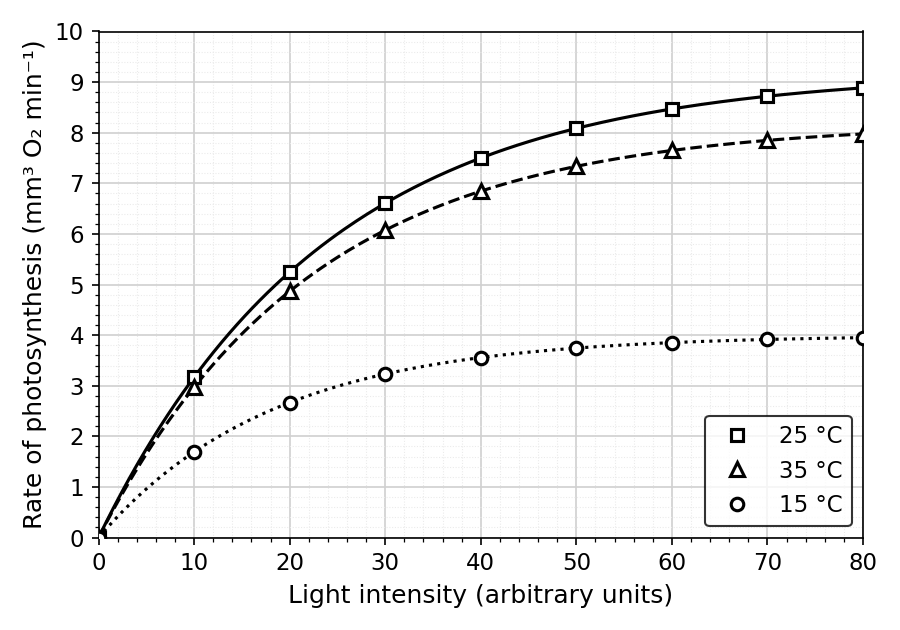
(a) State the rate of photosynthesis at a light intensity of 40 arbitrary units and a temperature of 25 °C.
(b) Identify the limiting factor for photosynthesis at a light intensity of 20 arbitrary units.
(c) Explain the effect of increasing the temperature from 15 °C to 25 °C on the rate of photosynthesis at a light intensity of 70 arbitrary units.
(d) The experiment was repeated at 45 °C. Predict, with a reason, the effect on the rate of photosynthesis at high light intensity compared to the rate at 35 °C.
Find the x-value of 40 on the graph. Follow the line up to the curve for 25 °C and then read the corresponding y-value. Remember to include units.
Look at the shape of all three curves at this light intensity. What factor is preventing the rate from being higher, even when temperature is increased?
At high light intensity, another factor is limiting the rate. Consider the role of enzymes in photosynthesis and how temperature affects them.
Think about what happens to proteins, especially enzymes, at temperatures well above their optimum.
Question 9
HardPaper 2 · calculator15 marksGene expression and protein function are highly regulated processes that allow cells to respond to their environment and maintain homeostasis.
(a) Outline how gene expression can be regulated at the stages of transcription and translation.
(b) Explain the mechanism by which a steroid hormone, such as oestradiol, initiates gene expression.
(c) Explain how the activity of cellular proteins, such as enzymes and receptors, can be controlled or inhibited after they have been synthesized.
Think about what can bind to DNA to stop transcription, how epigenetic tags affect DNA coiling, and what happens to mRNA to prevent it from being translated.
Consider the chemical nature of steroid hormones. How do they enter the cell, what do they bind to inside, and how does this complex interact with DNA?
Discuss how ligands activate proteins, and describe the three main types of enzyme inhibition (competitive, non-competitive/feedback, and mechanism-based), providing a named example for each.
Question 10
MediumPaper 1A · calculator1 markThe graph shows the effect of pH on the activity of the enzyme trypsin, which functions in the human small intestine.
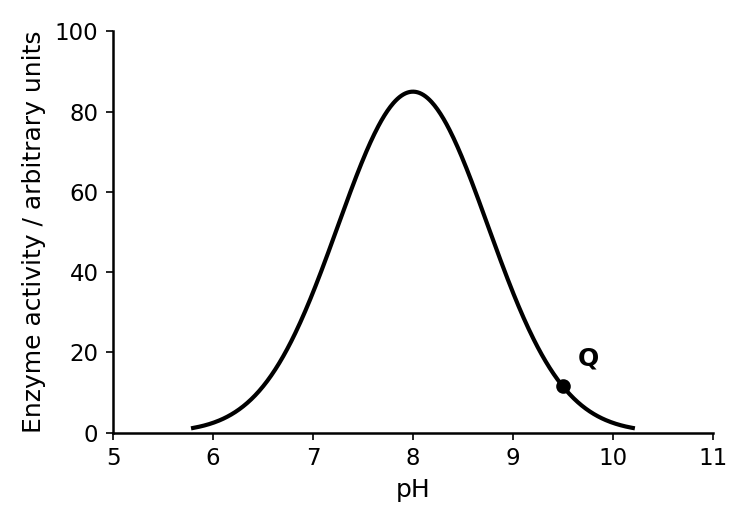
What is the reason for the enzyme's activity at point Q?
A. The active site has been altered by the change in pH.
B. The substrate molecules have less kinetic energy.
C. The concentration of the substrate is the limiting factor.
D. The enzyme has been used up by the reaction.
Consider how environmental conditions, such as pH, affect the three-dimensional structure of proteins like enzymes.
Question 11
MediumPaper 2 · calculator5 marks(a) The optimum pH for pepsin, an enzyme in the human stomach, is 2.0. The optimum pH for trypsin, an enzyme in the small intestine, is 8.0.
Calculate the ratio of the proton concentration at the optimum pH of pepsin to the proton concentration at the optimum pH of trypsin.
(b) Calculate the ratio of the proton concentration in a lysosome at pH 5.0 to the proton concentration in the surrounding cytoplasm at pH 7.2.
(c) State the term used to describe the irreversible change in the three-dimensional structure of an enzyme when exposed to a pH far outside its range of tolerance.
Remember that pH is a logarithmic scale. A pH of corresponds to a proton concentration of .
Find the proton concentration for both pH values using , then divide the lysosome concentration by the cytoplasm concentration.
What happens to the active site of a protein when the pH breaks its intramolecular bonds?
Question 12
MediumPaper 2 · calculator5 marksCatalase is an enzyme that breaks down hydrogen peroxide into water and oxygen in cells.
Outline the function of catalase as a biological catalyst.
(b) Explain why cells require thousands of different enzymes in addition to catalase.
(c) State the specific interaction that must occur between hydrogen peroxide and catalase for the breakdown to happen.
Think about what a catalyst does to the speed of a reaction and what happens to the catalyst itself by the end of the process.
Consider the relationship between an enzyme's active site and its substrate, and the variety of chemical processes happening in a cell.
What physical event must take place between the substrate molecule and the enzyme's binding region?
Question 13
MediumPaper 2 · calculator10 marks(a) Explain the possible effects of a single base substitution mutation on the structure and activity of an enzyme.
(b) Compare and contrast the effects of base substitutions with those of base insertions and deletions.
Think about how changing one letter in the DNA sequence affects the mRNA codons, the amino acids, and ultimately the 3D shape of the active site.
Consider how reading the genetic code in triplets is affected when you swap a base versus when you add or remove one. Make sure to include both similarities and differences.
Question 14
MediumPaper 2 · calculator5 marksThe emperor penguin (Aptenodytes forsteri) lives in the Antarctic, where external temperatures can drop significantly. Despite this, it maintains a constant internal environment.
Explain the costs and benefits of homeostasis for organisms such as the emperor penguin.
Think about why enzymes and cells need specific conditions to function properly, and what the organism must expend to keep these conditions stable when the outside environment changes.
No question on this page matches those filters. Try another difficulty or paper.
Every Enzymes and Metabolism question, marked for you
Every answer is marked mark by mark, IB-style, and the AI tutor helps when you are stuck.
Where marks are lost
- Command terms are consistently under-read. Students answer describe when the question said explain, so they give an account with no reasons and cap at half marks. The reverse also happens on outline, where a student writes an essay for a 2-mark summary and runs out of time.
- compare and contrast answers give only similarities, or only differences.