Defence Against Disease: notes and practice questions
- This topic explores how organisms defend against infectious diseases caused by pathogens.
- Primary defenses include physical barriers like skin and mucous membranes, and blood clotting.
- The immune system has innate (non-specific) and adaptive (specific, memory-based) components.
- Phagocytes engulf pathogens as part of innate immunity.
- Adaptive immunity involves lymphocytes, which produce specific antibodies in response to antigens.
- Vaccines introduce antigens to stimulate adaptive immunity and memory cell formation.
- Antibiotics are effective against bacteria but not viruses, which can evolve rapidly.
- Herd immunity reduces disease transmission when a population has sufficient immunity.
How it is examined
This topic is a reliable source of extended-response Paper 2 questions at both levels, because it is 5 hours at SL with no HL extension. The antibody production sequence (antigen presented, specific B-cell, helper T-cell activation, clonal expansion, plasma cells, memory cells) is worth 4 to 6 marks and is marked point by point. Herd immunity answers need a threshold percentage idea, not just "more people are immune". COVID-19 percentage change calculations appear in Paper 1B and lose marks when the student computes percentage difference instead.
- C3.2.1 Pathogens as the cause of infectious diseases. A broad range of disease-causing organisms can infect humans. The term pathogen is typically reserved for viruses, bacteria, fungi and protists. Archaea are not known to cause any diseases in humans. NOS: careful observation can lead to important progress, as with 19th-century childbed fever in Vienna and cholera in London.
- C3.2.2 Skin and mucous membranes as a primary defence. The skin acts as both a physical and a chemical barrier.
- C3.2.3 Sealing of cuts in skin by blood clotting, including release of clotting factors from platelets and the cascade pathway that rapidly converts fibrinogen to fibrin by thrombin, trapping erythrocytes to form a clot.
- C3.2.4 Differences between the innate and the adaptive immune system. The innate system responds to broad categories of pathogen and does not change during life; the adaptive system responds specifically to particular pathogens and builds a memory, so the response becomes more effective.
Antibody structure is not in the syllabus. Do not ask for the shape of an antibody or its variable and constant regions.
Guiding questions
- How do body systems recognize pathogens and fight infections?
- What factors influence the incidence of disease in populations?
Linking questions
- How do animals protect themselves from threats?
- How can false-positive and false-negative results be avoided in diagnostic tests?
Practice questions
12 questions · 3 easy · 8 medium · 1 hardQuestion 1
EasyPaper 1A · calculator1 markWhich row correctly identifies a process in the innate immune system and a process in the adaptive immune system?
| Innate Immune System | Adaptive Immune System | |
|---|---|---|
| A. | Phagocytosis | Production of memory cells |
| B. | Production of antibodies | Blood clotting |
| C. | Action of mucous membranes | Phagocytosis |
| D. | Production of memory cells | Action of skin barrier |
Recall the different components of the immune system. The innate system is non-specific and immediate. The adaptive system is specific, has memory, and is slower to respond. Where do processes like phagocytosis, antibody production, and memory cell formation fit?
Question 2
MediumPaper 1A · calculator1 markA child receives a vaccination for chickenpox. Several years later, the child is exposed to the chickenpox virus but does not develop the disease. Which component of the immune system is responsible for this protection?
A. Phagocytes that engulf the virus upon first exposure.
B. Memory cells that produce a rapid secondary response.
C. Skin and mucous membranes that prevent viral entry.
D. Antibiotics produced by the body after vaccination.
Consider the purpose of vaccination. It aims to create a 'memory' of the pathogen. Which part of the immune system is responsible for immunological memory and a fast response upon re-exposure?
Question 3
HardPaper 2 · calculator15 marksThe table shows data from a national health ministry for an outbreak of a novel viral respiratory disease over a one-year period.
| Age group | Cases in males | Cases in females | Deaths in males | Deaths in females |
|---|---|---|---|---|
| 60+ | 1200 | 1500 | 180 | 240 |
| 45–59 | 5400 | 4800 | 45 | 32 |
| 30–44 | 14,500 | 12,100 | 22 | 15 |
| 15–29 | 16,200 | 13,400 | 8 | 5 |
| 2500 | 2400 | 1 | 1 |
Comment on the relationship between age and numbers of cases.
(b.i) Distinguish between males and females in the numbers of cases and numbers of deaths.
(b.ii) Suggest reasons for the differences observed between males and females.
(c) Calculate the percentage death rate in males aged 45–59 who became infected.
(d) Analyse the data to identify which group had the highest percentage death rate if infected.
Look at the total cases (males + females) for each age group. Where is the peak? Where are the lowest numbers?
Compare the columns for males and females row by row. Are there age groups where the pattern reverses?
Think about biological, social, or demographic factors that differ between sexes and age groups, such as life expectancy or occupational exposure.
Find the number of infected males aged 45-59 and the number of deaths in that group. Divide deaths by cases and multiply by 100.
You need to calculate the death rate (deaths divided by cases) for the groups with the highest number of deaths to find the maximum percentage.
Question 4
EasyPaper 1A · calculator1 markWhich defence mechanism is a characteristic of the innate immune system?
A. Engulfing of pathogens by phagocytes
B. Production of antibodies by lymphocytes
C. Formation of memory cells after infection
D. Specific recognition of viral antigens
Recall the difference between non-specific defences (innate) and specific, memory-based defences (adaptive).
Question 5
MediumPaper 1A · calculator1 markWhat is the primary mechanism by which vaccination provides long-term immunity?
A. Introduction of antibodies against the pathogen.
B. Stimulation of the production of memory cells.
C. Activation of phagocytes for a non-specific response.
D. Direct destruction of pathogens by vaccine components.
Consider how the adaptive immune system responds to an antigen. What is produced during the primary immune response that allows for a faster and stronger secondary response?
Question 6
EasyPaper 1A · calculator1 markWhat do the skin and mucous membranes have in common as part of the body's defense against disease?
A. They both act as primary physical barriers against the entry of pathogens.
B. They both produce specific antibodies to neutralize foreign antigens.
C. They both contain phagocytes that engulf and destroy bacteria.
D. They both initiate the blood clotting cascade to seal wounds.
Consider which part of the immune system these structures belong to and whether their role is to prevent entry or to fight pathogens that are already inside.
Question 7
MediumPaper 2 · calculator10 marksDistinguish between the innate and adaptive immune systems.
Outline why antibiotics are effective against bacteria but not against viruses.
Compare and contrast the primary defences provided by the skin and mucous membranes.
Think about which system you are born with and which one develops over time, as well as which one involves antibodies and memory cells.
Consider the structural and metabolic differences between a bacterium and a virus. What do antibiotics actually target?
Identify what both structures do to stop pathogens, then think about where they are located and whether they are dry or moist.
Question 8
MediumPaper 2 · calculator15 marksThe graph shows the number of cases of Meningococcal group C (MenC) disease in a European country. In late 1999, a mass vaccination campaign was introduced for all individuals aged 0 to 18 years.
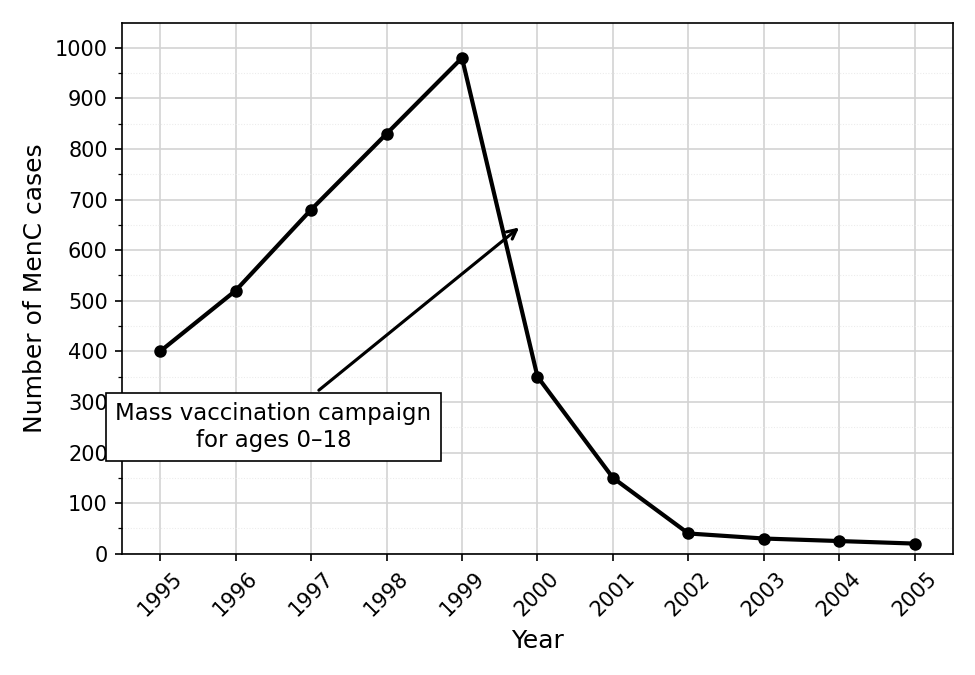
State the maximum number of MenC cases recorded in a single year.
Evaluate the success of the vaccination programme using the data in the graph.
Describe the response of the immune system to the MenC vaccine.
Suggest reasons for a booster dose of the vaccine being given to infants one year after their initial vaccination.
Suggest reasons why a small number of MenC cases continue to be recorded each year.
Explain why the MenC vaccination programme continues despite the very low number of cases.
Look for the highest point on the curve before the vaccination campaign started and read the corresponding value on the y-axis.
To evaluate, you need to provide both strengths (evidence that it worked) and limitations (evidence of where it might not be perfect) based on the graph's trends.
Think about the sequence of events starting from the introduction of the vaccine. Mention the specific types of cells involved in both innate and adaptive immunity, what they produce, and what remains in the blood to provide long-term protection.
Consider what happens to antibody levels over time and how the immune system's memory can be strengthened.
Think about why some individuals in a population might not be protected, either due to their own vaccination status or the nature of vaccines.
Consider the concept of protecting the entire population, including those who cannot be vaccinated, and the global presence of the disease.
Question 9
MediumPaper 1A · calculator1 markWhat is the role of lymphocytes during a bacterial infection?
A. They engulf and digest the bacteria through phagocytosis.
B. They produce specific antibodies that bind to bacterial antigens.
C. They release antibiotics to inhibit the metabolism of the bacteria.
D. They convert fibrinogen to fibrin to trap the bacteria.
Consider the difference between innate immunity (non-specific) and adaptive immunity (specific). Also, be careful not to confuse proteins produced by the human immune system with medications used to treat infections.
Question 10
MediumPaper 1A · calculator1 markWhich process is a primary function of the innate immune system?
A. Production of specific antibodies by lymphocytes
B. Non-specific engulfing of pathogens by phagocytes
C. Formation of memory cells after an initial infection
D. Recognition of specific antigens introduced by a vaccine
Recall the difference between innate (non-specific) and adaptive (specific) immunity. Which cells are responsible for the rapid, non-specific response to any pathogen?
Question 11
MediumPaper 1A · calculator1 markWhich statement correctly distinguishes the role of phagocytes from that of lymphocytes in the immune system?
A. Phagocytes provide specific immunity, while lymphocytes provide non-specific immunity.
B. Phagocytes engulf pathogens, while lymphocytes produce antibodies.
C. Phagocytes form memory cells, while lymphocytes act as a physical barrier.
D. Phagocytes are part of the adaptive immune system, while lymphocytes are part of the innate immune system.
Recall which type of white blood cell is responsible for the non-specific (innate) response and which is responsible for the specific (adaptive) response.
Question 12
MediumPaper 1A · calculator1 markA patient with tuberculosis, caused by the bacterium Mycobacterium tuberculosis, is treated with the antibiotic rifampicin. After several months, the patient's symptoms return, and the bacteria are found to be unaffected by rifampicin. What is the most likely biological explanation for this?
A. A random mutation provided resistance to some bacteria, which then survived and reproduced.
B. The rifampicin induced a mutation in the bacteria, causing them to become resistant.
C. The patient's immune system developed immunity to the rifampicin.
D. The bacteria produced antibodies that neutralized the rifampicin.
Consider how natural selection works in bacterial populations and remember which organisms are capable of producing antibodies.
No question on this page matches those filters. Try another difficulty or paper.
Every Defence Against Disease question, marked for you
Every answer is marked mark by mark, IB-style, and the AI tutor helps when you are stuck.
Where marks are lost
- Command terms are consistently under-read. Students answer describe when the question said explain, so they give an account with no reasons and cap at half marks. The reverse also happens on outline, where a student writes an essay for a 2-mark summary and runs out of time.
- compare and contrast answers give only similarities, or only differences.