Gas Exchange: notes and practice questions
- This topic explores adaptations for gas exchange in multicellular organisms, focusing on mammals and flowering plants.
- Efficient gas exchange surfaces are permeable, thin, moist, and have a large surface area.
- Mammalian lungs feature alveoli, surfactant, branched bronchioles, and extensive capillary beds.
- Ventilation in mammals involves the diaphragm, intercostal muscles, and ribs.
- Leaf adaptations for gas exchange include the waxy cuticle, epidermis, air spaces, spongy mesophyll, and stomata.
- Skills include measuring lung volumes and determining stomatal density from micrographs.
How it is examined
The leaf plan diagram and the alveolus are recurring drawing items. HL oxygen dissociation curves appear in Paper 1B as a graph-reading item and in Paper 2 as explain the Bohr shift, where the mark is for the benefit to respiring tissue, not just the direction of the shift. Foetal haemoglobin questions want "higher affinity than adult haemoglobin at the same partial pressure", stated as a comparison.
- B3.1.1 Gas exchange as a vital function in all organisms, and that the challenge grows with size because surface area-to-volume ratio falls and the distance from the centre to the exterior rises.
- B3.1.2 Properties of gas-exchange surfaces: permeability, thin tissue layer, moisture, large surface area.
- B3.1.3 Maintenance of concentration gradients at exchange surfaces in animals: dense networks of blood vessels, continuous blood flow, and ventilation with air for lungs or water for gills.
- B3.1.4 Adaptations of mammalian lungs for gas exchange, limited to alveolar lungs: surfactant, a branched network of bronchioles, extensive capillary beds, high surface area.
- B3.1.11 Adaptations of foetal and adult haemoglobin for oxygen transport, including cooperative binding of oxygen to haem groups and allosteric binding of carbon dioxide.
- B3.1.12 Bohr shift. How increased carbon dioxide causes increased dissociation of oxygen, and the benefit for actively respiring tissues.
- B3.1.13 Oxygen dissociation curves as a way of representing haemoglobin's affinity for oxygen at different oxygen concentrations, with the S-shaped form explained by cooperative binding.
Guiding questions
- How are multicellular organisms adapted to carry out gas exchange?
- What are the similarities and differences in gas exchange between a flowering plant and a mammal?
Linking questions
- How do multicellular organisms solve the problem of access to materials for all their cells?
- What is the relationship between gas exchange and metabolic processes in cells?
Practice questions
3 questions · 3 mediumQuestion 1
MediumPaper 1A · calculator1 markWhich statement correctly describes the process of inhalation in humans?
A. The diaphragm contracts and moves up, while the external intercostal muscles relax.
B. The volume of the thoracic cavity decreases, causing pressure to increase.
C. The external intercostal muscles contract, moving the rib cage up and out.
D. Air moves out of the lungs as the pressure inside becomes higher than atmospheric pressure.
Think about what needs to happen to the chest cavity to draw air in. Does it need to get bigger or smaller? Which muscle movements would cause that change?
Question 2
MediumPaper 1A · calculator1 markThe diagram shows a spirometer trace for a healthy adult.
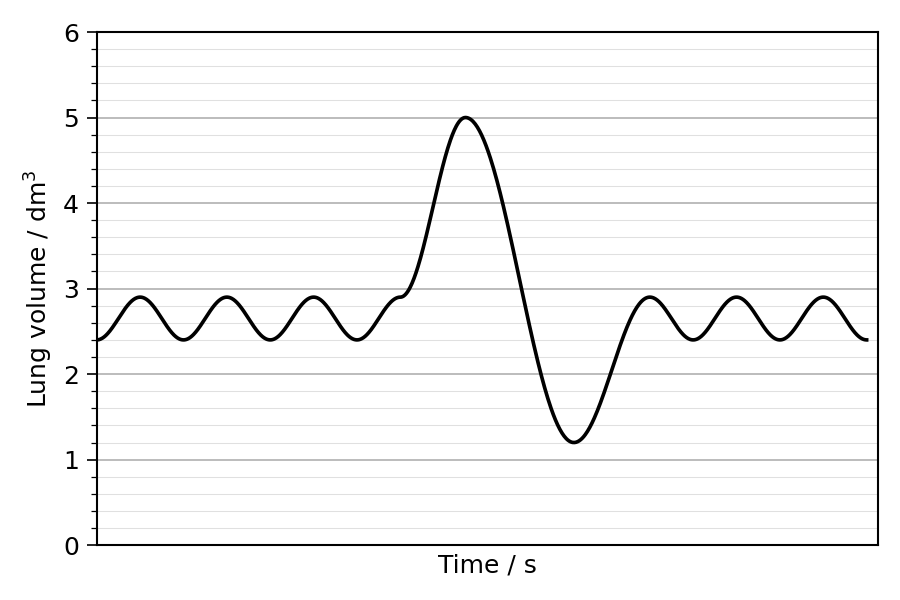
What is the inspiratory reserve volume?
A. 0.5 dm³
B. 2.1 dm³
C. 2.6 dm³
D. 3.8 dm³
Inspiratory reserve volume is the additional volume of air that can be inhaled after a normal inhalation. Identify the peak of a normal inhalation and the peak of a maximum inhalation on the graph, then find the difference.
Question 3
MediumPaper 1A · calculator1 markWhich changes occur in the thorax of a mammal to cause exhalation?
A. The diaphragm relaxes and the pressure in the thorax increases.
B. The diaphragm contracts and the pressure in the thorax decreases.
C. The ribs move upwards and outwards and the volume of the thorax decreases.
D. The ribs move downwards and inwards and the pressure in the thorax decreases.
Think about Boyle's Law: how does the volume of the thorax need to change to force air out, and what muscle movements achieve this?
No question on this page matches those filters. Try another difficulty or paper.
Every Gas Exchange question, marked for you
Every answer is marked mark by mark, IB-style, and the AI tutor helps when you are stuck.
Where marks are lost
- Command terms are consistently under-read. Students answer describe when the question said explain, so they give an account with no reasons and cap at half marks. The reverse also happens on outline, where a student writes an essay for a 2-mark summary and runs out of time.
- compare and contrast answers give only similarities, or only differences.
- On Section B, students answer the topic rather than the question.