Natural Selection: notes and practice questions
- This topic covers natural selection as the mechanism for evolutionary change, driven by heritable characteristics within a population.
- Variation arises from mutation, generating new alleles, and sexual reproduction, creating new combinations of alleles.
- Overproduction of offspring and competition for resources are factors that promote natural selection.
- Abiotic factors, such as temperature, act as selection pressures affecting individual survival.
- Differences in adaptation, survival, and reproduction among individuals form the basis for natural selection, linked to the concept of fitness.
- Evolutionary change requires that traits are heritable.
- Sexual selection, based on traits affecting mate attraction, can also drive evolution.
- Skills include interpreting data from experiments modeling selection pressures, such as John Endler's guppy studies.
How it is examined
Natural selection explain questions are marked as a sequence: variation exists, variation is heritable, more offspring are produced than survive, individuals with the advantageous trait survive and reproduce more, the allele frequency increases over generations. Skipping "heritable" or "over generations" is the usual loss. At HL, Hardy-Weinberg calculations are 2 to 4 marks and normally start from q² given as the frequency of the recessive phenotype, so students who start from q instead lose everything downstream.
- D4.1.1 Natural selection as the mechanism driving evolutionary change. It operates continuously and over billions of years, resulting in the biodiversity of life on Earth. NOS: in Darwin's time it was widely understood that species evolved but the mechanism was not clear; Darwin's theory provided a convincing mechanism and replaced Lamarckism, which is an example of a paradigm shift. Students should understand "paradigm shift".
- D4.1.2 Roles of mutation and sexual reproduction in generating the variation on which natural selection acts. Mutation generates new alleles and sexual reproduction generates new combinations of alleles.
- D4.1.3 Overproduction of offspring and competition for resources as factors that promote natural selection, with examples of food and other resources that may limit carrying capacity.
- D4.1.4 Abiotic factors as selection pressures, with examples of density-independent factors such as high or low temperatures affecting survival.
- D4.1.9 Concept of the gene pool. A gene pool consists of all the genes and their different alleles present in a population.
- D4.1.10 Allele frequencies of geographically isolated populations. Application of skills: use databases to search allele frequencies, with at least one human example.
- D4.1.11 Changes in allele frequency in the gene pool as a consequence of natural selection between individuals according to differences in their heritable traits. Darwin developed the theory; biologists subsequently integrated genetics with natural selection in what is now known as neo-Darwinism.
- D4.1.12 Differences between directional, disruptive and stabilizing selection. All three result in a change in allele frequency.
Guiding questions
- What processes can cause changes in allele frequencies within a population?
- What is the role of reproduction in the process of natural selection?
Linking questions
- How do intraspecific interactions differ from interspecific interactions?
- What mechanisms minimize competition?
Practice questions
11 questions · 2 easy · 5 medium · 4 hardQuestion 1
EasyPaper 1A · calculator1 markIn John Endler's experiments, male guppies (Poecilia reticulata) in pools with no predators evolved to have larger and more brightly coloured spots over several generations.
What evolutionary mechanism primarily drove the increase in spot size and colouration?
A. Sexual selection
B. Natural selection by abiotic factors
C. Interspecific competition
D. Artificial selection
Consider what advantage bright colouration gives a male guppy when it does not need to hide from predators.
Question 2
MediumPaper 1B · calculator10 marksAmino acid sequences of two Zika virus proteins were analysed from patient samples between 2015 and 2018 to determine the number of mutations compared to a reference strain. The pie charts show the distribution of mutations for the Envelope (E) protein and the Non-structural protein 5 (NS5).
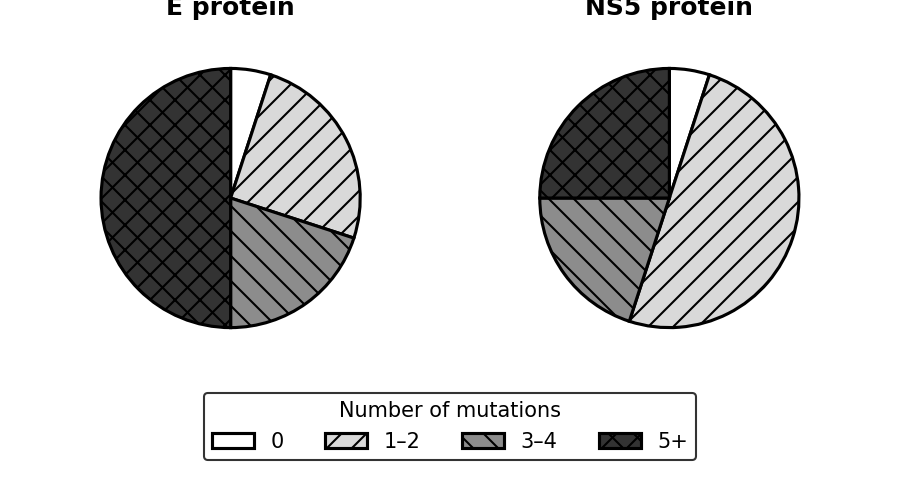
Compare and contrast the data for the two proteins.
The E protein is coded by 1512 bases in the viral genome and the NS5 protein is coded by 2712 bases. Deduce whether the difference in the number of mutations between the E and NS5 proteins is due to their gene lengths.
Mutations occur randomly during viral replication, but some specific base substitutions in the E protein gene were found in many patient samples, while other possible substitutions were never detected. Suggest reasons for these observations.
Look for both similarities (sectors that are the same size) and differences (sectors that are much larger in one chart than the other) to get full marks.
If mutation rate depended only on length, which gene would you expect to have more mutations? Does this match the data in the pie charts?
Think about how natural selection acts on viruses. What happens to a virus if a mutation makes it better at infecting cells, versus a mutation that destroys a crucial protein?
Question 3
HardPaper 2 · calculator15 marksMutations are the ultimate source of genetic variation.
(a) Sickle cell anaemia is a genetic disease caused by a single base substitution mutation. Outline the consequences of this mutation, from the DNA level to the protein produced.
(b) Haemophilia is a human disease caused by a sex-linked allele. Outline the inheritance pattern of haemophilia.
(c) Explain how the allele for sickle cell anaemia provides an example of natural selection in human populations.
Think about the central dogma: DNA -> mRNA -> protein. How does a change in the DNA base sequence affect the mRNA codon, and in turn, which amino acid is incorporated into the polypeptide chain?
Remember that sex-linked traits are carried on the X or Y chromosome. How does this affect how the trait is passed from parents to offspring, particularly the difference between males and females?
Consider the environmental context, specifically the presence of malaria. How does the sickle cell allele affect an individual's survival and reproduction (their 'fitness') in this environment? Think about the three possible genotypes.
Question 4
EasyPaper 1A · calculator1 markWhich of the following are required for natural selection to cause evolutionary change in a population?
I. Overproduction of offspring leading to competition
II. Genetic variation among individuals in the population
III. Inheritance of traits acquired during an organism's lifetime
A. I and II only
B. I and III only
C. II and III only
D. I, II and III
Think about which types of traits can actually be passed on to offspring through DNA, and what conditions create a struggle for survival.
Question 5
MediumPaper 2 · calculator10 marks(a) Commercial fishing of Atlantic cod (Gadus morhua) in the Northwest Atlantic was highly intensive from 1970 until a moratorium (ban) was introduced in 1992. Fishing regulations required a minimum mesh size for nets, meaning only larger fish were caught.
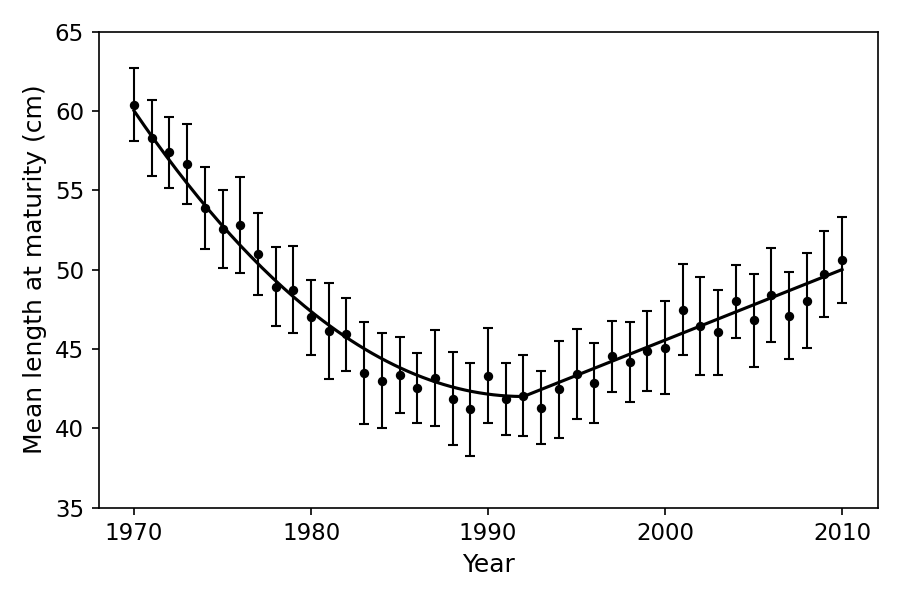
Intense commercial fishing occurred between 1970 and 1992. Explain the effects of this fishing on the length at maturity of the cod.
(b) The commercial fishery was closed in 1992, reducing fishing mortality by over 90%. Suggest reasons for the increase in length at maturity after 1992.
(c) Outline what conclusions can be drawn from the error bars on the graph.
Think about which fish are surviving to reproduce and what alleles they pass on to the next generation.
Without the fishing nets, what advantages might larger fish have in their natural environment?
Error bars represent the spread of data. What does it mean if they overlap from one year to the next?
Question 6
HardPaper 2 · calculator15 marks(a) Outline why viruses are classified as obligate parasites rather than living cells.
(b) Explain the concept of convergent evolution in the context of viral origins.
(c) Discuss the mechanisms of rapid evolution in viruses and the consequences for treating viral diseases.
Think about what structures and metabolic processes viruses lack, and what they must obtain from a host cell in order to replicate.
Do all viruses share a single common ancestor? Consider how different lineages might independently develop similar traits to survive as intracellular parasites.
Consider the mutation rates of RNA viruses like HIV or influenza, how new variation is generated, and how this affects the long-term efficacy of vaccines and antiviral drugs.
Question 7
MediumPaper 1A · calculator1 markJohn Endler investigated the effects of selection pressures on Trinidadian guppies (Poecilia reticulata). The table shows the mean number of coloured spots on male guppies in two natural pools. Pool X contains a high density of predatory fish, while Pool Y contains no predatory fish.
| Pool | Predatory fish | Mean number of spots per male |
|---|---|---|
| X | Present | 8.4 |
| Y | Absent | 13.2 |
A sample of guppies from Pool X was transferred to an artificial pond with no predatory fish.
What would be the expected change in the mean number of spots per male guppy in the artificial pond after several generations, and what is the primary mechanism driving this change?
A. An increase, driven by sexual selection
B. An increase, driven by natural selection for camouflage
C. A decrease, driven by sexual selection
D. A decrease, driven by natural selection for camouflage
Look at the data to see how the presence or absence of predators affects the number of spots. Then, recall why male guppies have spots in the first place and which type of selection favours them.
Question 8
HardPaper 2 · calculator15 marks(a) Outline the processes that generate genetic variation within a population.
(b) Explain how natural selection acts on this variation to cause evolutionary change.
(c) Discuss how anthropogenic climate change affects the distribution and survival of species in polar habitats, including the emperor penguin.
Think about the original source of new traits and how cell division and reproduction mix these traits.
Consider what happens when a population produces too many offspring, and how advantageous traits affect survival and reproduction.
Include the causes of climate change, its physical effects on polar ice, and specific examples of how this impacts named species like the emperor penguin or walrus.
Question 9
MediumPaper 1A · calculator1 markWhich statements correctly describe the processes that generate genetic variation within a population?
I. Crossing over generates new alleles.
II. Random orientation of bivalents generates new combinations of alleles.
III. Gene mutation is the original source of new alleles.
A. I and II only
B. II and III only
C. I and III only
D. I, II and III
Consider the difference between creating a brand new version of a gene (an allele) and shuffling the versions that already exist.
Question 10
HardPaper 2 · calculator15 marksSexual reproduction in flowering plants involves the production of gametes by meiosis, followed by pollination and fertilization.
Outline the events that occur during prophase I of meiosis.
Describe the process of fertilization in flowering plants.
Explain how meiosis and sexual reproduction promote genetic variation in a population.
Think about what happens to the chromosomes before they align at the equator. How do homologous chromosomes interact?
Trace the path of the male gamete from the moment a pollen grain lands on the flower until it reaches the egg.
Consider the two main sources of variation during meiosis, and what happens when gametes from two different individuals combine.
Question 11
MediumPaper 1A · calculator1 markA patient with tuberculosis, caused by the bacterium Mycobacterium tuberculosis, is treated with the antibiotic rifampicin. After several months, the patient's symptoms return, and the bacteria are found to be unaffected by rifampicin. What is the most likely biological explanation for this?
A. A random mutation provided resistance to some bacteria, which then survived and reproduced.
B. The rifampicin induced a mutation in the bacteria, causing them to become resistant.
C. The patient's immune system developed immunity to the rifampicin.
D. The bacteria produced antibodies that neutralized the rifampicin.
Consider how natural selection works in bacterial populations and remember which organisms are capable of producing antibodies.
No question on this page matches those filters. Try another difficulty or paper.
Every Natural Selection question, marked for you
Every answer is marked mark by mark, IB-style, and the AI tutor helps when you are stuck.
Where marks are lost
- Command terms are consistently under-read. Students answer describe when the question said explain, so they give an account with no reasons and cap at half marks. The reverse also happens on outline, where a student writes an essay for a 2-mark summary and runs out of time.
- compare and contrast answers give only similarities, or only differences.