Cell Respiration: notes and practice questions
- This topic explores how cells release energy from carbon compounds to produce adenosine triphosphate (ATP).
- ATP is the energy currency of cells, used for processes like active transport, macromolecule synthesis, and cellular movement.
- Energy is released when ATP is hydrolysed to ADP and phosphate, and required to synthesize ATP from ADP and phosphate.
- Cell respiration uses carbon compounds like glucose and fatty acids as substrates to produce ATP.
- Aerobic respiration requires oxygen, occurs in mitochondria, and yields more ATP than anaerobic respiration.
- Anaerobic respiration in humans produces lactate; simple word equations for both types, with glucose as substrate, should be known.
- The rate of cell respiration can be measured and calculated.
How it is examined
At SL the word equations and the aerobic/anaerobic comparison are the two reliable items, and the comparison is usually a table in the mark scheme. At HL, the four stages and where each happens (cytoplasm, matrix, inner membrane) are asked repeatedly, and location marks are awarded separately from process marks. Naming an intermediate other than citrate or oxaloacetate earns nothing but costs nothing. Rate-of-respiration calculations from respirometer data show up in Paper 1B.
- C1.2.1 ATP as the molecule that distributes energy within cells. Include the full name adenosine triphosphate and that it is a nucleotide, and the properties that make it suitable as the energy currency of the cell.
- C1.2.2 Life processes that ATP supplies with energy: active transport across membranes, synthesis of macromolecules (anabolism), and movement of the whole cell or of cell components such as chromosomes.
- C1.2.3 Energy transfers during interconversion between ATP and ADP. Energy is released by hydrolysis of ATP to ADP and phosphate; energy is required to synthesize ATP from ADP and phosphate.
- C1.2.4 Cell respiration as a system for producing ATP within the cell using energy released from carbon compounds. Glucose and fatty acids are the principal substrates but a wide range of carbon compounds can be used. Students should be able to distinguish cell respiration from gas exchange.
- C1.2.7 Role of NAD as a carrier of hydrogen, and oxidation by removal of hydrogen. Oxidation is electron loss, so removing hydrogen with its electron (dehydrogenation) oxidizes the substrate. Redox reactions involve both oxidation and reduction, and NAD is reduced when it accepts hydrogen.
- C1.2.8 Conversion of glucose to pyruvate by stepwise reactions in glycolysis with a net yield of ATP and reduced NAD. Include phosphorylation, lysis, oxidation and ATP formation.
- C1.2.9 Conversion of pyruvate to lactate as a way of regenerating NAD in anaerobic cell respiration, which allows glycolysis to continue with a net yield of two ATP per glucose.
- C1.2.10 Anaerobic cell respiration in yeast and its use in brewing and baking. The pathways are the same in humans and yeast apart from how NAD is regenerated using pyruvate, and therefore the final products differ.
Guiding questions
- What are the roles of hydrogen and oxygen in the release of energy in cells?
- How is energy distributed and used inside cells?
Linking questions
- In what forms is energy stored in living organisms?
- What are the consequences of respiration for ecosystems?
Practice questions
12 questions · 4 easy · 7 medium · 1 hardQuestion 1
EasyPaper 1A · calculator1 markDuring intense exercise, human muscle cells may not receive enough oxygen. Which products are formed from glucose during anaerobic respiration in these cells?
A. Ethanol and carbon dioxide
B. Lactate only
C. Lactate and ATP
D. Carbon dioxide and water
Recall the two types of respiration. What does 'anaerobic' mean? Think about the specific process that occurs in human muscles when oxygen is limited and what its essential energy product is.
Question 2
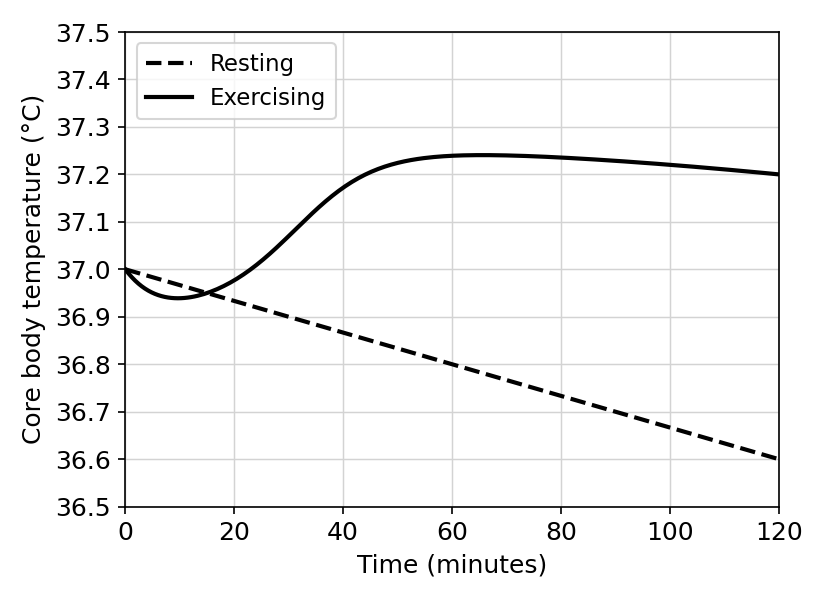
MediumPaper 2 · calculator12 marksThermoregulation is a key homeostatic process. A study investigated the response of human participants to a cold environment (). Participants were divided into two groups: one group remained at rest, while the other performed moderate exercise on a stationary bicycle. Core body temperature was measured every 15 minutes for two hours.
{width="3.6in"}
(a) Describe the trend in core body temperature for the exercising group.
(b) Compare the core body temperature in the resting group with the exercising group over the 120-minute period.
(c) Suggest a reason for the difference in core body temperature observed between the two groups.
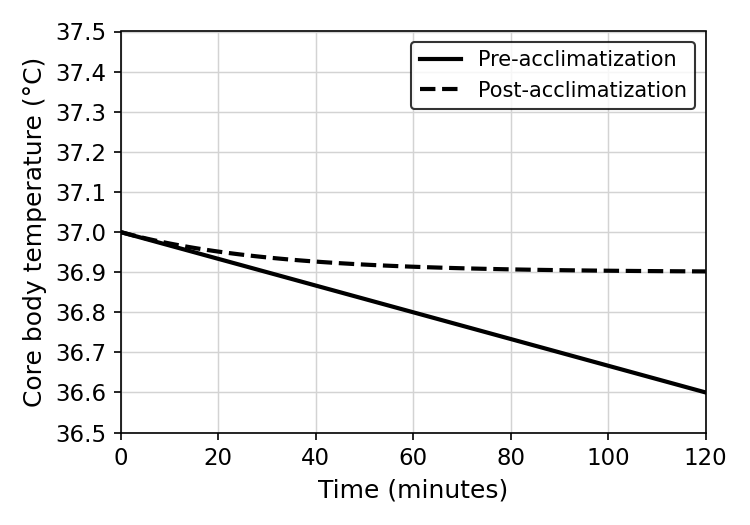
(d) The resting group then underwent a 10-week cold acclimatization program, involving regular, controlled exposure to cold. Their core body temperature response to the same cold environment () at rest was measured again.
{width="3.6in"}
Distinguish between the results pre- and post-acclimatization.
(e) Suggest why participants were required to rest in a thermoneutral room () for 30 minutes before each experimental trial.
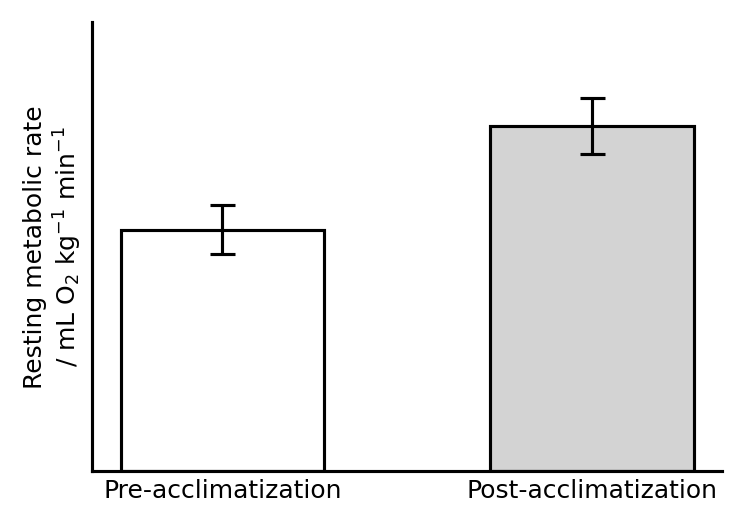
(f) The study also measured the resting metabolic rate of the participants before and after the acclimatization program.
{width="3.6in"}
Describe the difference in resting metabolic rate before and after the program.
(g) Suggest how an increased resting metabolic rate might contribute to the improved tolerance to cold shown in part (d).
(h) The hormone thyroxin is involved in regulating metabolic rate. Outline the role of thyroxin in thermoregulation.
Look at the line representing the 'Exercising' group. How does the temperature change from the start of the experiment to the end? Break down the trend into different phases if necessary.
A comparison requires you to state both similarities and differences. Look at the starting points, the direction of change, and the final values for both lines on the graph.
Consider the physiological effects of exercise. What does muscle activity produce besides movement?
To distinguish is to point out the differences. How does the 'Post-acclimatization' curve differ from the 'Pre-acclimatization' curve in terms of the magnitude and rate of temperature change?
Think about the principles of a controlled experiment. Why is it important for all subjects to begin the experiment from the same physiological state?
Simply state the change shown in the bar chart. Compare the height of the 'Post-acclimatization' bar to the 'Pre-acclimatization' bar.
What is the relationship between metabolic rate and body heat? If the body's 'engine' is running faster at rest, what effect does this have on heat production?
Recall the endocrine control of metabolism. Which gland secretes thyroxin, and what is its primary effect on the body's cells that relates to heat?
Question 3
HardPaper 1B · calculator6 marksThe graph shows data-logging of three variables in a coastal rock pool containing the brown alga Fucus vesiculosus over a 48-hour period.
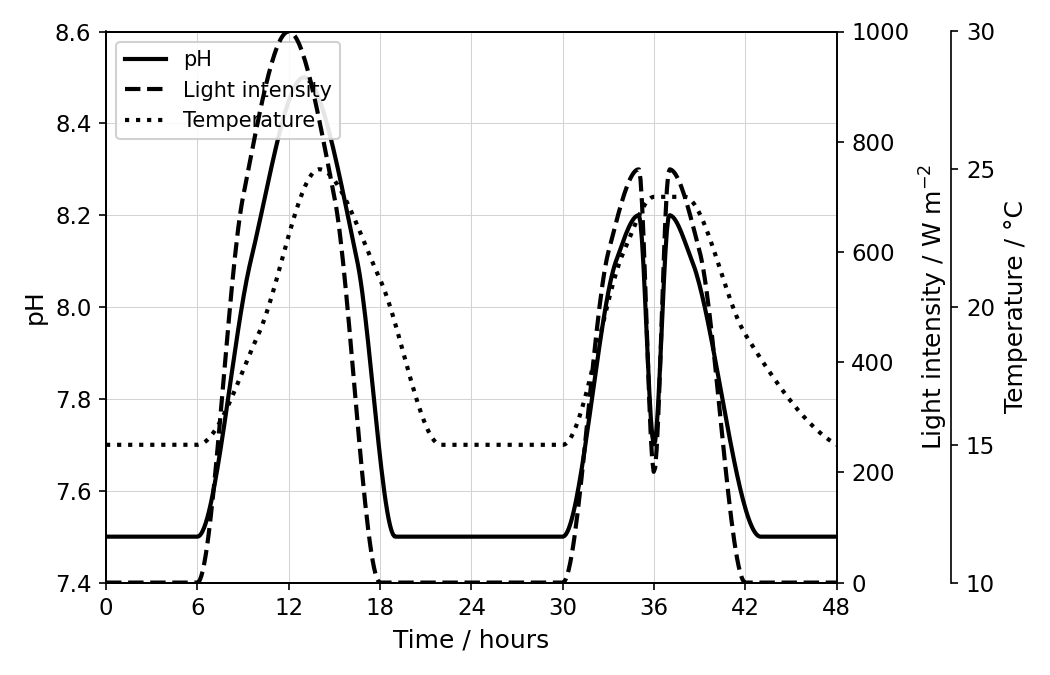
Explain the causes of the rises and falls in the pH of the rock pool water.
(b.i) State the relationship shown in the graph between light intensity and dissolved concentration.
(b.ii) State the relationship shown in the graph between temperature and dissolved concentration.
(c) From the graph, deduce whether light intensity or temperature has a greater effect on the dissolved concentration.
Think about how photosynthesis and respiration affect the concentration of carbon dioxide in the water, and how carbon dioxide concentration affects pH.
Remember that pH is inversely related to carbon dioxide concentration. Look at how pH changes when light intensity is high versus low.
Compare the overall trend of the temperature curve with the inferred carbon dioxide concentration (based on pH).
Look for a point on the graph where light intensity and temperature do not follow their usual synchronized pattern, such as the fog event on day 2.
Question 4
EasyPaper 1A · calculator1 markWhich statement correctly compares aerobic and anaerobic cell respiration in humans?
A. Aerobic respiration produces lactate and a small yield of ATP.
B. Anaerobic respiration occurs in the mitochondria and produces a large yield of ATP.
C. Aerobic respiration requires oxygen and produces a larger yield of ATP than anaerobic respiration.
D. Anaerobic respiration produces carbon dioxide and water.
Think about the key differences between the two types of respiration regarding oxygen use, location in the cell, products, and the amount of energy released.
Question 5
MediumPaper 1B · calculator10 marks(a) The table shows the areas of different membranes () in a plasma cell (an antibody-secreting B lymphocyte).
| Membrane | Area / |
|---|---|
| Rough endoplasmic reticulum | 18 000 |
| Smooth endoplasmic reticulum | 150 |
| Outer mitochondrial membrane | 1 200 |
| Inner mitochondrial membrane | 6 500 |
| Plasma membrane | 864 |
| Golgi apparatus | 1 800 |
| Nucleus | 300 |
Calculate the volume of the plasma cell, assuming it is cubic.
(b) Explain the difference in area of the inner and outer mitochondrial membranes.
(c) Justify the conclusion that the plasma cell is highly specialized for protein secretion.
(d) Comment on the area of the smooth endoplasmic reticulum in the plasma cell.
Remember that a cube has 6 identical square faces. First find the area of one face using the plasma membrane area, then find the side length, and finally calculate the volume.
Think about the structure of the inner mitochondrial membrane and the specific biochemical processes that occur there.
Look at the areas of the organelles involved in the synthesis, modification, and packaging of proteins.
Compare the area of the smooth ER to the rough ER, and consider the specific functions of the smooth ER that might not be needed in a plasma cell.
Question 6
EasyPaper 1A · calculator1 markThe diagram shows the structure of a mitochondrion. Where does the Krebs cycle occur?
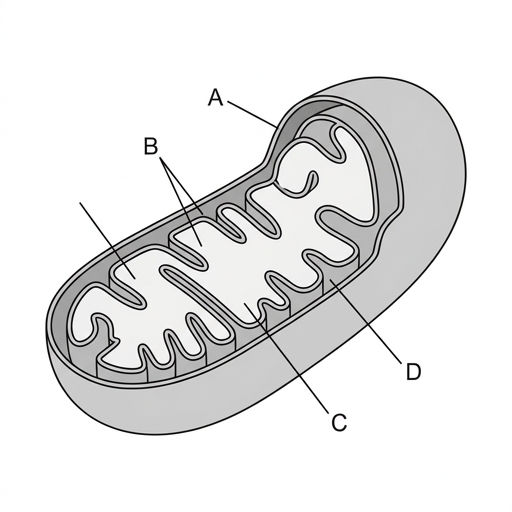
A. A
B. B
C. C
D. D
Consider the different stages of aerobic cell respiration and where each one takes place within the mitochondrion. The Krebs cycle is also known as the citric acid cycle.
Question 7
MediumPaper 2 · calculator10 marks(a.i) Ruminococcus albus is a bacterium found in the rumen (first stomach) of cattle. It breaks down cellulose from ingested grass and produces acetate () as a waste product.
Identify, with a reason, whether R. albus is autotrophic, heterotrophic or mixotrophic.
(a.ii) Identify, with a reason, whether R. albus is holozoic or saprotrophic.
(b) R. albus is difficult to study in standard laboratory conditions because it dies rapidly when exposed to air. Explain two conclusions that can be drawn from this observation.
(c) The epithelial cells of the cow's rumen absorb the acetate produced by the bacteria. Suggest how the cow's cells might use this substance.
Consider the source of carbon for this bacterium and whether it has access to light energy in its habitat.
Think about how bacteria process their food compared to animals that possess a digestive tract.
What term describes organisms that cannot tolerate oxygen, and what does this imply about the conditions inside the cow's stomach?
Acetate is a carbon compound. What cellular process uses carbon compounds to release energy?
Question 8
EasyPaper 1A · calculator1 markHuman muscle cells can generate ATP through both aerobic and anaerobic respiration depending on the availability of oxygen. Which row correctly identifies the products of these two pathways when glucose is the substrate?
| Aerobic respiration | Anaerobic respiration | |
|---|---|---|
| A. | Carbon dioxide and water | Lactate |
| B. | Carbon dioxide and water | Ethanol and carbon dioxide |
| C. | Carbon dioxide only | Lactate |
| D. | Carbon dioxide only | Ethanol and carbon dioxide |
Recall the simple word equations for respiration. Think about whether human anaerobic respiration produces a gas, and do not confuse it with fermentation in yeast.
Question 9
MediumPaper 1B · calculator9 marks(a) The graph shows the results of an experiment in which the oxygen consumption rate of deer mice (Peromyscus maniculatus) was measured at various environmental temperatures from to . Between and , the mice maintained a constant core body temperature, but above their body temperature increased.
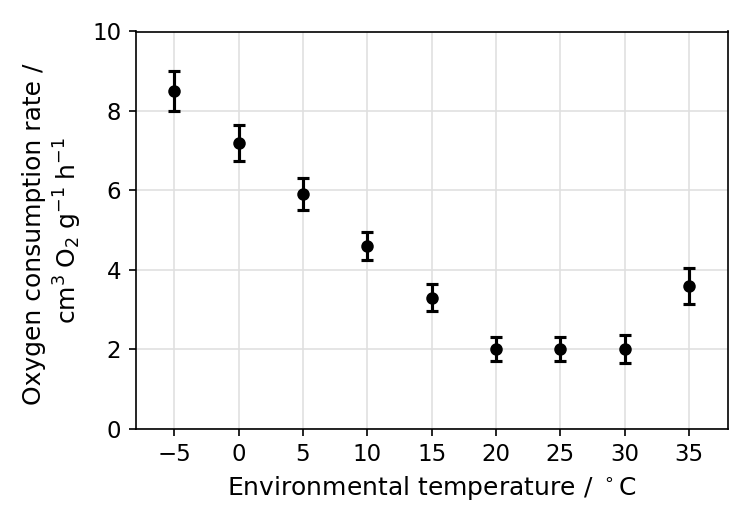
Describe the relationship between environmental temperature and oxygen consumption rate in the deer mice.
(b) Explain the change in oxygen consumption rate as the environmental temperature drops from to .
(c) Suggest a reason for the change in oxygen consumption rate as environmental temperatures increased from to .
(d) Suggest two reasons for the variation in oxygen consumption rate between individual mice at each environmental temperature.
Look at the three distinct sections of the graph: below , between and , and above . State what happens to the oxygen consumption in each temperature range.
Consider what oxygen is used for in cells and how the products of this process help a mammal survive in cold temperatures.
Think about what physiological processes a mammal might use to cool down, and whether these processes require energy.
What natural differences exist between individuals of the same species that could affect their metabolism or heat loss?
Question 10
MediumPaper 1A · calculator1 markAn influx of agricultural fertilizer into a lake causes a rapid increase in the population of algae. Following the death of the algae, the dissolved oxygen concentration in the lake drops significantly.
Which process is directly responsible for this decrease in oxygen?
A. Aerobic respiration by saprotrophic bacteria
B. Cessation of photosynthesis by the dead algae
C. Anaerobic respiration by decomposers
D. Aerobic respiration by primary consumers
Consider what happens to the organic matter of the algae after they die and which organisms are responsible for breaking it down.
Question 11
MediumPaper 1A · calculator1 markDuring a high-intensity sprint, human muscle cells rely heavily on anaerobic respiration. Which row correctly identifies the word equation for this process and its ATP yield compared to aerobic respiration?
| Word equation | ATP yield compared to aerobic respiration | |
|---|---|---|
| A. | glucose lactate | lower |
| B. | glucose lactate + carbon dioxide | lower |
| C. | glucose lactate | higher |
| D. | glucose + oxygen carbon dioxide + water | higher |
Recall the specific products of anaerobic respiration in humans, and consider whether aerobic or anaerobic respiration is more efficient at producing ATP.
Question 12
MediumPaper 1A · calculator1 markHydrogen carbonate indicator is red at atmospheric levels. It turns yellow when levels increase and purple when levels decrease. Tests were carried out in sealed tubes containing this indicator, varying the presence of an aquatic plant (Cabomba caroliniana) and a freshwater snail (Lymnaea stagnalis).
Which condition would result in the indicator turning purple?
A. Plant kept in the light without a snail
B. Plant kept in the dark without a snail
C. Snail kept in the light without a plant
D. Plant and snail kept in the dark
Consider which biological processes produce and which processes consume it. How does light affect these processes in plants versus animals?
No question on this page matches those filters. Try another difficulty or paper.
Every Cell Respiration question, marked for you
Every answer is marked mark by mark, IB-style, and the AI tutor helps when you are stuck.
Where marks are lost
- Command terms are consistently under-read. Students answer describe when the question said explain, so they give an account with no reasons and cap at half marks. The reverse also happens on outline, where a student writes an essay for a 2-mark summary and runs out of time.
- compare and contrast answers give only similarities, or only differences.