Photosynthesis: notes and practice questions
- This topic explains photosynthesis as the transformation of light energy into chemical energy to produce carbon compounds.
- The overall word equation is: carbon dioxide + water glucose + oxygen.
- Oxygen released during photosynthesis is a by-product of water splitting.
- Photosynthetic pigments absorb specific light wavelengths, which can be analyzed using absorption and action spectra.
- The rate of photosynthesis is influenced by limiting factors such as carbon dioxide concentration, light intensity, and temperature.
- Skills include separating pigments by chromatography and determining photosynthesis rates from experimental data.
How it is examined
Limiting factor graphs are the most examined part of this topic at SL and turn up in Paper 1A, 1B and 2. Answers must name which factor is limiting in which region of the curve. Rf calculations are 1 to 2 marks and need working. At HL, the interdependence point in C1.3.19 is a favourite explain item, and the mark for "no CO2 means the Calvin cycle stops consuming NADPH and ATP, so photosystem II backs up" needs the chain spelled out.
- C1.3.1 Transformation of light energy to chemical energy when carbon compounds are produced in photosynthesis. This supplies most of the chemical energy needed for life processes in ecosystems.
- C1.3.2 Conversion of carbon dioxide to glucose using hydrogen obtained by splitting water. Students should be able to write a simple word equation for photosynthesis with glucose as the product.
- C1.3.3 Oxygen as a by-product of photosynthesis in plants, algae and cyanobacteria. Students should know the simple word equation and that the oxygen produced comes from the splitting of water.
- C1.3.4 Separation and identification of photosynthetic pigments by chromatography. Application of skills: calculate Rf values from a chromatographic separation and identify pigments by colour and by Rf value. Thin-layer or paper chromatography can be used.
- C1.3.9 Photosystems as arrays of pigment molecules that generate and emit excited electrons. Photosystems are always located in membranes and occur in cyanobacteria and in the chloroplasts of photosynthetic eukaryotes. They are molecular arrays of chlorophyll and accessory pigments with a special chlorophyll as the reaction centre from which an excited electron is emitted.
- C1.3.10 Advantages of the structured array of different pigment types. A single molecule of chlorophyll or any other pigment could not perform any part of photosynthesis.
- C1.3.11 Generation of oxygen by photolysis of water in photosystem II. The protons and electrons from photolysis are used in photosynthesis but oxygen is a waste product, with immense consequences for organisms and geology once it appeared.
- C1.3.12 ATP production by chemiosmosis in thylakoids. Include the proton gradient, ATP synthase, and proton pumping by the chain of electron carriers. Electrons are sourced either from photosystem I in cyclic photophosphorylation or from photosystem II in non-cyclic photophosphorylation.
Guiding questions
- How is energy from sunlight absorbed and used in photosynthesis?
- How do abiotic factors interact with photosynthesis?
Linking questions
- What are the consequences of photosynthesis for ecosystems?
- What are the functions of pigments in living organisms?
Practice questions
8 questions · 6 medium · 2 hardQuestion 1
MediumPaper 1B · calculator6 marksAn experiment was conducted to investigate the effect of light intensity and temperature on the rate of photosynthesis in the aquatic plant Cabomba caroliniana. The rate of photosynthesis was measured by the volume of oxygen produced per minute. The results are shown in the graph below.
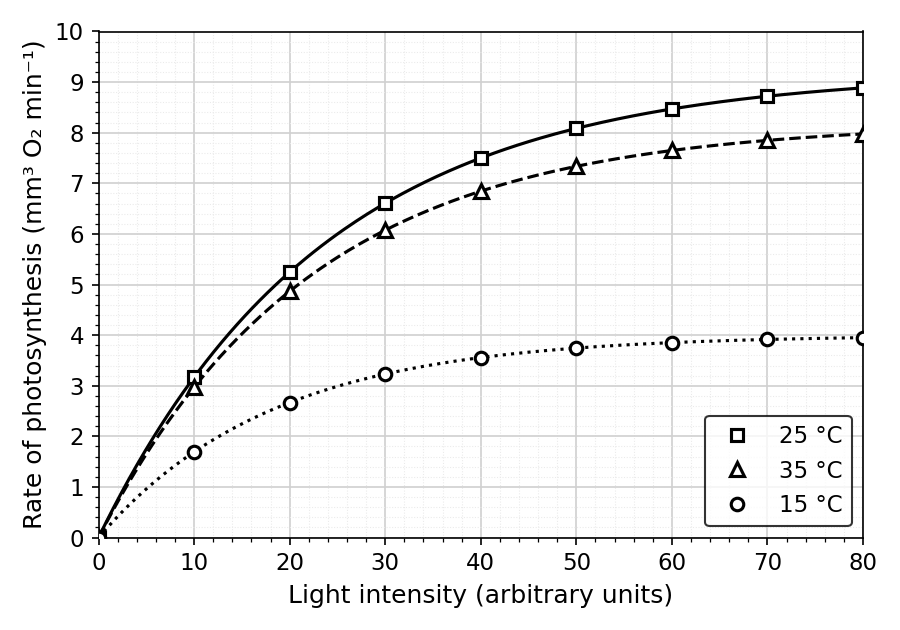
(a) State the rate of photosynthesis at a light intensity of 40 arbitrary units and a temperature of 25 °C.
(b) Identify the limiting factor for photosynthesis at a light intensity of 20 arbitrary units.
(c) Explain the effect of increasing the temperature from 15 °C to 25 °C on the rate of photosynthesis at a light intensity of 70 arbitrary units.
(d) The experiment was repeated at 45 °C. Predict, with a reason, the effect on the rate of photosynthesis at high light intensity compared to the rate at 35 °C.
Find the x-value of 40 on the graph. Follow the line up to the curve for 25 °C and then read the corresponding y-value. Remember to include units.
Look at the shape of all three curves at this light intensity. What factor is preventing the rate from being higher, even when temperature is increased?
At high light intensity, another factor is limiting the rate. Consider the role of enzymes in photosynthesis and how temperature affects them.
Think about what happens to proteins, especially enzymes, at temperatures well above their optimum.
Question 2
HardPaper 1A · calculator8 marksA student investigated the photosynthetic pigments in two species of algae: Chlorella vulgaris, a green alga found in freshwater, and Porphyra umbilicalis, a red alga found in the intertidal zone. The pigments were extracted from each alga and separated using paper chromatography. The resulting chromatogram is shown below. The solvent front moved 9.0 cm from the origin line.
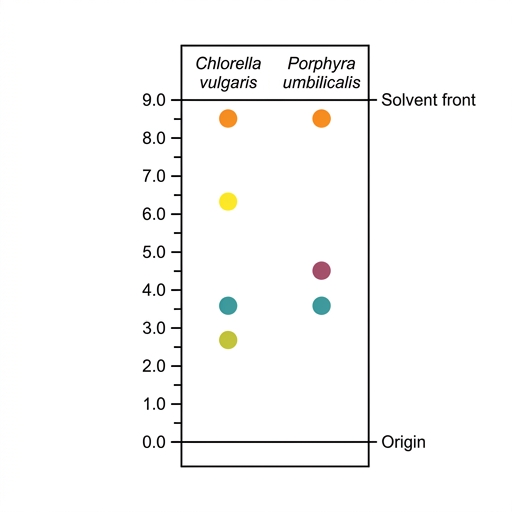
A table of known photosynthetic pigments and their properties is provided.
| Pigment | Colour | value in this solvent |
|---|---|---|
| Carotene | Orange | 0.95 |
| Phaeophytin | Grey-brown | 0.81 |
| Xanthophyll | Yellow | 0.70 |
| Chlorophyll a | Blue-green | 0.40 |
| Chlorophyll b | Yellowish-green | 0.30 |
| Phycoerythrin | Reddish-purple | 0.50 |
(a) Calculate the value for spot B.
(b) Using the data provided, identify the pigments represented by spots A, C, and D in Chlorella vulgaris.
(c) The red alga Porphyra often lives in deeper water than the green alga Chlorella. Explain how the pigments present in Porphyra are an adaptation to this environment.
The value is a ratio. It is calculated by dividing the distance travelled by the spot by the distance travelled by the solvent front. Both distances should be measured from the origin line.
For each spot, you will first need to calculate its value, just as you did in part (a). Then, compare your calculated values to the known values in the table to identify each pigment.
First, identify the pigment that is unique to Porphyra from the chromatogram. Then, consider which wavelengths of light penetrate deepest into water. How does this unique pigment help the alga to survive in its habitat?
Question 3
MediumPaper 1B · calculator6 marksA student is studying a cross-section of a leaf from a sunflower (Helianthus annuus) using a light microscope. They focus on a single palisade mesophyll cell. The actual length of this cell is 30 µm. The student draws the cell with a length of 6 cm in their notebook.
(a) Calculate the magnification of the student's drawing.
(b) Distinguish between the magnification and the resolution of a microscopic image.
(c) The student wants to observe the detailed internal structure of a chloroplast from the palisade cell, including the thylakoid stacks. State the type of microscope required for this task.
(d) State one reason for the high density of chloroplasts in palisade mesophyll cells.
Remember the formula for magnification: Magnification = Image size / Actual size. Make sure your units for image size and actual size are the same before you divide.
Think about what each term describes. One refers to the size of the image, and the other refers to its clarity or detail. A good answer will define both and highlight the difference.
Consider the limitations of a light microscope. What kind of microscope can see much smaller structures in high detail?
What is the main function of a palisade cell in a leaf, and which organelle is responsible for this function?
Question 4
HardPaper 1B · calculator6 marksThe graph shows data-logging of three variables in a coastal rock pool containing the brown alga Fucus vesiculosus over a 48-hour period.
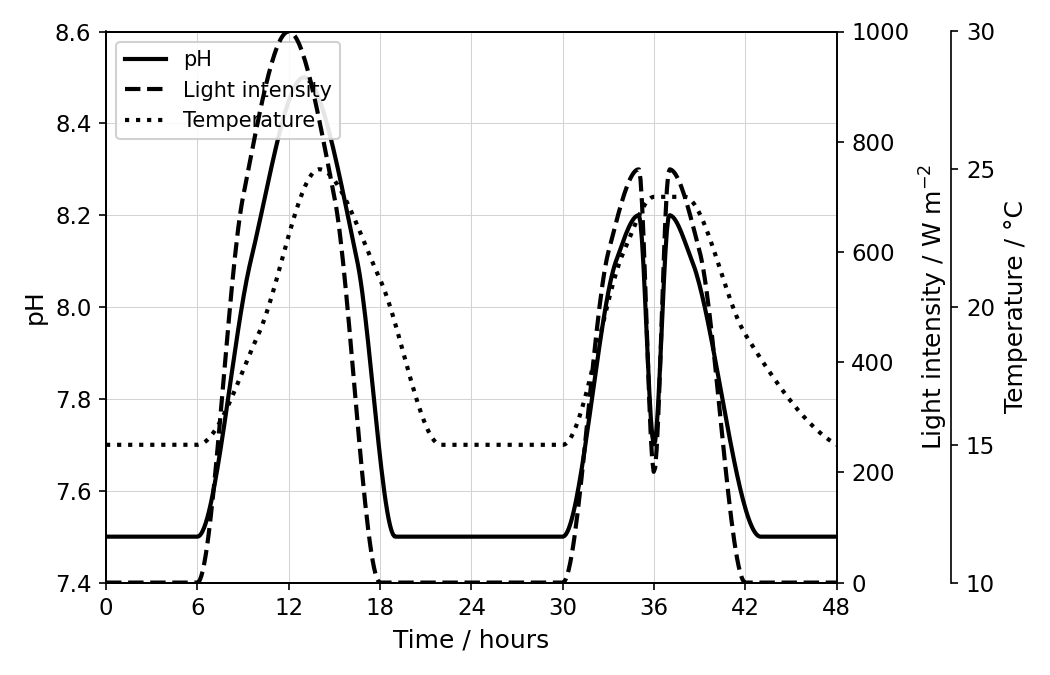
Explain the causes of the rises and falls in the pH of the rock pool water.
(b.i) State the relationship shown in the graph between light intensity and dissolved concentration.
(b.ii) State the relationship shown in the graph between temperature and dissolved concentration.
(c) From the graph, deduce whether light intensity or temperature has a greater effect on the dissolved concentration.
Think about how photosynthesis and respiration affect the concentration of carbon dioxide in the water, and how carbon dioxide concentration affects pH.
Remember that pH is inversely related to carbon dioxide concentration. Look at how pH changes when light intensity is high versus low.
Compare the overall trend of the temperature curve with the inferred carbon dioxide concentration (based on pH).
Look for a point on the graph where light intensity and temperature do not follow their usual synchronized pattern, such as the fog event on day 2.
Question 5
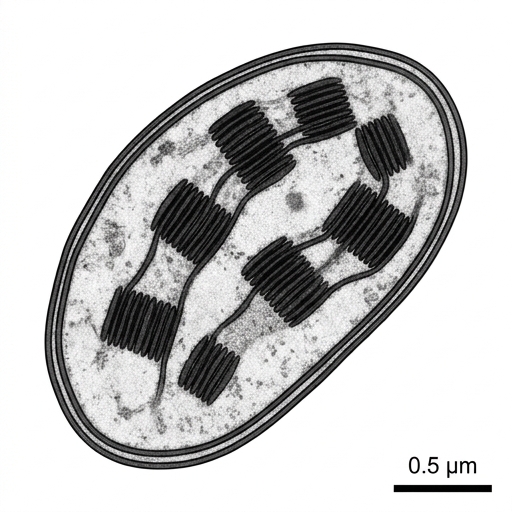
MediumPaper 2 · calculator5 marksThe image shows a transmission electron micrograph (TEM) of a chloroplast.
(a)
(i) Name a type of cell in a flowering plant that does not contain chloroplasts.
(a) (ii) State two products of the overall process of photosynthesis.
(b) Chloroplasts contain their own circular DNA and 70S ribosomes. Explain how these features provide evidence for the endosymbiotic theory.
Consider the different parts of a plant. Which parts are not exposed to sunlight and therefore have no need for photosynthesis?
Recall the word equation for photosynthesis. The products are the substances that are created during the reaction.
Compare the features mentioned (circular DNA, 70S ribosomes) with the features of prokaryotic and eukaryotic cells. What does the term 'endosymbiosis' imply about the origin of this organelle?
Question 6
MediumPaper 2 · calculator5 marksExplain how predicted changes in the global climate and atmospheric composition could affect future rates of photosynthesis in terrestrial ecosystems.
Consider the main factors that limit the rate of photosynthesis and how climate change (such as rising temperatures and greenhouse gases) will alter them.
Question 7
MediumPaper 2 · calculator10 marks(HL only) A researcher treats isolated chloroplasts with a chemical that makes the thylakoid membrane highly permeable to protons ().
Explain the effect of this chemical on the synthesis of ATP in the chloroplast.
Explain how the failure to produce ATP affects the light-independent reactions of photosynthesis.
Even though ATP synthesis is inhibited, oxygen continues to be produced for a short time. Explain the process by which oxygen is produced in the chloroplast.
Think about the role of the proton gradient in chemiosmosis and how ATP synthase works.
Consider the specific steps in the Calvin cycle that require ATP.
Recall the source of oxygen in photosynthesis and the specific reaction that releases it.
Question 8
MediumPaper 1A · calculator1 markHydrogen carbonate indicator is red at atmospheric levels. It turns yellow when levels increase and purple when levels decrease. Tests were carried out in sealed tubes containing this indicator, varying the presence of an aquatic plant (Cabomba caroliniana) and a freshwater snail (Lymnaea stagnalis).
Which condition would result in the indicator turning purple?
A. Plant kept in the light without a snail
B. Plant kept in the dark without a snail
C. Snail kept in the light without a plant
D. Plant and snail kept in the dark
Consider which biological processes produce and which processes consume it. How does light affect these processes in plants versus animals?
No question on this page matches those filters. Try another difficulty or paper.
Every Photosynthesis question, marked for you
Every answer is marked mark by mark, IB-style, and the AI tutor helps when you are stuck.
Where marks are lost
- Command terms are consistently under-read. Students answer describe when the question said explain, so they give an account with no reasons and cap at half marks. The reverse also happens on outline, where a student writes an essay for a 2-mark summary and runs out of time.