Viruses: notes and practice questions
- This topic covers the structural features, diversity, life cycles, origins, and rapid evolution of viruses.
- Viruses are obligate parasites, characterized by small, fixed size, nucleic acid (DNA or RNA) as genetic material, and a protein capsid.
- They lack cytoplasm and most enzymes, relying on host cells for energy, nutrition, and protein synthesis.
- Viral genetic material can be single- or double-stranded DNA or RNA, and some viruses are enveloped.
- Viruses replicate via lytic and lysogenic cycles, exemplified by bacteriophage lambda.
- Rapid evolution in viruses, such as influenza and HIV, has consequences for disease treatment.
How it is examined
HL only, so it appears in HL Paper 1A and HL Paper 2. Typical shapes: outline the lytic cycle (2 to 3 marks, sequence matters), distinguish lytic from lysogenic, explain why viruses evolve fast. Answers that describe a generic virus rather than bacteriophage lambda can still score where the mark scheme is generic, but named examples are safer.
There is no SL content in A2.3. The whole subtopic is HL.
Do not set this topic for SL students.
Guiding questions
- How can viruses exist with so few genes?
- In what ways do viruses vary?
Linking questions
- What mechanisms contribute to convergent evolution?
- To what extent is the natural history of life characterized by increasing complexity or simplicity?
Practice questions
6 questions · 2 medium · 4 hardQuestion 1
MediumPaper 1B · calculator10 marksAmino acid sequences of two Zika virus proteins were analysed from patient samples between 2015 and 2018 to determine the number of mutations compared to a reference strain. The pie charts show the distribution of mutations for the Envelope (E) protein and the Non-structural protein 5 (NS5).
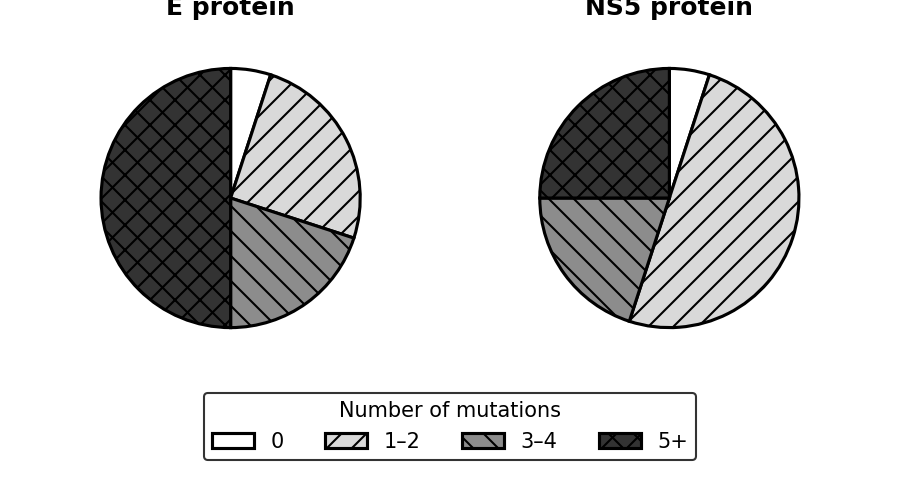
Compare and contrast the data for the two proteins.
The E protein is coded by 1512 bases in the viral genome and the NS5 protein is coded by 2712 bases. Deduce whether the difference in the number of mutations between the E and NS5 proteins is due to their gene lengths.
Mutations occur randomly during viral replication, but some specific base substitutions in the E protein gene were found in many patient samples, while other possible substitutions were never detected. Suggest reasons for these observations.
Look for both similarities (sectors that are the same size) and differences (sectors that are much larger in one chart than the other) to get full marks.
If mutation rate depended only on length, which gene would you expect to have more mutations? Does this match the data in the pie charts?
Think about how natural selection acts on viruses. What happens to a virus if a mutation makes it better at infecting cells, versus a mutation that destroys a crucial protein?
Question 2
HardPaper 2 · calculator15 marks(a) Outline why viruses are classified as obligate parasites rather than living cells.
(b) Explain the concept of convergent evolution in the context of viral origins.
(c) Discuss the mechanisms of rapid evolution in viruses and the consequences for treating viral diseases.
Think about what structures and metabolic processes viruses lack, and what they must obtain from a host cell in order to replicate.
Do all viruses share a single common ancestor? Consider how different lineages might independently develop similar traits to survive as intracellular parasites.
Consider the mutation rates of RNA viruses like HIV or influenza, how new variation is generated, and how this affects the long-term efficacy of vaccines and antiviral drugs.
Question 3
MediumPaper 2 · calculator10 marksDistinguish between the innate and adaptive immune systems.
Outline why antibiotics are effective against bacteria but not against viruses.
Compare and contrast the primary defences provided by the skin and mucous membranes.
Think about which system you are born with and which one develops over time, as well as which one involves antibodies and memory cells.
Consider the structural and metabolic differences between a bacterium and a virus. What do antibiotics actually target?
Identify what both structures do to stop pathogens, then think about where they are located and whether they are dry or moist.
Question 4
HardPaper 2 · calculator10 marks(a) A culture of Escherichia coli was infected with bacteriophage lambda. The concentration of free, infectious viral particles in the culture medium was measured over minutes. The results are shown in the graph, divided into four phases (A to D).
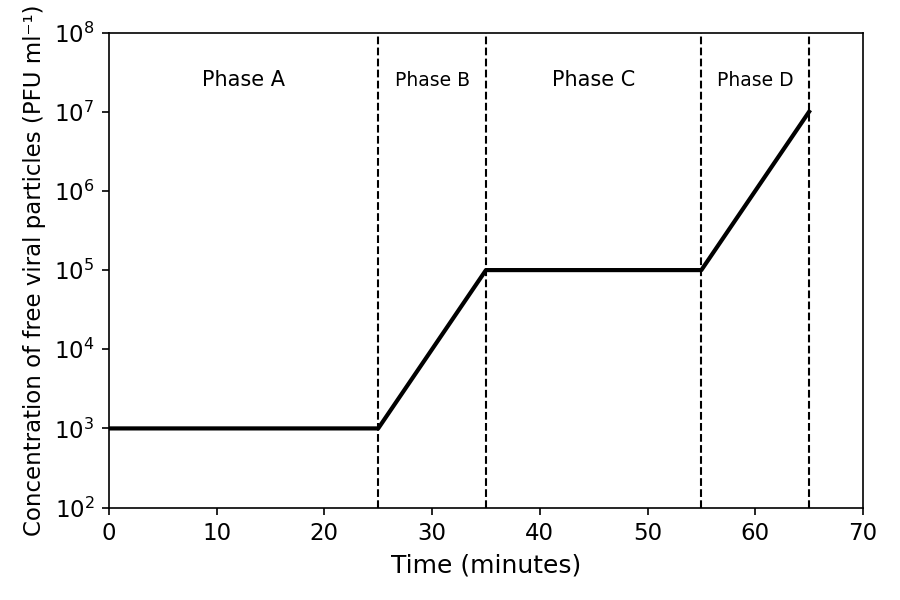
Compare and contrast the changes in the concentration of free viruses across the four phases.
(b.i) Deduce what is happening during phase B.
(b.ii) Deduce what is happening during phase C.
(c) Deduce, with a reason, whether the bacteriophage lambda is in a lytic or a lysogenic cycle.
Look for patterns in the graph. Group the phases by what the line is doing (increasing versus staying flat).
Why would the number of free viruses in the surrounding medium suddenly increase?
The number of free viruses is constant, but they have just infected a new batch of host cells. What processes must occur inside a host cell before new viruses can be released?
Does the graph show the virus remaining dormant, or actively destroying host cells to replicate?
Question 5
HardPaper 2 · calculator10 marksBacteriophages and animal viruses, such as the influenza virus, infect different types of host cells but share fundamental characteristics.
(a) Describe the structural features that are common to all viruses, regardless of their host.
(b) Outline the structural features that can differ between various types of viruses.
(c) Explain why biologists conclude that viruses do not share a single common ancestor.
Think about the basic components that make up a virus particle and how its size and growth compare to a living cell.
Consider the different types of genetic material viruses can carry and whether they have an outer lipid layer.
If viruses do not have one common ancestor, how did they get their shared features, and where did they likely originate from?
Question 6
HardPaper 2 · calculator15 marksThe table shows data from a national health ministry for an outbreak of a novel viral respiratory disease over a one-year period.
| Age group | Cases in males | Cases in females | Deaths in males | Deaths in females |
|---|---|---|---|---|
| 60+ | 1200 | 1500 | 180 | 240 |
| 45–59 | 5400 | 4800 | 45 | 32 |
| 30–44 | 14,500 | 12,100 | 22 | 15 |
| 15–29 | 16,200 | 13,400 | 8 | 5 |
| 2500 | 2400 | 1 | 1 |
Comment on the relationship between age and numbers of cases.
(b.i) Distinguish between males and females in the numbers of cases and numbers of deaths.
(b.ii) Suggest reasons for the differences observed between males and females.
(c) Calculate the percentage death rate in males aged 45–59 who became infected.
(d) Analyse the data to identify which group had the highest percentage death rate if infected.
Look at the total cases (males + females) for each age group. Where is the peak? Where are the lowest numbers?
Compare the columns for males and females row by row. Are there age groups where the pattern reverses?
Think about biological, social, or demographic factors that differ between sexes and age groups, such as life expectancy or occupational exposure.
Find the number of infected males aged 45-59 and the number of deaths in that group. Divide deaths by cases and multiply by 100.
You need to calculate the death rate (deaths divided by cases) for the groups with the highest number of deaths to find the maximum percentage.
No question on this page matches those filters. Try another difficulty or paper.
Every Viruses question, marked for you
Every answer is marked mark by mark, IB-style, and the AI tutor helps when you are stuck.
Where marks are lost
- Command terms are consistently under-read. Students answer describe when the question said explain, so they give an account with no reasons and cap at half marks. The reverse also happens on outline, where a student writes an essay for a 2-mark summary and runs out of time.
- compare and contrast answers give only similarities, or only differences.