Integration of Body Systems: notes and practice questions
- This topic covers how different body systems coordinate and interact to maintain overall function and emergent properties in multicellular organisms.
- Body systems are organized hierarchically from cells to tissues, organs, and systems.
- Integration relies on nervous and hormonal signalling, and material transport via the blood system.
- The brain acts as a central integrator for information, learning, and memory.
- The spinal cord manages unconscious processes, such as pain reflex arcs involving sensory and motor neurons.
- Hormones like melatonin regulate sleep patterns, while epinephrine prepares the body for activity.
- Negative feedback mechanisms are crucial for homeostasis, controlling variables such as blood glucose, body temperature, heart rate, and ventilation.
How it is examined
The reflex arc is a drawing and labelling item as well as a sequence outline, and the mark scheme wants receptor, sensory neuron, interneuron, motor neuron, effector in order. Negative feedback questions on heart rate and ventilation want the loop closed, so an answer that stops at "the medulla sends impulses" without the effect on the variable loses the last mark. At HL, phototropism explanations need auxin redistribution to the shaded side plus cell elongation, and the acid growth mechanism is where the third mark sits.
- C3.1.1 System integration as a necessary process in living systems. Coordination is needed for component parts to collectively perform an overall function.
- C3.1.2 Cells, tissues, organs and body systems as a hierarchy of subsystems integrated in a multicellular organism, responsible for emergent properties. The guide's example is a cheetah becoming an effective predator through integration of its body systems.
- C3.1.3 Integration of organs by hormonal and nervous signalling and by transport of materials and energy. Distinguish the roles of the nervous and endocrine systems in sending messages, and emphasize the role of the blood system in transporting materials between organs.
- C3.1.4 The brain as a central information integration organ, limited to processing information combined from several inputs and to learning and memory.
- C3.1.17 Observations of tropic responses in seedlings. Application of skills: gather qualitative data using diagrams to record observations, and collect quantitative data by measuring the angle of curvature. NOS: distinguish qualitative from quantitative observations and understand the factors limiting precision and accuracy.
- C3.1.18 Positive phototropism as a directional growth response to lateral light in plant shoots.
- C3.1.19 Phytohormones as signalling chemicals controlling growth, development and response to stimuli in plants. A variety of chemicals are used as phytohormones.
- C3.1.20 Auxin efflux carriers as an example of maintaining concentration gradients of phytohormones. Auxin diffuses freely into plant cells but not out of them. Efflux carriers can be positioned on one side of a cell membrane, and if all cells concentrate them on the same side, auxin is actively transported from cell to cell and becomes concentrated in part of the plant.
Guiding questions
- What are the roles of nerves and hormones in integration of body systems?
- What are the roles of feedback mechanisms in regulation of body systems?
Linking questions
- What are examples of branching (dendritic) and net-like (reticulate) patterns of organization?
- What are the consequences of positive feedback in biological systems?
Practice questions
11 questions · 6 easy · 2 medium · 3 hardQuestion 1
EasyPaper 1A · calculator1 markIn a spinal reflex arc, what is the primary function of the relay neuron (interneuron)?
A. To carry the nerve impulse from the receptor to the spinal cord.
B. To form a synapse with the effector, causing a response.
C. To connect the sensory neuron to the motor neuron within the central nervous system.
D. To transmit the pain signal to the brain for conscious perception.
Consider the pathway of a nerve impulse during a reflex action. What are the roles of the sensory neuron, motor neuron, and the neuron that links them within the spinal cord?
Question 2
MediumPaper 2 · calculator15 marksLiving organisms must maintain a stable internal environment, a process known as homeostasis.
(a) Explain the control of blood glucose concentration in humans.
(b) Explain the effect of pH on the activity of enzymes.
(c) Distinguish between the transport of glucose and oxygen in the blood, with reference to the properties of water.
Think about the two key hormones released from the pancreas. What triggers the release of each hormone, what are their target cells, and what is the resulting effect on blood glucose levels?
Consider how pH affects the chemical bonds that maintain a protein's specific three-dimensional shape. What is the term for the irreversible change in an enzyme's structure, and how does this affect its function?
Compare the polarity of glucose and oxygen molecules. How does this property affect how well each substance can dissolve in the main component of blood plasma, which is water?
Question 3
HardPaper 1B · calculator8 marksThe diagram shows pressure changes in the left atrium, left ventricle, and aorta during one cardiac cycle in a healthy adult at rest.
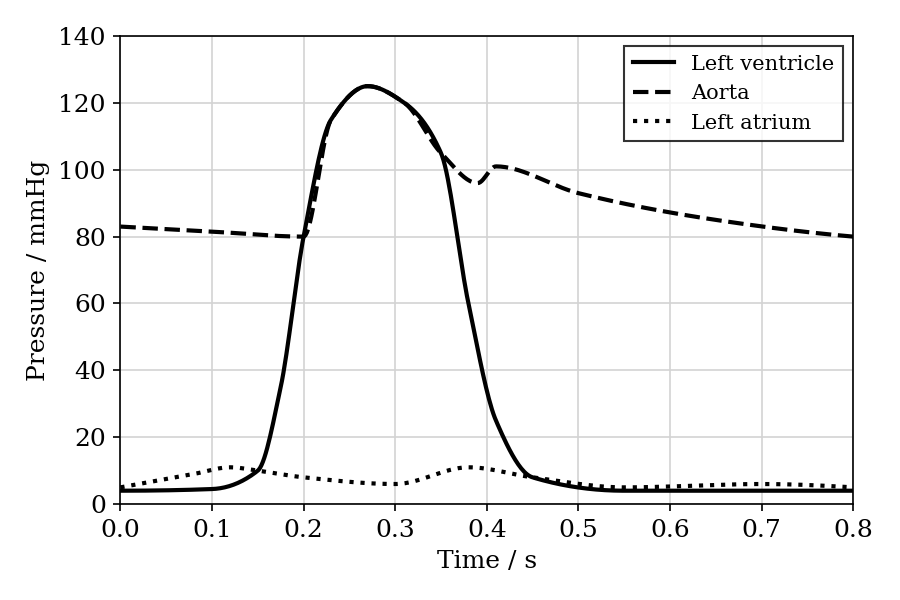
(a) Identify the systolic and diastolic blood pressure of this individual. Include units with your answer.
(b) State the time at which the left ventricle contains the maximum volume of blood.
(c) Explain the pressure changes in the left ventricle between 0.15 s and 0.35 s.
(d) The cardiac output is the volume of blood pumped by the heart per minute. It is calculated by multiplying the heart rate by the stroke volume. Calculate the cardiac output for this individual in L min⁻¹, assuming the stroke volume is 70 ml.
Systolic pressure is the peak pressure in the aorta, while diastolic pressure is the lowest pressure in the aorta. Read these values from the aortic pressure curve on the graph.
The ventricle is fullest just before it begins to contract to pump blood out. This phase is called end-diastole. On the graph, this corresponds to the moment the mitral valve closes and ventricular pressure starts to rise steeply.
This period covers two phases of ventricular systole. First, consider what happens to the pressure when the ventricle contracts but both the mitral and aortic valves are closed. Then, consider what happens once the aortic valve opens.
First, determine the duration of one cardiac cycle from the graph. Use this to calculate the heart rate in beats per minute. Then, use the given formula to find the cardiac output.
Question 4
EasyPaper 1A · calculator1 markWhich of the following is an example of a positive feedback mechanism?
A. The release of glucagon when blood glucose levels are low.
B. The constriction of blood vessels in the skin when body temperature falls.
C. The release of oxytocin to stimulate contractions during childbirth.
D. An increase in the rate of breathing when blood CO₂ concentration rises.
Positive feedback mechanisms amplify or reinforce the initial change, moving the system further away from its starting state. Negative feedback mechanisms counteract the change to restore balance.
Question 5
MediumPaper 1A · calculator1 markA patient experiences difficulty with balance and coordinating movements, such as walking in a straight line, after a stroke. Which area of the brain is most likely affected?
A. Cerebrum
B. Medulla oblongata
C. Cerebellum
D. Hypothalamus
Consider the specific functions of the major parts of the brain. Which part is specialized for coordinating voluntary movements and maintaining posture and balance?
Question 6
HardPaper 2 · calculator17 marksThe graph shows the changes in blood pressure as blood flows through the human circulatory system from the left ventricle back to the right atrium.
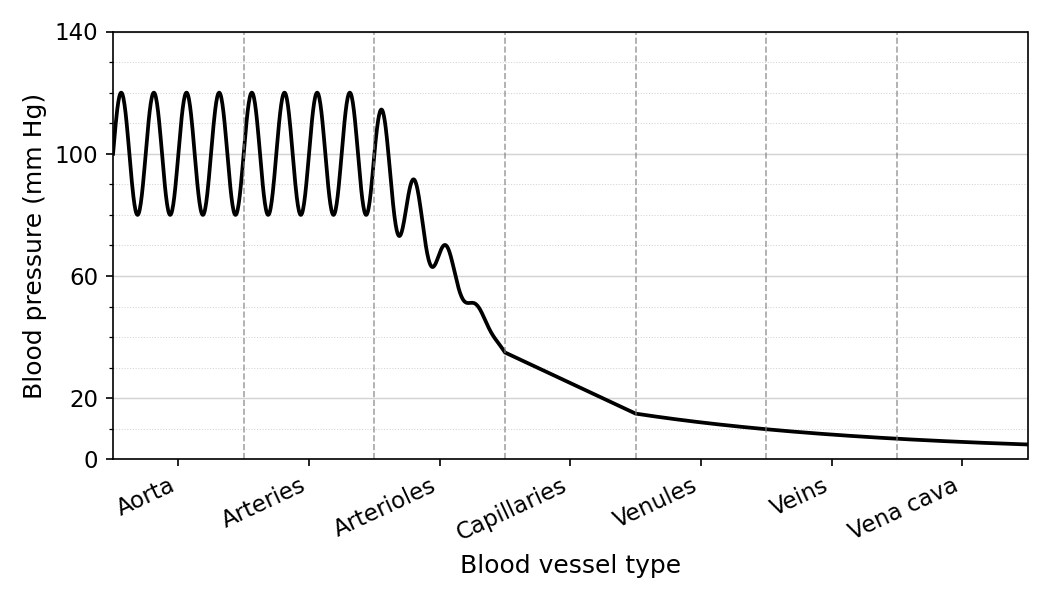
(a) Identify the blood vessel type where the maximum fluctuation in blood pressure occurs.
(b) Calculate the pulse pressure, defined as the difference between the maximum and minimum blood pressure, in the aorta. Include units in your answer.
(c) Explain the cause of the rapid fluctuations in blood pressure observed in the aorta.
(d) Explain how the structure of arteries allows them to withstand and maintain this high blood pressure.
(e) Outline why the blood pressure must be relatively low in the capillaries.
(f) Veins have very low blood pressure. Describe the mechanisms that ensure blood in the veins is returned to the heart.
(g) During exercise, the body requires a higher cardiac output. Explain how the heart rate is controlled by negative feedback to maintain homeostasis during exercise.
Look at the graph to see where the difference between the peaks and troughs is the largest.
Subtract the lowest pressure value from the highest pressure value in the aorta section of the graph.
Think about what the heart is doing to push blood into the aorta and what happens when it rests.
Consider the tissues that make up the artery wall, specifically muscle and elastic fibers, and their mechanical properties.
Think about the structure of a capillary wall and its main function of material exchange.
Since pressure is too low to push blood back, what structures inside veins and outside them help move blood in one direction?
Describe the negative feedback loop: what is the stimulus, where is it detected, what is the control center, and how does the effector (the heart) respond?
Question 7
EasyPaper 1A · calculator1 markWhat is the function of the motor neuron in a pain reflex arc?
A. It detects the painful stimulus in the skin.
B. It carries impulses from the receptor to the spinal cord.
C. It carries impulses from the spinal cord to the effector.
D. It processes the sensory information in the brain.
Think about the direction of the nerve impulse after it leaves the central nervous system to cause a physical response.
Question 8
HardPaper 2 · calculator10 marks(HL only)
Outline how a steroid hormone initiates a response in a target cell.
Outline the mechanism of signal transduction when epinephrine binds to its receptor.
Explain the role of epinephrine in preparing the body for vigorous activity.
Think about the chemical properties of steroid hormones and where their receptors are located.
Epinephrine cannot enter the cell. What type of receptor does it bind to, and what second messenger is produced?
Consider the 'fight or flight' response and how different body systems (like the heart, lungs, and liver) are integrated to support muscle action.
Question 9
EasyPaper 1A · calculator1 markWhich row correctly matches the endocrine gland, the hormone it secretes, and its primary action?
| Gland | Hormone | Action | |
|---|---|---|---|
| A. | Pancreas | Insulin | Increases blood glucose concentration |
| B. | Adrenal | Epinephrine | Prepares the body for vigorous activity |
| C. | Pineal | Melatonin | Increases metabolic rate |
| D. | Thyroid | Thyroxin | Regulates circadian rhythms |
Recall which hormone is responsible for the 'fight or flight' response and where it is produced. Pay close attention to whether the action listed matches the specific hormone.
Question 10
EasyPaper 1A · calculator1 markWhich statement describes the control mechanism of a pain reflex arc?
A. It is a voluntary response integrated by the brain.
B. It is an unconscious response integrated by the spinal cord.
C. It is an unconscious response integrated by the brain.
D. It is a voluntary response integrated by the spinal cord.
Consider whether pulling your hand away from a hot object requires conscious thought, and which part of the central nervous system processes this rapid response.
Question 11
EasyPaper 1A · calculator1 markWhich mechanism is responsible for regulating the rhythmic contractions of circular and longitudinal muscles in the digestive tract?
A. Voluntary control by the central nervous system
B. Involuntary control by the enteric nervous system
C. Involuntary control by the central nervous system
D. Voluntary control by the enteric nervous system
Think about whether you have to consciously think about digesting your food, and which specific network of nerves is located in the gut.
No question on this page matches those filters. Try another difficulty or paper.
Every Integration of Body Systems question, marked for you
Every answer is marked mark by mark, IB-style, and the AI tutor helps when you are stuck.
Where marks are lost
- Command terms are consistently under-read. Students answer describe when the question said explain, so they give an account with no reasons and cap at half marks. The reverse also happens on outline, where a student writes an essay for a 2-mark summary and runs out of time.