Organelles and Compartmentalization: notes and practice questions
- This topic covers the structure and function of organelles and the advantages of cellular compartmentalization.
- Organelles are discrete subunits of cells adapted to perform specific functions.
- The cell wall, cytoskeleton, and cytoplasm are not considered organelles; nuclei, vesicles, ribosomes, and the plasma membrane are.
- Compartmentalization separates gene transcription and translation, allowing post-transcriptional modification of mRNA in eukaryotes.
- Compartmentalization concentrates metabolites and enzymes and separates incompatible biochemical processes.
- Scientific progress in understanding organelles often follows the development of new techniques, such as ultracentrifuges for cell fractionation.
How it is examined
At SL this is a 1-hour subtopic and shows up as short outline items on the advantages of compartmentalization. At HL the organelle adaptation lists are prime explain how the structure of X is adapted to its function material, 3 to 4 marks, one mark per adaptation linked to its consequence.
- B2.2.1 Organelles as discrete subunits of cells adapted to perform specific functions. The cell wall, cytoskeleton and cytoplasm are not organelles; nuclei, vesicles, ribosomes and the plasma membrane are. NOS: progress often follows new techniques, here the ultracentrifuge and cell fractionation.
- B2.2.2 Advantage of separating the nucleus and cytoplasm into separate compartments, limited to separating transcription from translation, so post-transcriptional modification of mRNA can happen before the mRNA meets ribosomes. In prokaryotes this is not possible.
- B2.2.3 Advantages of compartmentalization in the cytoplasm: concentration of metabolites and enzymes, and separation of incompatible biochemical processes, with lysosomes and phagocytic vacuoles as examples.
- B2.2.4 Adaptations of the mitochondrion for producing ATP by aerobic cell respiration: a double membrane with a small intermembrane space volume, large surface area of cristae, and compartmentalization of Krebs cycle enzymes and substrates in the matrix.
- B2.2.5 Adaptations of the chloroplast for photosynthesis: large surface area of thylakoid membranes with photosystems, small volumes of fluid inside thylakoids, and compartmentalization of Calvin cycle enzymes and substrates in the stroma.
- B2.2.6 Functional benefits of the double membrane of the nucleus, including the need for pores and for the membrane to break into vesicles during mitosis and meiosis.
- B2.2.7 Structure and function of free ribosomes and the rough endoplasmic reticulum. Free ribosomes make proteins retained in the cell; membrane-bound ribosomes on the rough ER make proteins for transport within the cell and for secretion.
Guiding questions
- How are organelles in cells adapted to their functions?
- What are the advantages of compartmentalization in cells?
Linking questions
- What are examples of structure-function correlations at each level of biological organization?
- What separation techniques are used by biologists?
Practice questions
10 questions · 1 easy · 7 medium · 2 hardQuestion 1
EasyPaper 1A · calculator1 markWhich of the following is NOT a function of the nucleus in a eukaryotic cell?
A. Storing the cell's hereditary material (DNA).
B. Synthesizing proteins for export from the cell.
C. Controlling cell growth and division.
D. Assembling ribosomes in the nucleolus.
Consider the location of each major cellular process. Where does protein synthesis occur? Compare this with the known roles of the nucleus.
Question 2
MediumPaper 2 · calculator4 marksThe diagram shows a simplified prokaryotic cell and a eukaryotic animal cell.
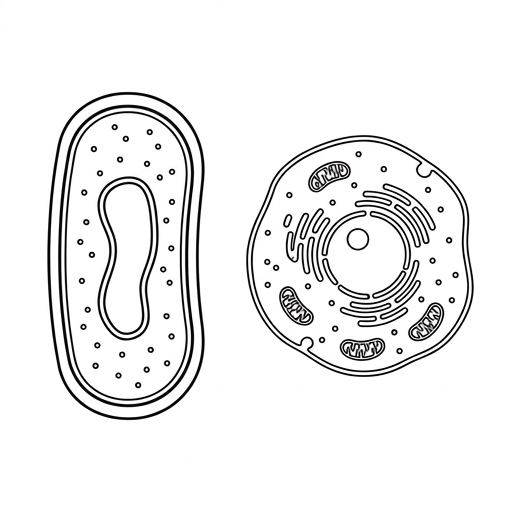
(a) State two structures that are present in both the prokaryotic cell and the eukaryotic animal cell.
(b) (i) State one membrane-bound organelle present in the eukaryotic cell but absent in the prokaryotic cell.
(b) (ii) State one difference, other than location, between the DNA of the prokaryotic cell and the DNA of the eukaryotic cell.
Look for components that are fundamental to any cell's basic function and boundary, regardless of its complexity.
Think about the key feature that defines a eukaryotic cell, which is the presence of internal compartments.
Consider the shape of the DNA molecule and what it is associated with inside the cell.
Question 3
HardPaper 2 · calculator15 marks(a) Outline the processes and conditions required for the spontaneous origin of cells on early Earth.
(b) Describe the advantages of compartmentalization in eukaryotic cells.
(c) Explain how the structure of proteins allows them to perform diverse functions in cell membranes and metabolism.
Think about the atmosphere of early Earth and the steps needed to go from simple molecules to a fully functioning cell, including the Miller-Urey experiment.
Consider why it is beneficial for a cell to have membrane-bound organelles rather than having all its enzymes and substrates mixed together in the cytoplasm.
Link the sequence and properties of amino acids (like hydrophobic/hydrophilic R-groups) to the 3D shape of proteins, and then explain how this shape allows them to act as membrane transporters and metabolic enzymes.
Question 4
MediumPaper 1B · calculator6 marksA student is studying a cross-section of a leaf from a sunflower (Helianthus annuus) using a light microscope. They focus on a single palisade mesophyll cell. The actual length of this cell is 30 µm. The student draws the cell with a length of 6 cm in their notebook.
(a) Calculate the magnification of the student's drawing.
(b) Distinguish between the magnification and the resolution of a microscopic image.
(c) The student wants to observe the detailed internal structure of a chloroplast from the palisade cell, including the thylakoid stacks. State the type of microscope required for this task.
(d) State one reason for the high density of chloroplasts in palisade mesophyll cells.
Remember the formula for magnification: Magnification = Image size / Actual size. Make sure your units for image size and actual size are the same before you divide.
Think about what each term describes. One refers to the size of the image, and the other refers to its clarity or detail. A good answer will define both and highlight the difference.
Consider the limitations of a light microscope. What kind of microscope can see much smaller structures in high detail?
What is the main function of a palisade cell in a leaf, and which organelle is responsible for this function?
Question 5
HardPaper 2 · calculator15 marksEukaryotic cells are characterized by the presence of membrane-bound organelles, which compartmentalize various biochemical processes.
(a) Compare and contrast the structure of chloroplasts and mitochondria.
(b) Describe the advantages of compartmentalization in eukaryotic cells.
(c) Explain the role of compartmentalization in the synthesis, modification, and transport of proteins destined for secretion.
Think about the membranes, genetic material, and internal structures of both organelles. Remember to provide both similarities and differences.
Consider how having separate 'rooms' in a cell might help with efficiency, optimal conditions, and protecting the cell from its own enzymes.
Trace the pathway of a protein from the DNA code in the nucleus to its release outside the cell. Mention the specific organelles and vesicles involved.
Question 6
MediumPaper 2 · calculator5 marksThe image shows a transmission electron micrograph (TEM) of a chloroplast.
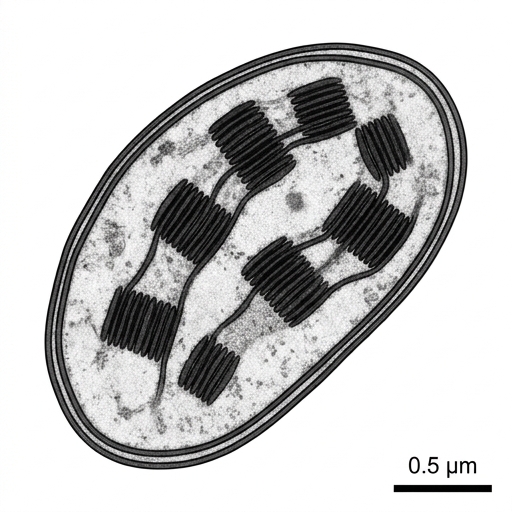
(a)
(i) Name a type of cell in a flowering plant that does not contain chloroplasts.
(a) (ii) State two products of the overall process of photosynthesis.
(b) Chloroplasts contain their own circular DNA and 70S ribosomes. Explain how these features provide evidence for the endosymbiotic theory.
Consider the different parts of a plant. Which parts are not exposed to sunlight and therefore have no need for photosynthesis?
Recall the word equation for photosynthesis. The products are the substances that are created during the reaction.
Compare the features mentioned (circular DNA, 70S ribosomes) with the features of prokaryotic and eukaryotic cells. What does the term 'endosymbiosis' imply about the origin of this organelle?
Question 7
MediumPaper 2 · calculator5 marks(a) The optimum pH for pepsin, an enzyme in the human stomach, is 2.0. The optimum pH for trypsin, an enzyme in the small intestine, is 8.0.
Calculate the ratio of the proton concentration at the optimum pH of pepsin to the proton concentration at the optimum pH of trypsin.
(b) Calculate the ratio of the proton concentration in a lysosome at pH 5.0 to the proton concentration in the surrounding cytoplasm at pH 7.2.
(c) State the term used to describe the irreversible change in the three-dimensional structure of an enzyme when exposed to a pH far outside its range of tolerance.
Remember that pH is a logarithmic scale. A pH of corresponds to a proton concentration of .
Find the proton concentration for both pH values using , then divide the lysosome concentration by the cytoplasm concentration.
What happens to the active site of a protein when the pH breaks its intramolecular bonds?
Question 8
MediumPaper 1B · calculator10 marks(a) The table shows the areas of different membranes () in a plasma cell (an antibody-secreting B lymphocyte).
| Membrane | Area / |
|---|---|
| Rough endoplasmic reticulum | 18 000 |
| Smooth endoplasmic reticulum | 150 |
| Outer mitochondrial membrane | 1 200 |
| Inner mitochondrial membrane | 6 500 |
| Plasma membrane | 864 |
| Golgi apparatus | 1 800 |
| Nucleus | 300 |
Calculate the volume of the plasma cell, assuming it is cubic.
(b) Explain the difference in area of the inner and outer mitochondrial membranes.
(c) Justify the conclusion that the plasma cell is highly specialized for protein secretion.
(d) Comment on the area of the smooth endoplasmic reticulum in the plasma cell.
Remember that a cube has 6 identical square faces. First find the area of one face using the plasma membrane area, then find the side length, and finally calculate the volume.
Think about the structure of the inner mitochondrial membrane and the specific biochemical processes that occur there.
Look at the areas of the organelles involved in the synthesis, modification, and packaging of proteins.
Compare the area of the smooth ER to the rough ER, and consider the specific functions of the smooth ER that might not be needed in a plasma cell.
Question 9
MediumPaper 2 · calculator10 marksThe table shows the percentage composition by volume of three types of mammalian cell. Cytoplasm volumes do not include membrane-bound organelles. Macrophages engulf and digest bacterial pathogens. Pancreatic acinar cells synthesize and secrete digestive enzymes. Cardiac muscle cells contract continuously to pump blood.
| Component | Pancreatic acinar (%) | Cardiac muscle (%) | Macrophage (%) |
|---|---|---|---|
| Cytoplasm | 42.1 | 51.5 | 61.2 |
| Nucleus | 8.4 | 4.2 | 11.5 |
| Mitochondria | 7.8 | 36.4 | 4.9 |
| Rough ER | 26.5 | 1.5 | 4.2 |
| Lysosomes | 1.2 | 0.8 | 14.6 |
Suggest reasons for the differences in the volume of mitochondria across the three cell types.
Suggest reasons for the differences in the volume of rough endoplasmic reticulum (rER) across the three cell types.
Suggest reasons for the differences in the volume of lysosomes across the three cell types.
The total percentages for each cell type are lower than 100%. Deduce the reason for this.
Think about the specific energy requirements of each cell type based on their functions described in the text.
Relate the function of the rough ER to the specific products made by pancreatic acinar cells.
Consider what lysosomes contain and how that relates to the function of a macrophage.
Are there any other structures inside a eukaryotic cell that take up space but are not listed in the table?
Question 10
MediumPaper 1A · calculator1 markWhich of the following structures is classified as an organelle?
A. Cytoplasm
B. Cell wall
C. Plasma membrane
D. Cytoskeleton
Recall the specific list of structures that the IB syllabus explicitly includes and excludes from being classified as organelles.
No question on this page matches those filters. Try another difficulty or paper.
Every Organelles and Compartmentalization question, marked for you
Every answer is marked mark by mark, IB-style, and the AI tutor helps when you are stuck.
Where marks are lost
- Command terms are consistently under-read. Students answer describe when the question said explain, so they give an account with no reasons and cap at half marks. The reverse also happens on outline, where a student writes an essay for a 2-mark summary and runs out of time.
- compare and contrast answers give only similarities, or only differences.