Proteins: notes and practice questions
- This topic covers the fundamental structure, formation, and properties of proteins, which are essential macromolecules for all living organisms.
- A generalized amino acid consists of a central alpha carbon atom bonded to an amine group , a carboxyl group , a hydrogen atom, and a variable R-group.
- Polypeptides are formed when amino acid monomers link together via peptide bonds in condensation reactions.
- The vast diversity of proteins stems from the 20 different amino acids, their sequence, and the length of the polypeptide chain.
- Essential amino acids are those that an organism cannot synthesize and must obtain from its diet.
- Proteins can undergo denaturation, an irreversible change in their three-dimensional structure, typically caused by extreme temperatures or pH levels.
How it is examined
Drawing a generalized amino acid and a dipeptide are standard Paper 2 items and are marked strictly on group placement. HL work on the four bond types in tertiary structure is a classic 4-mark outline. Denaturation answers need the shape change, not just "the protein stops working".
- B1.2.1 Generalized structure of an amino acid. Students should be able to draw a generalized amino acid showing the alpha carbon with amine group, carboxyl group, R-group and hydrogen attached.
- B1.2.2 Condensation reactions forming dipeptides and longer chains. Students should be able to write the word equation and draw a generalized dipeptide after modelling the reaction with molecular models.
- B1.2.3 Dietary requirements for amino acids. Essential amino acids cannot be synthesized and must come from food; non-essential ones can be made from other amino acids. Vegan diets need attention to essential amino acid intake.
- B1.2.4 Infinite variety of possible peptide chains: 20 amino acids are coded for in the genetic code, chains can be any length from a few to thousands, and amino acids can be in any order. Be familiar with examples of polypeptides.
- B1.2.6 Chemical diversity in the R-groups of amino acids as the basis for diversity in protein form and function. R-groups determine the properties of assembled polypeptides; they are hydrophobic or hydrophilic, and hydrophilic ones are polar or charged, acidic or basic.
- B1.2.7 Impact of primary structure on the conformation of proteins. Sequence and the precise position of each amino acid determine the three-dimensional shape, so proteins have precise, predictable and repeatable structures.
- B1.2.8 Pleating and coiling of secondary structure, with hydrogen bonding in regular positions stabilizing alpha helices and beta-pleated sheets.
- B1.2.9 Dependence of tertiary structure on hydrogen bonds, ionic bonds, disulfide covalent bonds and hydrophobic interactions. Amine and carboxyl groups in R-groups can become charged by binding or dissociating hydrogen ions and then take part in ionic bonding.
Guiding questions
- What is the relationship between amino acid sequence and the diversity in form and function of proteins?
- How are protein molecules affected by their chemical and physical environments?
Linking questions
- How do abiotic factors influence the form of molecules?
- What is the relationship between the genome and the proteome of an organism?
Practice questions
9 questions · 2 easy · 4 medium · 3 hardQuestion 1
EasyPaper 1A · calculator1 markWhich of the following molecules contain the element nitrogen?
I. A triglyceride
II. An amino acid
III. A monosaccharide
A. I only
B. II only
C. I and II only
D. II and III only
Consider the basic chemical structure of each type of molecule. Which one has a functional group containing nitrogen?
Question 2
MediumPaper 1B · calculator6 marksAn experiment was conducted to investigate the effect of light intensity and temperature on the rate of photosynthesis in the aquatic plant Cabomba caroliniana. The rate of photosynthesis was measured by the volume of oxygen produced per minute. The results are shown in the graph below.
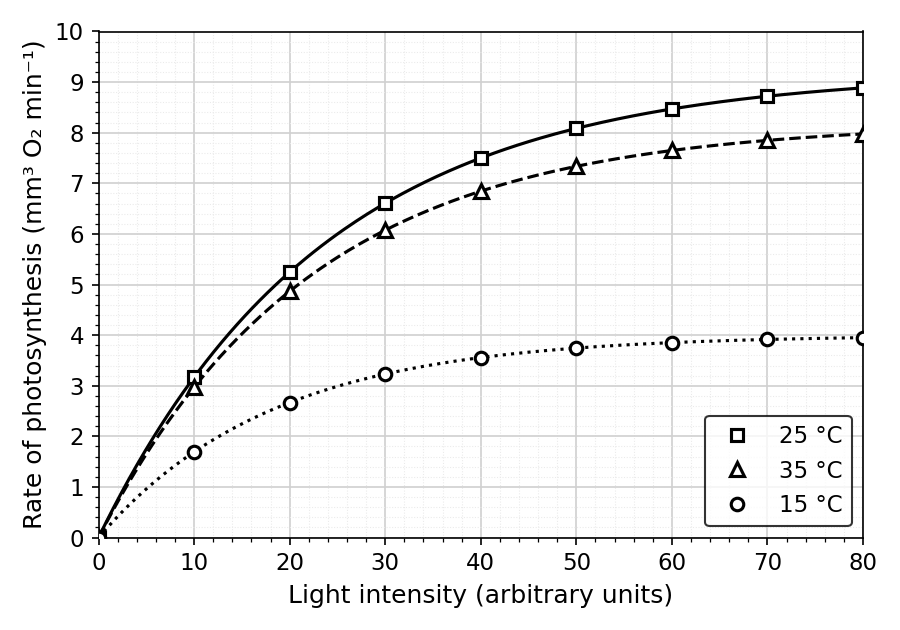
(a) State the rate of photosynthesis at a light intensity of 40 arbitrary units and a temperature of 25 °C.
(b) Identify the limiting factor for photosynthesis at a light intensity of 20 arbitrary units.
(c) Explain the effect of increasing the temperature from 15 °C to 25 °C on the rate of photosynthesis at a light intensity of 70 arbitrary units.
(d) The experiment was repeated at 45 °C. Predict, with a reason, the effect on the rate of photosynthesis at high light intensity compared to the rate at 35 °C.
Find the x-value of 40 on the graph. Follow the line up to the curve for 25 °C and then read the corresponding y-value. Remember to include units.
Look at the shape of all three curves at this light intensity. What factor is preventing the rate from being higher, even when temperature is increased?
At high light intensity, another factor is limiting the rate. Consider the role of enzymes in photosynthesis and how temperature affects them.
Think about what happens to proteins, especially enzymes, at temperatures well above their optimum.
Question 3
HardPaper 2 · calculator10 marksThe following table shows the mass of the nine essential amino acids in maize protein and kidney bean protein. The table also shows the percentage of the World Health Organization (WHO) recommended daily requirement that would be met if the recommended total daily amount of protein consumed was entirely maize or kidney bean protein.
| Amino acid | Maize (grain) | Kidney bean (legume) | ||
|---|---|---|---|---|
| mg per g protein | % of WHO amount | mg per g protein | % of WHO amount | |
| Histidine | 28 | 187% | 28 | 187% |
| Isoleucine | 35 | 117% | 43 | 143% |
| Leucine | 120 | 203% | 80 | 136% |
| Lysine | 25 | 56% | 65 | 144% |
| Methionine | 30 | 136% | 11 | 50% |
| Phenylalanine | 45 | 118% | 55 | 145% |
| Threonine | 35 | 152% | 40 | 174% |
| Tryptophan | 5 | 83% | 10 | 167% |
| Valine | 45 | 115% | 50 | 128% |
Explain why certain amino acids are classified as essential in the human diet.
Deduce, using the data, whether the WHO recommended daily intake is the same for all essential amino acids.
Suggest why the human body requires a greater mass of leucine than tryptophan in the diet.
Identify the amino acid that is required in the smallest quantity according to the WHO recommendations.
Justify the conclusion that relying solely on kidney beans for dietary protein could lead to a deficiency disease.
Discuss how a diet consisting entirely of plant-based foods can provide all essential amino acids, using the data provided.
Think about what the human body can and cannot synthesize on its own, and where these molecules must come from.
Compare the mass (mg) and the percentage (%) for two different amino acids. If the masses are similar, are the percentages similar?
Consider the composition of human proteins and what happens to amino acids after they are used.
Look for the amino acid where a small mass gives a large percentage of the daily requirement.
Look at the percentage column for kidney beans. Is there any amino acid that falls significantly below 100%?
Look at the amino acids that are deficient in maize and kidney beans. How do the two foods compare for those specific amino acids?
Question 4
EasyPaper 1A · calculator1 markThe table shows examples of essential and non-essential amino acids for humans.
| Essential amino acids | Non-essential amino acids |
|---|---|
| methionine | aspartic acid |
| tryptophan | glutamic acid |
Which statement is correct?
A. Methionine can be synthesized by human cells.
B. Aspartic acid must be absorbed from digested food.
C. Tryptophan cannot be synthesized by the human body.
D. Glutamic acid is not required for polypeptide synthesis.
Recall the biological definition of 'essential' and 'non-essential' in the context of dietary amino acids.
Question 5
MediumPaper 2 · calculator5 marks(a) The optimum pH for pepsin, an enzyme in the human stomach, is 2.0. The optimum pH for trypsin, an enzyme in the small intestine, is 8.0.
Calculate the ratio of the proton concentration at the optimum pH of pepsin to the proton concentration at the optimum pH of trypsin.
(b) Calculate the ratio of the proton concentration in a lysosome at pH 5.0 to the proton concentration in the surrounding cytoplasm at pH 7.2.
(c) State the term used to describe the irreversible change in the three-dimensional structure of an enzyme when exposed to a pH far outside its range of tolerance.
Remember that pH is a logarithmic scale. A pH of corresponds to a proton concentration of .
Find the proton concentration for both pH values using , then divide the lysosome concentration by the cytoplasm concentration.
What happens to the active site of a protein when the pH breaks its intramolecular bonds?
Question 6
HardPaper 2 · calculator15 marksProteins are highly diverse macromolecules that perform a wide range of functions in living organisms, including acting as biological catalysts.
Outline how the sequence of amino acids in a polypeptide is determined and how this leads to the vast diversity of proteins.
Enzymes are globular proteins that act as biological catalysts. Outline the effects of temperature and pH on the rate of enzyme-catalyzed reactions.
Explain the mechanism of enzyme action and how metabolic pathways can be controlled by feedback inhibition, using the synthesis of isoleucine as an example.
Think about what codes for the amino acid sequence during translation and how many different amino acids exist to build these chains.
Describe what happens to enzyme activity as temperature and pH increase and decrease, and explain why these changes occur at a molecular level.
Explain how enzymes lower activation energy and use the induced-fit model. Then describe how the end product of a pathway can inhibit an earlier step, specifically mentioning isoleucine and threonine.
Question 7
MediumPaper 1A · calculator1 markA student is analyzing the nutritional content of a strictly plant-based diet. Why must the diet include a variety of different plant protein sources?
A. Plant proteins do not contain peptide bonds.
B. Individual plant sources may lack one or more essential amino acids.
C. Plant proteins are denatured more easily than animal proteins.
D. Plant proteins are composed of a different set of 20 amino acids than animal proteins.
Recall the definition of essential amino acids and consider whether a single plant source typically provides all of them in the required amounts.
Question 8
HardPaper 2 · calculator15 marks(a) Outline the processes and conditions required for the spontaneous origin of cells on early Earth.
(b) Describe the advantages of compartmentalization in eukaryotic cells.
(c) Explain how the structure of proteins allows them to perform diverse functions in cell membranes and metabolism.
Think about the atmosphere of early Earth and the steps needed to go from simple molecules to a fully functioning cell, including the Miller-Urey experiment.
Consider why it is beneficial for a cell to have membrane-bound organelles rather than having all its enzymes and substrates mixed together in the cytoplasm.
Link the sequence and properties of amino acids (like hydrophobic/hydrophilic R-groups) to the 3D shape of proteins, and then explain how this shape allows them to act as membrane transporters and metabolic enzymes.
Question 9
MediumPaper 1A · calculator1 markResearchers recently determined the precise three-dimensional structure of the spike protein from a novel virus. To achieve this high-resolution image, they rapidly cooled the protein sample to to prevent the formation of damaging water crystals, keeping the protein molecules stable in their natural conformation.
Which technique did the researchers use?
A. Cryogenic electron microscopy
B. Freeze-fracture electron microscopy
C. X-ray diffraction
D. Immunofluorescence
Consider which technique involves freezing a sample to preserve the natural state of individual molecules for high-resolution imaging, rather than splitting a membrane or using antibodies.
No question on this page matches those filters. Try another difficulty or paper.
Every Proteins question, marked for you
Every answer is marked mark by mark, IB-style, and the AI tutor helps when you are stuck.
Where marks are lost
- Command terms are consistently under-read. Students answer describe when the question said explain, so they give an account with no reasons and cap at half marks. The reverse also happens on outline, where a student writes an essay for a 2-mark summary and runs out of time.